
Assisted Outpatient Treatment A Way Forward Presented to

- Slides: 21
Assisted Outpatient Treatment: A Way Forward Presented to the NJAMHAA Conference 4/13/16 by: Robert N. Davison, MA, LPC Executive Director Mental Health Association of Essex County Kathryn E. Howie, LCSW Supervisor, IOC Trinitas Regional Medical Center Louis Schwarcz, MA President & CEO Mental Health Assoc. Morris County
What Is IOC/AOT? Kathryn E. Howie, LCSW
What is IOC/AOT? � Involuntary Outpatient Commitment � aka Assisted Outpatient Treatment � A plan for recovery from mental illness that is approved by the court, to be carried out in an outpatient setting for a consumer who has a history of responding to treatment (N. J. S. A. 30: 4 -27. 2 (jj))
Three Components � INVOLUNTARY ◦ Saying they will participate is insufficient ◦ If there is evidence they are unlikely to do so � OUTPATIENT ◦ Live in the community (need valid address) ◦ Attend treatment (frequency varies) ◦ Take meds
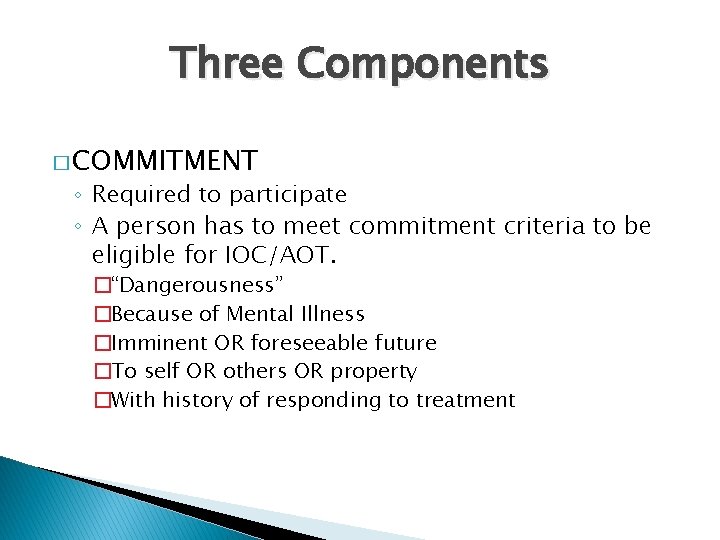
Three Components � COMMITMENT ◦ Required to participate ◦ A person has to meet commitment criteria to be eligible for IOC/AOT. �“Dangerousness” �Because of Mental Illness �Imminent OR foreseeable future �To self OR others OR property �With history of responding to treatment
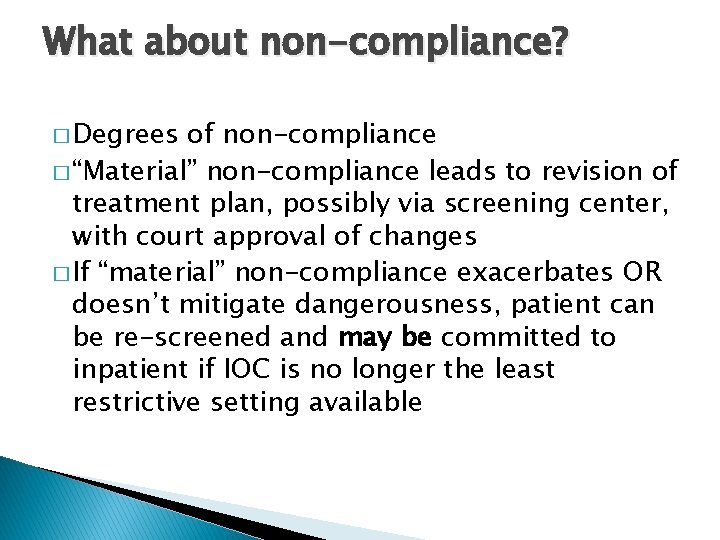
What about non-compliance? � Degrees of non-compliance � “Material” non-compliance leads to revision of treatment plan, possibly via screening center, with court approval of changes � If “material” non-compliance exacerbates OR doesn’t mitigate dangerousness, patient can be re-screened and may be committed to inpatient if IOC is no longer the least restrictive setting available
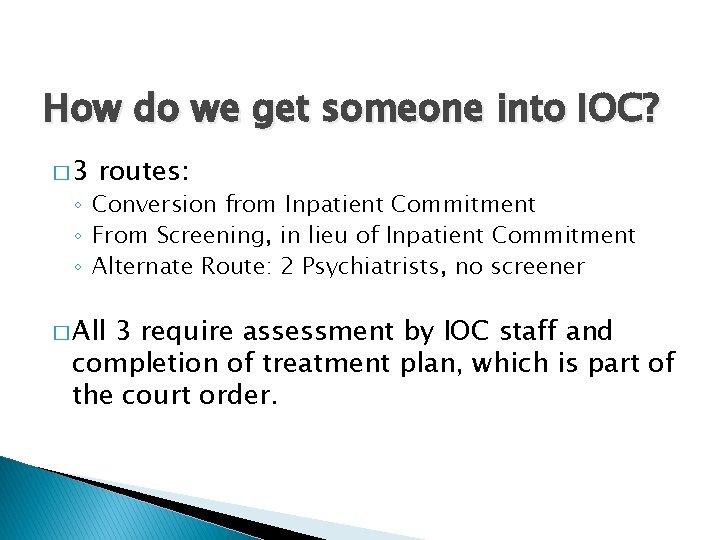
How do we get someone into IOC? � 3 routes: ◦ Conversion from Inpatient Commitment ◦ From Screening, in lieu of Inpatient Commitment ◦ Alternate Route: 2 Psychiatrists, no screener � All 3 require assessment by IOC staff and completion of treatment plan, which is part of the court order.
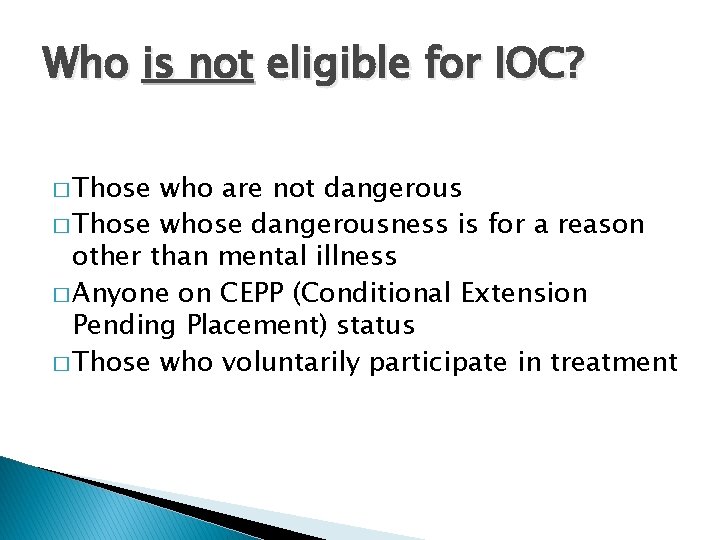
Who is not eligible for IOC? � Those who are not dangerous � Those whose dangerousness is for a reason other than mental illness � Anyone on CEPP (Conditional Extension Pending Placement) status � Those who voluntarily participate in treatment
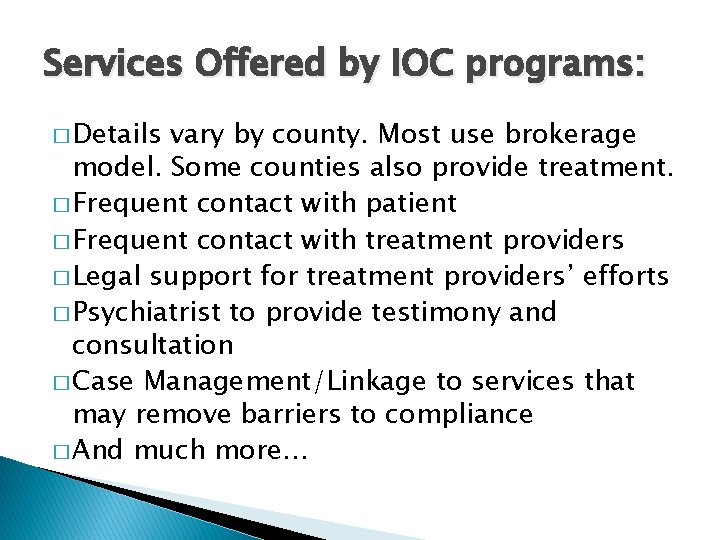
Services Offered by IOC programs: � Details vary by county. Most use brokerage model. Some counties also provide treatment. � Frequent contact with patient � Frequent contact with treatment providers � Legal support for treatment providers’ efforts � Psychiatrist to provide testimony and consultation � Case Management/Linkage to services that may remove barriers to compliance � And much more…
Does IOC/AOT Work? Robert N. Davison, MA, LPC
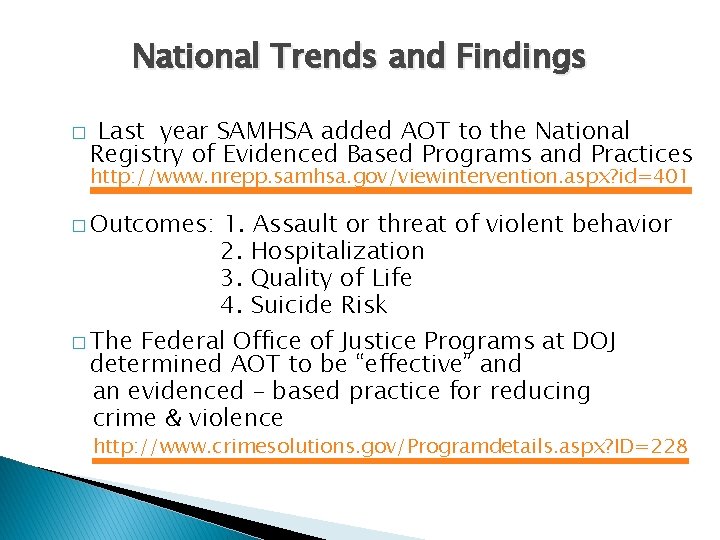
National Trends and Findings � Last year SAMHSA added AOT to the National Registry of Evidenced Based Programs and Practices http: //www. nrepp. samhsa. gov/viewintervention. aspx? id=401 � Outcomes: 1. Assault or threat of violent behavior 2. Hospitalization 3. Quality of Life 4. Suicide Risk � The Federal Office of Justice Programs at DOJ determined AOT to be “effective” and an evidenced – based practice for reducing crime & violence http: //www. crimesolutions. gov/Programdetails. aspx? ID=228
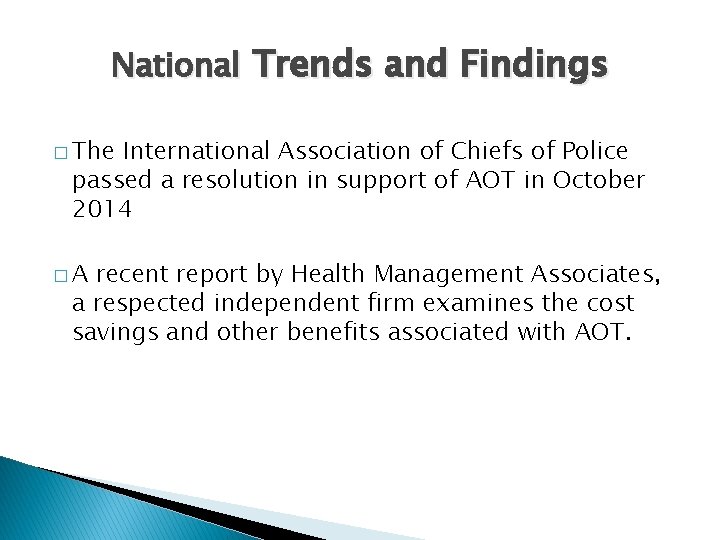
National Trends and Findings � The International Association of Chiefs of Police passed a resolution in support of AOT in October 2014 �A recent report by Health Management Associates, a respected independent firm examines the cost savings and other benefits associated with AOT.
National Trends and Findings � They compared data from New York and Ohio and found varying results- approximately 50% cost savings. � These findings push back the “New Yorkers Unique” narrative. Ohio built the program into their existing system, rather than adding in a broad new program with new service. http: //www. tacreports. org/aot-cost-study
National Trends and Findings � New York State AOT Program Evaluation, June 30, 2009 Duke University School of Medicine, Durham, NC “We find that New York State’s AOT Program improves a range of important outcomes for its recipients, apparently without feared negative consequences to recipients. The increased services available under AOT clearly improve recipient outcomes, however, the AOT order, itself, and its monitoring do appear to offer additional benefits in improving outcomes. It is also important to recognize that the AOT order exerts a critical effect on service providers stimulating their efforts to prioritize care for AOT recipients. ”
New Jersey Trends 2012 - Five Counties implemented Essex County First � 2005 – Governor’s Task Force on Mental Health � 2013 – Six Counties implemented � 2015 - Additional 10 � 2007 -2009 – Six Hearings Counties awarded grants � 2015 – Rutgers University � 2009 – Signed into law performing assessment � 2015 – Rutgers University performing assessment � 9/2015 All 21 Counties have IOC � 1/2017 -Rutger’s study should be completed � 2004– Codey/Bassano Bill �
The Essex County Experience March 1, 2015 to February 29, 2016 � Total Consumers Served – Seventy-one (71) � 100% had a history of Multi-hospitalizations � 100% had a history of violence � 71% had a history of arrests � 75% had a history of substance abuse � 95% had a history of Assertive Case Management or Integrated Case Management Services � 30 New Cases Opened * Many referrals were not accepted because either the consumer did not meet the AOT standard or they required additional inpatient care
The Essex County Experience 22 consumers were discharged � 13 “Graduated” (15 -18 month average length of service) � 2 moved out of county and transferred to other county IOC � 2 discharged within 6 months 1 – no longer met the standard 1 - MIA � 2 re-hospitalized and currently receiving Long-Term Psychiatric hospitalization � 3 moved out of state �
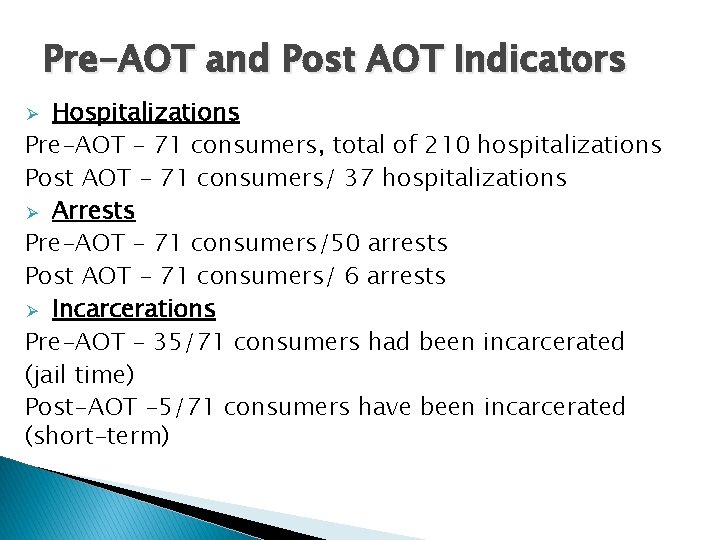
Pre-AOT and Post AOT Indicators Hospitalizations Pre-AOT – 71 consumers, total of 210 hospitalizations Post AOT – 71 consumers/ 37 hospitalizations Ø Arrests Pre-AOT – 71 consumers/50 arrests Post AOT – 71 consumers/ 6 arrests Ø Incarcerations Pre-AOT – 35/71 consumers had been incarcerated (jail time) Post-AOT – 5/71 consumers have been incarcerated (short-term) Ø
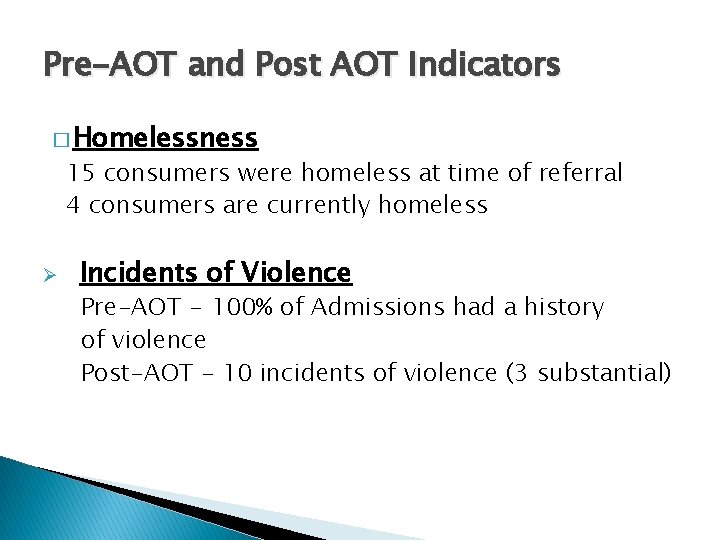
Pre-AOT and Post AOT Indicators � Homelessness 15 consumers were homeless at time of referral 4 consumers are currently homeless Ø Incidents of Violence Pre-AOT - 100% of Admissions had a history of violence Post-AOT – 10 incidents of violence (3 substantial)
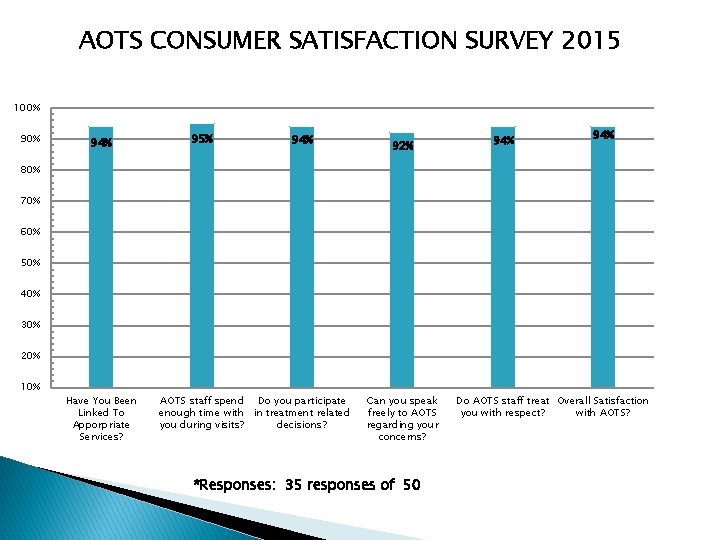
AOTS CONSUMER SATISFACTION SURVEY 2015 100% 94% 95% 94% 92% 94% 80% 70% 60% 50% 40% 30% 20% 10% Have You Been Linked To Apporpriate Services? AOTS staff spend Do you participate enough time with in treatment related you during visits? decisions? Can you speak freely to AOTS regarding your concerns? *Responses: 35 responses of 50 Do AOTS staff treat Overall Satisfaction you with respect? with AOTS?
Discussion: A Way Forward Facilitated by Louis Schwarcz, MA