
Assimilation of EOS Aura Ozone Data for NWP
- Slides: 12
Assimilation of EOS Aura Ozone Data for NWP and Air Quality Applications I. Stajner and L. -P. Chang GMAO NASA Goddard and SAIC JCSDA Science Workshop Greenbelt, Maryland, June 1, 2006
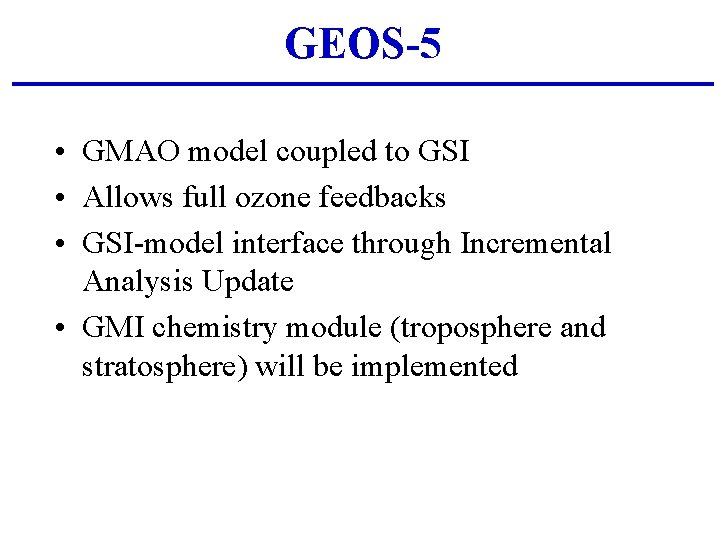
GEOS-5 • GMAO model coupled to GSI • Allows full ozone feedbacks • GSI-model interface through Incremental Analysis Update • GMI chemistry module (troposphere and stratosphere) will be implemented
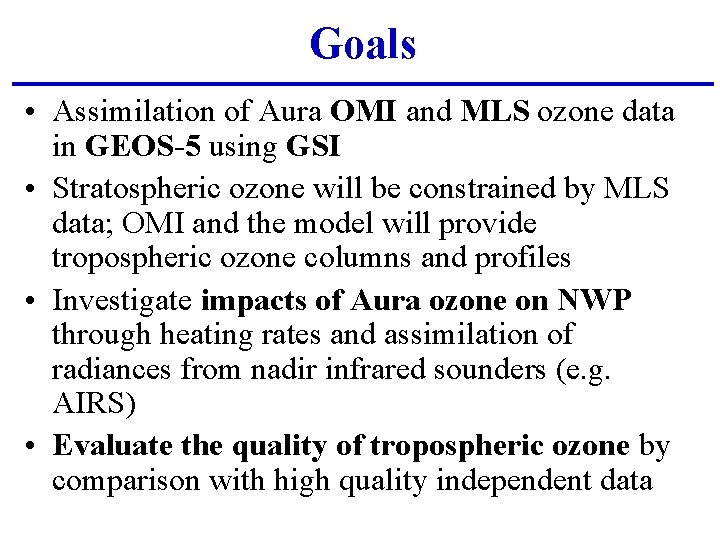
Goals • Assimilation of Aura OMI and MLS ozone data in GEOS-5 using GSI • Stratospheric ozone will be constrained by MLS data; OMI and the model will provide tropospheric ozone columns and profiles • Investigate impacts of Aura ozone on NWP through heating rates and assimilation of radiances from nadir infrared sounders (e. g. AIRS) • Evaluate the quality of tropospheric ozone by comparison with high quality independent data
Background • Impact of Aura OMI and MLS data on ozone in GEOS-4 • Spatial and temporal variability of ozone needs to be captured in order to get improvements from ozone feedback
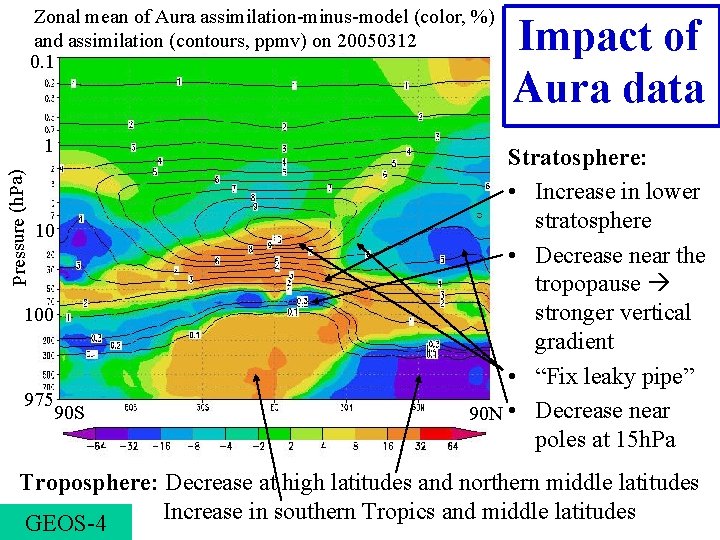
Zonal mean of Aura assimilation-minus-model (color, %) and assimilation (contours, ppmv) on 20050312 0. 1 Pressure (h. Pa) 1 10 100 975 90 S Impact of Aura data Stratosphere: • Increase in lower stratosphere • Decrease near the tropopause stronger vertical gradient • “Fix leaky pipe” 90 N • Decrease near poles at 15 h. Pa Troposphere: Decrease at high latitudes and northern middle latitudes Increase in southern Tropics and middle latitudes GEOS-4
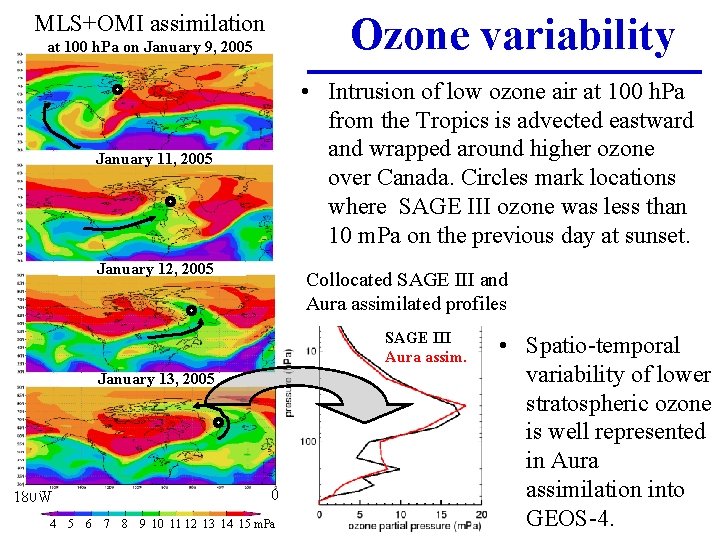
Ozone variability MLS+OMI assimilation at 100 h. Pa on January 9, 2005 • Intrusion of low ozone air at 100 h. Pa from the Tropics is advected eastward and wrapped around higher ozone over Canada. Circles mark locations where SAGE III ozone was less than 10 m. Pa on the previous day at sunset. January 11, 2005 January 12, 2005 Collocated SAGE III and Aura assimilated profiles SAGE III Aura assim. January 13, 2005 0 180 W 4 5 6 7 8 9 10 11 12 13 14 15 m. Pa • Spatio-temporal variability of lower stratospheric ozone is well represented in Aura assimilation into GEOS-4.
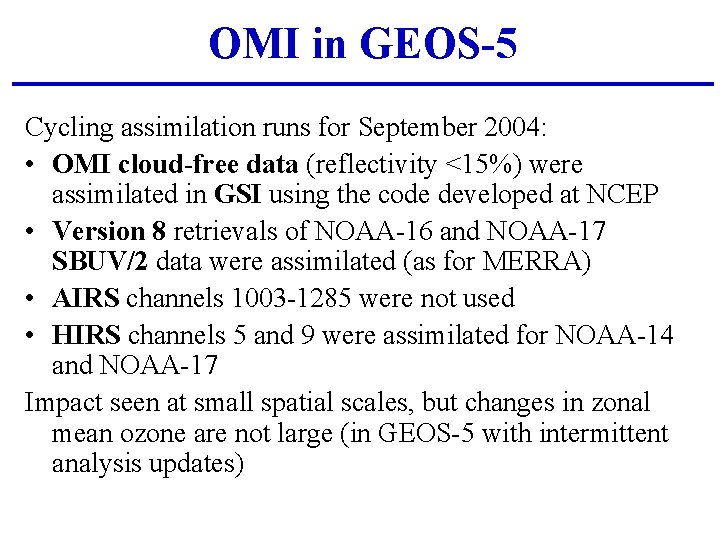
OMI in GEOS-5 Cycling assimilation runs for September 2004: • OMI cloud-free data (reflectivity <15%) were assimilated in GSI using the code developed at NCEP • Version 8 retrievals of NOAA-16 and NOAA-17 SBUV/2 data were assimilated (as for MERRA) • AIRS channels 1003 -1285 were not used • HIRS channels 5 and 9 were assimilated for NOAA-14 and NOAA-17 Impact seen at small spatial scales, but changes in zonal mean ozone are not large (in GEOS-5 with intermittent analysis updates)
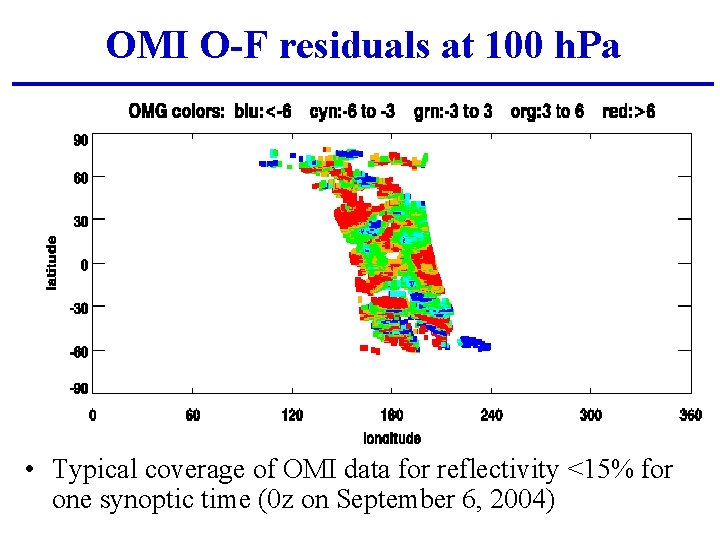
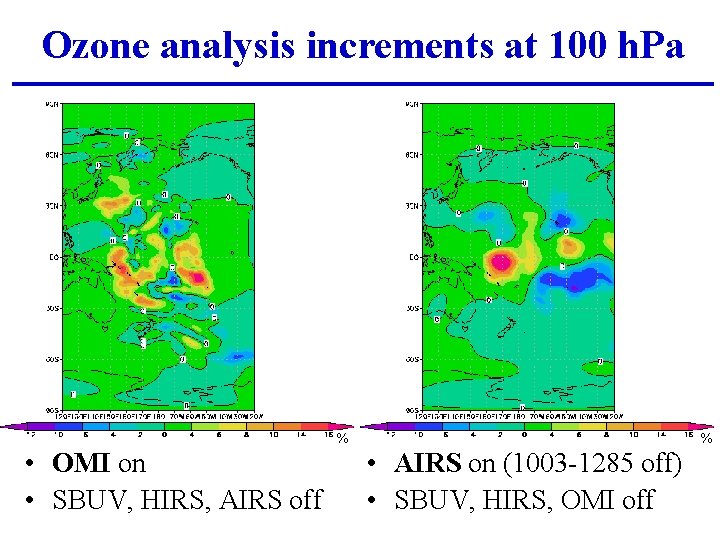
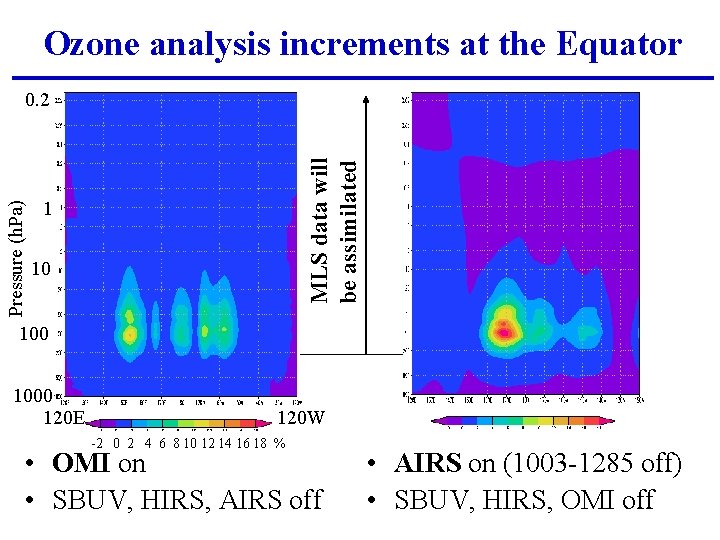
Case study: impacts of ozone data • In order to separate impacts of different data types on ozone in GSI these data types were turned off sequentially • Comparisons for a single synoptic time (0 z on September 6, 2004) will be shown
OMI O-F residuals at 100 h. Pa • Typical coverage of OMI data for reflectivity <15% for one synoptic time (0 z on September 6, 2004)
Ozone analysis increments at 100 h. Pa % • OMI on • SBUV, HIRS, AIRS off % • AIRS on (1003 -1285 off) • SBUV, HIRS, OMI off
Ozone analysis increments at the Equator MLS data will be assimilated Pressure (h. Pa) 0. 2 1 10 1000 120 E 120 W -2 0 2 4 6 8 10 12 14 16 18 % • OMI on • SBUV, HIRS, AIRS off • AIRS on (1003 -1285 off) • SBUV, HIRS, OMI off
Conclusions and plans • Preliminary evaluation of the impact of OMI data in the GEOS-5 (with Version 8 of N 16 and N 17 SBUV, TOVS and AIRS data in GSI) done. • GEOS-5 system rapidly maturing: – assimilated ozone can be used in radiation – Incremental Analysis Update in order to improve transport of chemical constituents • Plan further evaluation of impacts of OMI and comparisons with the impacts of AIRS • Plan assimilation of MLS in GSI