
Assimilation Following the government policies of segregation and
- Slides: 14
Assimilation Following the government policies of segregation and assimilation, the government moved to an approach of assimilation. The first Commonwealth-State Native Welfare Conference was held in 1937, out of which emerged the policy of assimilation. The conference resolved that: ‘…the destiny of the natives of aboriginal origin, but not of the full blood, lies in their ultimate absorption by the people of the Commonwealth, and it there recommends that full efforts be directed to that end’. 1. What group of people is this policy directed towards? 2. What is the ultimate goal of this policy?
After reading over the text, please answer these questions… 1. What was the aim of the government with the policy of assimilation? 2. What did the government think of Aboriginal people at the time? 3. What did Aboriginal people think about the policy of assimilation? 4. What did the general public think about the policy of assimilation?
How would you feel if… You were taken away from your family… You were taken away from where you live, where you are from. . . You were taken away from your culture. . .
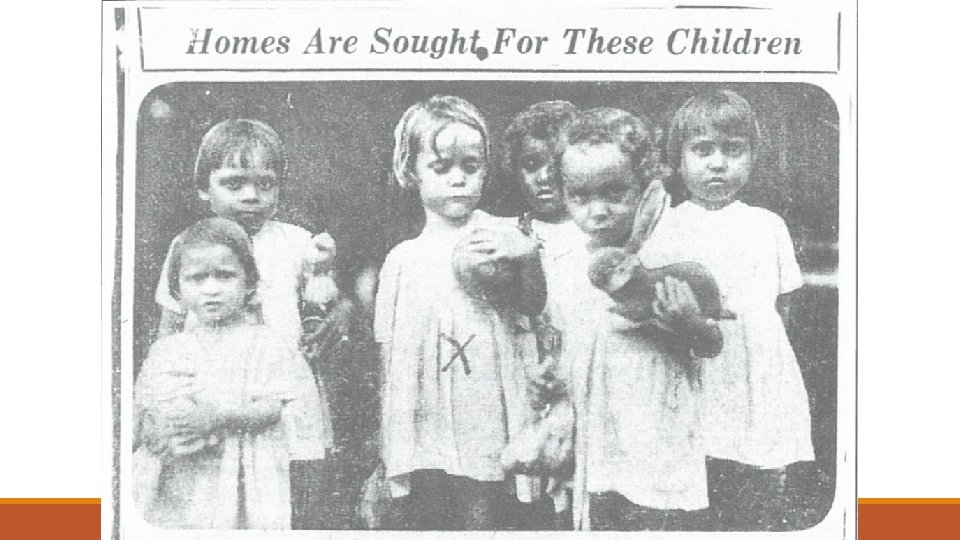
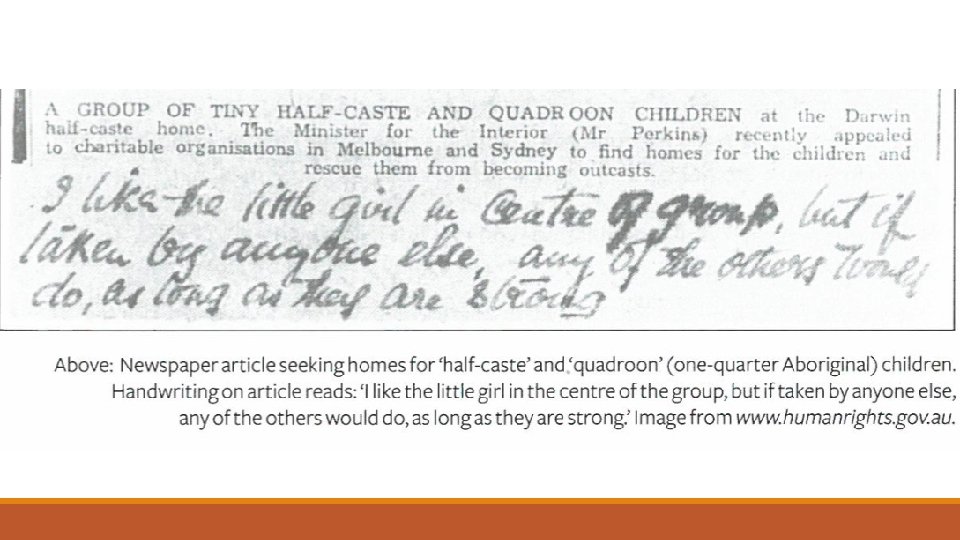
Assimilation and Child Removal Assimilation (the policy of making half-castes less Aboriginal) led to the policy of child removal. The removals were done on the grounds of ’neglected’ but often this was just ‘poverty’. The response was to remove children rather than to seek other solutions. In some states, the Aboriginal Protectors (government workers) still had guardianship over all Aboriginal children until the early 1960 s so the question of parental permission remained irrelevant. In total thousands of Aboriginal children were removed – it is estimated it was between 10 and 30% of all Aboriginal children during the period.
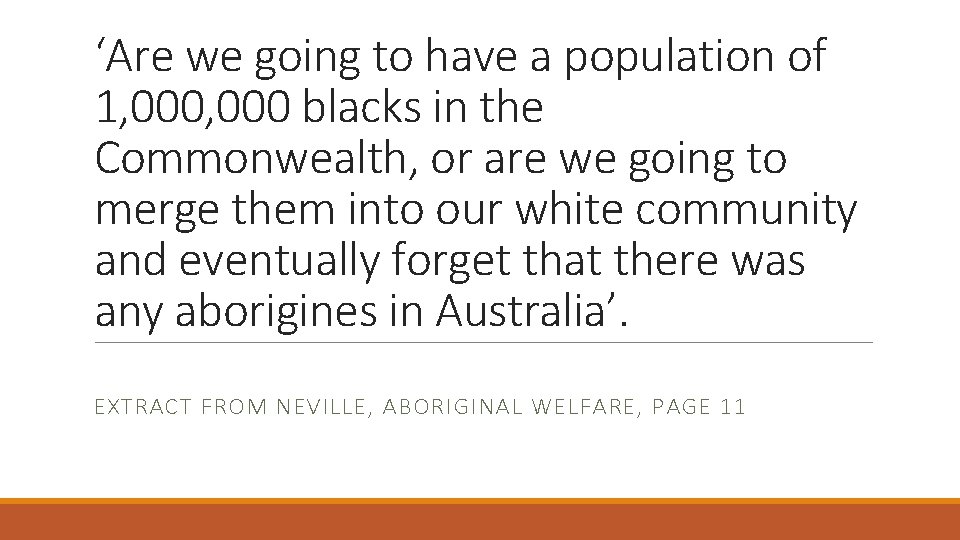
‘Are we going to have a population of 1, 000 blacks in the Commonwealth, or are we going to merge them into our white community and eventually forget that there was any aborigines in Australia’. EXTRACT FROM NEVILLE, ABORIGINAL WELFARE, PAGE 11
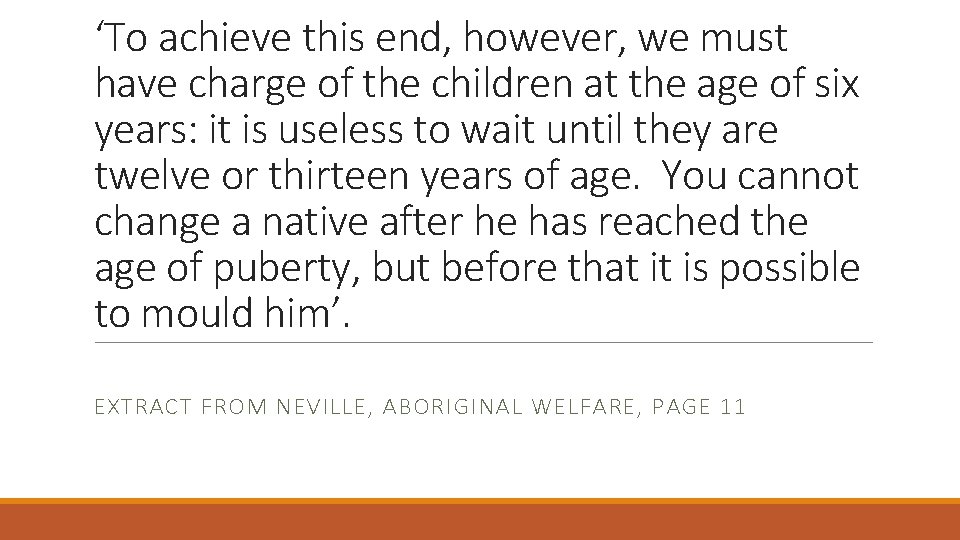
‘To achieve this end, however, we must have charge of the children at the age of six years: it is useless to wait until they are twelve or thirteen years of age. You cannot change a native after he has reached the age of puberty, but before that it is possible to mould him’. EXTRACT FROM NEVILLE, ABORIGINAL WELFARE, PAGE 11
‘Although the children were illegitimate, the mothers were greatly attached to them, and did not wish to be parted from them’. EXTRACT FROM NEVILLE, ABORIGINAL WELFARE, PAGE 11
What impact do you think being removed would have had on these children's’ connection to their culture and land?
Using a colour code, highlight phrases regarding the following points in each source: 1. Perceived problems regarding ‘half-castes’ 2. Aims of assimilation and attitudes motivating assimilation 3. Practical actions involved with the policy of assimilation 4. Extinction of ‘full-bloods’ 5. Involvements of government and other organisations with assimilation
Empathy- The ability to walk in someone else’s shoes and to be aware and sensitive of other’s feelings, thoughts and experiences.
Historical empathy- Encourages us to view events from all sides and to not judge past events by today’s standards. You have to consider the attitudes and social norms of the time.
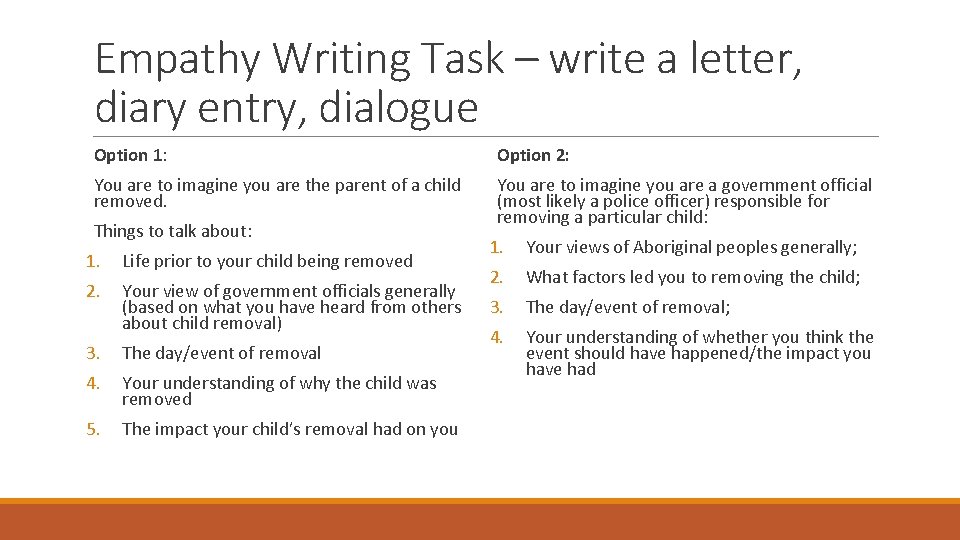
Empathy Writing Task – write a letter, diary entry, dialogue Option 1: Option 2: You are to imagine you are the parent of a child removed. You are to imagine you are a government official (most likely a police officer) responsible for removing a particular child: Things to talk about: 1. Life prior to your child being removed 2. Your view of government officials generally (based on what you have heard from others about child removal) 3. The day/event of removal 4. Your understanding of why the child was removed 5. The impact your child’s removal had on you 1. Your views of Aboriginal peoples generally; 2. What factors led you to removing the child; 3. The day/event of removal; 4. Your understanding of whether you think the event should have happened/the impact you have had