
Assignment Worksheet on conversions Assignment was n Page
- Slides: 25
Assignment: Worksheet on conversions
Assignment was: n. Page 239 #1 a-f, #2 e-h
Converting Moles to Mass or Moles to Grams, Grams to Moles For various substances
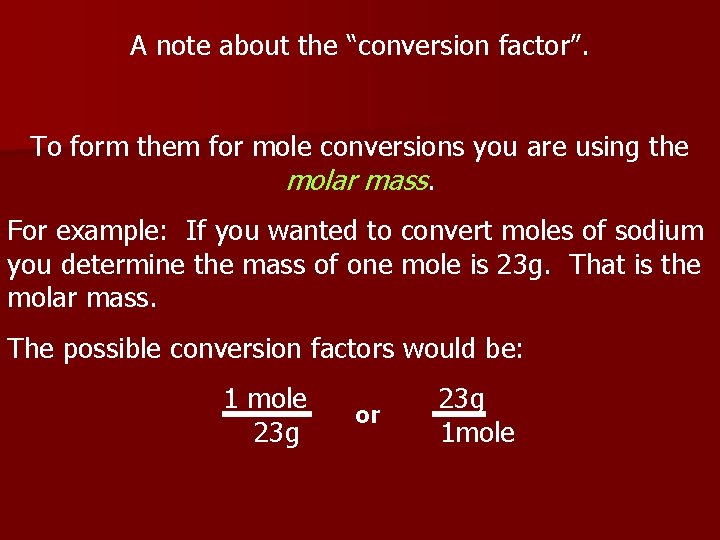
A note about the “conversion factor”. To form them for mole conversions you are using the molar mass. For example: If you wanted to convert moles of sodium you determine the mass of one mole is 23 g. That is the molar mass. The possible conversion factors would be: 1 mole 23 g or 23 g 1 mole
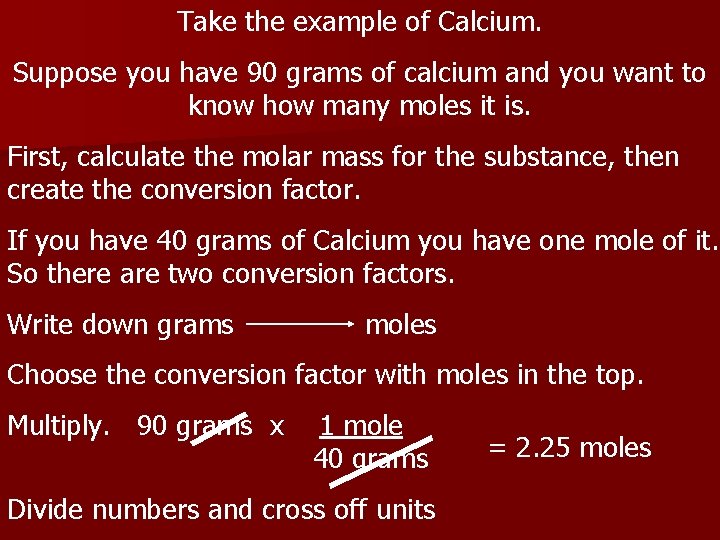
Take the example of Calcium. Suppose you have 90 grams of calcium and you want to know how many moles it is. First, calculate the molar mass for the substance, then create the conversion factor. If you have 40 grams of Calcium you have one mole of it. So there are two conversion factors. Write down grams moles Choose the conversion factor with moles in the top. Multiply. 90 grams x 1 mole 40 grams Divide numbers and cross off units = 2. 25 moles
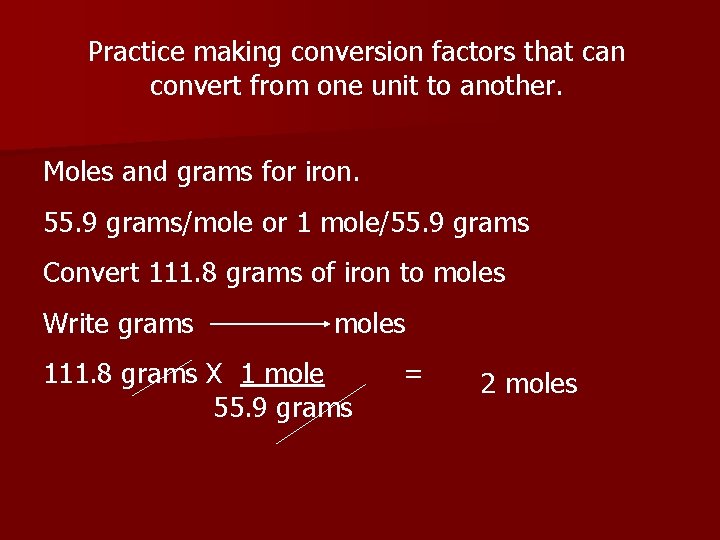
Practice making conversion factors that can convert from one unit to another. Moles and grams for iron. 55. 9 grams/mole or 1 mole/55. 9 grams Convert 111. 8 grams of iron to moles Write grams moles 111. 8 grams X 1 mole 55. 9 grams = 2 moles
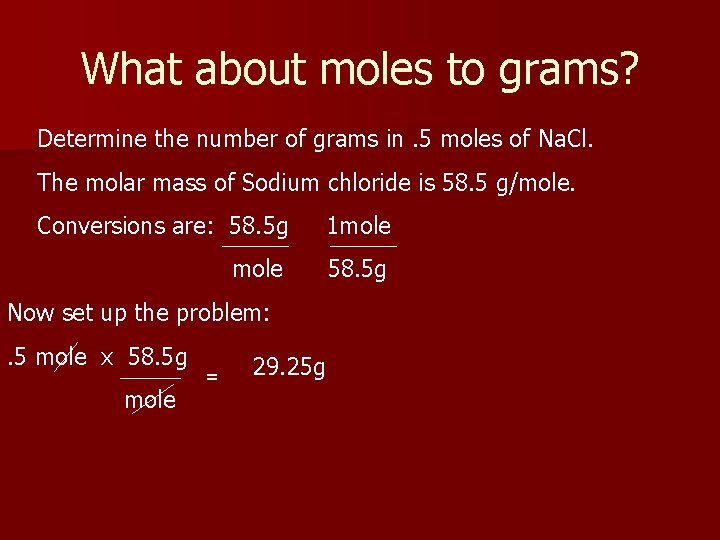
What about moles to grams? Determine the number of grams in. 5 moles of Na. Cl. The molar mass of Sodium chloride is 58. 5 g/mole. Conversions are: 58. 5 g 1 mole 58. 5 g Now set up the problem: . 5 mole x 58. 5 g mole = 29. 25 g
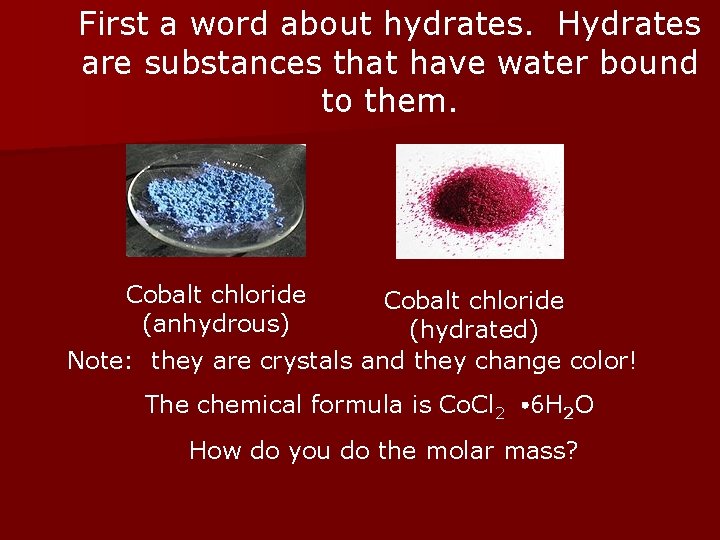
First a word about hydrates. Hydrates are substances that have water bound to them. Cobalt chloride (anhydrous) Cobalt chloride (hydrated) Note: they are crystals and they change color! The chemical formula is Co. Cl 2 6 H 2 O How do you do the molar mass?
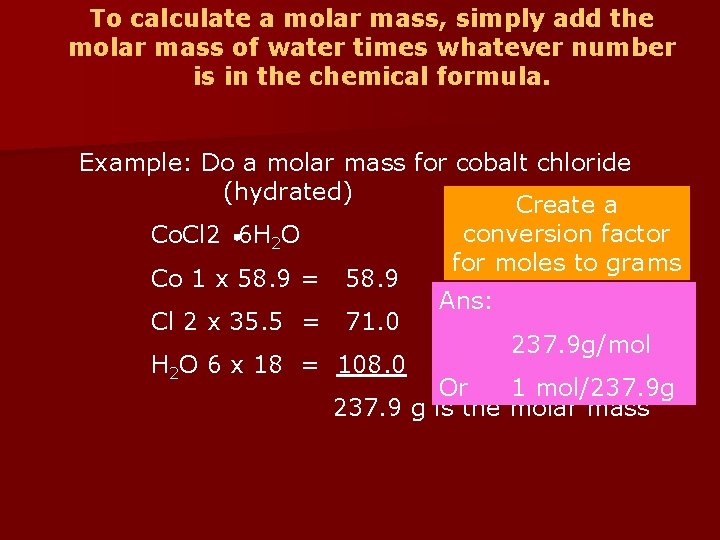
To calculate a molar mass, simply add the molar mass of water times whatever number is in the chemical formula. Example: Do a molar mass for cobalt chloride (hydrated) Create a conversion factor Co. Cl 2 6 H 2 O for moles to grams Co 1 x 58. 9 = 58. 9 Ans: Cl 2 x 35. 5 = 71. 0 237. 9 g/mol H 2 O 6 x 18 = 108. 0 Or 1 mol/237. 9 g 237. 9 g is the molar mass
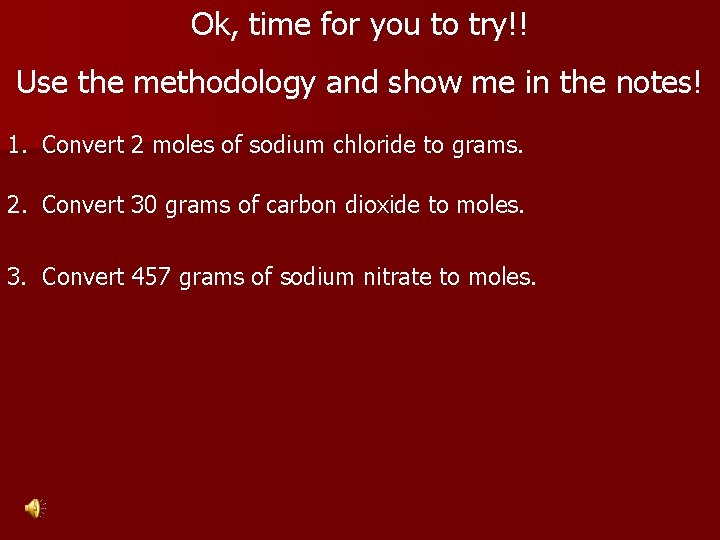
Ok, time for you to try!! Use the methodology and show me in the notes! 1. Convert 2 moles of sodium chloride to grams. 2. Convert 30 grams of carbon dioxide to moles. 3. Convert 457 grams of sodium nitrate to moles.
End
If needed, the following slides provide a review of conversion factors.
Do you look like this trying to do “units”? Can you convert from one unit to another easily? Or are conversions confusing? Does your ability seem “broken”? How many grams of nitrogen are in 16. 7 liters of gas? ? ?
Well don’t despair!! Repair!!! ……With your very own coool conversion kit from chemco. Yes with “coool conversions” you too will be doing conversions with ease!
All for the low low price of absolutely nothing, that’s right no money down, no money ever! All you have to do is pay attention!! No more confusion! No more frustration! Moles to grams? No problem! Grams to moles? No problem!! Amazing!
A Cooool Trick Conversion Factors In chemistry you need to learn to convert one unit to another. One cool way to do this and never get “messed up” is to use conversion factors. We will start with: grams to moles and moles to grams What’s this about? Well……first you need to learn some math and use a simple example.
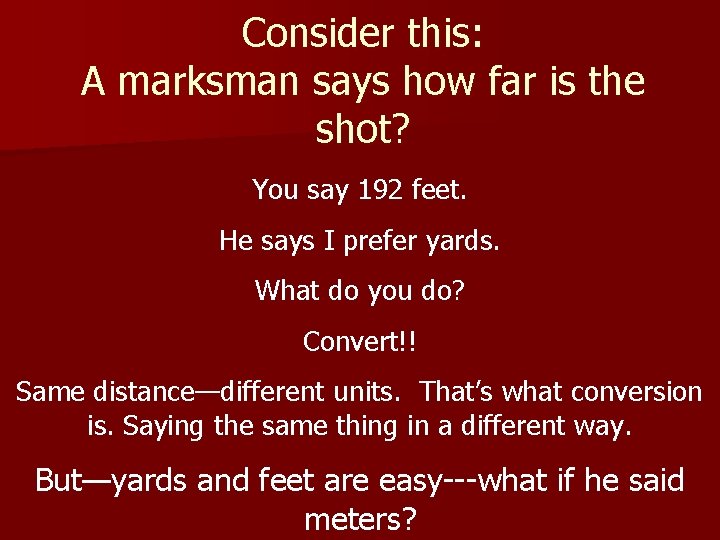
Consider this: A marksman says how far is the shot? You say 192 feet. He says I prefer yards. What do you do? Convert!! Same distance—different units. That’s what conversion is. Saying the same thing in a different way. But—yards and feet are easy---what if he said meters?
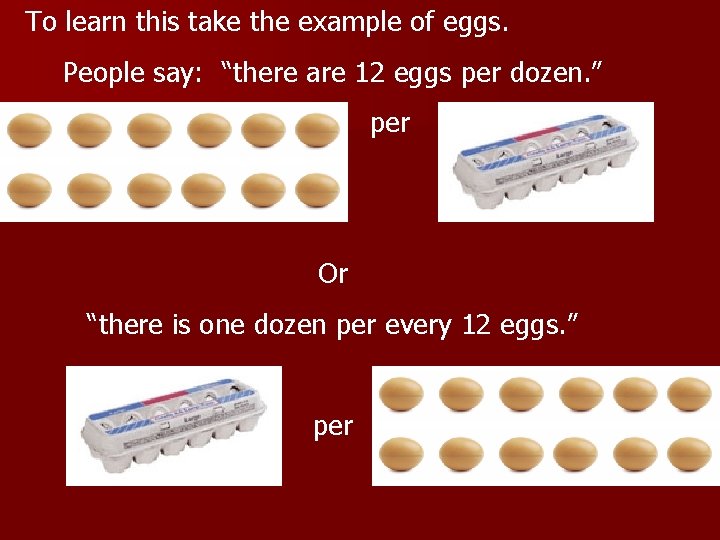
To learn this take the example of eggs. People say: “there are 12 eggs per dozen. ” per Or “there is one dozen per every 12 eggs. ” per
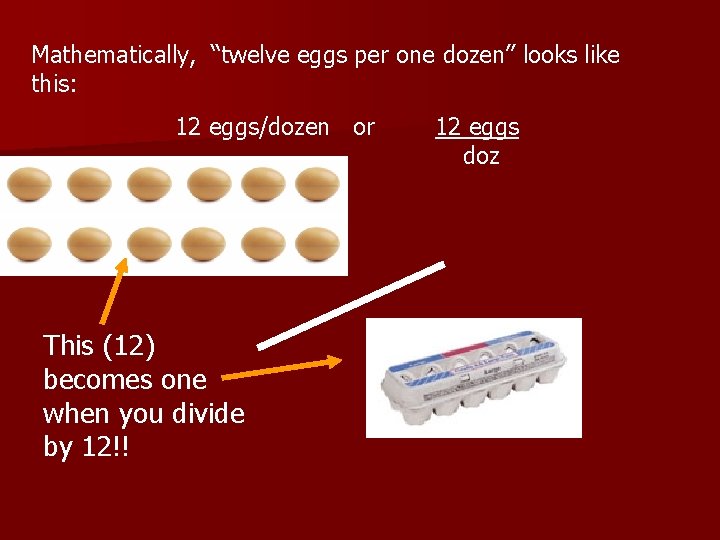
Mathematically, “twelve eggs per one dozen” looks like this: 12 eggs/dozen or This (12) becomes one when you divide by 12!! 12 eggs doz
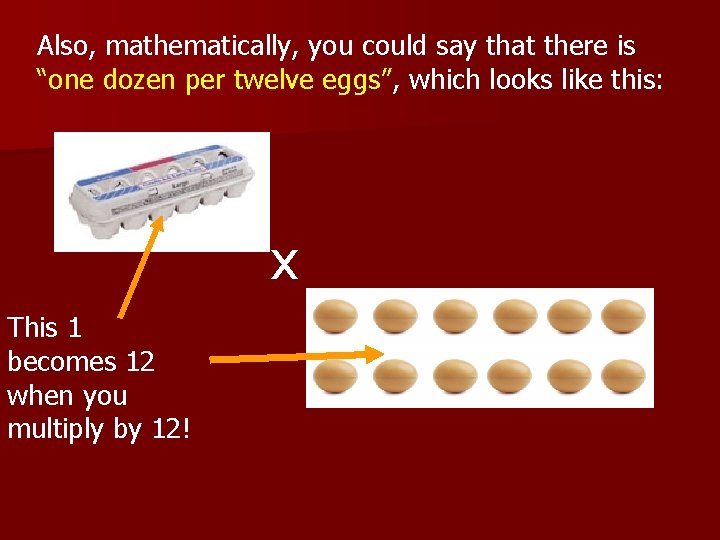
Also, mathematically, you could say that there is “one dozen per twelve eggs”, which looks like this: x This 1 becomes 12 when you multiply by 12!
Your way you are either multiplying or dividing. My way we will always multiply—it is simpler and more foolproof.
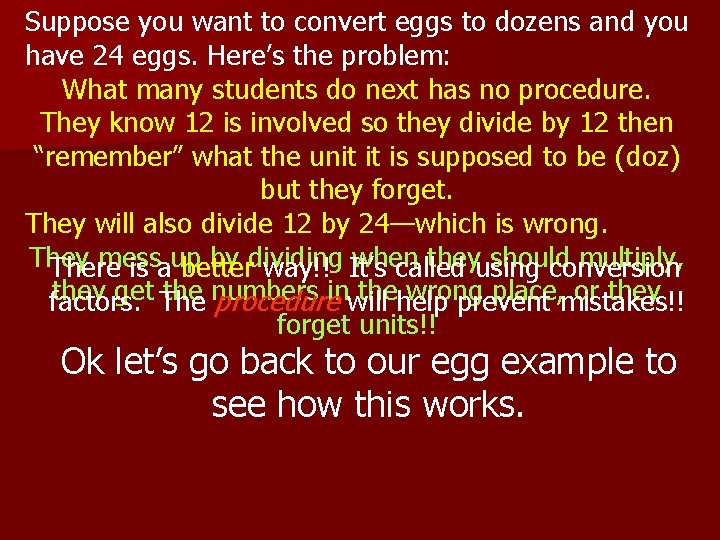
Suppose you want to convert eggs to dozens and you have 24 eggs. Here’s the problem: What many students do next has no procedure. They know 12 is involved so they divide by 12 then “remember” what the unit it is supposed to be (doz) but they forget. They will also divide 12 by 24—which is wrong. They mess by dividing when theyusing should multiply, There is aup better way!! It’s called conversion they get The the numbers thehelp wrong place, mistakes!! or they factors. procedureinwill prevent forget units!! Ok let’s go back to our egg example to see how this works.
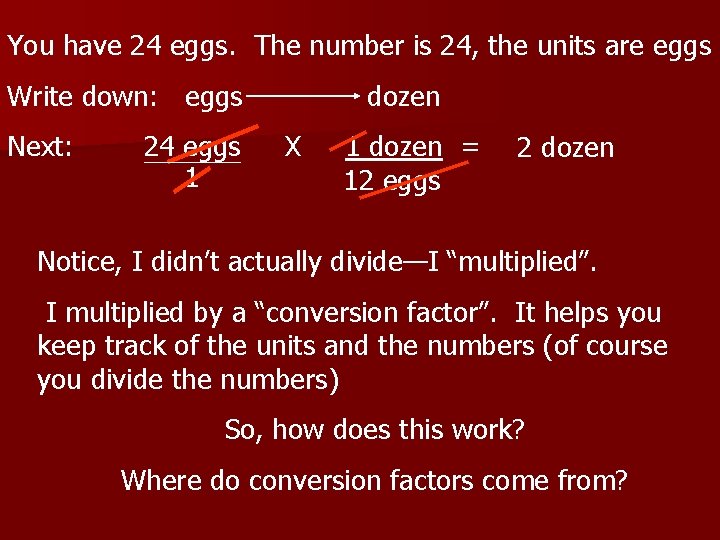
You have 24 eggs. The number is 24, the units are eggs Write down: eggs Next: 24 eggs 1 dozen X 1 dozen = 12 eggs 2 dozen Notice, I didn’t actually divide—I “multiplied”. I multiplied by a “conversion factor”. It helps you keep track of the units and the numbers (of course you divide the numbers) So, how does this work? Where do conversion factors come from?
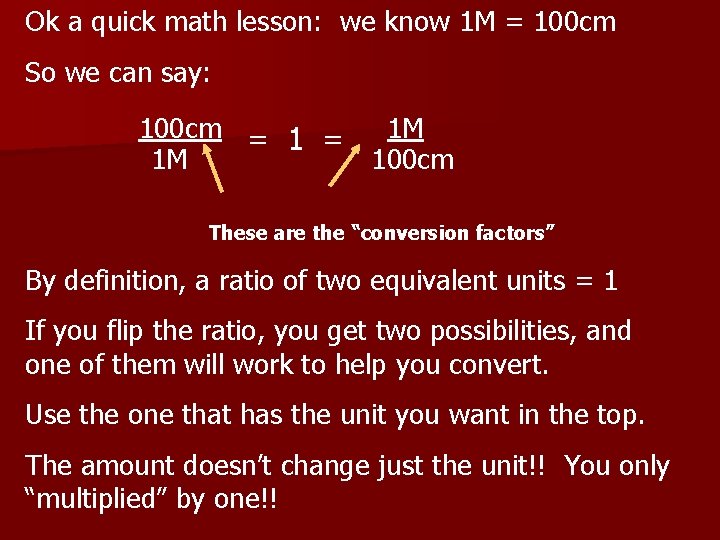
Ok a quick math lesson: we know 1 M = 100 cm So we can say: 100 cm = 1 M 1 M 100 cm These are the “conversion factors” By definition, a ratio of two equivalent units = 1 If you flip the ratio, you get two possibilities, and one of them will work to help you convert. Use the one that has the unit you want in the top. The amount doesn’t change just the unit!! You only “multiplied” by one!!
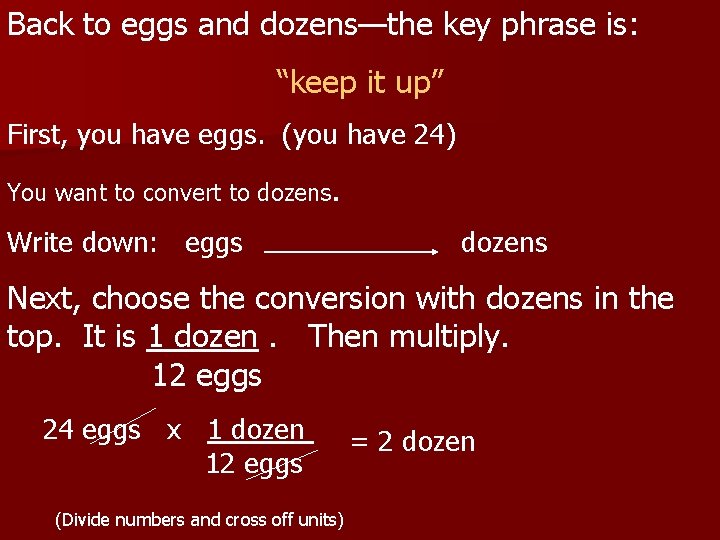
Back to eggs and dozens—the key phrase is: “keep it up” First, you have eggs. (you have 24) You want to convert to dozens. Write down: eggs dozens Next, choose the conversion with dozens in the top. It is 1 dozen. Then multiply. 12 eggs 24 eggs x 1 dozen 12 eggs (Divide numbers and cross off units) = 2 dozen