
Assignment Short narrative film proposal Story outline Shot

- Slides: 15
Assignment Short narrative film proposal: • Story outline • Shot list *Storyboard • Location Scouting • Casting (find some one in your group) Turn in your short film proposal to your lab instructor on Week 4 (9/21, 9/22, 9/23)
The Film Camera Bolex H-16 Reflex 16 mm camera
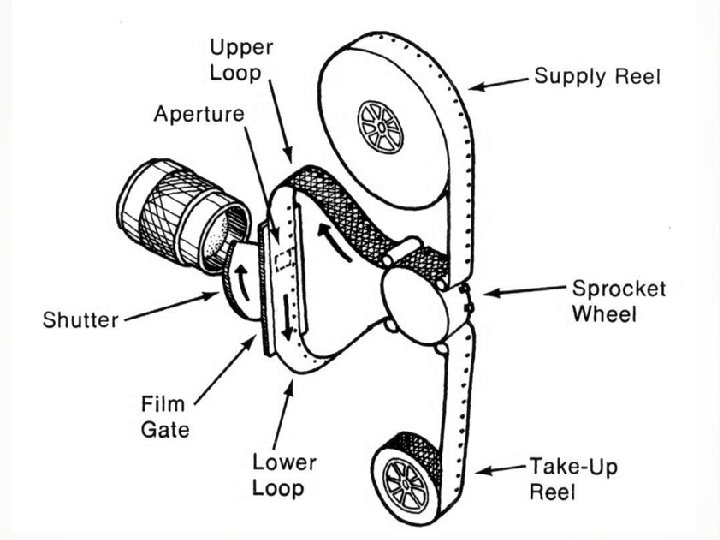
�An Overview of the Camera » The Lens Mount » The Viewfinder » The Film Chamber » The Motor » The Film gate and claw » The Shutter
Exposure » Exposure is determined by intensity of light that pass through the lens and the time each frame is exposed to the light. » Exposure = Intensity X Time It is controlled by aperture(T-stop) and (camera speed)Frame-rate » Other factures that play a role in determining exposure are: Film speed, Lighting, Filter, Shutter Angle
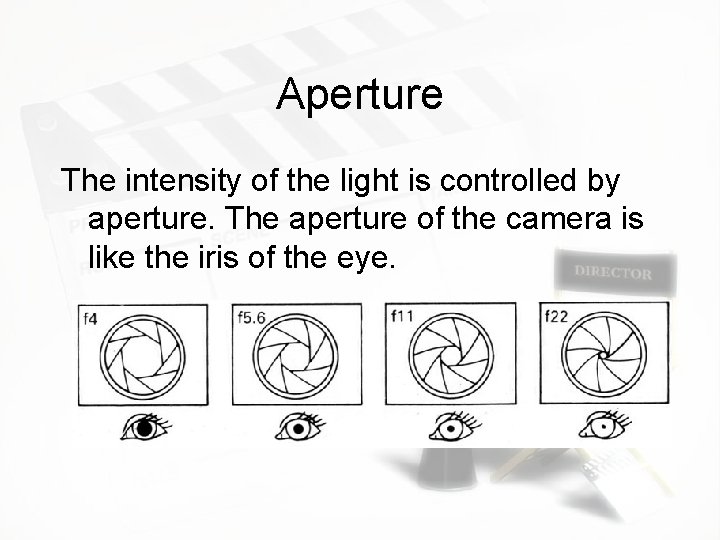
Aperture The intensity of the light is controlled by aperture. The aperture of the camera is like the iris of the eye.
Film Speed » A fast stock or high film speed refers to a film’s sensitivity to light. The higher the film speed, the more sensitive it is to light. ASA number » Typical film speed: 50 D -100 T and below: Slow 200 T-320 T: Medium 500 T-800 T: Fast
Camera Speed of Film Rate » Standard Speed: 24 fps » Slow motion: speed faster than 24 fps » Fast motion: Undercranking: speed slower than 24 fps Time-lapse: With significantly slower speeds, time is proportionally sped up. Animation.
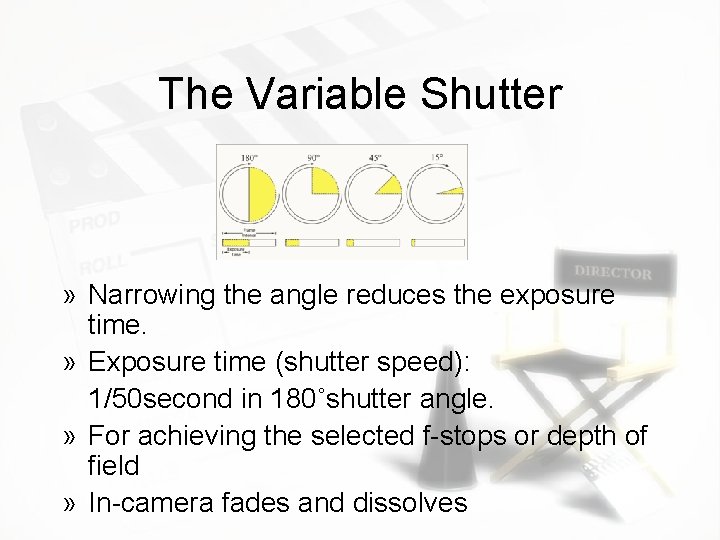
The Variable Shutter » Narrowing the angle reduces the exposure time. » Exposure time (shutter speed): 1/50 second in 180˚shutter angle. » For achieving the selected f-stops or depth of field » In-camera fades and dissolves
Motion Picture Film Characteristics » Film Size: » 65 mm: Optimum image quality and effects works » 35 mm: Theatrical release and broadcast television » 16 mm: Transfer to video for broadcast television and student filmmaking » 8 mm: Student filmmaking and special looks
Aspect Ratio » 1. 33 : 1 - academy or standard (4: 3) » 1. 66: 1 - European widescreen » 1. 85: 1 - American widescreen (16: 9) » 2. 35: 1 - Anamorphic projected image (Super 35 mm)
Light Measurements » Incident light meters measure the intensity of illumination coming from the lamp and express the reading in f-stops, based on the film speed and camera speed or shutter speed input. » Reflected light meters measure the light reflected from the subject and yield a reading in lumens per square foot
Four things to pay attention on your shoot * Composition * Exposure * Focus * Light
Reading: Chapter 4: The Lens