
Assignment 4 FSP 1 A variable store values
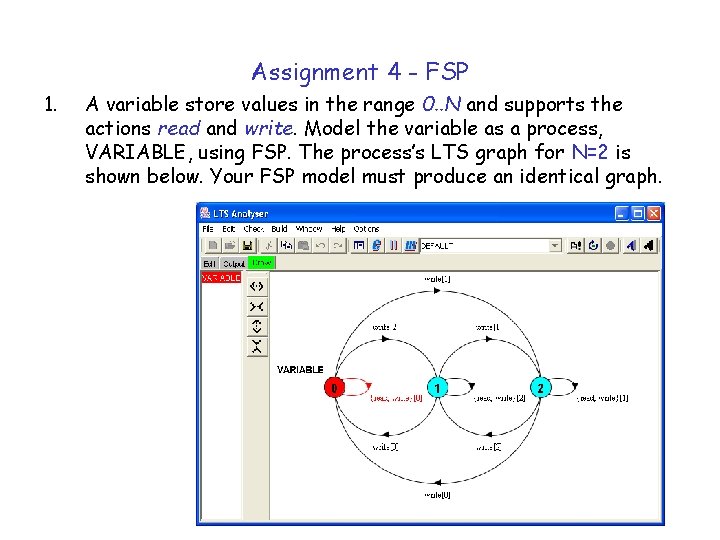
Assignment 4 - FSP 1. A variable store values in the range 0. . N and supports the actions read and write. Model the variable as a process, VARIABLE, using FSP. The process’s LTS graph for N=2 is shown below. Your FSP model must produce an identical graph.
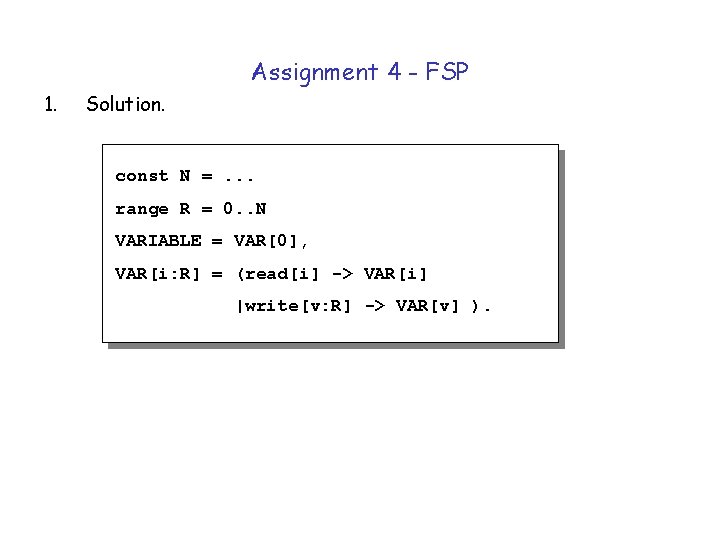
Assignment 4 - FSP 1. Solution. const N =. . . range R = 0. . N VARIABLE = VAR[0], VAR[i: R] = (read[i] -> VAR[i] |write[v: R] -> VAR[v] ).
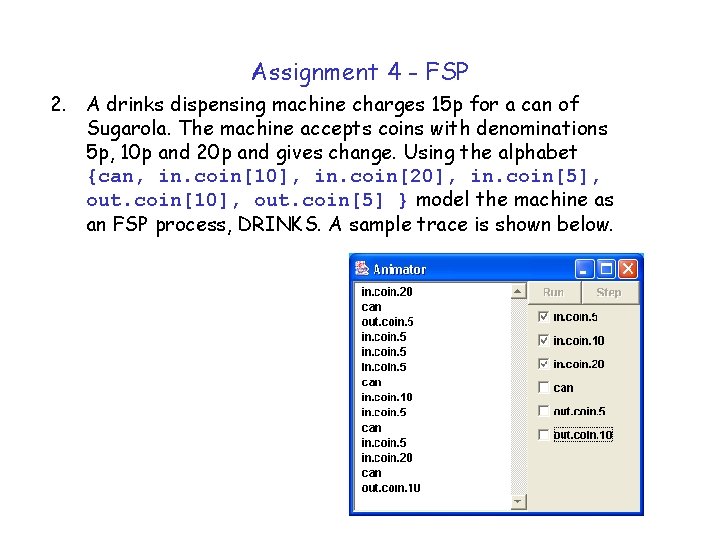
Assignment 4 - FSP 2. A drinks dispensing machine charges 15 p for a can of Sugarola. The machine accepts coins with denominations 5 p, 10 p and 20 p and gives change. Using the alphabet {can, in. coin[10], in. coin[20], in. coin[5], out. coin[10], out. coin[5] } model the machine as an FSP process, DRINKS. A sample trace is shown below.
![Assignment 4 - FSP 2. Solution. DRINKS = CREDIT[0], CREDIT[0] = (in. coin[5] ->](http://slidetodoc.com/presentation_image_h/017e7df1a76c60482404575111596497/image-4.jpg "Assignment 4 - FSP 2. Solution. DRINKS = CREDIT[0], CREDIT[0] = (in. coin[5] ->")
Assignment 4 - FSP 2. Solution. DRINKS = CREDIT[0], CREDIT[0] = (in. coin[5] -> CREDIT[5] |in. coin[10] -> CREDIT[10] |in. coin[20] -> CHANGE[5]), CREDIT[5] = (in. coin[5] -> CREDIT[10] |in. coin[10] -> CHANGE[0] |in. coin[20] -> CHANGE[10]), CREDIT[10] = (in. coin[5] -> CHANGE[0] |in. coin[10] -> CHANGE[5] |in. coin[20] -> CHANGE[15]), CHANGE[0] = (can -> DRINKS), CHANGE[5] = (can -> out. coin[5] -> DRINKS), CHANGE[10] = (can -> out. coin[10] -> DRINKS), CHANGE[15] = (can -> out. coin[5] -> out. coin[10] -> DRINKS).
Assignment 4 - FSP 3. Consider the following scenario. There are n bees and a hungry bear. They share a pot of honey. The pot is initially empty; its capacity is H portions of honey. The bear waits until the pot is full, eats all the honey and waits until the pot is full again: this pattern repeats forever. Each bee repeatedly gathers one portion of honey and puts it into the pot; if the pot is full when a bee arrives it must wait until the bear has eaten the honey before adding its portion: this pattern repeats forever. Model this scenario using FSP. The LTS graph for 4 bees is shown below. Your FSP model must produce an identical graph.
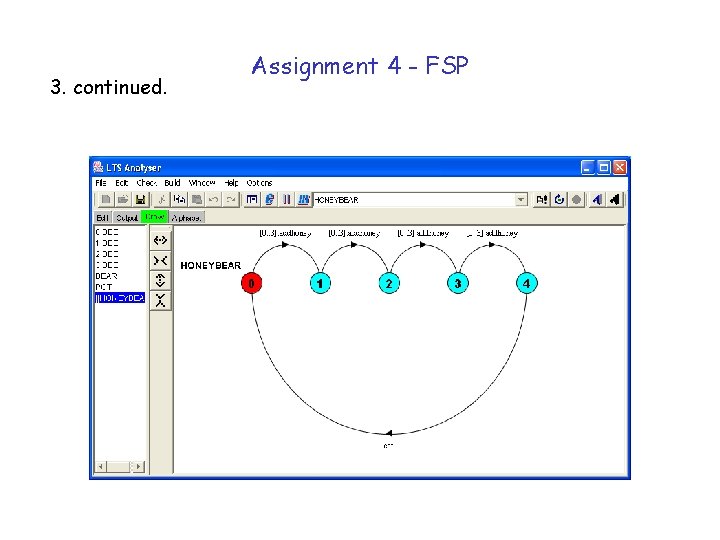
3. continued. Assignment 4 - FSP
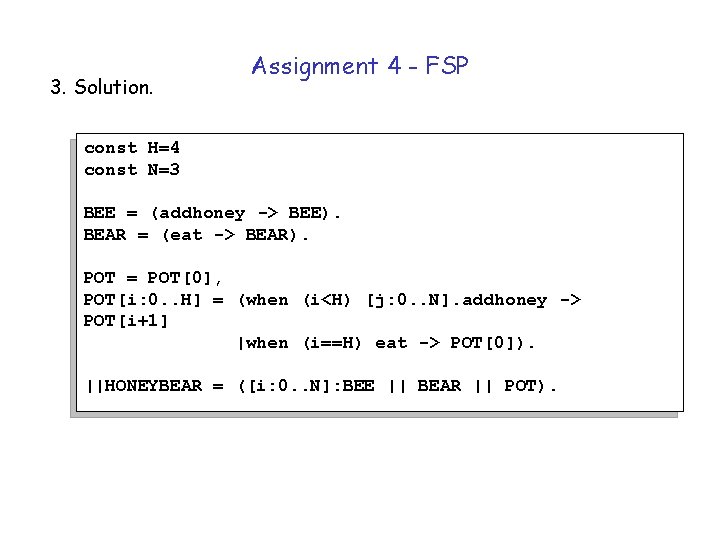
3. Solution. Assignment 4 - FSP const H=4 const N=3 BEE = (addhoney -> BEE). BEAR = (eat -> BEAR). POT = POT[0], POT[i: 0. . H] = (when (i<H) [j: 0. . N]. addhoney -> POT[i+1] |when (i==H) eat -> POT[0]). ||HONEYBEAR = ([i: 0. . N]: BEE || BEAR || POT).
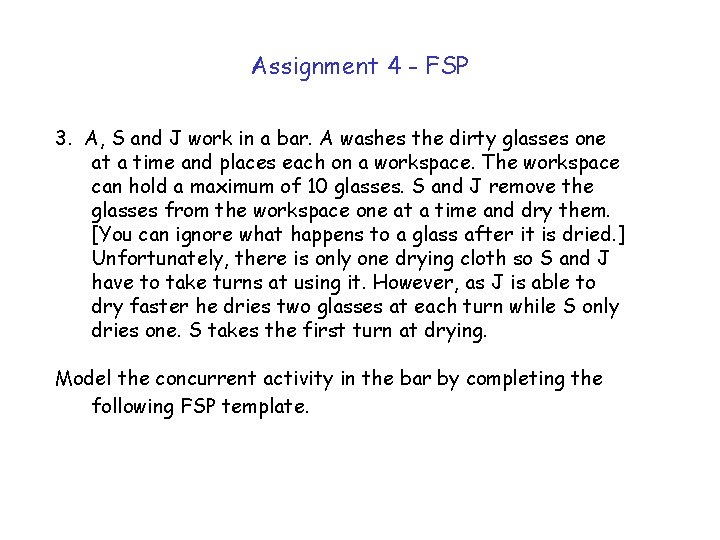
Assignment 4 - FSP 3. A, S and J work in a bar. A washes the dirty glasses one at a time and places each on a workspace. The workspace can hold a maximum of 10 glasses. S and J remove the glasses from the workspace one at a time and dry them. [You can ignore what happens to a glass after it is dried. ] Unfortunately, there is only one drying cloth so S and J have to take turns at using it. However, as J is able to dry faster he dries two glasses at each turn while S only dries one. S takes the first turn at drying. Model the concurrent activity in the bar by completing the following FSP template.
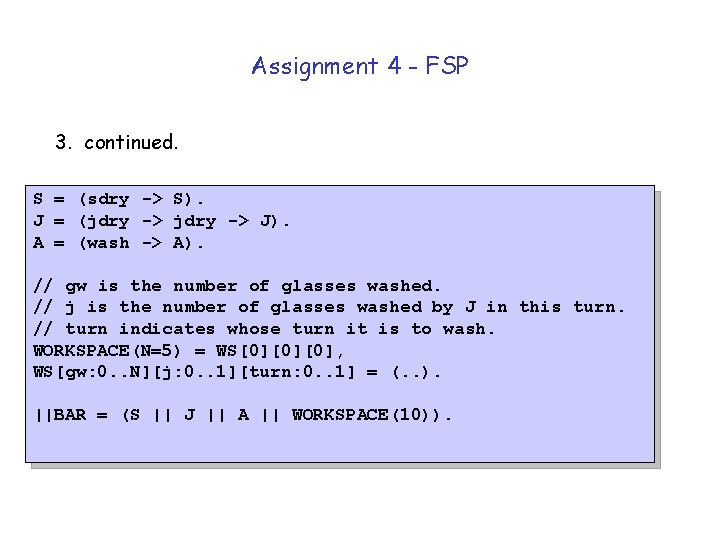
Assignment 4 - FSP 3. continued. S = (sdry -> S). J = (jdry -> J). A = (wash -> A). // gw is the number of glasses washed. // j is the number of glasses washed by J in this turn. // turn indicates whose turn it is to wash. WORKSPACE(N=5) = WS[0][0][0], WS[gw: 0. . N][j: 0. . 1][turn: 0. . 1] = (. . ). ||BAR = (S || J || A || WORKSPACE(10)).
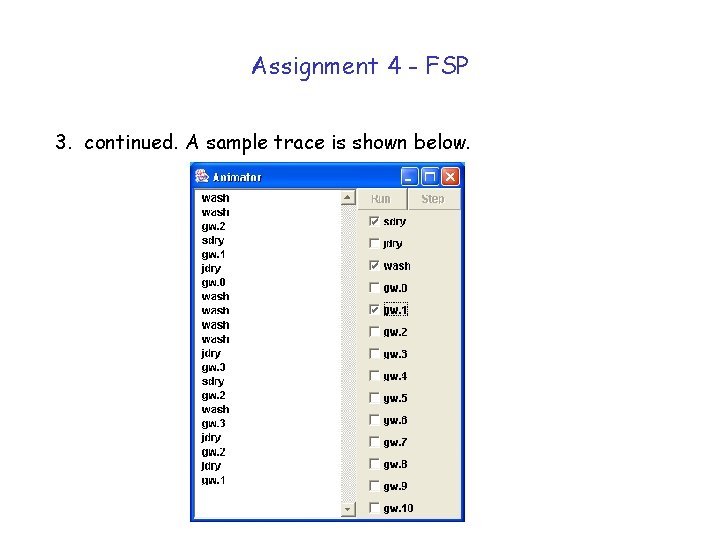
Assignment 4 - FSP 3. continued. A sample trace is shown below.
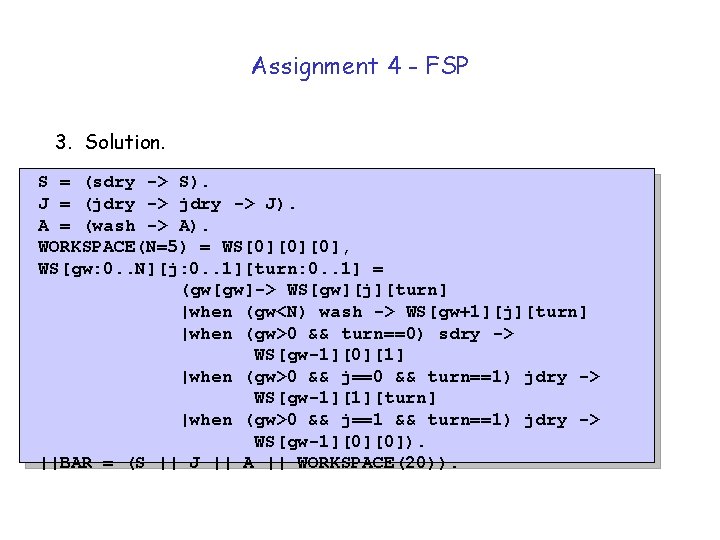
Assignment 4 - FSP 3. Solution. S = (sdry -> S). J = (jdry -> J). A = (wash -> A). WORKSPACE(N=5) = WS[0][0][0], WS[gw: 0. . N][j: 0. . 1][turn: 0. . 1] = (gw[gw]-> WS[gw][j][turn] |when (gw<N) wash -> WS[gw+1][j][turn] |when (gw>0 && turn==0) sdry -> WS[gw-1][0][1] |when (gw>0 && j==0 && turn==1) jdry -> WS[gw-1][1][turn] |when (gw>0 && j==1 && turn==1) jdry -> WS[gw-1][0][0]). ||BAR = (S || J || A || WORKSPACE(20)).
- Slides: 11