
Assignment 1 MEMOIR Goals of a Memoir To

- Slides: 25
Assignment #1 MEMOIR
Goals of a Memoir � To capture an important moment convey something about its significance
Key Features �A good story � Vivid language � Characters � Dialogue � Reflection / Significance
A Good Story � Your narrative need not be about an earth-shattering event, but your topic— and how you write about it—should interest your potential readers. � At the center of most good stories stands a conflict or question that needs resolution.
Vivid Language � Details bring a memoir to life by giving readers mental images of the sights, sounds, smells, tastes, and textures of the world in which your story takes place. � SHOW over tell. A narrative is more than simply a report of what happened; vivid details and dialogue bring the events of the past to life, thereby immersing readers in your experience.
Clear Significance � Memories of the past are filtered through our view from the present. � Avoid coming right out and saying why the incident is so important to you. � What and how you tell your story should implicitly convey this significance.
Purpose � What is the importance of the memory you are trying to convey? � How will this story help your readers (and yourself) understand you, as you were then and as you are now? � Beyond yourself, how will this story help your readers understand something about the human condition?
Audience � Who are your readers? � What do you want them to learn from reading your memoir? � How can you help them understand your experience, but also apply it / relate it to other similar experiences that they might encounter in their own lives?
Presentation � What impression do you want to give, and how can your words contribute to that impression? � What tone do you want to project? Sincere? Serious? Humorous? Detached? Self-critical? � How will your tone reflect your purpose and affect your audience?
Thesis � Your story is a vehicle for making some sort of argument � Don’t lose sense of your overall purpose and focus in writing a literacy narrative � Like any other form of writing, every element of your narrative should contribute to validating thesis.
Structure of a Literacy Narrative � Introduction � Body � Conclusion
Introduction � Hooks readers by dropping them in the middle of an interesting situation or by presenting them with an especially vivid description. � Introduces focal point of your narrative � Introduces tension/conflict � Gets readers emotionally invested in your topic
Body � Develop conflict introduced in the opening paragraph(s). � Here is where the plot or major sequence of events leading up to the climax takes place. � Only include events that are the most meaningful to you and that best illustrate the point you want to make
� Develop characters through 1) vivid description and 2) dialogue aimed at revealing a character’s personality and his or her relationship to others. � Use dialogue purposefully to help readers attain deeper insight into the thoughts and emotions of your characters.
Reflection and Analysis � Encourage readers to notice particular details or help them understand the significance of a particular experience for a character’s self-development. � As you narrate events, look for places where you can briefly pause the action and provide a few sentences of reflection and/or analysis.
Conclusion � Reinforces the message of the story. � Be sure the elements of your narrative work together to deliver one clear, coherent message. � You might choose to end your narrative with a scene that perfectly captures the mood you want readers to experience or with an image you want them to remember.
Writing Tips � Specific sensory details and vivid descriptions help deliver a specific message. � Invite readers to emotionally connect with and invest in the lives and activities of the major characters in your narrative.
Show, Don’t Tell � Dramatize, � Writing dramatize! in a manner that allows the reader to experience the story through a character’s action, words, thoughts, senses, and feelings rather than through the narrator’s exposition, summarization, and description.
� Instead of stating a situation flat out, let the reader discover what you’re trying to say by watching a character in action and by listening to his or her dialogue. � SHOWING brings your characters to life. � SHOWING makes scenes vivid and immerses your audience in the experience. � Of course telling is sometimes necessary, but scenes that are important to the story should be dramatized.
Description CONCRETE VS. ABSTRACT
Concrete vs Abstract � Concrete language makes the story clearer and more real to the reader because it offers information that we can easily grasp and perhaps empathize with. � Abstract language makes the story difficult to visualize and leaves your reader feeling empty, disconnected and confused.
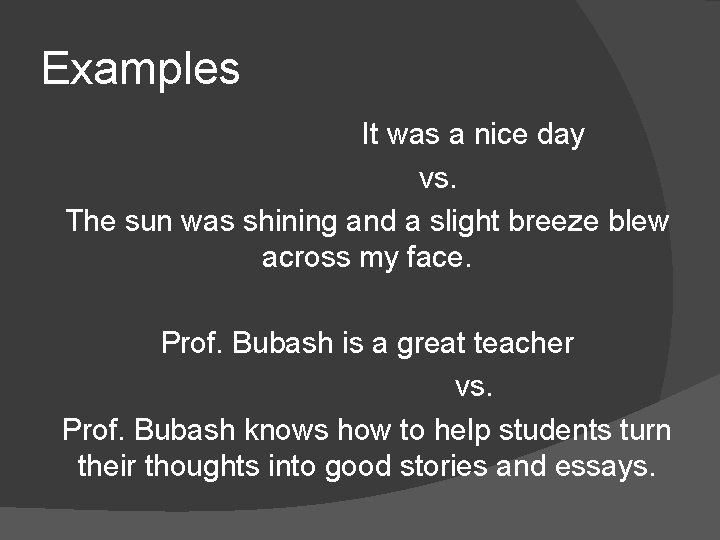
Examples It was a nice day vs. The sun was shining and a slight breeze blew across my face. Prof. Bubash is a great teacher vs. Prof. Bubash knows how to help students turn their thoughts into good stories and essays.
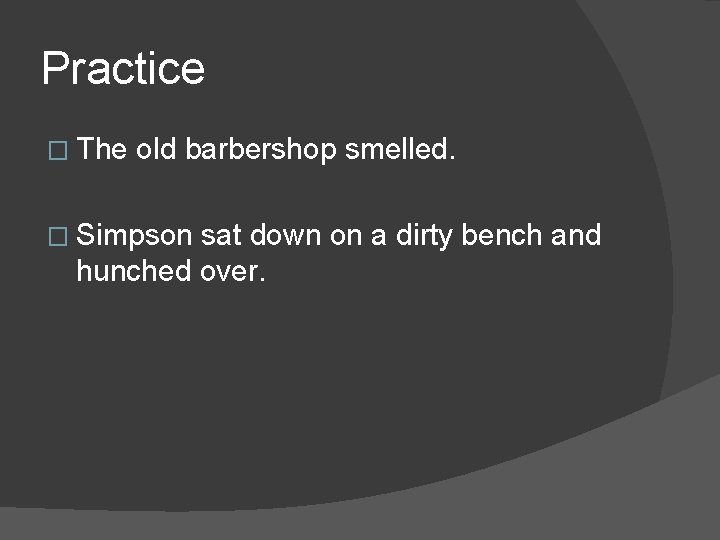
Practice � The old barbershop smelled. � Simpson sat down on a dirty bench and hunched over.
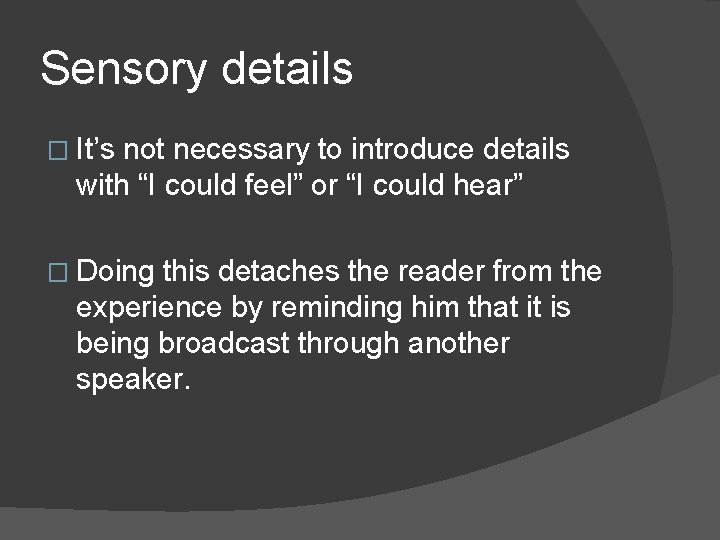
Sensory details � It’s not necessary to introduce details with “I could feel” or “I could hear” � Doing this detaches the reader from the experience by reminding him that it is being broadcast through another speaker.
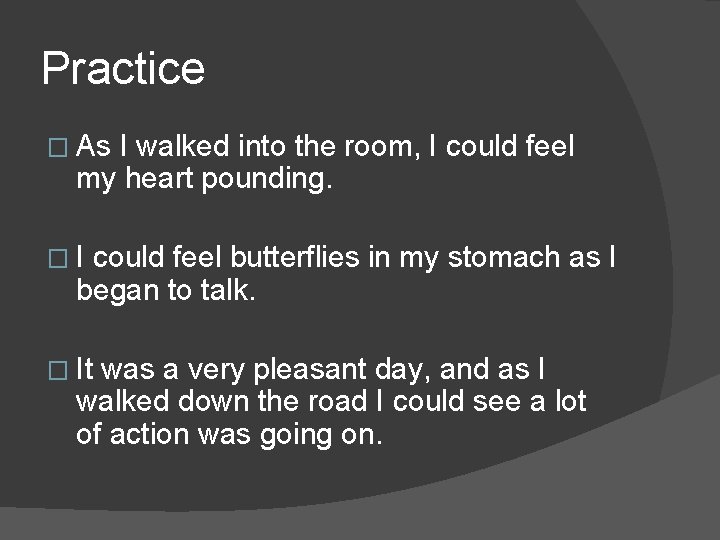
Practice � As I walked into the room, I could feel my heart pounding. �I could feel butterflies in my stomach as I began to talk. � It was a very pleasant day, and as I walked down the road I could see a lot of action was going on.