
Assign 13 2 Adding Equilibrium Constants and Calculating
Assign. #13. 2 – Adding Equilibrium Constants and Calculating Equilibrium Concentrations
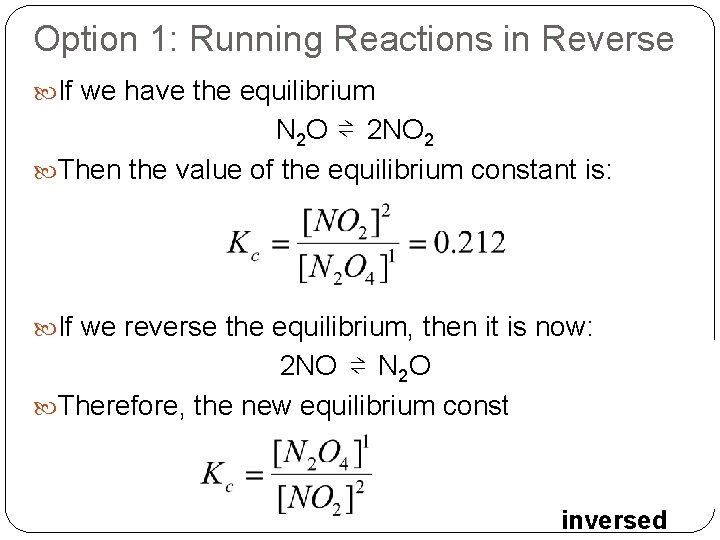
Option 1: Running Reactions in Reverse If we have the equilibrium N 2 O ⇌ 2 NO 2 Then the value of the equilibrium constant is: If we reverse the equilibrium, then it is now: When a 2 NO ⇌ N 2 O reaction is run Therefore, the new equilibrium constant is in reverse, the equilibrium constant is inversed
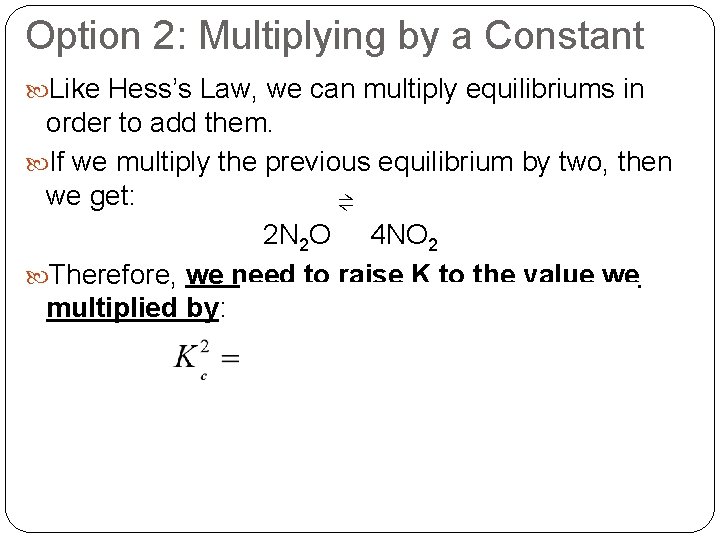
Option 2: Multiplying by a Constant Like Hess’s Law, we can multiply equilibriums in order to add them. If we multiply the previous equilibrium by two, then we get: ⇌ 2 N 2 O 4 NO 2 Therefore, we need to raise K to the value we multiplied by:
Option 3: Adding Equilibriums Like Hess’s Law, we can add equilibriums to obtain the desired reaction When we add equilibriums, the equilibrium constants are multiplied.
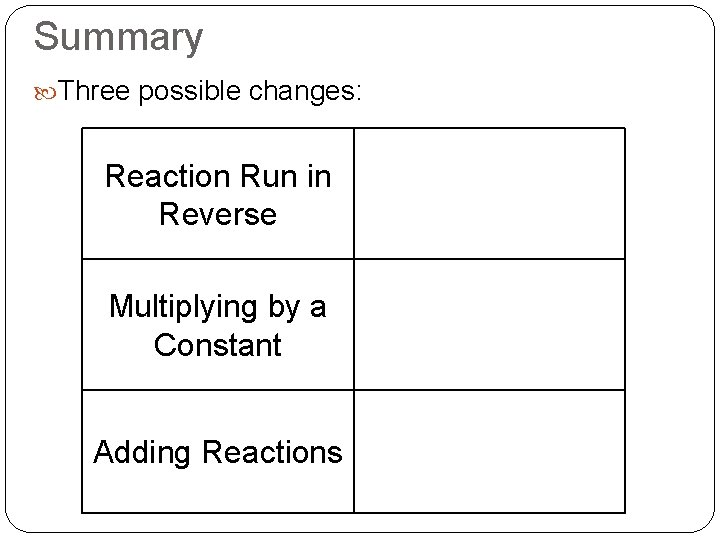
Summary Three possible changes: Reaction Run in Reverse Multiplying by a Constant Adding Reactions
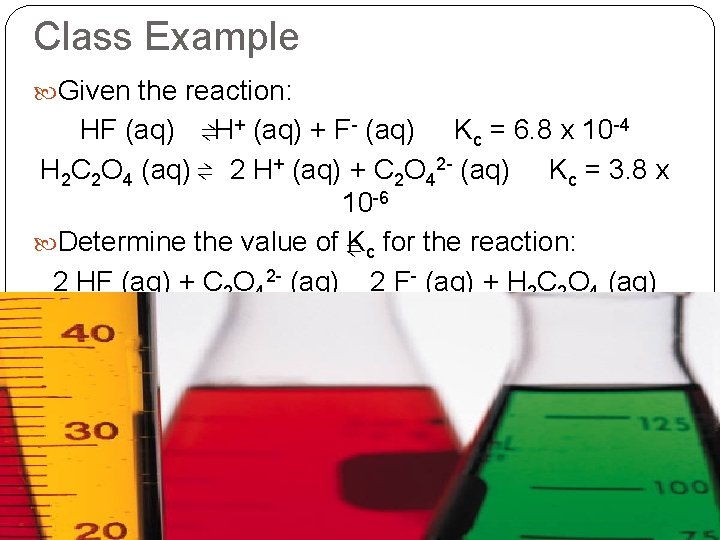
Class Example Given the reaction: HF (aq) ⇌H+ (aq) + F- (aq) Kc = 6. 8 x 10 -4 H 2 C 2 O 4 (aq) ⇌ 2 H+ (aq) + C 2 O 42 - (aq) Kc = 3. 8 x 10 -6 Determine the value of ⇌ Kc for the reaction: 2 HF (aq) + C 2 O 42 - (aq) 2 F- (aq) + H 2 C 2 O 4 (aq)
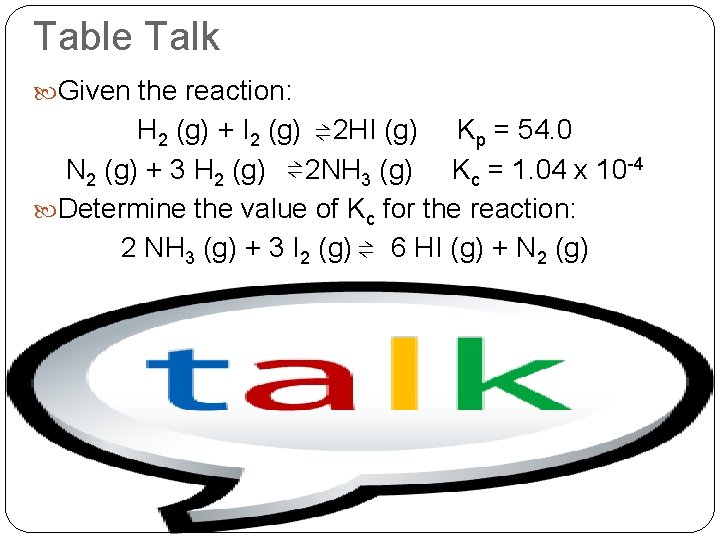
Table Talk Given the reaction: H 2 (g) + I 2 (g) ⇌ 2 HI (g) Kp = 54. 0 N 2 (g) + 3 H 2 (g) ⇌ 2 NH 3 (g) Kc = 1. 04 x 10 -4 Determine the value of Kc for the reaction: 2 NH 3 (g) + 3 I 2 (g) ⇌ 6 HI (g) + N 2 (g)
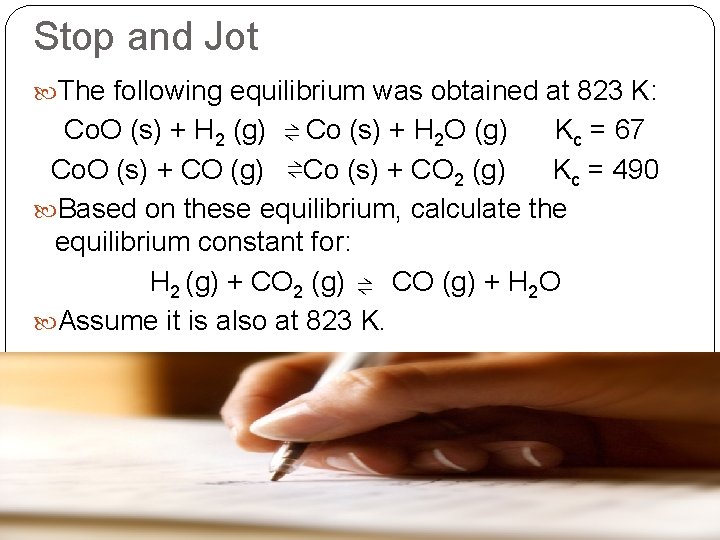
Stop and Jot The following equilibrium was obtained at 823 K: Co. O (s) + H 2 (g) ⇌ Co (s) + H 2 O (g) Kc = 67 Co. O (s) + CO (g) ⇌Co (s) + CO 2 (g) Kc = 490 Based on these equilibrium, calculate the equilibrium constant for: H 2 (g) + CO 2 (g) ⇌ CO (g) + H 2 O Assume it is also at 823 K.
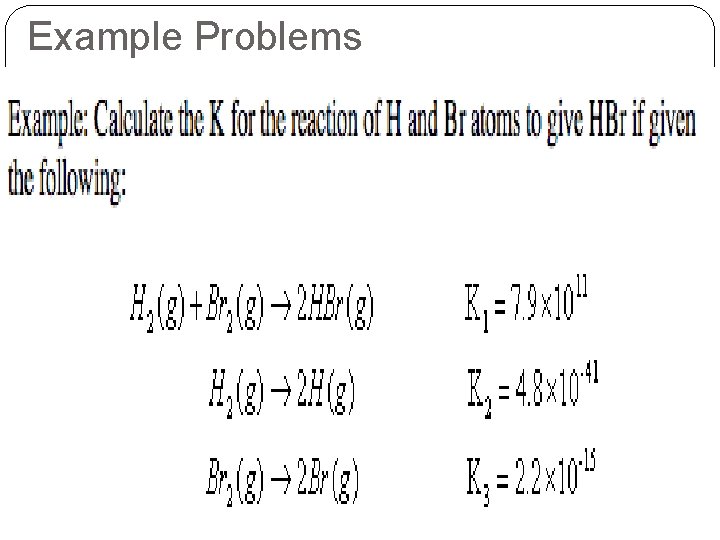
Example Problems
Calculating Equilibrium Concentrations Oftentimes, we know the amount of substance that we begin with, but the equilibrium amounts are unknown. We use stoichiometry to help solve for the equilibrium concentrations using the initial conditions and the value of Kc.
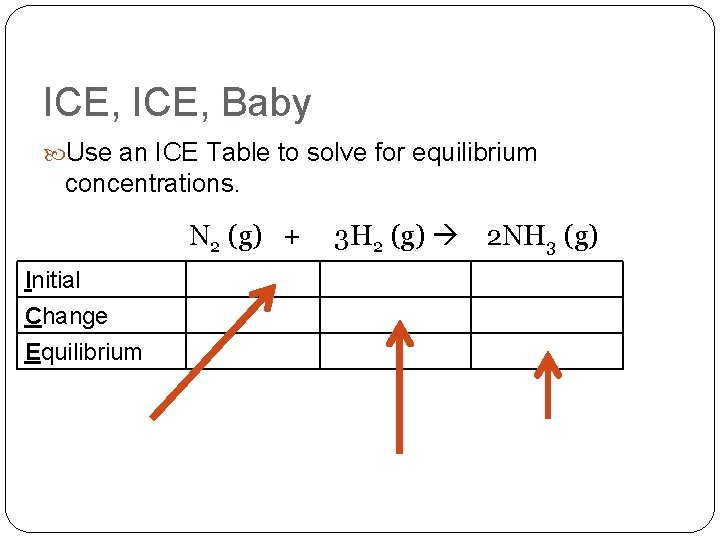
ICE, Baby Use an ICE Table to solve for equilibrium concentrations. N 2 (g) + 3 H 2 (g) 2 NH 3 (g) Initial Change Equilibrium Initial concentrations go here Result of adding and subtracting I/C Coefficient times x goes here
Class Example A 1. 000 L flask if filled with 1. 000 mol of H 2 and 2. 00 mole of I 2 at 448 o. C. The value of the equilibrium constant Kc, for the reaction: H 2 (g) + I 2 (g) ⇌ 2 HI (g) At 448 o. C is 50. 5. What are the equilibrium concentrations of H 2, I 2, and HI in moles per liter?
Table Talk For the equilibrium: PCl 5 (g) ⇌ PCl 3 (g) + Cl 2 (g) The equilibrium constant, Kp, is 0. 497 at 500 K. A gas cylinder at 500 K charged with PCl 5 (g) at an initial pressure of 1. 66 atm. What are the equilibrium pressures of PCl 5, PCl 3, Cl 2
Class Example A closed system initially containing 1. 00 x 10 -3 M H 2 and 2. 000 x 10 -3 M I 2 at 448 o. C is allowed to reach equilibrium and at equilibrium the HI concentration is 1. 87 x 10 -3 M. Calculate Kc for the reaction taking place, which is: ⇌ H 2 (g) + I 2 (g) 2 HI (g)
Table Talk Sulfur trioxide decomposes at high temperature in a sealed container: 2 SO 2 (g) ⇌ 2 SO 2 (g) + O 2 (g) Initially the vessel is charged at 1000 K with So 3 (g) at a partial pressure of 0. 500 atm. At equilibrium the SO 3 partial pressure is 0. 200 atm. Calculate the value of Kp at 1000 K
- Slides: 15