
AssetsLiabilities Mismatch Risks and Challenges Sami AlSuwailem IRTI
Assets-Liabilities Mismatch: Risks and Challenges Sami Al-Suwailem IRTI, IDB Jumada Thani, 1430 H – June, 2009

Overview �Maturity mismatch: ◦ Liabilities are shorter than assets (borrow short and lend long) ◦ Reduces costs (short term interest usually lower) �Currency mismatch: ◦ Borrow in a currency and lend in another ◦ Exploits interest rate differentials 2

Maturity Transformation �Benefits: liquidity—micro level �Costs: ◦ ◦ ◦ Fallacy of composition Risk of runs High leverage Endogenous risk—financial fragility Systemic risk—macro level �International crises �“The original sin” 3
Endogenous Risk �Financial sector is more volatile than real economy �Richard Bookstaber (2007): ◦ “The fact that total risk of financial markets has grown in spite of a marked decline in exogenous economic risk is a key symptom of the design flaws within the system” 4

Maturity Mismatch vs. Ponzi Schemes �Both have serial structure: ◦ Take from B to pay A; from C to pay B; from D to pay C, etc. ◦ Default arises when the chain stops �MM is solvent, PS is not �Ponzi scheme is a “naked” MM design �“Optimal Ponzi design” when government is expected to step in! 5
Historical Responses �Bank runs �Saving & Loans 1980’s �Lender of Last Resort, Deposit Insurance, and government bailout �Problem: moral hazard 6
Shadow Banking System �In the past two decades nonbank financial institutions replicated the commercial banking model via money markets �Banks also shifted from deposits to money markets �Size of the shadow system in 2007 reached $10. 5 trillion, while commercial banking system was $10 trillion 7
Liquidity Party �By end of 2006, investment banks were rolling over 25% of their balance sheets on daily basis �Overnight repos = $2. 5 trillion �“When the music stops, in terms of liquidity, things will be complicated. But as long as the music is playing, you’ve got to get up and dance. We‘re still dancing. ” �C. Prince, CEO, Citigroup, July 10, 2007 8
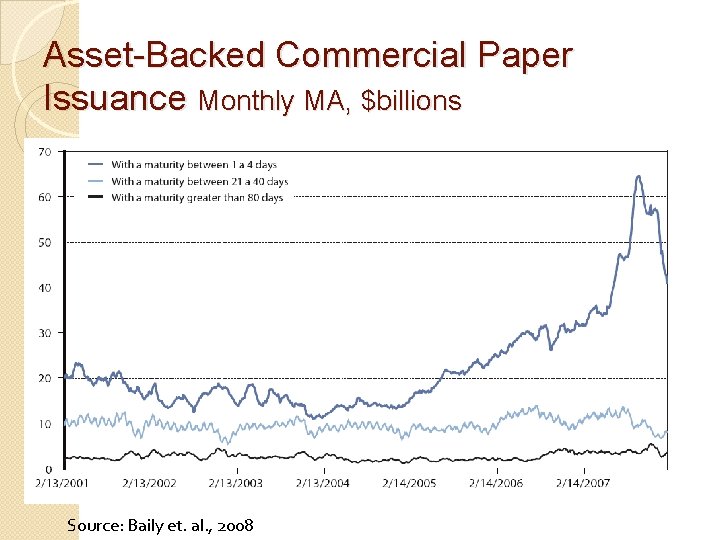
Asset-Backed Commercial Paper Issuance Monthly MA, $billions Source: Baily et. al. , 2008
More Risky System �Money market is more risky and volatile than deposits �Plus, no insurance or LOLR for such institutions �“What is truly shocking is that the risks posed by this funding mismatch have gone so unnoticed, for so long. ” �Gillian Tett, Financial Times, Sep. 2007 10
Global Financial Crisis �Triggered by classical run, but in the shadow banking sector �The same mechanism of other international crises �The system needs to be redesigned 11
International Responses �BIS: Macro-prudential measures against systemic and liquidity risks �FSA: Core funding ratio �IMF: Balance-sheet approach for financial assessment �CMBS: Mark-to-funding �Group of Thirty & WEF: Less short term debt 12
Islamic Finance �Integration of debt creation with wealth creation �Alignment of funding and spending �Alignment of assets and liabilities �Mismatch may arise incidentally but not deliberately 13
Deliberate Mismatching �A loan to be paid by another loan, to be paid by another, etc. �Each loan is an obligation that bank does not have ability to pay on time— “sale of what you don’t have” �Highly risky—gharar �“Two sales in one”: Fulfillment of one contract is conditioned on another 14
Islamic Model of Intermediation �Profit and loss sharing on both sides �“Mutual funds banking” �“Limited purpose banking” �Perfect match and inherent stability 15
Islamic Banks in Practice �Used to be stable with ample liquidity �Recently they are increasingly misaligning their balances �Borrow short through reversed tawarruq �Lend long through organized tawarruq �Islamic banks face the same vulnerabilities of conventional banks 16
Diversity �Islamic finance promotes diversity: ◦ It is directly linked to the diverse real economy �The more finance becomes detached from real economy, the more it becomes homogenous 17
Liquidity “Black-hole” �A homogenous market fails to meet “law of large numbers” �Herd behavior and correlated risk �Fallacy of composition: if every one wants to sell, liquidity disappears �Diversity is essential for market liquidity 18
Role of Regulation Andrew Haldane, Bo. E (2009): ◦ Deregulation swept away banking segregation and, with it, robustness of the financial network ◦ That is why Glass-Steagall Act is back on the international policy agenda ◦ It may be the wrong or too narrow an answer. But it asks the right question: Can network structure be altered to improve network robustness? 19
Firm Boundaries �Firms may be segregated based on aligned maturity structures �Financial landscape is distributed along maturity horizon �This assures stability and diversity �No need for Glass-Steagall act 20
Conclusion �Deliberate mismatching is Islamically questionable and economically dangerous �Glass-Steagall Act is outdated and incomprehensive �Regulation based on aligned maturities might provide a better approach 21

- Slides: 22