
Assets Subject to Special Controls ASSC Automation Requirements
Assets Subject to Special Controls (ASSC) Automation Requirements Nat Bassi DES WATERGUARD Assistant Head – ASSC September 2019 2/28/2021 1 Defence Equipment & Support
Background • The ASSC Project has been formed to implement a Defence wide database which captures all assets held within the Defence supply chain, specifically, whether they are export controlled (for example, under the ITAR) and what approvals are in place for MOD to hold and transact on them. Issue • Export Control authorisations received are often archaic documents that have been scanned, this process is required to inform the supply chain on “authorised transactions” with third-parties. Processing these documents is: • Difficult to interpret the data; • Time consuming to process; and • Often erroneous due to human error when transposing information. 2/28/2021 2 Defence Equipment & Support
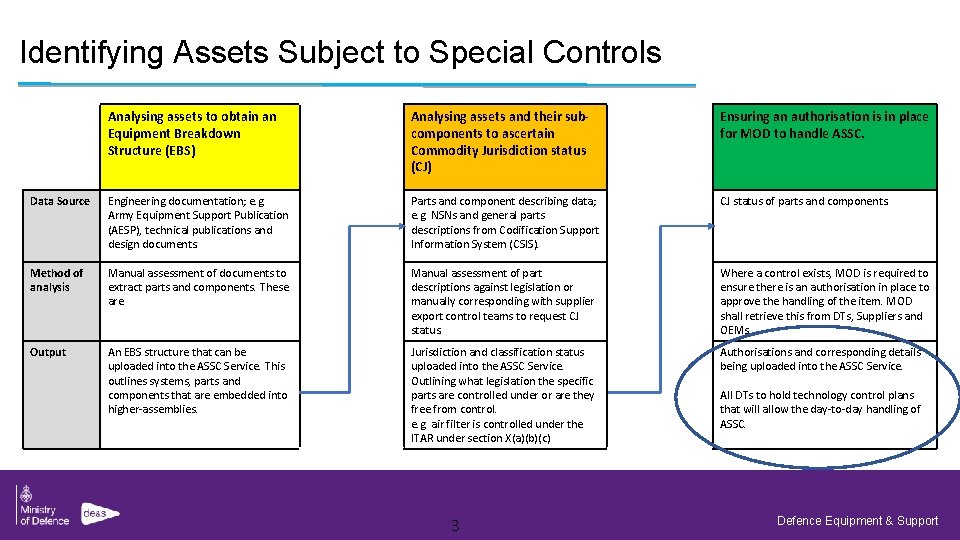
Identifying Assets Subject to Special Controls Analysing assets to obtain an Equipment Breakdown Structure (EBS) Analysing assets and their subcomponents to ascertain Commodity Jurisdiction status (CJ) Ensuring an authorisation is in place for MOD to handle ASSC. Data Source Engineering documentation; e. g. Army Equipment Support Publication (AESP), technical publications and design documents. Parts and component describing data; e. g. NSNs and general parts descriptions from Codification Support Information System (CSIS). CJ status of parts and components. Method of analysis Manual assessment of documents to extract parts and components. These are Manual assessment of part descriptions against legislation or manually corresponding with supplier export control teams to request CJ status. Where a control exists, MOD is required to ensure there is an authorisation in place to approve the handling of the item. MOD shall retrieve this from DTs, Suppliers and OEMs. Output An EBS structure that can be uploaded into the ASSC Service. This outlines systems, parts and components that are embedded into higher-assemblies. Jurisdiction and classification status uploaded into the ASSC Service. Outlining what legislation the specific parts are controlled under or are they free from control. e. g. air filter is controlled under the ITAR under section X(a)(b)(c) Authorisations and corresponding details being uploaded into the ASSC Service. 2/28/2021 3 All DTs to hold technology control plans that will allow the day-to-day handling of ASSC. Defence Equipment & Support
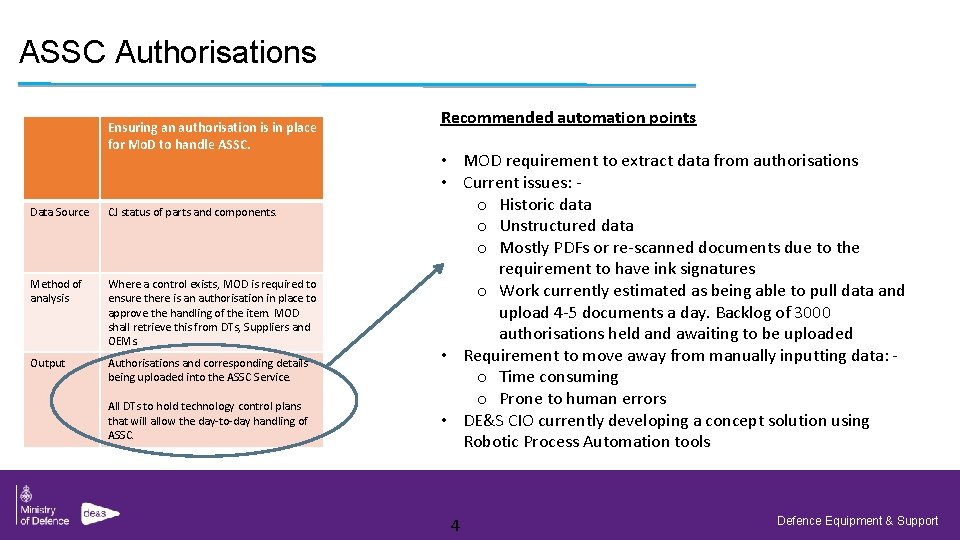
ASSC Authorisations Ensuring an authorisation is in place for Mo. D to handle ASSC. Data Source CJ status of parts and components. Method of analysis Where a control exists, MOD is required to ensure there is an authorisation in place to approve the handling of the item. MOD shall retrieve this from DTs, Suppliers and OEMs. Output Authorisations and corresponding details being uploaded into the ASSC Service. All DTs to hold technology control plans that will allow the day-to-day handling of ASSC. 2/28/2021 Recommended automation points • MOD requirement to extract data from authorisations • Current issues: o Historic data o Unstructured data o Mostly PDFs or re-scanned documents due to the requirement to have ink signatures o Work currently estimated as being able to pull data and upload 4 -5 documents a day. Backlog of 3000 authorisations held and awaiting to be uploaded • Requirement to move away from manually inputting data: o Time consuming o Prone to human errors • DE&S CIO currently developing a concept solution using Robotic Process Automation tools 4 Defence Equipment & Support
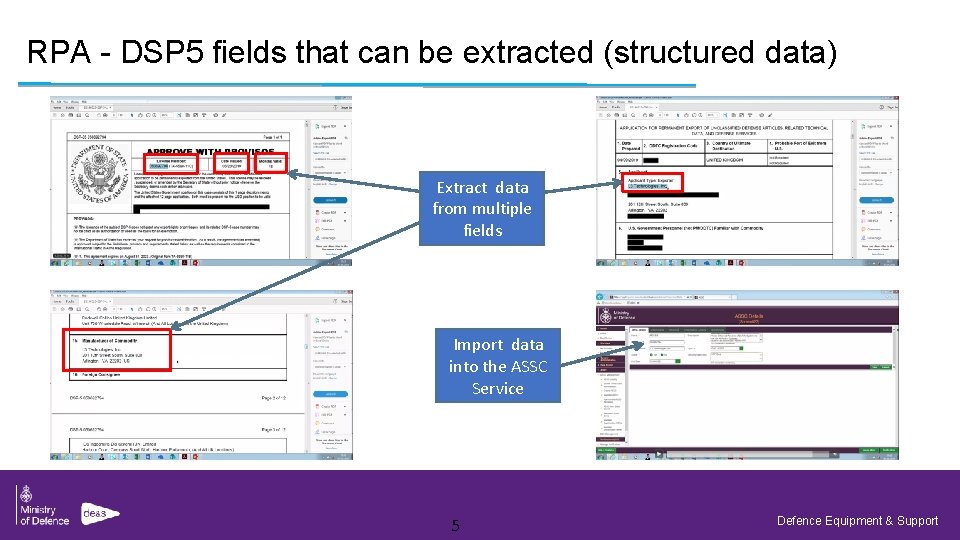
RPA - DSP 5 fields that can be extracted (structured data) Extract data from multiple fields Import data into the ASSC Service 2/28/2021 5 Defence Equipment & Support
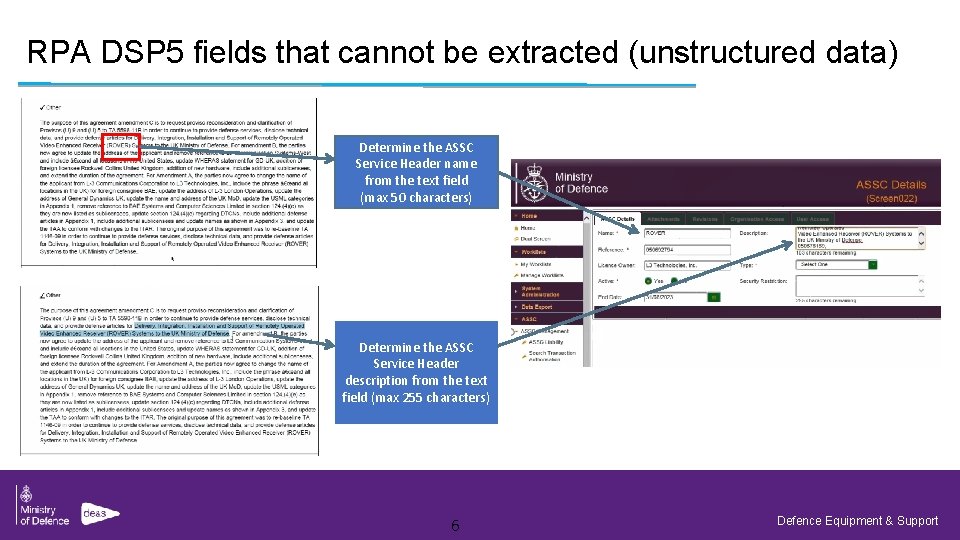
RPA DSP 5 fields that cannot be extracted (unstructured data) Determine the ASSC Service Header name from the text field (max 50 characters) Determine the ASSC Service Header description from the text field (max 255 characters) 2/28/2021 6 Defence Equipment & Support
Other Automation Opportunities • Technical Assistant Agreements • Equipment Breakdown Structure • Structure data from various sources/publications and create a Parent/Child relationship • Commodity Jurisdiction Assessments • Calculate if equipment items are controlled, based on ITAR & EAR regulations and various data sources • Full video available, recorded by the ASSC Service Manager. This 30 minute video demonstrates how license information is extracted manually from the documents and imported manually into the ASSC Service database 2/28/2021 7 Defence Equipment & Support
QUESTIONS… 2/28/2021 8 Defence Equipment & Support
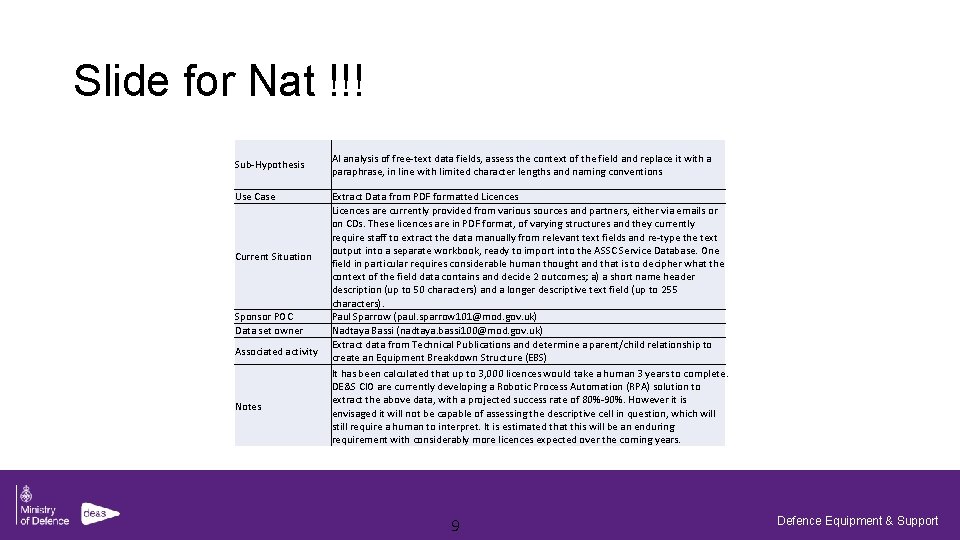
Slide for Nat !!! Sub-Hypothesis Use Case Current Situation Sponsor POC Data set owner Associated activity Notes 2/28/2021 AI analysis of free-text data fields, assess the context of the field and replace it with a paraphrase, in line with limited character lengths and naming conventions Extract Data from PDF formatted Licences are currently provided from various sources and partners, either via emails or on CDs. These licences are in PDF format, of varying structures and they currently require staff to extract the data manually from relevant text fields and re-type the text output into a separate workbook, ready to import into the ASSC Service Database. One field in particular requires considerable human thought and that is to decipher what the context of the field data contains and decide 2 outcomes; a) a short name header description (up to 50 characters) and a longer descriptive text field (up to 255 characters). Paul Sparrow (paul. sparrow 101@mod. gov. uk) Nadtaya Bassi (nadtaya. bassi 100@mod. gov. uk) Extract data from Technical Publications and determine a parent/child relationship to create an Equipment Breakdown Structure (EBS) It has been calculated that up to 3, 000 licences would take a human 3 years to complete. DE&S CIO are currently developing a Robotic Process Automation (RPA) solution to extract the above data, with a projected success rate of 80%-90%. However it is envisaged it will not be capable of assessing the descriptive cell in question, which will still require a human to interpret. It is estimated that this will be an enduring requirement with considerably more licences expected over the coming years. 9 Defence Equipment & Support
- Slides: 9