
ASSETS RECOVERY AGENCY REDUCING CRIME AND THE FEAR


- Slides: 14
ASSETS RECOVERY AGENCY REDUCING CRIME AND THE FEAR OF CRIME BY MAKING SURE CRIME DOES NOT PAY John Tanner Head of Policy and Performance 1
This presentation will cover: • • Why we do asset recovery Why we have a new structure What asset recovery means Our powers and examples of cases ASSETS RECOVERY 2 AGENCY
Why recover criminal assets? Problems identified by research: • Criminals left to enjoy fruits of wrongdoing even if successfully convicted and punished, sending message that crime does pay; • Assets used to fund further criminal activity; • Large criminal money flows destabilise financial systems; • Confiscation orders only made in about 2% of potential cases; • When confiscation orders made, poor enforcement processes. ASSETS RECOVERY 3 AGENCY
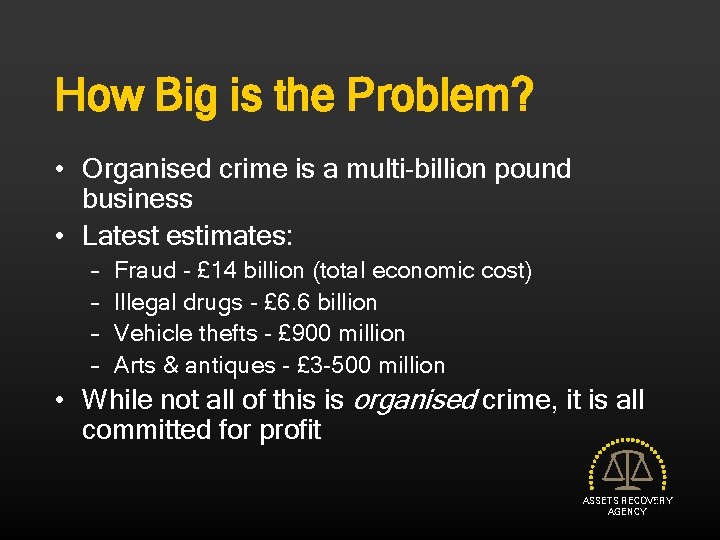
How Big is the Problem? • Organised crime is a multi-billion pound business • Latest estimates: – – Fraud - £ 14 billion (total economic cost) Illegal drugs - £ 6. 6 billion Vehicle thefts - £ 900 million Arts & antiques - £ 3 -500 million • While not all of this is organised crime, it is all committed for profit ASSETS RECOVERY 4 AGENCY
High level political support “It is not acceptable that people should enjoy the proceeds of criminal activity and live a life of luxury when it is built on the misery of victims or activities which damage or exploit society” Rt. Hon Tony Blair MP June 2000 ASSETS RECOVERY 5 AGENCY
The Hierarchy of Action 1. Confiscation– • Action by prosecuting authorities to obtain conviction and confiscation in criminal courts will remain the priority • Linking benefit to assets ASSETS RECOVERY 6 AGENCY
The Hierarchy of Action 2. Civil Recovery • If conviction/confiscation not feasible • Linking unlawful conduct to recoverable property ASSETS RECOVERY 7 AGENCY
The Hierarchy of Action 3. Taxation • If civil recovery not effective or feasible • No need to demonstrate - taxable source of income - link from income to crime ASSETS RECOVERY 8 AGENCY
Examples of potential use of civil recovery power • Criminal case cannot be brought because of the circumstances • Prosecution unsuccessful, but prospect of success in civil proceedings because issue to be proved different • Prosecution successful but either no confiscation order overturned on a legal technicality ASSETS RECOVERY 9 AGENCY
Confiscation • In June 2004 ARA obtained Confiscation Order assisting Trading Standards Officers in prosecution for the sale of counterfeit mobile phone covers. • Fined £ 50 for each of four offences. • Judge made a Confiscation Order of £ 335, 000. ASSETS RECOVERY 10 AGENCY
Civil Recovery • Leading terrorist in Northern Ireland with many convictions for serious crime. Released from prison in 1988 with no assets. • Became a major drugs trafficker and was arrested on suspicion of murder on five separate occasions. • May 2003 he was shot dead. • ARA used its powers to require the disclosure of information and search. • September 2003 ARA obtained orders restraining almost £ 2 m of assets. • Now seeking final judgement. ASSETS RECOVERY 11 AGENCY
Tax Cases • The Agency currently has 7 tax investigations under way. • 3 tax assessments for total value £ 0. 58 m have been issued • Enforcement action in 1 case ASSETS RECOVERY 12 AGENCY
Impact • Under £ 25 m in 2001/2 • Over £ 45 million recovered in 2003 -04 • 1331 cash seizures under new powers in POCA, over £ 63 million • 112 confiscation orders under new powers, over £ 1. 2 m • ARA - 20 confiscation cases, £ 4. 4 m; 59 civil recovery cases, £ 14. 1 m restrained; 7 tax cases ASSETS RECOVERY 13 AGENCY
Summary • Purpose of the Act and the Agency is to reduce crime and contribute to safer communities by: – Seizing criminals assets through criminal confiscation, civil recovery or taxation – Disrupting criminals ability to conduct their business – Promoting the use of financial investigation as a tool to fight crime. ASSETS RECOVERY 14 AGENCY