
AssetBased Community Development An Overview and Framework for
Asset-Based Community Development An Overview and Framework for Discussion for Habitat for Humanity Affiliate Boards of Directors 1
Training Objectives 1. Orient HFH affiliate Board members and other organizational leaders to the concept of Asset Based Community Development (ABCD) 2. Present ABCD in the context of Neighborhood Revitalization 3. Provide a framework for ways that HFH Boards can integrate ABCD into their roles, responsibilities, and governance approach 4. Offer a set of questions that Boards can use to stimulate discussion around ABCD 2
Defining ABCD • Asset: a useful or valuable thing, person or quality – Tangible or intangible – Goes beyond a traditional economic definition • Community Development: “both a process and the result of an organized and ongoing effort in a community… based on a shared vision for the quality of life that residents wish to achieve and sustain. ” (HFHI) • Asset-Based Community Development: “A methodology that seeks to uncover and use the strengths within communities as a means for sustainable development. ” (ABCD Institute) 3

ABCD Principles • All people, and all neighborhoods, are gifted, resourceful and capable • Traditional terminology around community development can be redefined • Turn “needs” into “assets” 4
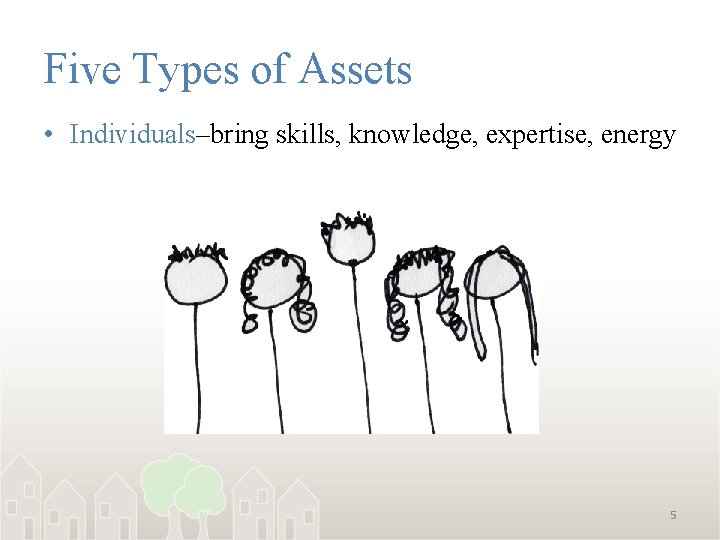
Five Types of Assets • Individuals–bring skills, knowledge, expertise, energy 5
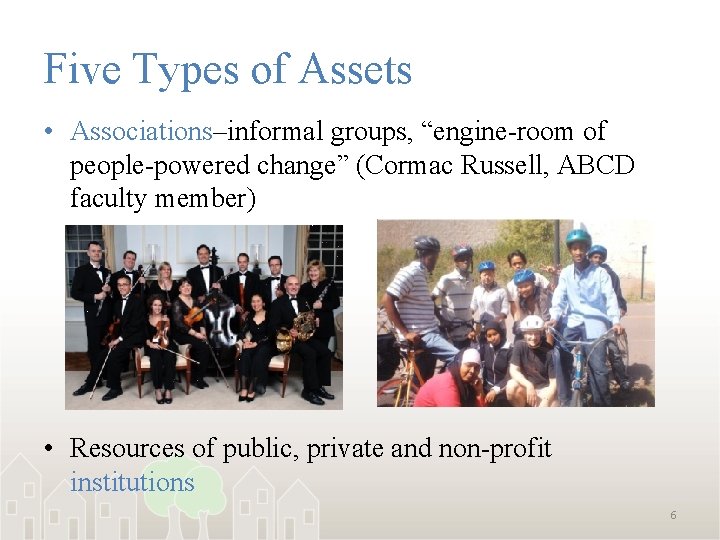
Five Types of Assets • Associations–informal groups, “engine-room of people-powered change” (Cormac Russell, ABCD faculty member) • Resources of public, private and non-profit institutions 6
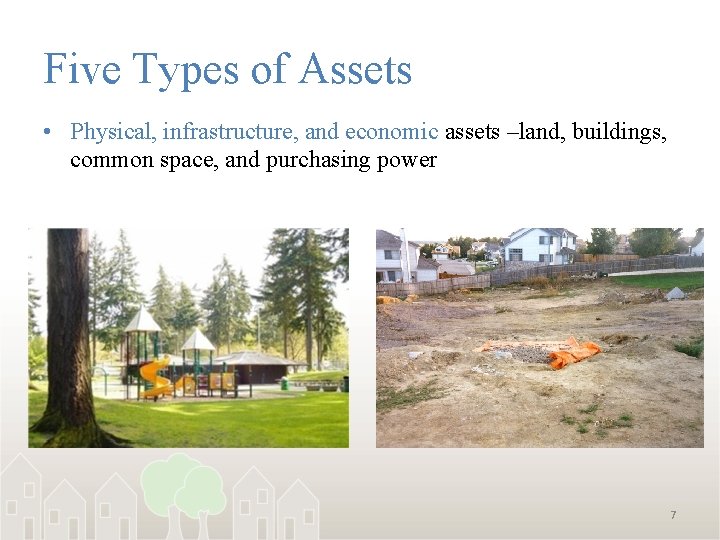
Five Types of Assets • Physical, infrastructure, and economic assets –land, buildings, common space, and purchasing power 7
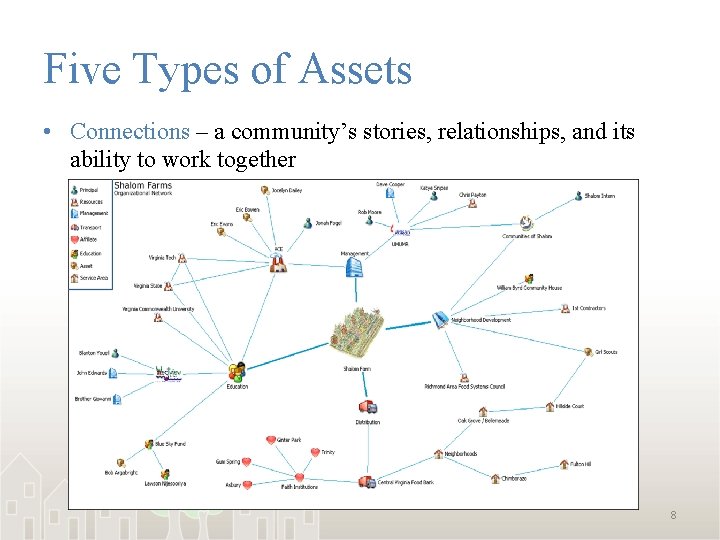
Five Types of Assets • Connections – a community’s stories, relationships, and its ability to work together 8
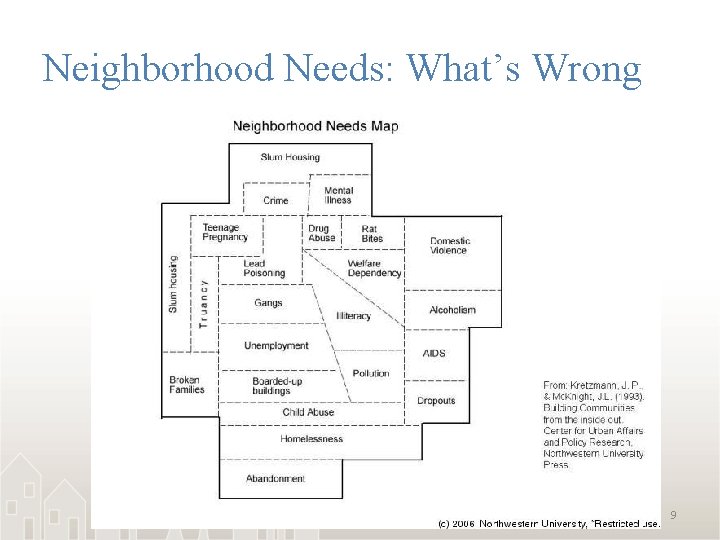
Neighborhood Needs: What’s Wrong 9
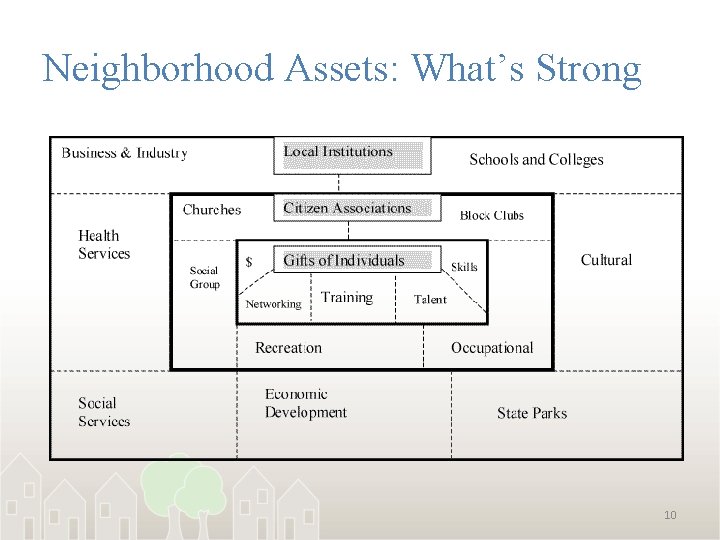
Neighborhood Assets: What’s Strong 10
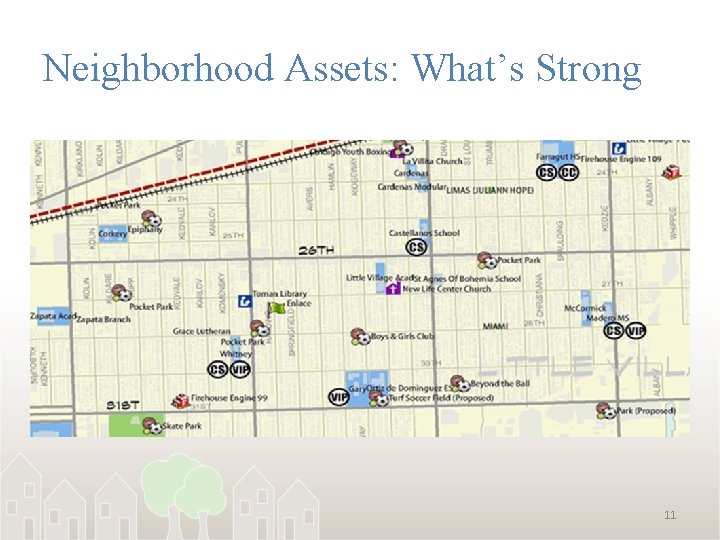
Neighborhood Assets: What’s Strong 11

ABCD Examples 12
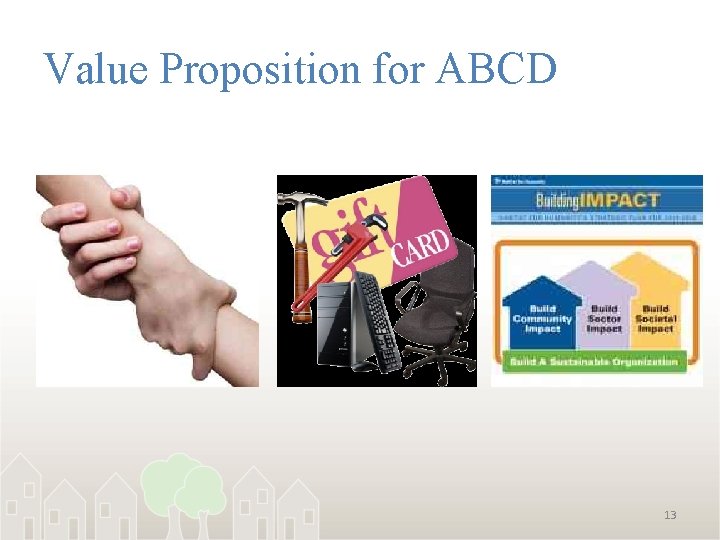
Value Proposition for ABCD 13
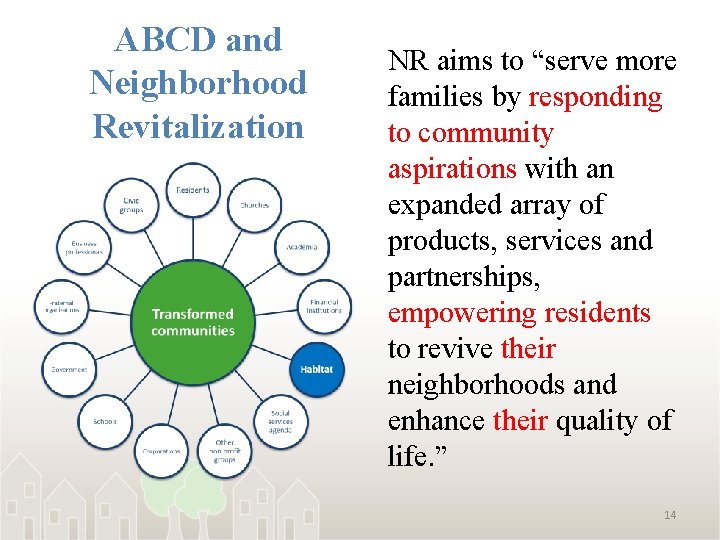
ABCD and Neighborhood Revitalization NR aims to “serve more families by responding to community aspirations with an expanded array of products, services and partnerships, empowering residents to revive their neighborhoods and enhance their quality of life. ” 14
NR Principles: We Will… 1. Work in a distinct, definable community. 2. Assume an asset-based approach to working with the community. 3. Adopt a humble, listening approach to the community. 4. Identify, respect and honor those who speak on behalf of the community. 15
NR Principles: We Will… 5. Recognize that housing is one component of a community development strategy. 6. Offer a range of housing products and services to contribute to the community’s aspirations. 7. Make a multiyear commitment to the community in which we agreed to work. 8. Commit to a process that holds the participants accountable to evaluating our work. 16
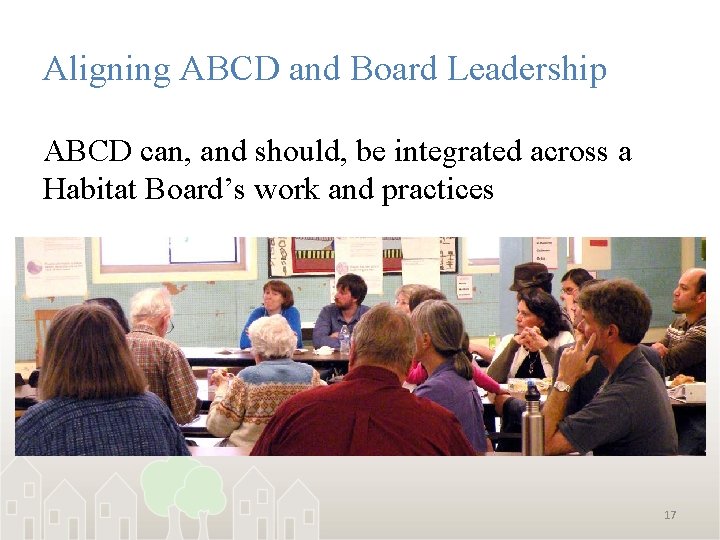
Aligning ABCD and Board Leadership ABCD can, and should, be integrated across a Habitat Board’s work and practices 17
ABCD & Board Composition/Meeting Structure • Are focus neighborhood residents serving on our Board of Directors and/or on Committees? • Where do Board meetings take place? Is there an opportunity to hold a Board meeting at a meeting space in our focus neighborhood? • Do we hear directly from focus neighborhood residents on a regular basis? 18
ABCD and a Board’s Fiduciary Role • How, and via what channels, is our commitment to ABCD incorporated in our budget? • Do residents have a voice in prioritizing where our affiliate’s time, money and energy is spent in this neighborhood? • How can we acknowledge and celebrate the value of the gifts and resources that neighborhood residents contribute to revitalizing their community? 19
ABCD and a Board’s Strategic Role • What is our long-range vision for our work in our focus neighborhood? Who are we working with to make this vision a reality? • How are we incorporating community aspirations and neighborhood resources into our long-range plans? • To what degree are residents leading revitalization efforts in our target neighborhood? 20
ABCD at the 10, 000 Foot Level • What is our role in contributing to our focus neighborhood’s health? What are others’ roles? • What words do we use to describe our work? Are they needs-based, or assetbased? • How can we become the kind of organization that others identify as an asset? 21
Summary and Closing Thoughts • Success in ABCD: – Is a relationship-driven process; it takes time – Needs to be a habit, not a “one-off” activity – Requires introspection, intentional discussion, and a commitment to revisit organizational norms – Focuses on listening and asking, not telling 22
Resources • The Asset-Based Community Development Institute: www. abcdinstitute. org • Building Communities from the Inside Out: A Path Toward Finding and Mobilizing a Community's Assets, Kretzmann and Mc. Knight, 1993 • Lecture from Cormac Russell, ABCD faculty: https: //www. youtube. com/watch? v=ej. H 9 t. Psg. N_E • My. Habitat. org: – HFH Affiliate Rationale for ABCD Approach – ABCD Principles and Practices webinar 23
Thank You! 24
- Slides: 24