
Asset Integrity Process Safety Level 2 AIPS Audit










- Slides: 85
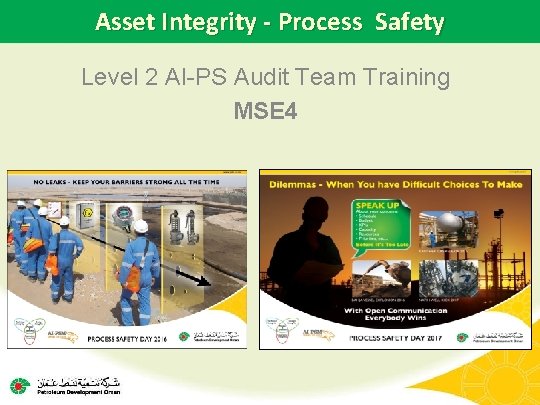
Asset Integrity - Process Safety Level 2 AI-PS Audit Team Training MSE 4
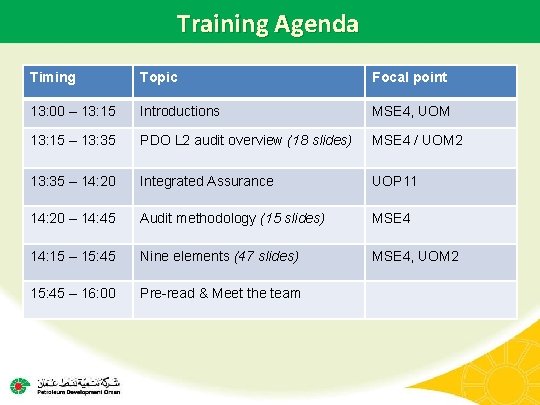
Training Agenda Timing Topic Focal point 13: 00 – 13: 15 Introductions MSE 4, UOM 13: 15 – 13: 35 PDO L 2 audit overview (18 slides) MSE 4 / UOM 2 13: 35 – 14: 20 Integrated Assurance UOP 11 14: 20 – 14: 45 Audit methodology (15 slides) MSE 4 14: 15 – 15: 45 Nine elements (47 slides) MSE 4, UOM 2 15: 45 – 16: 00 Pre-read & Meet the team
Introduction • HSE – muster • Facilities • Breaks (maybe) • Meeting rules • UOD/ UOP setting the scene LIVELINK site
Briefing Purpose The Level 2 AI-PS Audit Team Training is designed to ensure that there is a consistent understanding and execution of the Level 2 AI-PS audits across the five cross-directorate audit teams.
Training Objectives The objectives for the Level 2 AI-PS Audit Team Training are to: • Provide a common understanding of the Level 2 AI-PS crossdirectorate audit methodology. • Provide understanding of the recently introduced “L 3 Integrated Assurance” and relation to the AIPSM L 2 /L 3 assurance process. • Provide a common understanding of the Level 2 protocols for the “nine AI-PS Elements” in the scope of the cross-directorate audits. • Explain the relationship between the Level 2 self-assessment and the Level 2 AI-PS cross-directorate audits. • Where to find the pre-read and Integrated Assurance evidence
L 2 Audit Sponsors and Auditees Update schedules Overall Peer review –MSE 4
Audit Team participants Update schedule
Key Dates - 2016 Level 2 Audits Event Day Date Conduct self-assessment against the level 2 AI-PS protocols. Finalise schedule of audit with Audit Lead. Issue of pre-read. Training : Audit team pre-briefing on To. R, audit methodology and reporting. Opening meeting with Lead Auditor and Facility Audit Coordinator Muscat office interviews TBA Opening meeting in interior. Lead Auditor and Facility Audit Coordinator presentations. Interior interviews. Field work. Interior feedback. Flights back from interior Muscat office interviews / clarifications. Draft audit findings. Independent Peer review. Close-out meeting with Auditee Sponsor/Director Close Out presentation Draft report issued to auditee Responses from auditee/ Actions assigned in PIM Final summary report issued.
Report Peer Review • Plan time with peer reviewer to go over the findings and recommendations (day 5 morning). Rooms booked/confirmed : L 2 audit. • Update schedule • Prepare presentation pack for ‘no surprise’ meeting (day 5 afternoon) • Presentation to TDG (sponsors)
Auditee Close out meeting • Prepare to meet with the Auditee to go over the findings and recommendations (day 5 – afternoon) • Update schedule • Finalize Audit Close out Presentation pack • Presentation to TDG (sponsors) 10
Sponsor Feedback Sunday 29 th October 2017 The findings of the L 2 audits will be presented by the Lead auditors to TDG. List assets
PDO Asset Integrity Process Safety Management (PDO AI-PSM) Assurance & Auditing Process
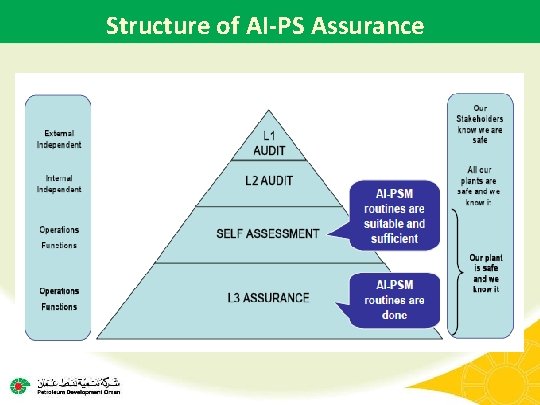
AI-PSM in PDO Assuring the safety of our people, our assets, the environment and the company’s reputation is a core value of PDO and providing assurance that we are managing our major process safety risks is a critical aspect of our corporate governance. Asset Integrity Process Safety (AI-PS) describes the way we manage our assets so that the process risk is As Low As Reasonably Practicable (ALARP).
Background to AI-PS Asset Integrity Process Safety (AI-PS) is the means of ensuring that the people, systems, processes and resources, which deliver integrity, are in place, in use and fit for purpose throughout the whole lifecycle of the asset. Our assets are safe and we know it. Asset Integrity Process Safety Management is a complex area of expertise covering a wide range of components, all of which are essential to ensuring systems, processes and equipment perform as required.
Structure of AI-PS Assurance
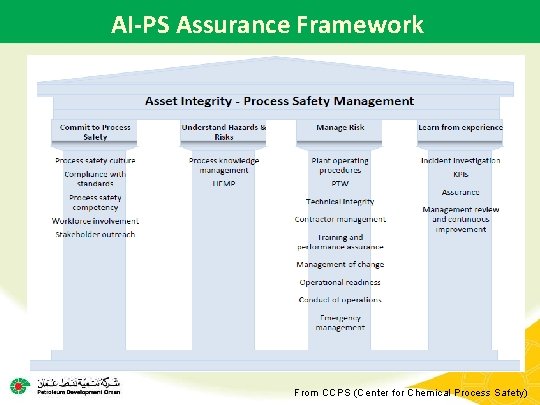
AI-PS Assurance Framework From CCPS (Center for Chemical Process Safety)
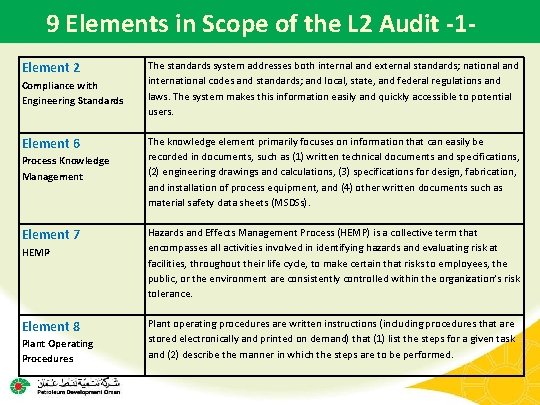
9 Elements in Scope of the L 2 Audit -1 Element 2 Compliance with Engineering Standards Element 6 Process Knowledge Management Element 7 HEMP Element 8 Plant Operating Procedures The standards system addresses both internal and external standards; national and international codes and standards; and local, state, and federal regulations and laws. The system makes this information easily and quickly accessible to potential users. The knowledge element primarily focuses on information that can easily be recorded in documents, such as (1) written technical documents and specifications, (2) engineering drawings and calculations, (3) specifications for design, fabrication, and installation of process equipment, and (4) other written documents such as material safety data sheets (MSDSs). Hazards and Effects Management Process (HEMP) is a collective term that encompasses all activities involved in identifying hazards and evaluating risk at facilities, throughout their life cycle, to make certain that risks to employees, the public, or the environment are consistently controlled within the organization’s risk tolerance. Plant operating procedures are written instructions (including procedures that are stored electronically and printed on demand) that (1) list the steps for a given task and (2) describe the manner in which the steps are to be performed.
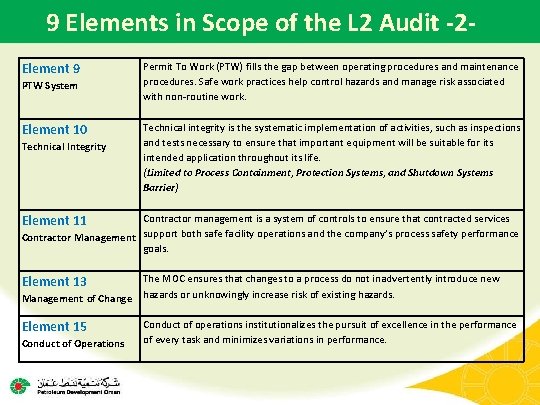
9 Elements in Scope of the L 2 Audit -2 Element 9 PTW System Element 10 Technical Integrity Permit To Work (PTW) fills the gap between operating procedures and maintenance procedures. Safe work practices help control hazards and manage risk associated with non-routine work. Technical integrity is the systematic implementation of activities, such as inspections and tests necessary to ensure that important equipment will be suitable for its intended application throughout its life. (Limited to Process Containment, Protection Systems, and Shutdown Systems Barrier) Contractor management is a system of controls to ensure that contracted services Contractor Management support both safe facility operations and the company’s process safety performance goals. Element 11 The MOC ensures that changes to a process do not inadvertently introduce new Management of Change hazards or unknowingly increase risk of existing hazards. Element 13 Element 15 Conduct of Operations Conduct of operations institutionalizes the pursuit of excellence in the performance of every task and minimizes variations in performance.
Integrated Assurance - UOP 1 Integrated Assurance
Auditing Techniques • • • Methodology Conducting interviews Audit findings Use Audit Working Papers Recommendations Element Assessment
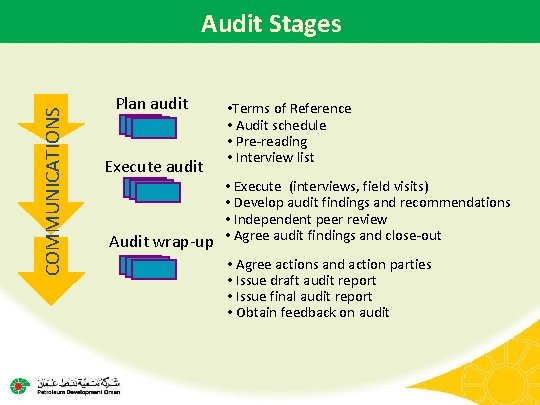
COMMUNICATIONS Audit Stages Plan audit Execute audit • Terms of Reference • Audit schedule • Pre-reading • Interview list • Execute (interviews, field visits) • Develop audit findings and recommendations • Independent peer review Audit wrap-up • Agree audit findings and close-out • Agree actions and action parties • Issue draft audit report • Issue final audit report • Obtain feedback on audit
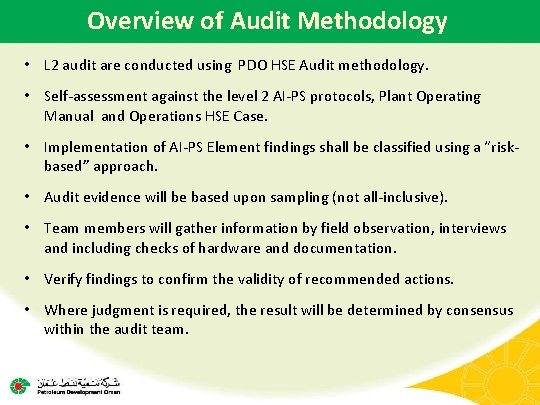
Overview of Audit Methodology • L 2 audit are conducted using PDO HSE Audit methodology. • Self-assessment against the level 2 AI-PS protocols, Plant Operating Manual and Operations HSE Case. • Implementation of AI-PS Element findings shall be classified using a “riskbased” approach. • Audit evidence will be based upon sampling (not all-inclusive). • Team members will gather information by field observation, interviews and including checks of hardware and documentation. • Verify findings to confirm the validity of recommended actions. • Where judgment is required, the result will be determined by consensus within the audit team.
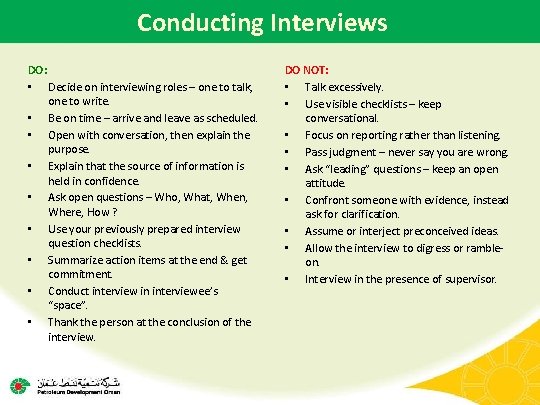
Conducting Interviews DO: • Decide on interviewing roles – one to talk, one to write. • Be on time – arrive and leave as scheduled. • Open with conversation, then explain the purpose. • Explain that the source of information is held in confidence. • Ask open questions – Who, What, When, Where, How ? • Use your previously prepared interview question checklists. • Summarize action items at the end & get commitment. • Conduct interview in interviewee’s “space”. • Thank the person at the conclusion of the interview. DO NOT: • Talk excessively. • Use visible checklists – keep conversational. • Focus on reporting rather than listening. • Pass judgment – never say you are wrong. • Ask “leading” questions – keep an open attitude. • Confront someone with evidence, instead ask for clarification. • Assume or interject preconceived ideas. • Allow the interview to digress or rambleon. • Interview in the presence of supervisor.
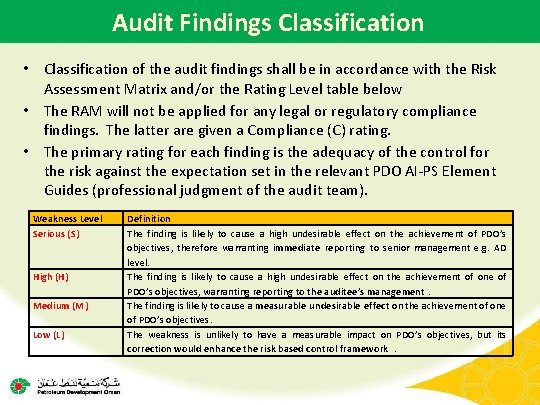
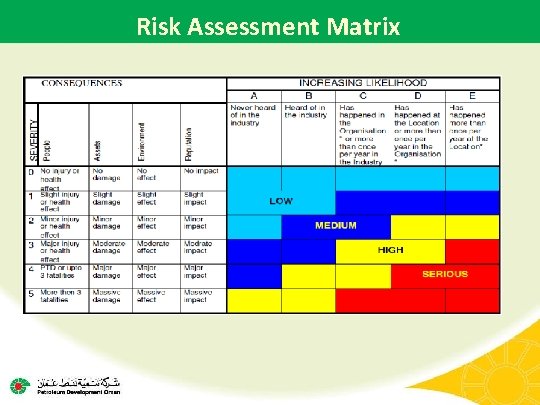
Audit Findings Classification • Classification of the audit findings shall be in accordance with the Risk Assessment Matrix and/or the Rating Level table below • The RAM will not be applied for any legal or regulatory compliance findings. The latter are given a Compliance (C) rating. • The primary rating for each finding is the adequacy of the control for the risk against the expectation set in the relevant PDO AI-PS Element Guides (professional judgment of the audit team). Weakness Level Serious (S) High (H) Medium (M) Low (L) Definition The finding is likely to cause a high undesirable effect on the achievement of PDO’s objectives, therefore warranting immediate reporting to senior management e. g. AD level. The finding is likely to cause a high undesirable effect on the achievement of one of PDO’s objectives, warranting reporting to the auditee’s management. The finding is likely to cause a measurable undesirable effect on the achievement of one of PDO’s objectives. The weakness is unlikely to have a measurable impact on PDO’s objectives, but its correction would enhance the risk based control framework.
Risk Assessment Matrix
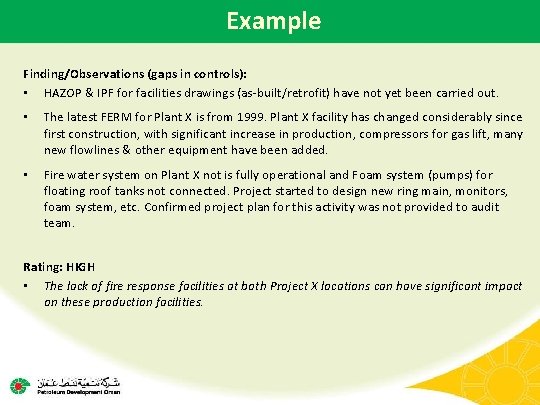
Example Finding/Observations (gaps in controls): • HAZOP & IPF for facilities drawings (as-built/retrofit) have not yet been carried out. • The latest FERM for Plant X is from 1999. Plant X facility has changed considerably since first construction, with significant increase in production, compressors for gas lift, many new flowlines & other equipment have been added. • Fire water system on Plant X not is fully operational and Foam system (pumps) for floating roof tanks not connected. Project started to design new ring main, monitors, foam system, etc. Confirmed project plan for this activity was not provided to audit team. Rating: HIGH • The lack of fire response facilities at both Project X locations can have significant impact on these production facilities.
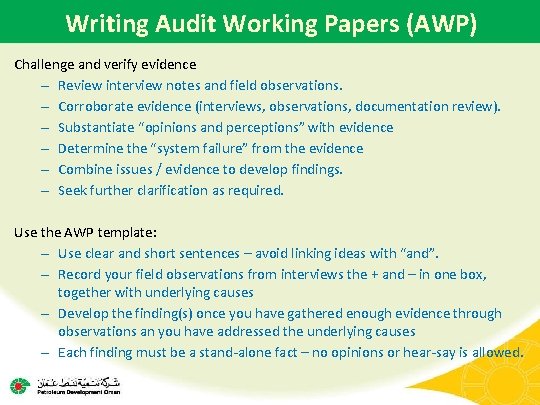
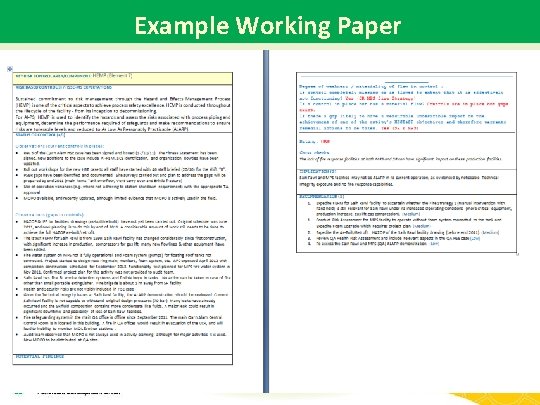
Writing Audit Working Papers (AWP) Challenge and verify evidence – Review interview notes and field observations. – Corroborate evidence (interviews, observations, documentation review). – Substantiate “opinions and perceptions” with evidence – Determine the “system failure” from the evidence – Combine issues / evidence to develop findings. – Seek further clarification as required. Use the AWP template: – Use clear and short sentences – avoid linking ideas with “and”. – Record your field observations from interviews the + and – in one box, together with underlying causes – Develop the finding(s) once you have gathered enough evidence through observations an you have addressed the underlying causes – Each finding must be a stand-alone fact – no opinions or hear-say is allowed.
Example Working Paper
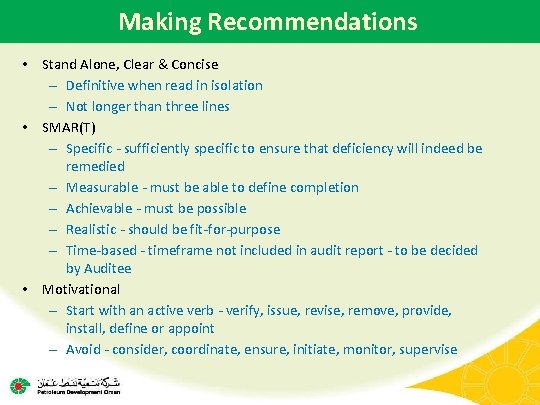
Making Recommendations • Stand Alone, Clear & Concise – Definitive when read in isolation – Not longer than three lines • SMAR(T) – Specific - sufficiently specific to ensure that deficiency will indeed be remedied – Measurable - must be able to define completion – Achievable - must be possible – Realistic - should be fit-for-purpose – Time-based - timeframe not included in audit report - to be decided by Auditee • Motivational – Start with an active verb - verify, issue, revise, remove, provide, install, define or appoint – Avoid - consider, coordinate, ensure, initiate, monitor, supervise
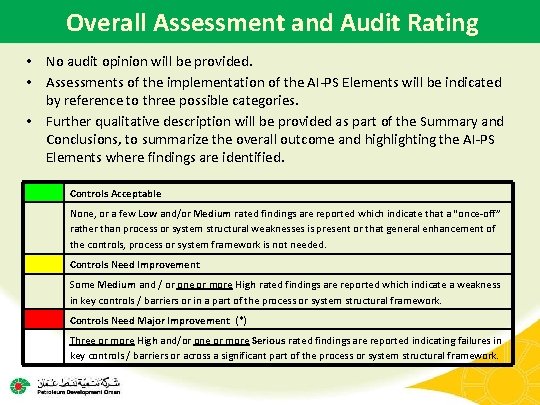
Overall Assessment and Audit Rating • No audit opinion will be provided. • Assessments of the implementation of the AI-PS Elements will be indicated by reference to three possible categories. • Further qualitative description will be provided as part of the Summary and Conclusions, to summarize the overall outcome and highlighting the AI-PS Elements where findings are identified. Controls Acceptable None, or a few Low and/or Medium rated findings are reported which indicate that a “once-off” rather than process or system structural weaknesses is present or that general enhancement of the controls, process or system framework is not needed. Controls Need Improvement Some Medium and / or one or more High rated findings are reported which indicate a weakness in key controls / barriers or in a part of the process or system structural framework. Controls Need Major Improvement (*) Three or more High and/or one or more Serious rated findings are reported indicating failures in key controls / barriers or across a significant part of the process or system structural framework.
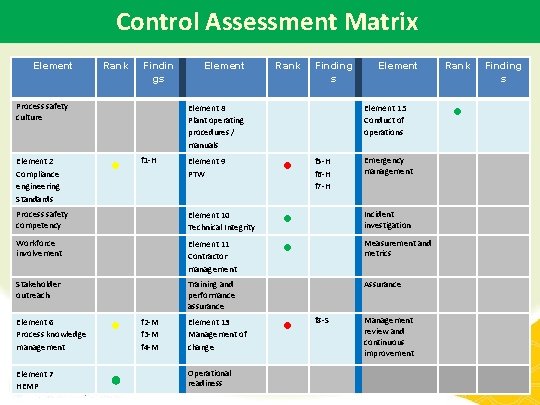
Control Assessment Matrix Element Rank Findin gs Process safety culture Element Rank Finding s Element 8 Plant operating procedures / manuals Element 15 Conduct of operations Element 9 PTW ● Process safety competency Element 10 Technical Integrity ● Incident investigation Workforce involvement Element 11 Contractor management ● Measurement and metrics Stakeholder outreach Training and performance assurance Element 2 Compliance engineering Standards ● Element 6 Process knowledge management ● Element 7 HEMP ● f 1 -H f 2 -M f 3 -M f 4 -M Element 13 Management of change Operational readiness f 5 -H f 6 -H f 7 -H Rank Finding s ● Emergency management Assurance ● f 8 -S Management review and continuous improvement 31
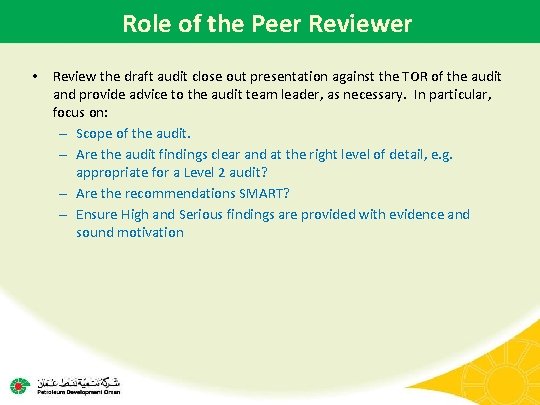
Role of the Peer Reviewer • Review the draft audit close out presentation against the TOR of the audit and provide advice to the audit team leader, as necessary. In particular, focus on: – Scope of the audit. – Are the audit findings clear and at the right level of detail, e. g. appropriate for a Level 2 audit? – Are the recommendations SMART? – Ensure High and Serious findings are provided with evidence and sound motivation
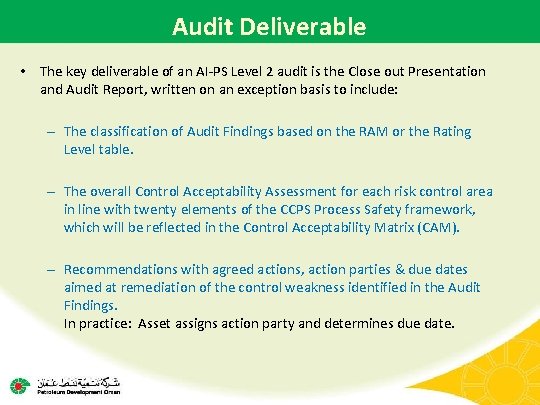
Audit Deliverable • The key deliverable of an AI-PS Level 2 audit is the Close out Presentation and Audit Report, written on an exception basis to include: – The classification of Audit Findings based on the RAM or the Rating Level table. – The overall Control Acceptability Assessment for each risk control area in line with twenty elements of the CCPS Process Safety framework, which will be reflected in the Control Acceptability Matrix (CAM). – Recommendations with agreed actions, action parties & due dates aimed at remediation of the control weakness identified in the Audit Findings. In practice: Asset assigns action party and determines due date.
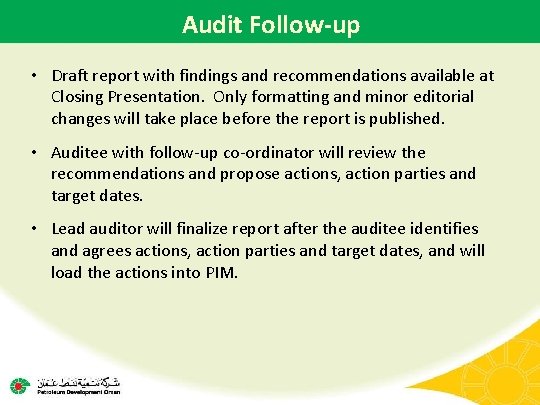
Audit Follow-up • Draft report with findings and recommendations available at Closing Presentation. Only formatting and minor editorial changes will take place before the report is published. • Auditee with follow-up co-ordinator will review the recommendations and propose actions, action parties and target dates. • Lead auditor will finalize report after the auditee identifies and agrees actions, action parties and target dates, and will load the actions into PIM.
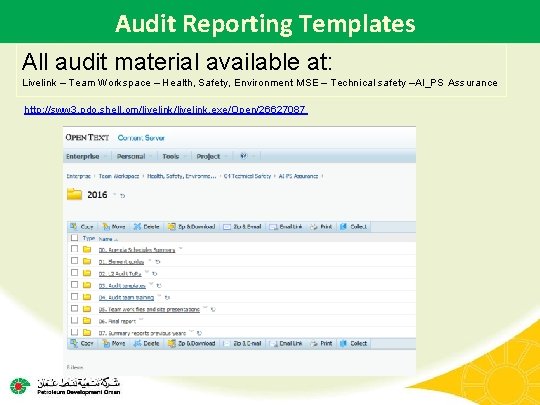
Audit Reporting Templates All audit material available at: Livelink – Team Workspace – Health, Safety, Environment MSE – Technical safety –AI_PS Assurance http: //sww 3. pdo. shell. om/livelink. exe/Open/26627087
Nine Elements Detailed Discussion
Nine Elements Overview Out of the 20 CCPS elements, 9 elements have been selected to be used for the Level 2 audits. Group A (engineering & contractors) – – (E 2) Compliance to engineering standards (E 6) Process safety knowledge (E 7) HEMP (E 11) Contractor management Group B (operations) – – – (E 8) Plant operating procedures (E 9) PTW (E 10) Technical integrity (E 13) MOC (E 15) Conduct of operations
Element 2 Compliance with engineering standards Focal point : (UOI)
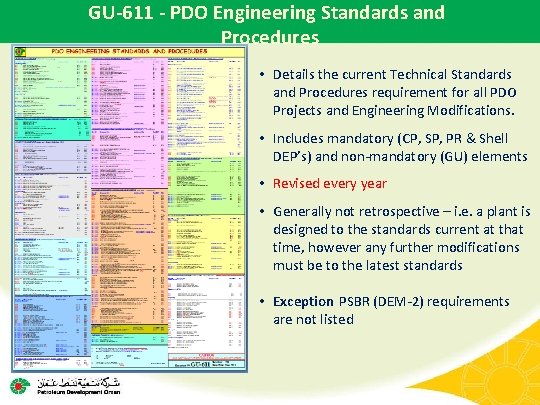
GU-611 - PDO Engineering Standards and Procedures • Details the current Technical Standards and Procedures requirement for all PDO Projects and Engineering Modifications. • Includes mandatory (CP, SP, PR & Shell DEP’s) and non-mandatory (GU) elements • Revised every year • Generally not retrospective – i. e. a plant is designed to the standards current at that time, however any further modifications must be to the latest standards • Exception PSBR (DEM-2) requirements are not listed
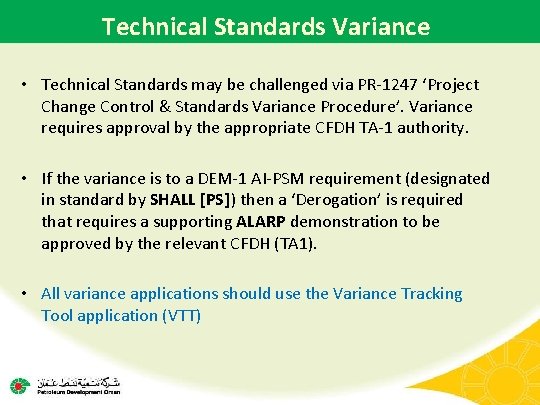
Technical Standards Variance • Technical Standards may be challenged via PR-1247 ‘Project Change Control & Standards Variance Procedure’. Variance requires approval by the appropriate CFDH TA-1 authority. • If the variance is to a DEM-1 AI-PSM requirement (designated in standard by SHALL [PS]) then a ‘Derogation’ is required that requires a supporting ALARP demonstration to be approved by the relevant CFDH (TA 1). • All variance applications should use the Variance Tracking Tool application (VTT)
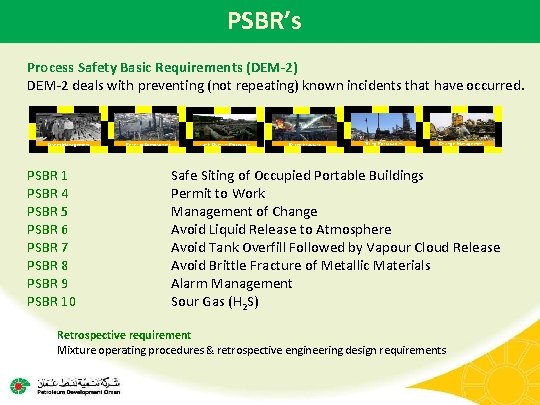
PSBR’s Process Safety Basic Requirements (DEM-2) DEM-2 deals with preventing (not repeating) known incidents that have occurred. Alarm Management PSBR 1 PSBR 4 PSBR 5 PSBR 6 PSBR 7 PSBR 8 PSBR 9 PSBR 10 Relief to Atmosphere Tank Overfill Protection Brittle Fracture Siting Portacabins Change Management Safe Siting of Occupied Portable Buildings Permit to Work Management of Change Avoid Liquid Release to Atmosphere Avoid Tank Overfill Followed by Vapour Cloud Release Avoid Brittle Fracture of Metallic Materials Alarm Management Sour Gas (H 2 S) Retrospective requirement Mixture operating procedures & retrospective engineering design requirements
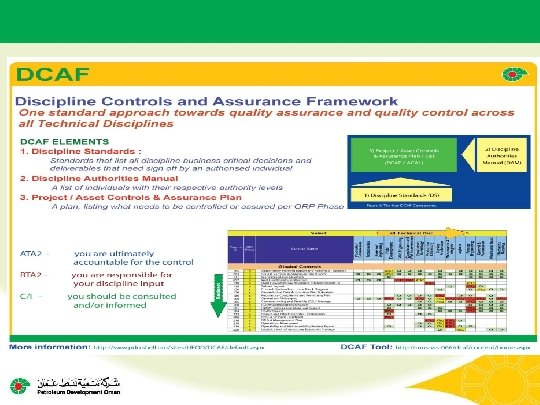
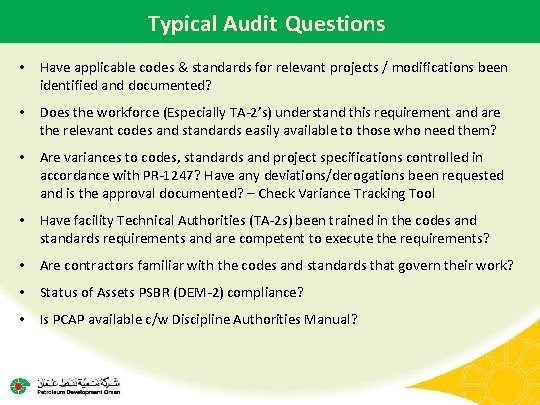
Typical Audit Questions • Have applicable codes & standards for relevant projects / modifications been identified and documented? • Does the workforce (Especially TA-2’s) understand this requirement and are the relevant codes and standards easily available to those who need them? • Are variances to codes, standards and project specifications controlled in accordance with PR-1247? Have any deviations/derogations been requested and is the approval documented? – Check Variance Tracking Tool • Have facility Technical Authorities (TA-2 s) been trained in the codes and standards requirements and are competent to execute the requirements? • Are contractors familiar with the codes and standards that govern their work? • Status of Assets PSBR (DEM-2) compliance? • Is PCAP available c/w Discipline Authorities Manual?
Element 6 Process Knowledge Management Focal point : (UOI)
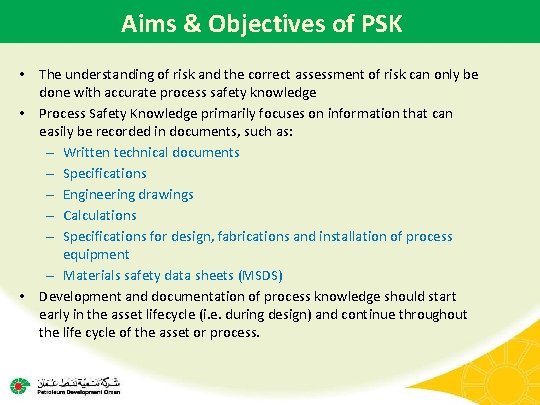
Aims & Objectives of PSK • The understanding of risk and the correct assessment of risk can only be done with accurate process safety knowledge • Process Safety Knowledge primarily focuses on information that can easily be recorded in documents, such as: – Written technical documents – Specifications – Engineering drawings – Calculations – Specifications for design, fabrications and installation of process equipment – Materials safety data sheets (MSDS) • Development and documentation of process knowledge should start early in the asset lifecycle (i. e. during design) and continue throughout the life cycle of the asset or process.
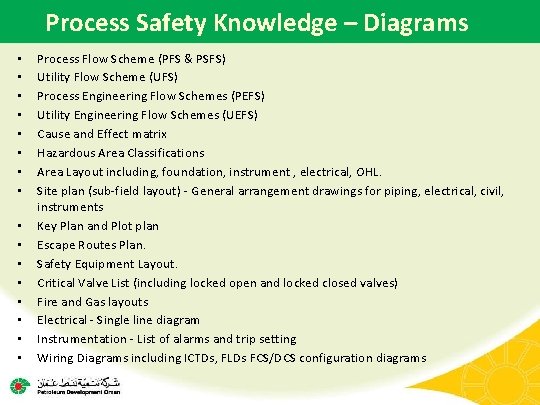
Process Safety Knowledge – Diagrams • • • • Process Flow Scheme (PFS & PSFS) Utility Flow Scheme (UFS) Process Engineering Flow Schemes (PEFS) Utility Engineering Flow Schemes (UEFS) Cause and Effect matrix Hazardous Area Classifications Area Layout including, foundation, instrument , electrical, OHL. Site plan (sub-field layout) - General arrangement drawings for piping, electrical, civil, instruments Key Plan and Plot plan Escape Routes Plan. Safety Equipment Layout. Critical Valve List (including locked open and locked closed valves) Fire and Gas layouts Electrical - Single line diagram Instrumentation - List of alarms and trip setting Wiring Diagrams including ICTDs, FLDs FCS/DCS configuration diagrams
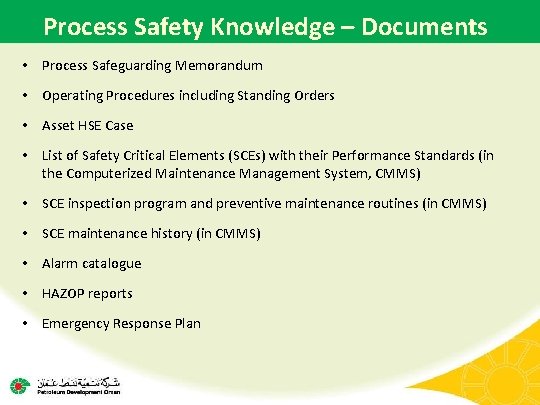
Process Safety Knowledge – Documents • Process Safeguarding Memorandum • Operating Procedures including Standing Orders • Asset HSE Case • List of Safety Critical Elements (SCEs) with their Performance Standards (in the Computerized Maintenance Management System, CMMS) • SCE inspection program and preventive maintenance routines (in CMMS) • SCE maintenance history (in CMMS) • Alarm catalogue • HAZOP reports • Emergency Response Plan
Element 7 HEMP Focal point : MSE 4
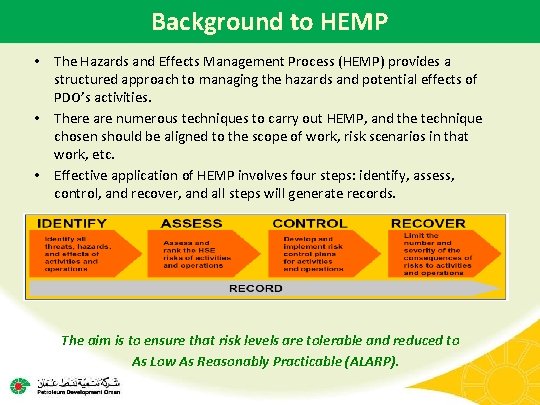
Background to HEMP • The Hazards and Effects Management Process (HEMP) provides a structured approach to managing the hazards and potential effects of PDO’s activities. • There are numerous techniques to carry out HEMP, and the technique chosen should be aligned to the scope of work, risk scenarios in that work, etc. • Effective application of HEMP involves four steps: identify, assess, control, and recover, and all steps will generate records. The aim is to ensure that risk levels are tolerable and reduced to As Low As Reasonably Practicable (ALARP).
Scope of HEMP • The scope of HEMP applies to all PDO assets during all phases of the facility lifecycle (design, commissioning, start up, shutdown, operations and decommissioning) and through day-to-day operations to ensure that hazards are identified and risks are managed to a level that is demonstrably tolerable and ALARP. • Specifically, the following types of HEMP are within scope: – Design Integrity Reviews – Risk assessments supporting Process Safety Basic Requirements (DEM-2) – Operations HSE Case – HEMP in projects and FCPs – Operational risk assessments (Mo. C, FSR, etc)
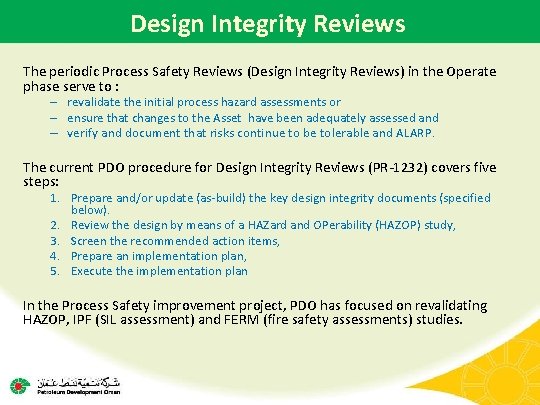
Design Integrity Reviews The periodic Process Safety Reviews (Design Integrity Reviews) in the Operate phase serve to : – revalidate the initial process hazard assessments or – ensure that changes to the Asset have been adequately assessed and – verify and document that risks continue to be tolerable and ALARP. The current PDO procedure for Design Integrity Reviews (PR-1232) covers five steps: 1. Prepare and/or update (as-build) the key design integrity documents (specified below). 2. Review the design by means of a HAZard and OPerability (HAZOP) study, 3. Screen the recommended action items, 4. Prepare an implementation plan, 5. Execute the implementation plan In the Process Safety improvement project, PDO has focused on revalidating HAZOP, IPF (SIL assessment) and FERM (fire safety assessments) studies.
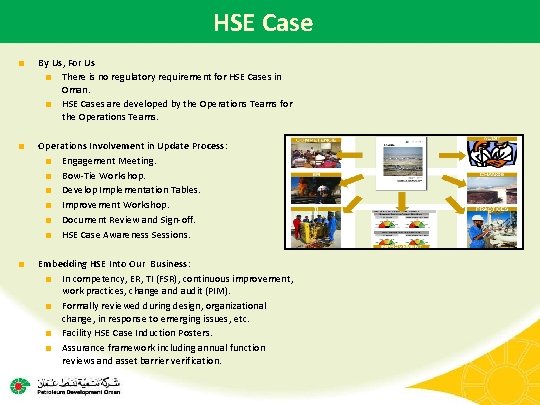
HSE Case ■ By Us, For Us ■ There is no regulatory requirement for HSE Cases in Oman. ■ HSE Cases are developed by the Operations Teams for the Operations Teams. ■ Operations Involvement in Update Process: ■ Engagement Meeting. ■ Bow-Tie Workshop. ■ Develop Implementation Tables. ■ Improvement Workshop. ■ Document Review and Sign-off. ■ HSE Case Awareness Sessions. ■ Embedding HSE Into Our Business: ■ In competency, ER, TI (FSR), continuous improvement, work practices, change and audit (PIM). ■ Formally reviewed during design, organizational change, in response to emerging issues, etc. ■ Facility HSE Case Induction Posters. ■ Assurance framework including annual function reviews and asset barrier verification.
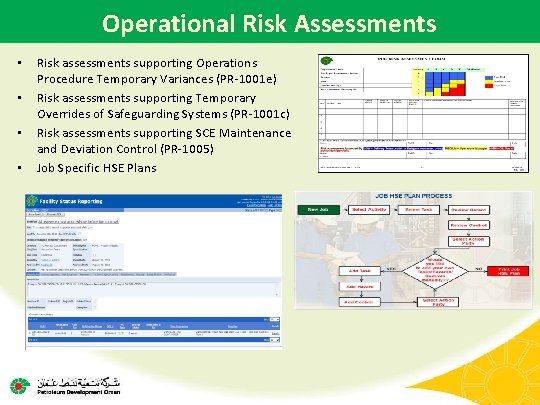
Operational Risk Assessments • • Risk assessments supporting Operations Procedure Temporary Variances (PR-1001 e) Risk assessments supporting Temporary Overrides of Safeguarding Systems (PR-1001 c) Risk assessments supporting SCE Maintenance and Deviation Control (PR-1005) Job Specific HSE Plans
Element 8 Plant Operating Procedures Focal point : (UOP 6)
Plant Operating Manuals • Plant Operating Manual is produced as part of Project and is a Key Deliverable. . • Accepted by the Asset (Operations) at handover • Is a “Mandatory / Controlled” document • Is maintained “Current” throughout the life of the Asset • Is available in “Soft” and “Hard” format • Has an Owner and a Custodian responsible for the upkeep • Accessible to all PDO and Contract personnel • Is auditable
Plant Operating Manuals • A Plant Operating Manual will cover: – Introduction and Philosophy – Safety – Process Description – Start-Up – Normal Operations, Alarms and Trips – Plant Control and Logging – Shutdown – Utilities – Consumables – First Line Maintenance
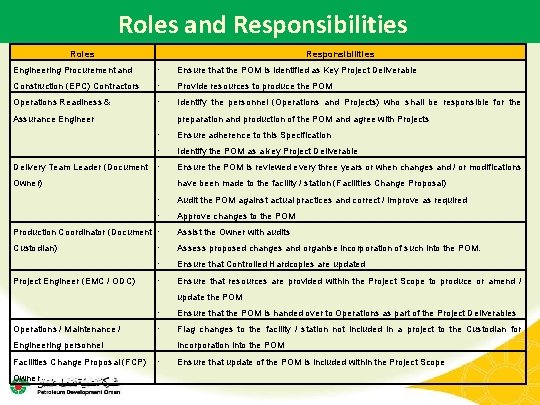
Roles and Responsibilities Roles Responsibilities Engineering Procurement and ∙ Ensure that the POM is identified as Key Project Deliverable Construction (EPC) Contractors ∙ Provide resources to produce the POM Operations Readiness & ∙ Identify the personnel (Operations and Projects) who shall be responsible for the Assurance Engineer Delivery Team Leader (Document preparation and production of the POM and agree with Projects ∙ Ensure adherence to this Specification ∙ Identify the POM as a key Project Deliverable ∙ Ensure the POM is reviewed every three years or when changes and / or modifications Owner) have been made to the facility / station (Facilities Change Proposal) ∙ Audit the POM against actual practices and correct / improve as required ∙ Approve changes to the POM Production Coordinator (Document ∙ Custodian) Project Engineer (EMC / ODC) Assist the Owner with audits ∙ Assess proposed changes and organise incorporation of such into the POM. ∙ Ensure that Controlled Hardcopies are updated ∙ Ensure that resources are provided within the Project Scope to produce or amend / update the POM Operations / Maintenance / ∙ Ensure that the POM is handed over to Operations as part of the Project Deliverables ∙ Flag changes to the facility / station not included in a project to the Custodian for Engineering personnel Facilities Change Proposal (FCP) Owner incorporation into the POM ∙ Ensure that update of the POM is included within the Project Scope
Element 9 PTW system Focal point : UOP 6
Background to PTW • The PDO Permit to Work (PTW) system does not exists simply to provide permission to carry out a hazardous job. It is an essential part of a system, which determines how that job can be carried out safely. • The Permit is regarded as a statement that all hazards and risks have been eliminated from, or controlled in the work area. – The issue of a Permit does not, by itself, make a job safe. That can only be achieved by those preparing for the work and those carrying it out. – The Permit To Work System forms a key part of the company HSE Management System, and demonstrates compliance with the legal framework of Oman Ministerial Decision 286/(2008). • IT IS A LEGAL DOCUMENT. • PDO PTW system considers the nature of the activity, and the area in which it is to be carried out to determine the level of risk and hence the hierarchy of controls necessary to control the work safely.
PDO PTW • The scope of PTW applies to all PDO assets during normal daily operations, to ensure that work activities is controlled and hazards are and risks are managed to a level that is demonstrably tolerable and ALARP. • Any work activity that is carried out in the PDO concession area is subject to a PTW system, whether PDO or an approved contractor system. Some low risk activities may not require a permit; these are authorized as a No Permit Job • Specifically the following activities are within scope: – Daily Operations including Maintenance – Engineering and Construction – Well Activities where custodianship of the Asset is still held by Operations The above activities in the following areas are within scope: • Process Areas: within a fenced area or well pad, etc • Hydrocarbon Areas: around flow lines, pipelines, etc. • Critical Sour Area Emergency Planning Zone • Non-Hydrocarbon Areas: Camp, Workshop facilities, etc
Permit Signatories All PTW Signatories must be trained, assessed and licensed for the role/area in which they operate. • PTW applicant (usually Company or Contractor Supervisor/Engineer) ➢ Responsible for visiting the worksite, identifying any hazards, preparing the Permit, and briefing the PTW Holder (Person actually supervising the work party) ➢ Responsible Supervisor (Usually Production or Electrical Supervisor for substations) ➢ Responsible for agreeing work scope, authorizing the Permit and associated Supplementary Certificates, and briefing Production Operators. ➢ Area Authority (Usually Production Operator or Electrical Technician) ➢ Responsible for ensuring the work site, is safe to proceed, ensuring all isolations are in place, and formally issuing the Permit to the PTW Holder every 12 hours. In addition he needs to carry out worksite and isolation audits on a regular basis. ➢ Responsible for ensuring any vehicles and diesel engines entering a Process facility comply with the Permit requirements in terms of continuous gas monitoring. ➢ PTW Holder (Usually a Contractor Foreman or Company Lead Technician) ➢ Responsible for carrying out a TRIC discussion at the worksite, ➢ Responsible for the safe execution of the task, and remaining at the worksite Work must stop if he leaves the worksite.
Element 10 Technical Integrity Qais Bahrani (UOM 2)
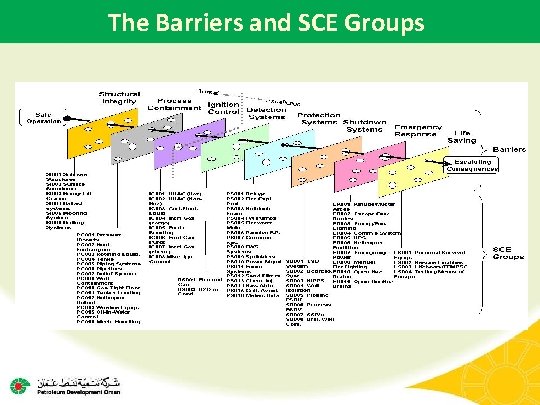
Technical Integrity Definitions Safety Critical Elements (SCE) SCE are defined as those items of equipment or structures: 1. Which could lead to a Major Accident if they fail, or 2. Prevent, or limit the consequences of a Major Accident Major accident hazards are those events which have the potential to lead to multiple fatalities and/or major environmental damage: 1. Major release of hydrocarbons that could lead to fire or explosion. 2. A major release of hazardous or toxic materials e. g. H 2 S. 3. Major damage to the structural integrity of an installation. 4. Other incidents including health issues that may lead to multiple fatalities and/or major environmental damage.
The Barriers and SCE Groups
Asset Register Verification ▪ To identify all Safety Critical Element (SCE) and assign company approved performance standards to ensure that all Hardware Barriers to control Major Accident Hazards are in place. ▪ The process for identifying and managing SCE is described in the Safety Critical Management Manual EP 2009 -9009 (OE blade 12) ▪ The asset register verification scope to include, where appropriate, the development of Bill Of Material (BOM) for all SCE identified in the asset register. ▪ PDO Asset and Activity Registration Procedure PR-1344.
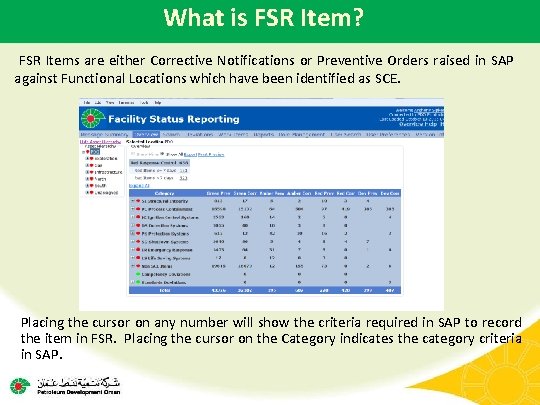
What is FSR Item? FSR Items are either Corrective Notifications or Preventive Orders raised in SAP against Functional Locations which have been identified as SCE. Placing the cursor on any number will show the criteria required in SAP to record the item in FSR. Placing the cursor on the Category indicates the category criteria in SAP.
What is a Deviation? • Deviations are regulated controls which allow operations to continue with non-conformances in place providing various conditions are met. Deviations are applied in the FSR system through the use of a Deviation Control Form • The Deviation Form allows the user to move an FSR Item into a Deviation status, removing the Item from Red so that it does not affect the corporate KPI “No Red beyond 7 days” • Deviations may also be prepared in advance. The User can select a Green or Amber FSR item and Prepare and Approve a Deviation.
Temporary Portable Equipment • The TPE document (PR-1960): – Meant to ensure that all equipment which will enter PDO sites (ie stations) are safe to be used, and it isn’t allowed to remain longer than absolutely necessary • Any equipment which is brought to sites (ie stations), and intended to be kept after working hours/shift change, needs to be risk assessed, inspected and registered. • The inspection can either be done in-house or using a third party • The equipment which are brought for daily use and removed from the sites after working hours/shift change does not need to be entered in the facility register, although it does need a valid inspection certificate, and it’s use risk assessed and controlled through the PTW system.
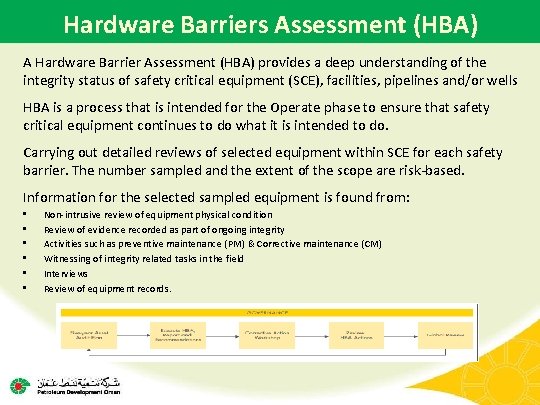
Hardware Barriers Assessment (HBA) A Hardware Barrier Assessment (HBA) provides a deep understanding of the integrity status of safety critical equipment (SCE), facilities, pipelines and/or wells HBA is a process that is intended for the Operate phase to ensure that safety critical equipment continues to do what it is intended to do. Carrying out detailed reviews of selected equipment within SCE for each safety barrier. The number sampled and the extent of the scope are risk-based. Information for the selected sampled equipment is found from: • • • Non-intrusive review of equipment physical condition Review of evidence recorded as part of ongoing integrity Activities such as preventive maintenance (PM) & Corrective maintenance (CM) Witnessing of integrity related tasks in the field Interviews Review of equipment records.
Element 11 Contractor Management Focal point : MSE 1
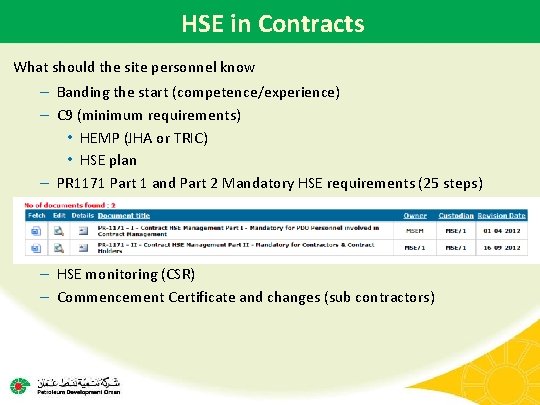
HSE in Contracts What should the site personnel know – Banding the start (competence/experience) – C 9 (minimum requirements) • HEMP (JHA or TRIC) • HSE plan – PR 1171 Part 1 and Part 2 Mandatory HSE requirements (25 steps) – HSE monitoring (CSR) – Commencement Certificate and changes (sub contractors)
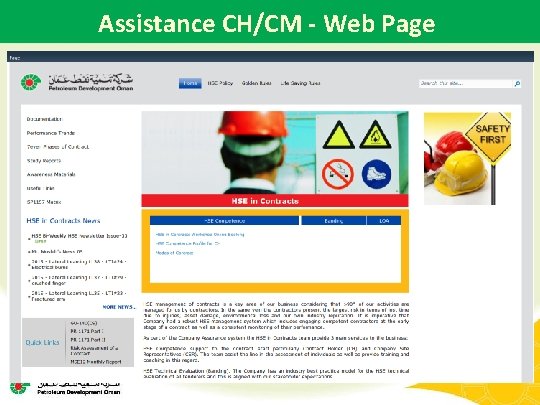
Assistance CH/CM - Web Page
Element 13 Management of Change Focal point : UOP/UEP
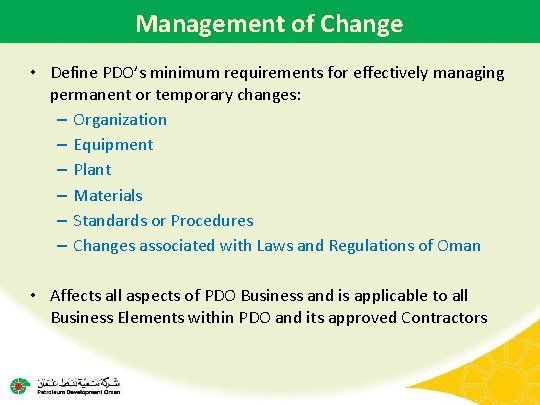
Management of Change • Define PDO’s minimum requirements for effectively managing permanent or temporary changes: – Organization – Equipment – Plant – Materials – Standards or Procedures – Changes associated with Laws and Regulations of Oman • Affects all aspects of PDO Business and is applicable to all Business Elements within PDO and its approved Contractors
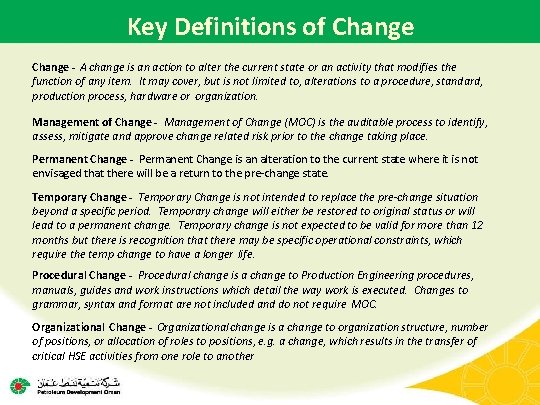
Key Definitions of Change - A change is an action to alter the current state or an activity that modifies the function of any item. It may cover, but is not limited to, alterations to a procedure, standard, production process, hardware or organization. Management of Change - Management of Change (MOC) is the auditable process to identify, assess, mitigate and approve change related risk prior to the change taking place. Permanent Change - Permanent Change is an alteration to the current state where it is not envisaged that there will be a return to the pre-change state. Temporary Change - Temporary Change is not intended to replace the pre-change situation beyond a specific period. Temporary change will either be restored to original status or will lead to a permanent change. Temporary change is not expected to be valid for more than 12 months but there is recognition that there may be specific operational constraints, which require the temp change to have a longer life. Procedural Change - Procedural change is a change to Production Engineering procedures, manuals, guides and work instructions which detail the way work is executed. Changes to grammar, syntax and format are not included and do not require MOC. Organizational Change - Organizational change is a change to organization structure, number of positions, or allocation of roles to positions, e. g. a change, which results in the transfer of critical HSE activities from one role to another
Element 15 Conduct of Operations Focal point : UOP 6
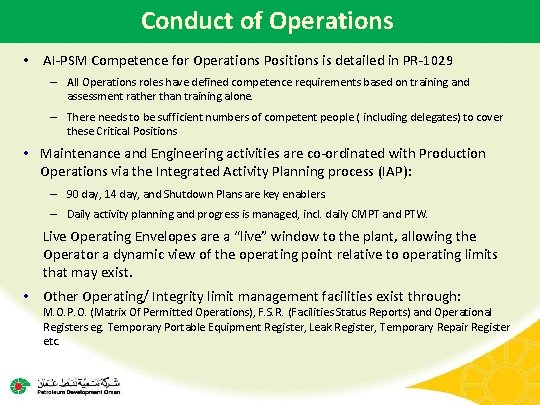
Conduct of Operations • AI-PSM Competence for Operations Positions is detailed in PR-1029 – All Operations roles have defined competence requirements based on training and assessment rather than training alone. – There needs to be sufficient numbers of competent people ( including delegates) to cover these Critical Positions • Maintenance and Engineering activities are co-ordinated with Production Operations via the Integrated Activity Planning process (IAP): – 90 day, 14 day, and Shutdown Plans are key enablers. – Daily activity planning and progress is managed, incl. daily CMPT and PTW. Live Operating Envelopes are a “live” window to the plant, allowing the Operator a dynamic view of the operating point relative to operating limits that may exist. • Other Operating/ Integrity limit management facilities exist through: M. O. P. O. (Matrix Of Permitted Operations), F. S. R. (Facilities Status Reports) and Operational Registers eg. Temporary Portable Equipment Register, Leak Register, Temporary Repair Register etc.
Conduct of Operations • Alarm Management is key to ensure Operators are not flooded by excessive alarms. The industry target is 6 alarms/hour/console. • Site ownership and active management of the improvement process to sustain any reduction achieved is key. • Accurate As-built drawings need to be in place that reflect the true plant status • Position of Spectacle Blinds and Locked Open/Locked Closed Valves needs to be verified at prescribed intervals by Production Operators and Supervisors. • Capturing change to plant has to be actively risk assessed and demonstrably managed. » Temporary overrides to safety systems need risk assessed, and the appropriate » » level of authority to implement. Access to Engineering functions within electronic control systems needs controlled to authorized people only. Inability to follow particular approved Operating Procedures requires risk assessment and formal approval/ authorization to deviate.
Conduct of Operations • Crew Handovers both daily and end of tour should consist of both written and verbal physical communication between offgoing and in-coming individuals. Both parties should sign the handover. ➢ Key topic detailed in PR-1000 need to be included in the written handover ➢ Operational logs need to be attached or available to the handover document. • Daily Operator tasks need to be identified and completed as per the schedule. • Operations PPC should be linked to AI-PSM activities and milestones.
Asset Integrity – Process Safety Asset Leadership Team (AIPSALT)
Overview • Level 3 AI-PSM activities shall be managed through Assetbased AI-PS Assurance Leadership Teams (AIPSALT). • Each Delivery Team Leader shall appoint and lead an AIPSALT to lead AI-PS in the Asset(s) managed by the Delivery Team Leader. • Each AIPSALT shall meet at least six times per year. However, AI-PS issues are expected to be discussed more regularly and typically at least on a weekly basis in other meetings. The meeting shall take place at the Asset and meeting minutes shall be taken.
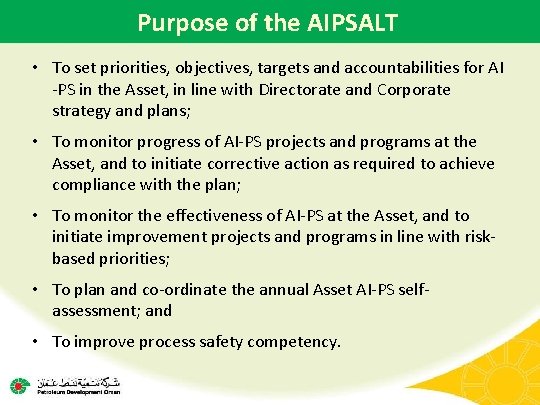
Purpose of the AIPSALT • To set priorities, objectives, targets and accountabilities for AI -PS in the Asset, in line with Directorate and Corporate strategy and plans; • To monitor progress of AI-PS projects and programs at the Asset, and to initiate corrective action as required to achieve compliance with the plan; • To monitor the effectiveness of AI-PS at the Asset, and to initiate improvement projects and programs in line with riskbased priorities; • To plan and co-ordinate the annual Asset AI-PS selfassessment; and • To improve process safety competency.
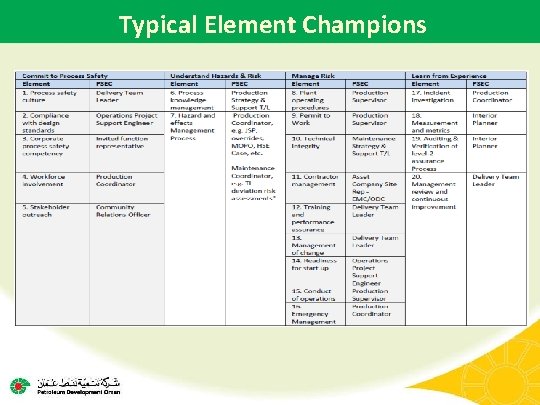
Typical Element Champions
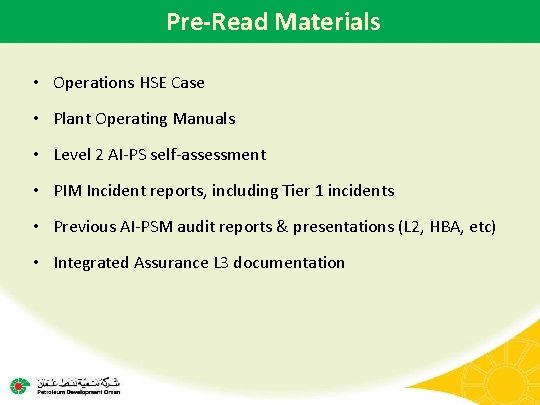
Pre-Read Materials • Operations HSE Case • Plant Operating Manuals • Level 2 AI-PS self-assessment • PIM Incident reports, including Tier 1 incidents • Previous AI-PSM audit reports & presentations (L 2, HBA, etc) • Integrated Assurance L 3 documentation
Risk Assessments and PSBRs Siting Portacabins Permit To Work Change Management Relief to Atmosphere Tank Overfill Protection Brittle Fracture Alarm Management of H 2 S