
ASSET GRADE 12 REVISION 2020 DNA CODE OF
- Slides: 29
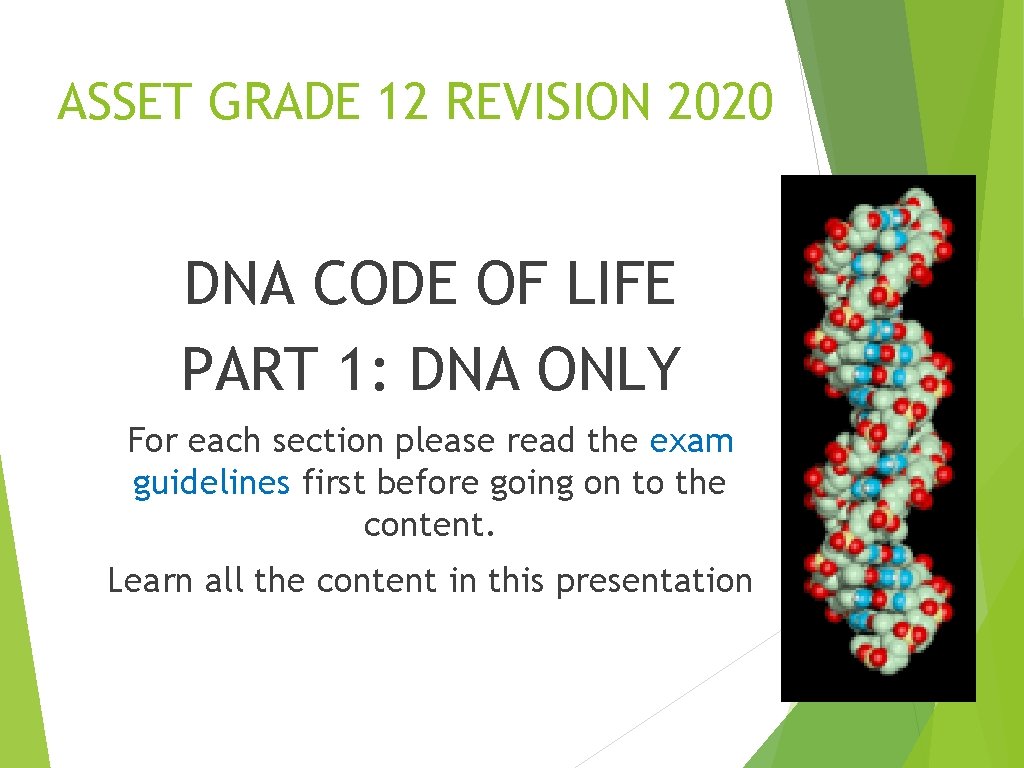
ASSET GRADE 12 REVISION 2020 DNA CODE OF LIFE PART 1: DNA ONLY For each section please read the exam guidelines first before going on to the content. Learn all the content in this presentation
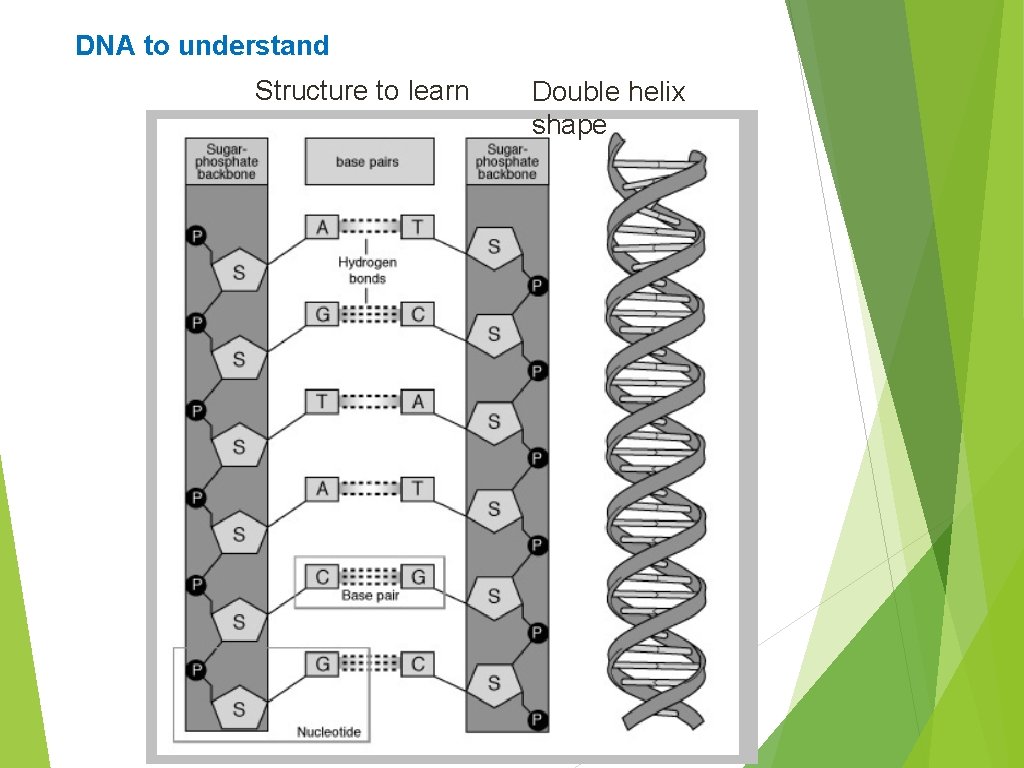
DNA to understand Structure to learn Double helix shape
Exam Guidelines DNA structure and function – see following slides State where DNA is found (location) know 1. DNA makes up the genes on chromosomes (nuclear DNA) 2. DNA is present in mitochondria (mitochondrial DNA)
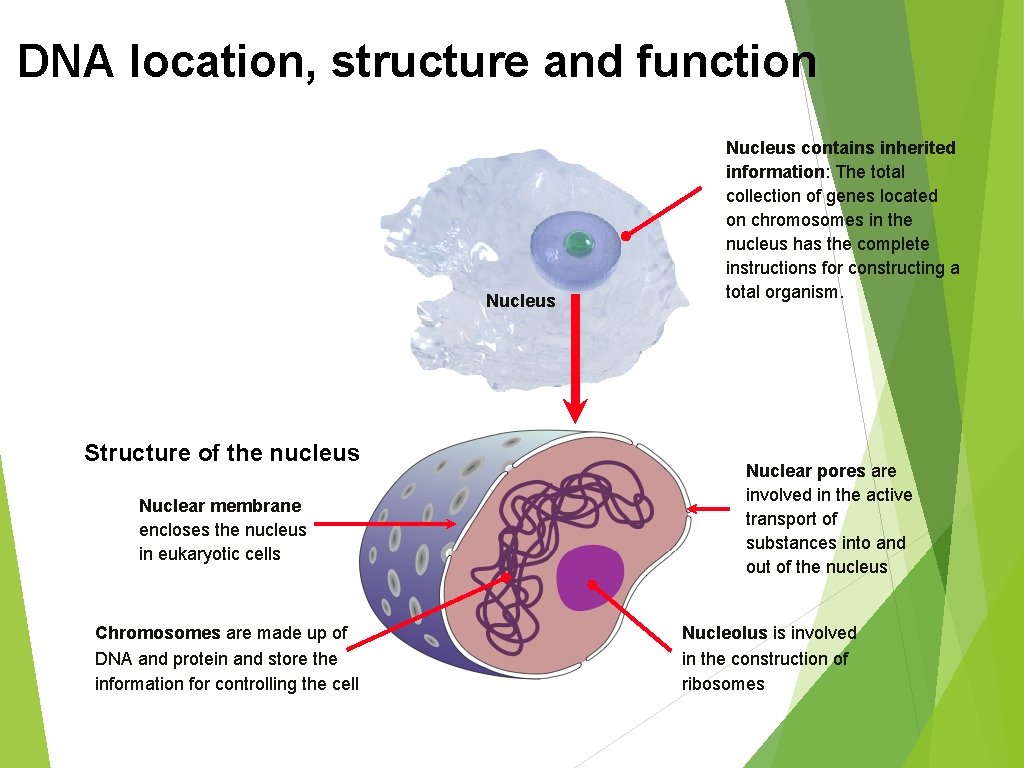
DNA location, structure and function Nucleus Structure of the nucleus Nuclear membrane encloses the nucleus in eukaryotic cells Chromosomes are made up of DNA and protein and store the information for controlling the cell Nucleus contains inherited information: The total collection of genes located on chromosomes in the nucleus has the complete instructions for constructing a total organism. Nuclear pores are involved in the active transport of substances into and out of the nucleus Nucleolus is involved in the construction of ribosomes
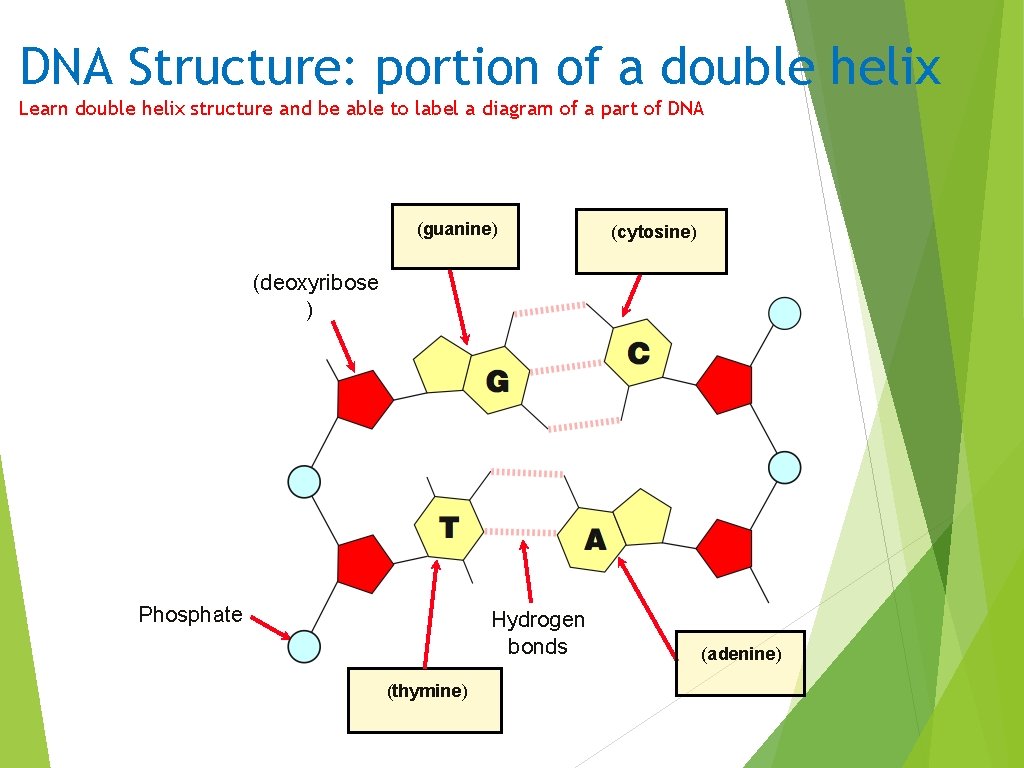
Exam guidelines Name three components of a DNA nucleotide (know): 1. Nitrogenous bases linked by weak hydrogen bonds: –> Four nitrogenous bases of DNA: adenine (A), thymine (T), cytosine (C), guanine (G) –> Pairing of bases in DNA occur as follows: A : T and G : C 2. Sugar portion (deoxyribose in DNA) 3. Phosphate portion
Nucleotides – apply to DNA and to RNA The building blocks of nucleic acids (DNA and RNA) are made up of the following components: a sugar (ribose or deoxyribose) a phosphate group a base (four types)
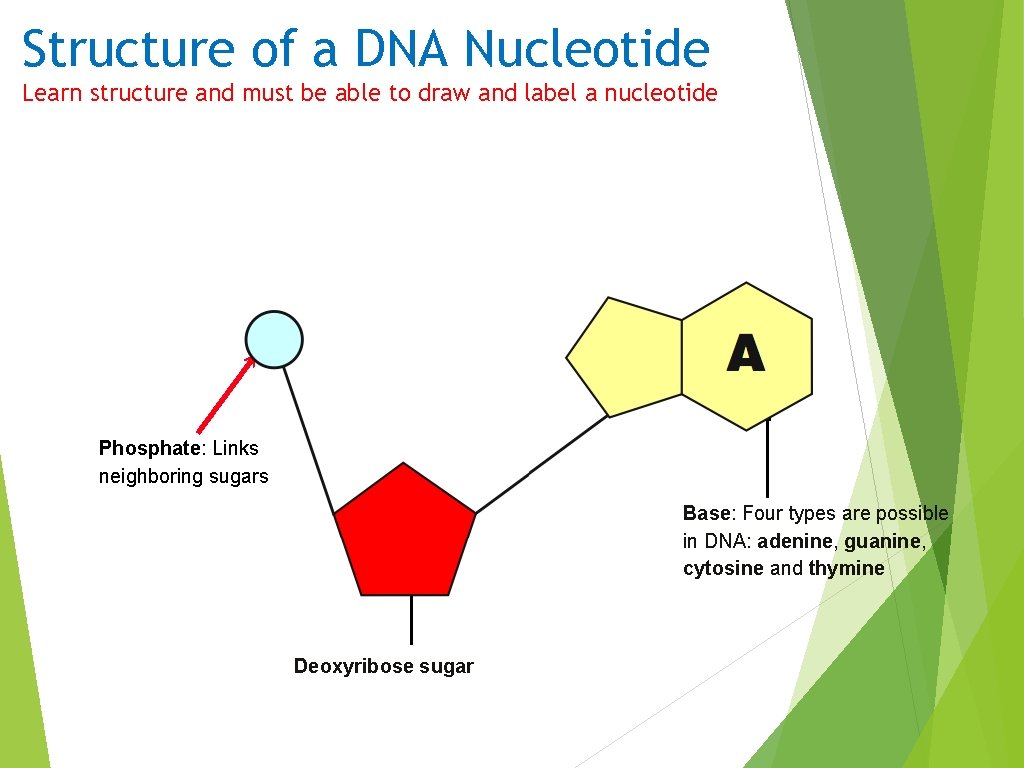
Structure of a DNA Nucleotide Learn structure and must be able to draw and label a nucleotide Phosphate: Links neighboring sugars Base: Four types are possible in DNA: adenine, guanine, cytosine and thymine Deoxyribose sugar
Exam guidelines Know that the natural shape of the DNA molecule is a double helix State the functions of DNA (know) –> Sections of DNA forming genes carry hereditary information –> DNA contains coded information for protein synthesis
DNA Structure: portion of a double helix Learn double helix structure and be able to label a diagram of a part of DNA (guanine) (cytosine) (deoxyribose ) Phosphate Hydrogen bonds (thymine) (adenine)
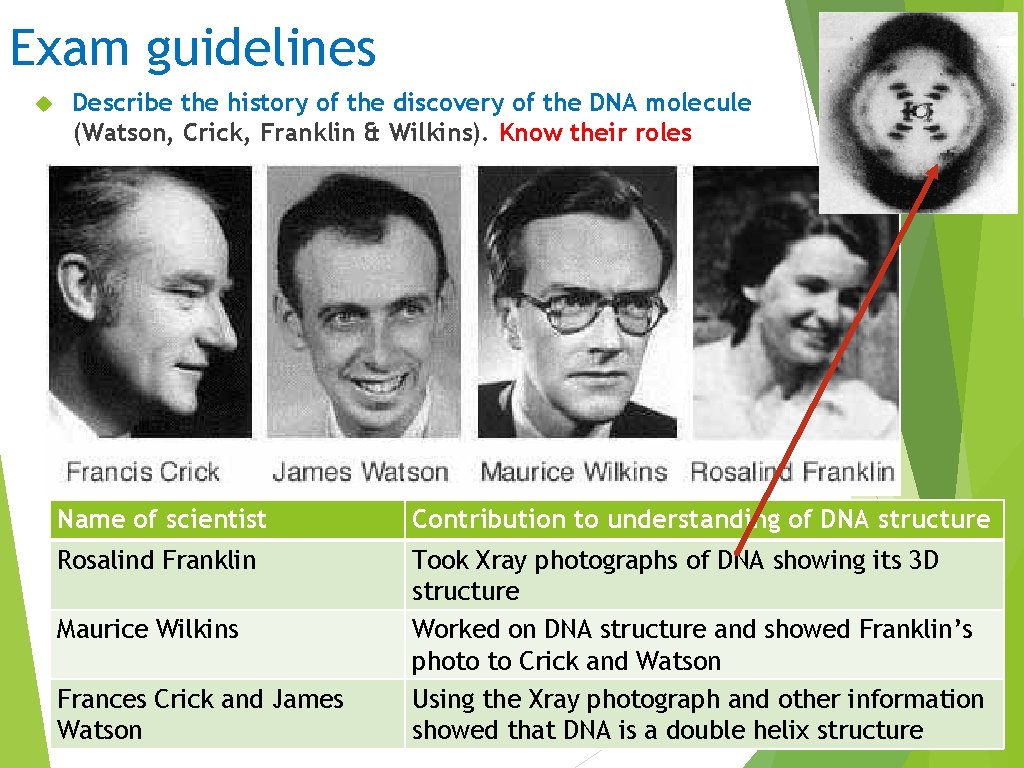
Exam guidelines Describe the history of the discovery of the DNA molecule (Watson, Crick, Franklin & Wilkins). Know their roles Name of scientist Contribution to understanding of DNA structure Rosalind Franklin Took Xray photographs of DNA showing its 3 D structure Worked on DNA structure and showed Franklin’s photo to Crick and Watson Using the Xray photograph and other information showed that DNA is a double helix structure Maurice Wilkins Frances Crick and James Watson
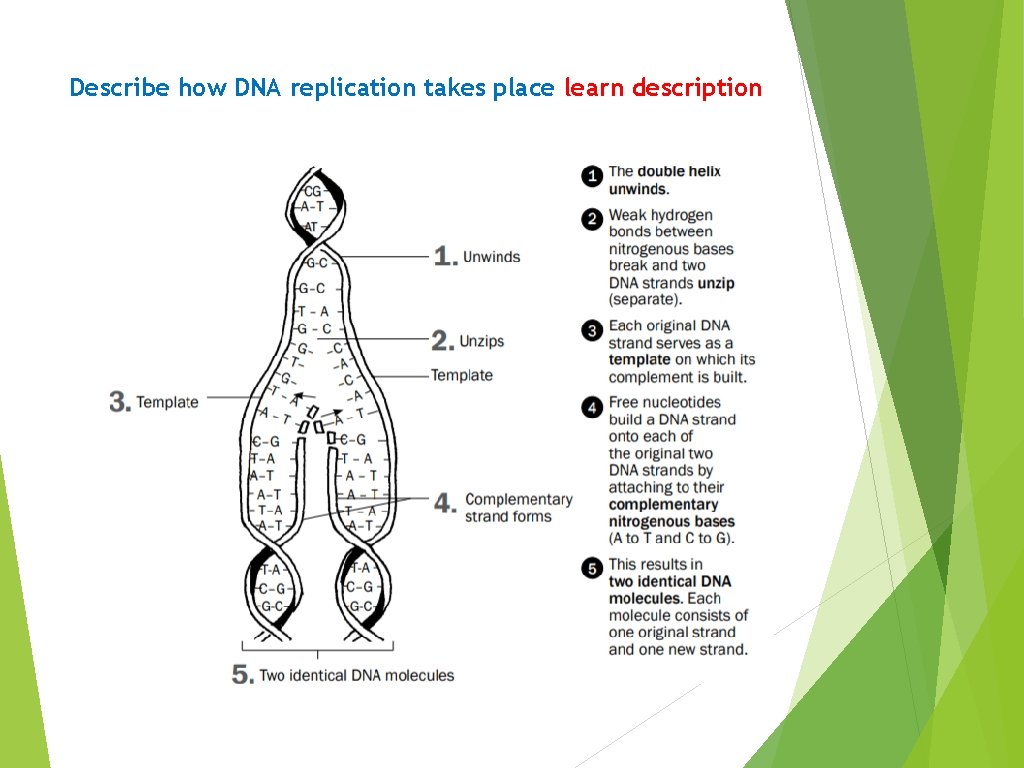
Exam Guidelines: DNA Replication know all Process of DNA replication: When in the cell cycle it takes place Takes place during interphase before mitosis or meiosis occurs Where in the cell it takes place Takes place inside the nucleus How DNA replication takes place (names of enzymes not required) - see next slide The significance (importance) of DNA replication
Describe how DNA replication takes place learn description
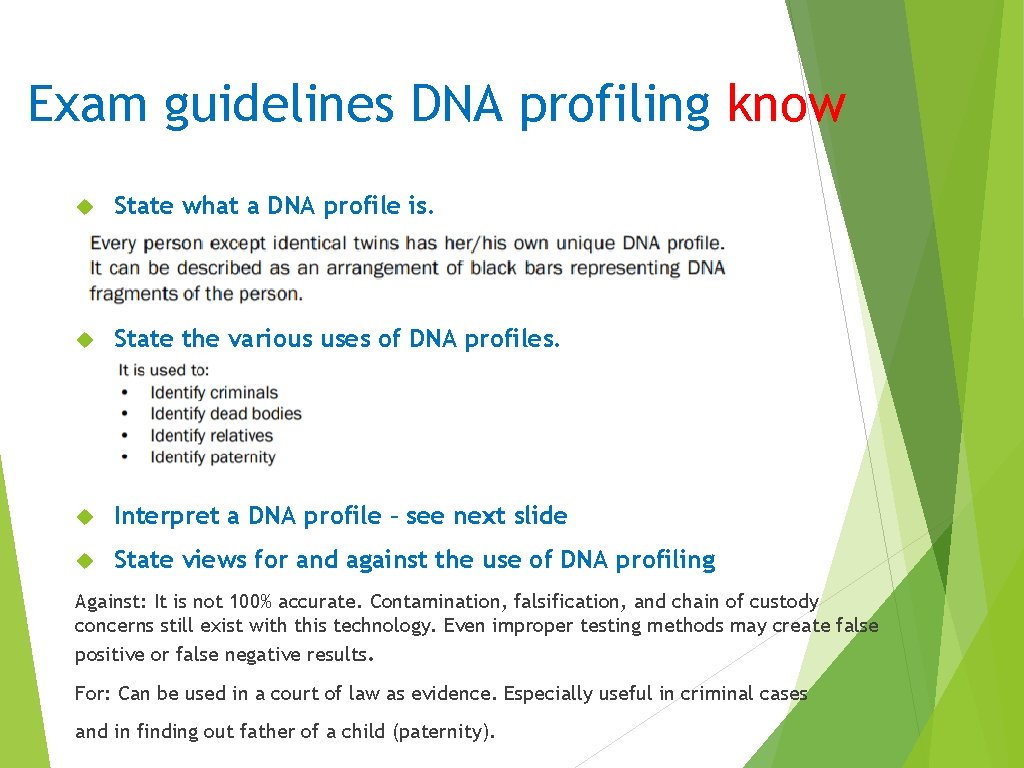
Exam guidelines DNA profiling know State what a DNA profile is. State the various uses of DNA profiles. Interpret a DNA profile – see next slide State views for and against the use of DNA profiling Against: It is not 100% accurate. Contamination, falsification, and chain of custody concerns still exist with this technology. Even improper testing methods may create false positive or false negative results. For: Can be used in a court of law as evidence. Especially useful in criminal cases and in finding out father of a child (paternity).
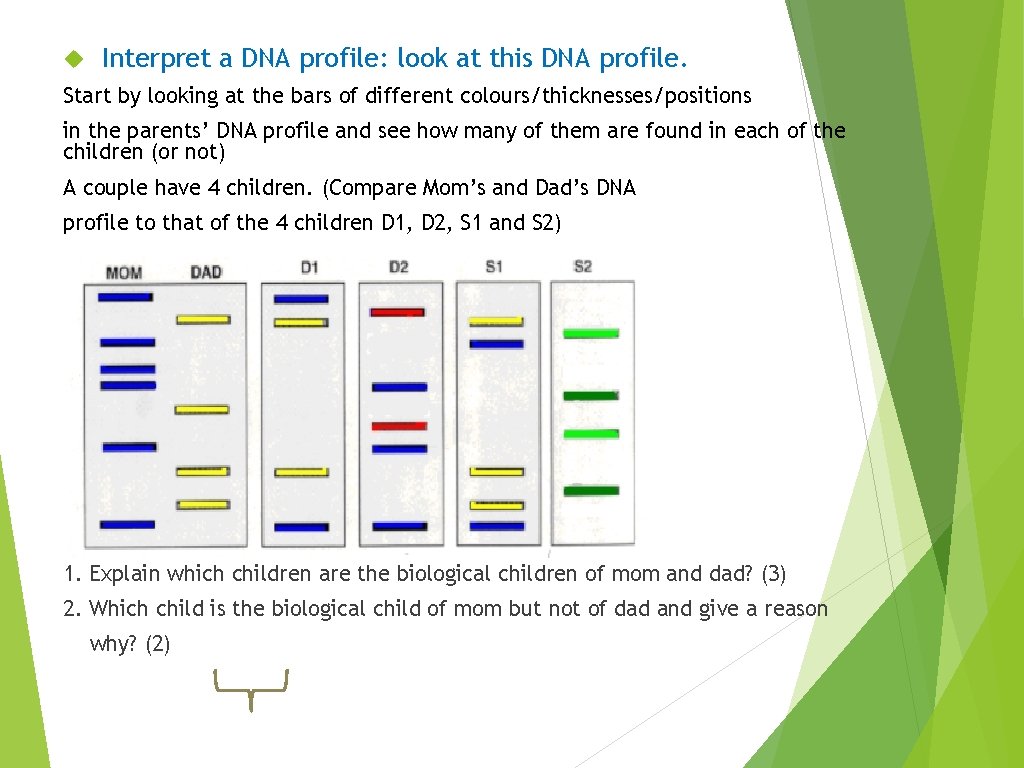
Interpret a DNA profile: look at this DNA profile. Start by looking at the bars of different colours/thicknesses/positions in the parents’ DNA profile and see how many of them are found in each of the children (or not) A couple have 4 children. (Compare Mom’s and Dad’s DNA profile to that of the 4 children D 1, D 2, S 1 and S 2) 1. Explain which children are the biological children of mom and dad? (3) 2. Which child is the biological child of mom but not of dad and give a reason why? (2)
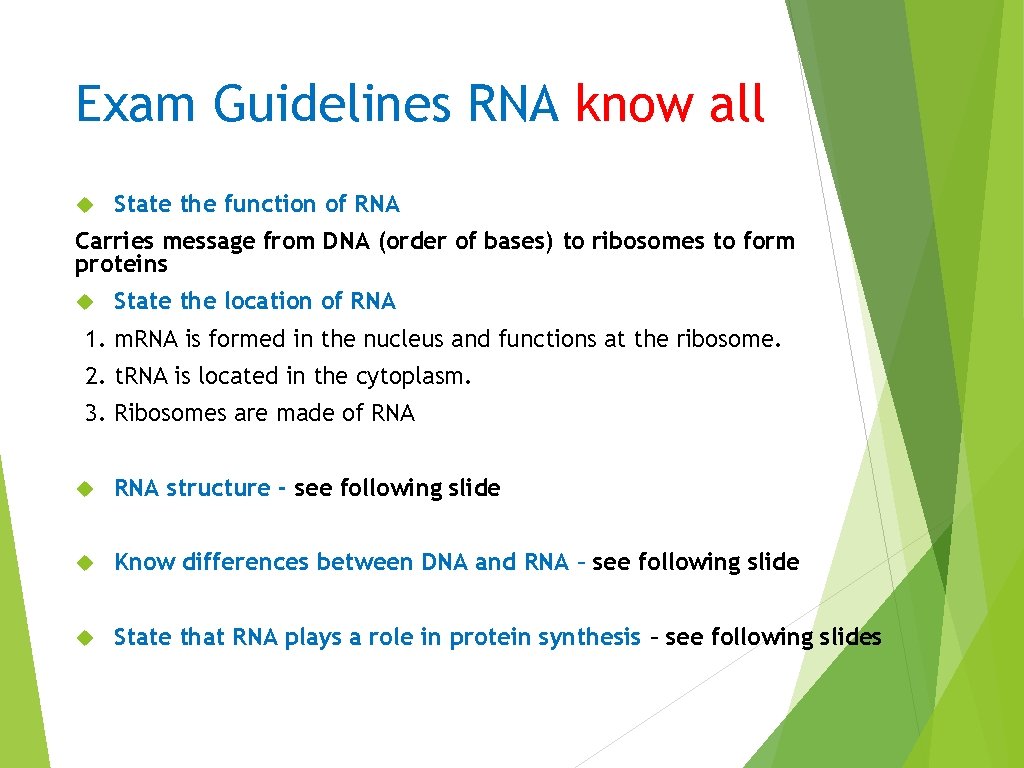
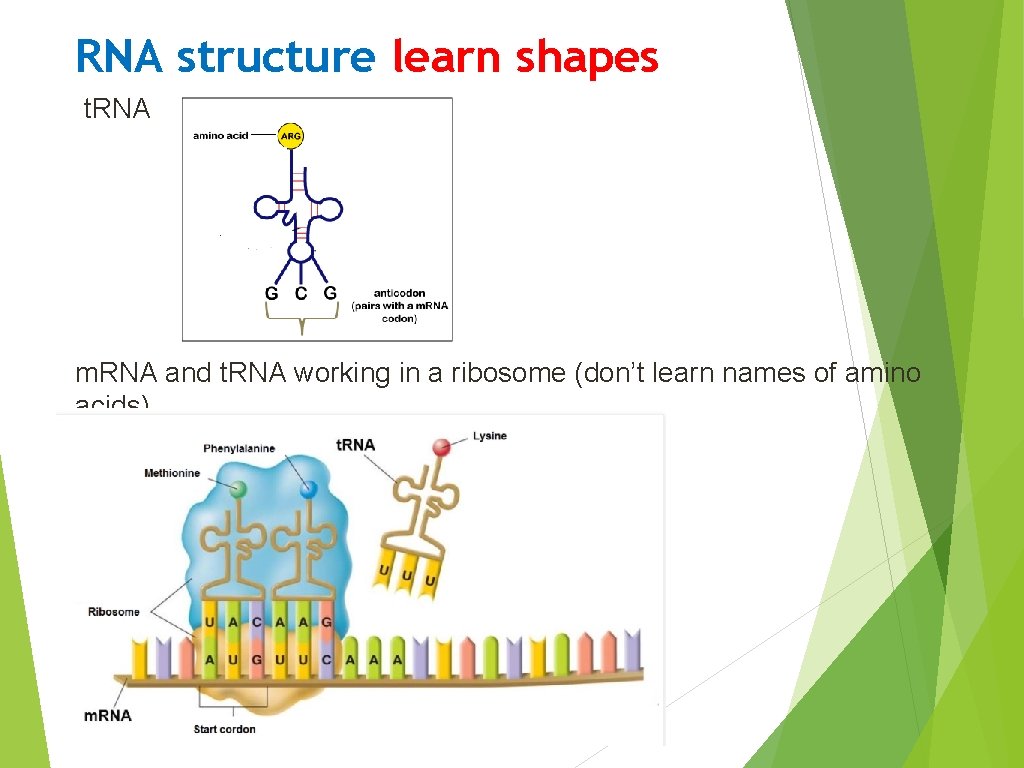
Exam Guidelines RNA know all State the function of RNA Carries message from DNA (order of bases) to ribosomes to form proteins State the location of RNA 1. m. RNA is formed in the nucleus and functions at the ribosome. 2. t. RNA is located in the cytoplasm. 3. Ribosomes are made of RNA structure - see following slide Know differences between DNA and RNA – see following slide State that RNA plays a role in protein synthesis – see following slides
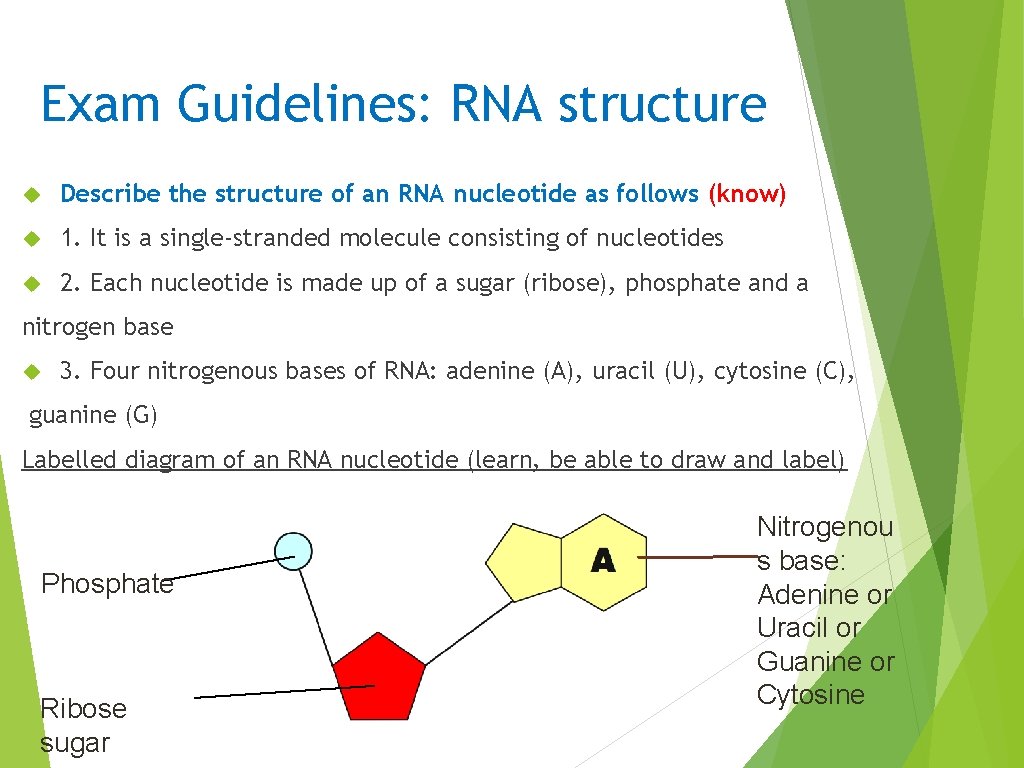
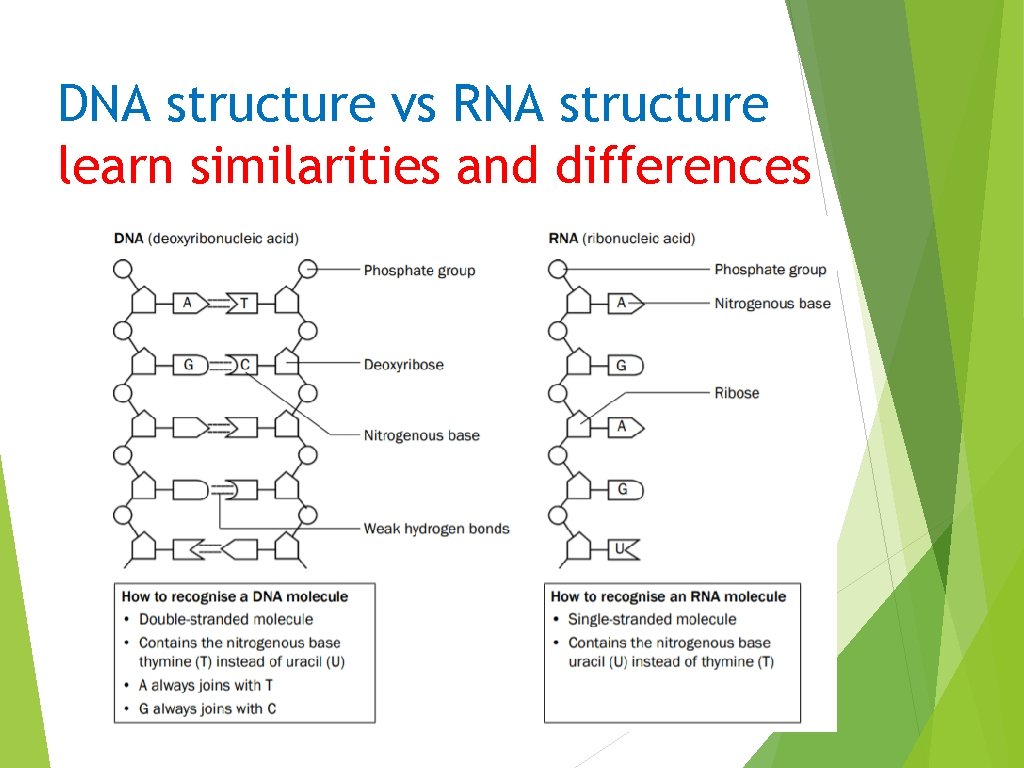
Exam Guidelines: RNA structure Describe the structure of an RNA nucleotide as follows (know) 1. It is a single-stranded molecule consisting of nucleotides 2. Each nucleotide is made up of a sugar (ribose), phosphate and a nitrogen base 3. Four nitrogenous bases of RNA: adenine (A), uracil (U), cytosine (C), guanine (G) Labelled diagram of an RNA nucleotide (learn, be able to draw and label) Phosphate Ribose sugar Nitrogenou s base: Adenine or Uracil or Guanine or Cytosine
RNA structure learn shapes t. RNA m. RNA and t. RNA working in a ribosome (don’t learn names of amino acids)
DNA structure vs RNA structure learn similarities and differences
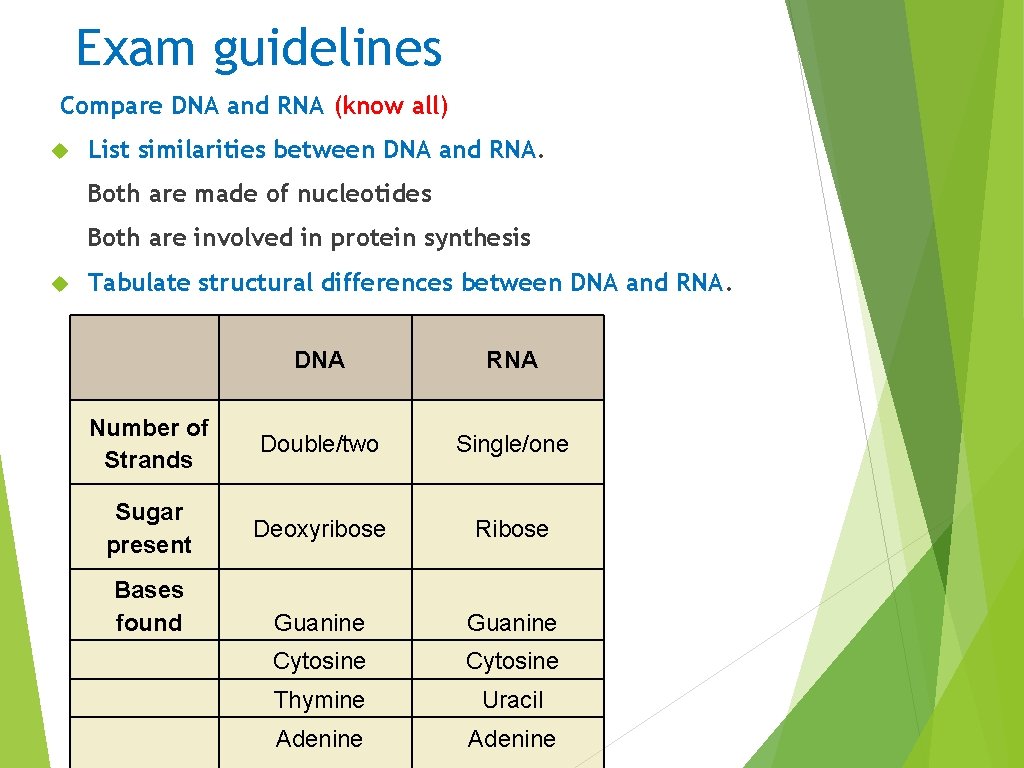
Exam guidelines Compare DNA and RNA (know all) List similarities between DNA and RNA. Both are made of nucleotides Both are involved in protein synthesis Tabulate structural differences between DNA and RNA. DNA RNA Number of Strands Double/two Single/one Sugar present Deoxyribose Ribose Guanine Cytosine Thymine Uracil Adenine Bases found
Exam Guidelines Protein Synthesis (know all) State that RNA plays a role in protein synthesis Define protein synthesis. Learn Protein synthesis is the process by which amino acids are joined to form proteins this is controlled by m. RNA through involvement of ribosomes, transfer RNA and enzymes.
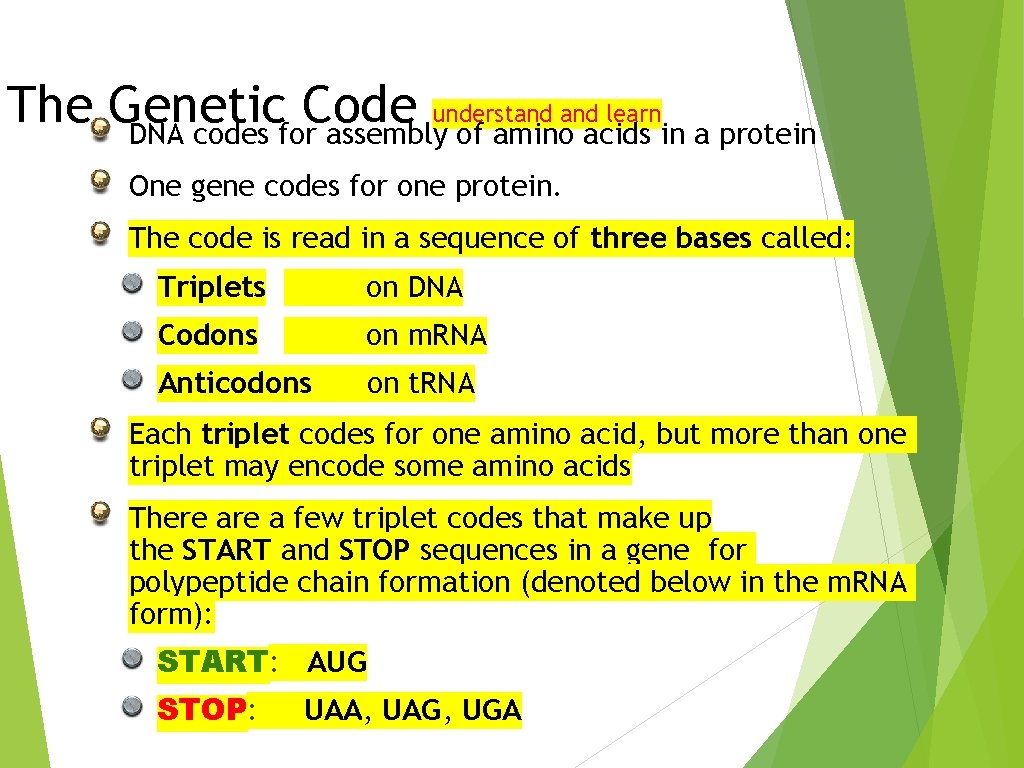
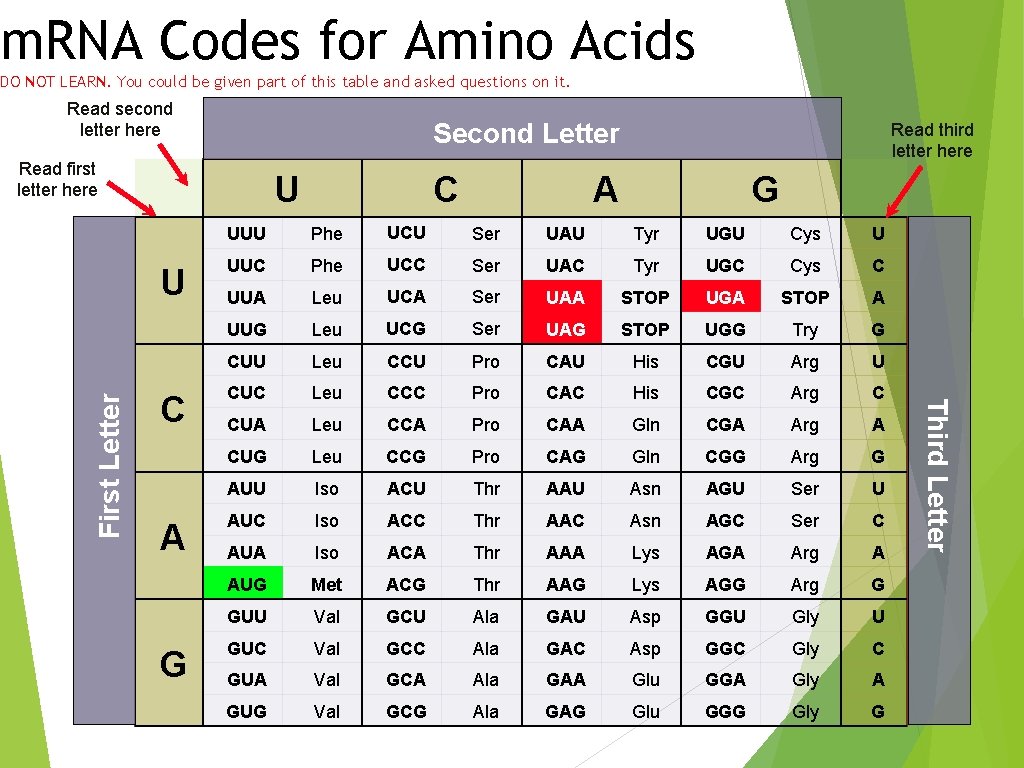
The Genetic Code understand learn DNA codes for assembly of amino acids in a protein One gene codes for one protein. The code is read in a sequence of three bases called: Triplets on DNA Codons on m. RNA Anticodons on t. RNA Each triplet codes for one amino acid, but more than one triplet may encode some amino acids There a few triplet codes that make up the START and STOP sequences in a gene for polypeptide chain formation (denoted below in the m. RNA form): START: AUG STOP: UAA, UAG, UGA
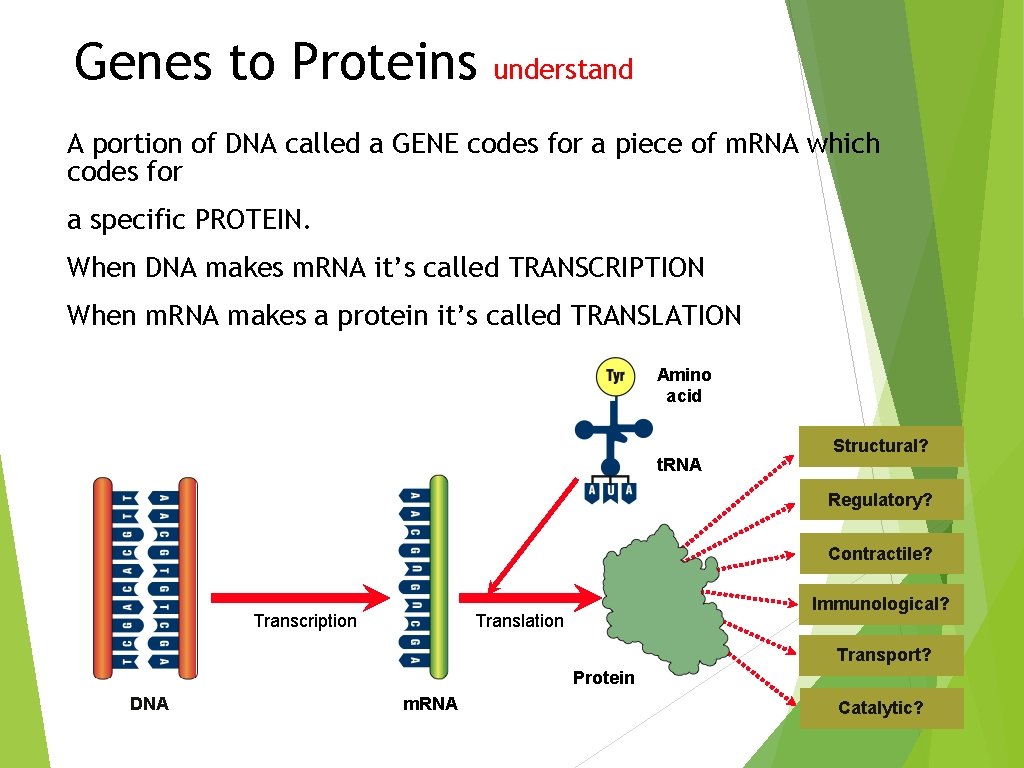
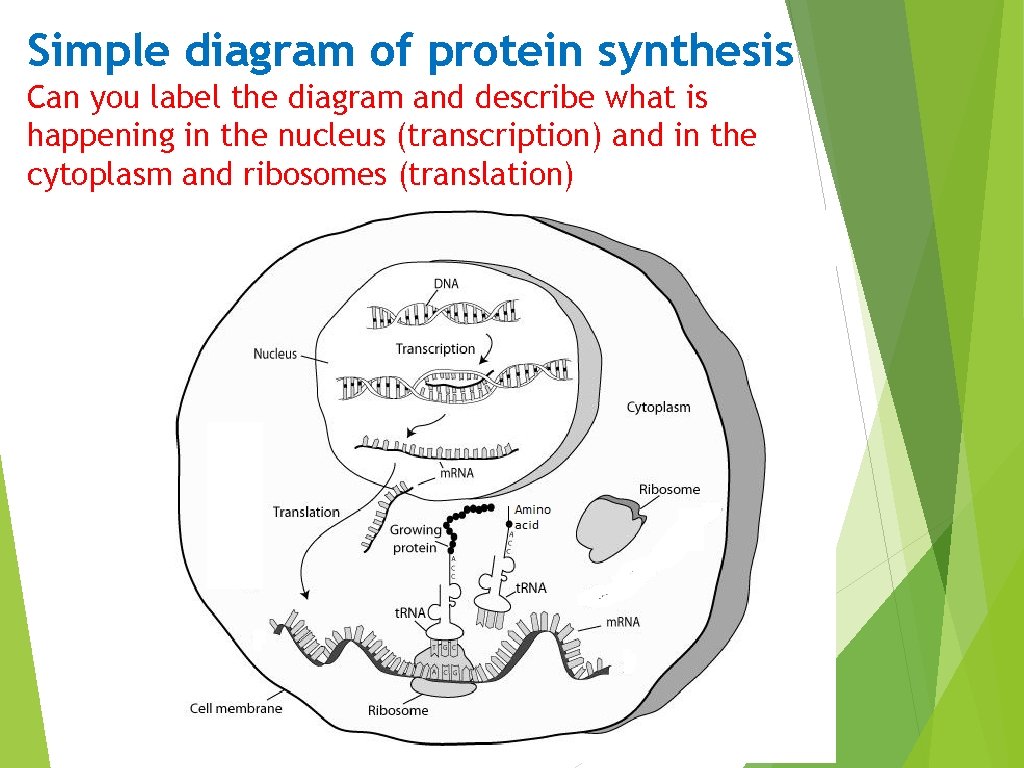
Genes to Proteins understand A portion of DNA called a GENE codes for a piece of m. RNA which codes for a specific PROTEIN. When DNA makes m. RNA it’s called TRANSCRIPTION When m. RNA makes a protein it’s called TRANSLATION Amino acid t. RNA Structural? Regulatory? Contractile? Immunological? Translation Transcription Transport? Protein DNA m. RNA Catalytic?
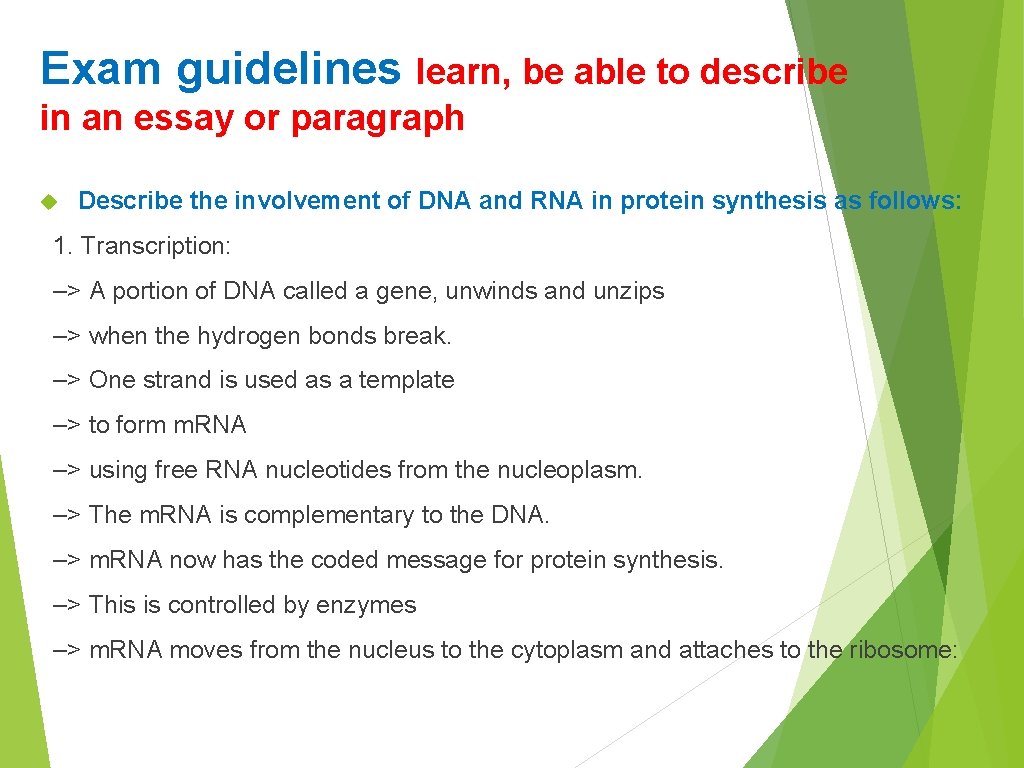
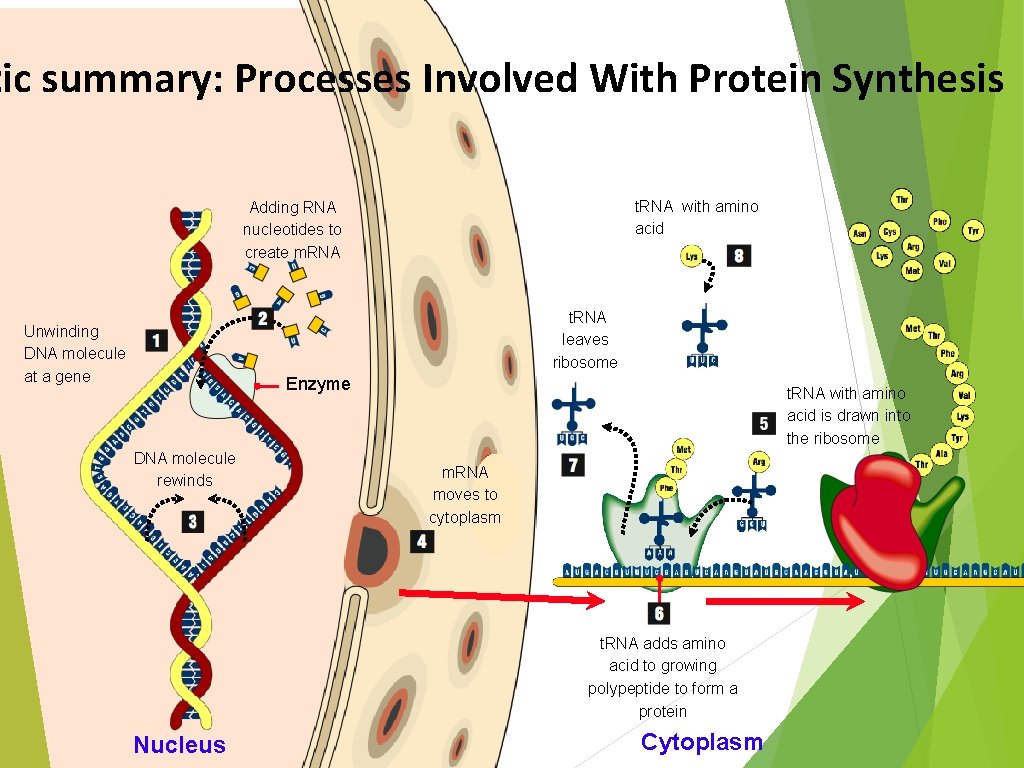
Exam guidelines learn, be able to describe in an essay or paragraph Describe the involvement of DNA and RNA in protein synthesis as follows: 1. Transcription: –> A portion of DNA called a gene, unwinds and unzips –> when the hydrogen bonds break. –> One strand is used as a template –> to form m. RNA –> using free RNA nucleotides from the nucleoplasm. –> The m. RNA is complementary to the DNA. –> m. RNA now has the coded message for protein synthesis. –> This is controlled by enzymes –> m. RNA moves from the nucleus to the cytoplasm and attaches to the ribosome:
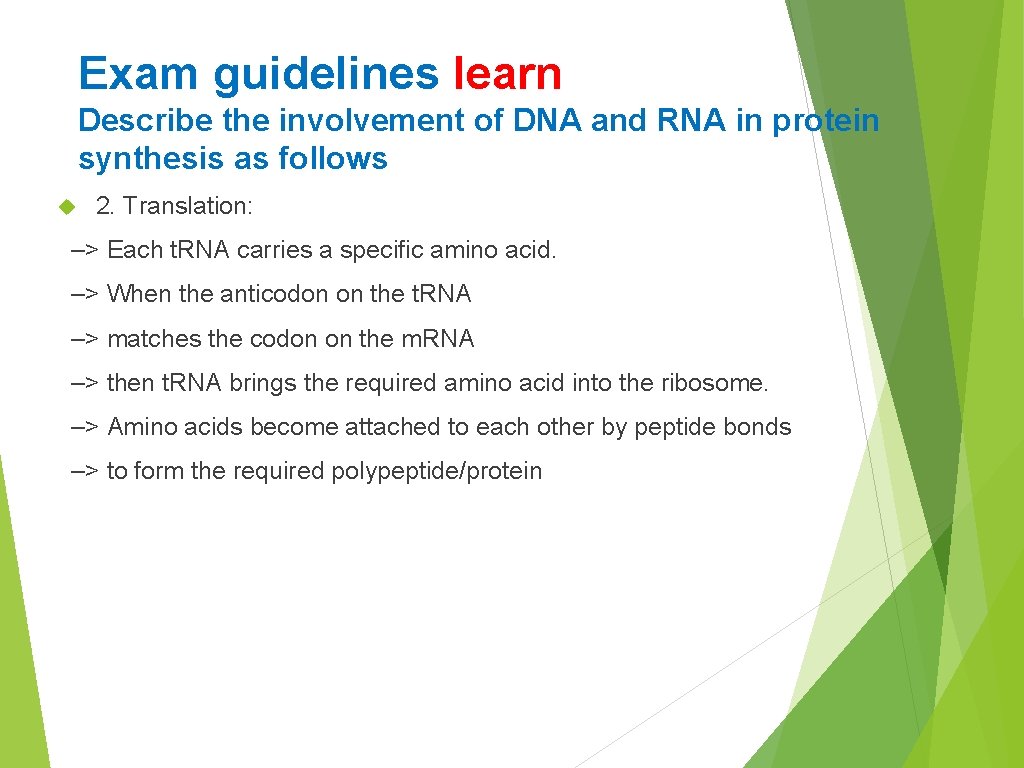
Exam guidelines learn Describe the involvement of DNA and RNA in protein synthesis as follows 2. Translation: –> Each t. RNA carries a specific amino acid. –> When the anticodon on the t. RNA –> matches the codon on the m. RNA –> then t. RNA brings the required amino acid into the ribosome. –> Amino acids become attached to each other by peptide bonds –> to form the required polypeptide/protein
Simple diagram of protein synthesis Can you label the diagram and describe what is happening in the nucleus (transcription) and in the cytoplasm and ribosomes (translation)
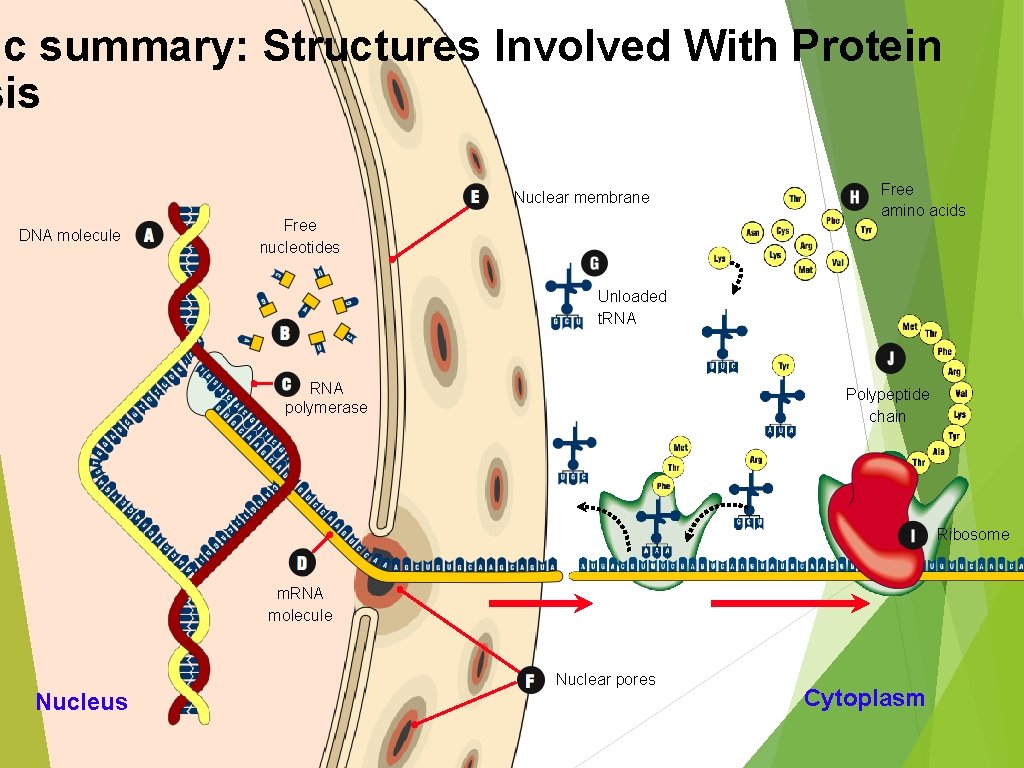
The next 3 slides are to help you understand the process of protein synthesis Genetic code/m. RNA codes for proteins – you may be given a section of DNA or a section of m. RNA to work out the amino acids which are coded for using a part of this table. Structures involved in protein synthesis – can you describe the function of each in protein synthesis? Processes involved in protein synthesis – from this summary can you write your own bulleted or numbered description of transcription and then translation?
m. RNA Codes for Amino Acids DO NOT LEARN. You could be given part of this table and asked questions on it. Read second letter here Second Letter Read first letter here U C A G UUU Phe UCU Ser UAU Tyr UGU Cys U UUC Phe UCC Ser UAC Tyr UGC Cys C UUA Leu UCA Ser UAA STOP UGA STOP A UUG Leu UCG Ser UAG STOP UGG Try G CUU Leu CCU Pro CAU His CGU Arg U CUC Leu CCC Pro CAC His CGC Arg C CUA Leu CCA Pro CAA Gln CGA Arg A CUG Leu CCG Pro CAG Gln CGG Arg G AUU Iso ACU Thr AAU Asn AGU Ser U AUC Iso ACC Thr AAC Asn AGC Ser C AUA Iso ACA Thr AAA Lys AGA Arg A AUG Met ACG Thr AAG Lys AGG Arg G GUU Val GCU Ala GAU Asp GGU Gly U GUC Val GCC Ala GAC Asp GGC Gly C GUA Val GCA Ala GAA Glu GGA Gly A GUG Val GCG Ala GAG Glu GGG Gly G Third Letter First Letter U C Read third letter here
ic summary: Structures Involved With Protein sis Nuclear membrane DNA molecule Free nucleotides Free amino acids Unloaded t. RNA polymerase Polypeptide chain Ribosome m. RNA molecule Nuclear pores Nucleus Cytoplasm
tic summary: Processes Involved With Protein Synthesis t. RNA with amino acid Adding RNA nucleotides to create m. RNA t. RNA leaves ribosome Unwinding DNA molecule at a gene Enzyme DNA molecule rewinds t. RNA with amino acid is drawn into the ribosome m. RNA moves to cytoplasm t. RNA adds amino acid to growing polypeptide to form a protein Nucleus Cytoplasm