
Asset Based Community Development and Appreciative Inquiry Shane
Asset Based Community Development and Appreciative Inquiry Shane R. Brady, Ph. D University of Oklahoma
Why ABCD? ABCD is best thought of as an approach and methodology to community development. Developed by Kretzmann and Mc. Knight in the early 90’s Alternative to deficit based approaches Situated in an empowerment or collaborative paradigm of community practice
Why Use ABCD? Consistent with “democratic” principles Empowerment Social justice Citizenship Allows engagement with diverse communities Supported by practice
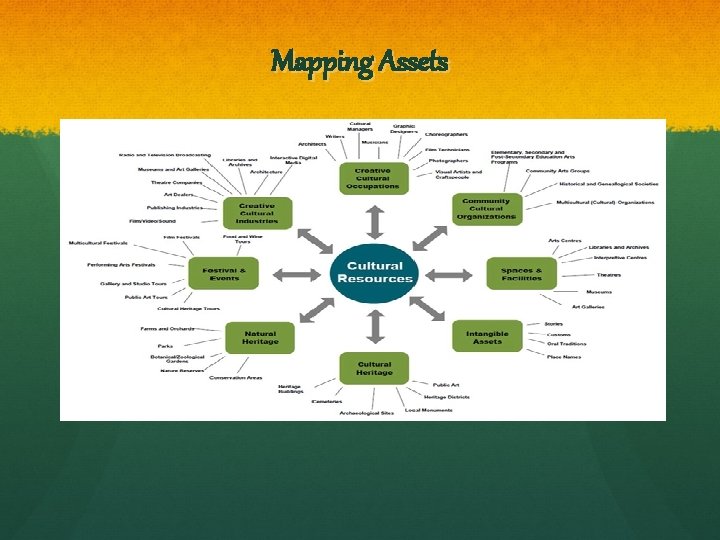
Mapping Assets
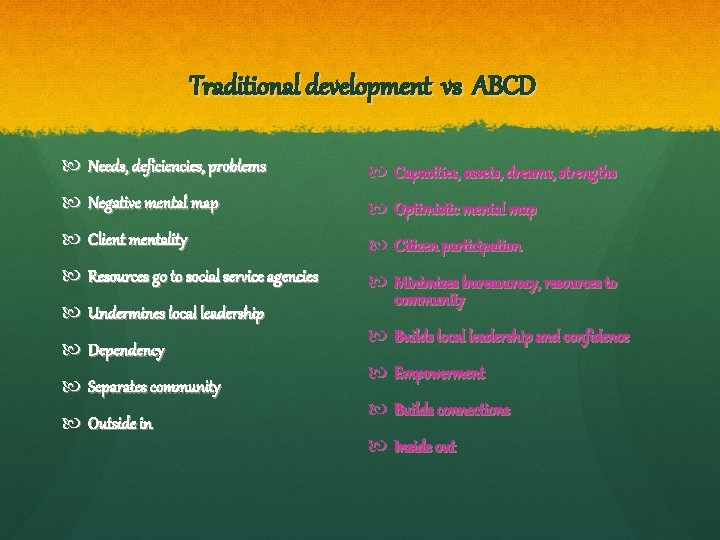
Traditional development vs ABCD Needs, deficiencies, problems Capacities, assets, dreams, strengths Negative mental map Optimistic mental map Client mentality Citizen participation Resources go to social service agencies Minimizes bureaucracy, resources to community Undermines local leadership Dependency Separates community Outside in Builds local leadership and confidence Empowerment Builds connections Inside out
What’s wrong with the old way? Deficiencies – define the entire picture Problems become discrete units – not interlocking pieces People become clients – “them” vs “us” Resources ($$) goes to agencies, not to the community Programs target individual needs, not community needs Gives message that solutions come from outside Individuals don’t connect with each other Deepens the cycle of dependency
What’s good about ABCD? Begins with what the community/individuals have Can begin/be sustained without funding, grants Builds leadership Builds internal connections – no “them” vs “us” Builds connections between community and the outside Issues and solutions defined holistically – as they are experienced Self-sufficiency/empowerment can be built
From the ABCD Institute “Our purpose is not to help people. Our purpose is to build a different kind of neighborhood for us all. ” “Everything we do is intentional. It all serves to build reciprocal, supportive relationships. ” “We are committed to building a stronger, more diverse community, a community that extends hospitality and welcomes the contribution of everyone. A strong community is where everyone contributes: young, old, disabled or otherwise. Participation creates a happier, healthier, more productive community. ” “Building relationships is what it’s all about. The networking, the one-on-one relationships – that’s what builds inclusive neighborhoods for everybody. ” From Rans, SA, Green, M Hidden Treasures: Building Community Connections by Engaging the gifts. . 2005 ABCD Institute
Principles of ABCD Asset-based Full participation/full contribution Everyone is important Mobilize all gifts, all creativity Relationship-driven Builds capacity, creative solutions Internally focused - local solutions More successful More efficient use of resources Creates citizen space
Categories of Assets Individuals Skills, talents, capacities Dreams, visions Associations Families, Institutions Businesses, schools, libraries, police, fire, non-profits Physical environment Greenspaces, transportation Local economy
ABCD Processes Map of community’s assets Individuals mobilize, contribute gifts, talents Internal connections Develop a vision, “common good” Define and solve problems Multiple pathways for leadership External connections Reinforce internal strengths Appropriate to community’s vision
ABCD In Action Interviews and conversations Stakeholders of all kinds Resident perspective must be emphasized Questions are affirming Must be brought into solutions (prototypes)
Appreciative Inquiry
What is AI is a strategy of inquiry used in organizations and communities with individuals and groups to identify strengths, assets, wishes, and dreams of members. AI was founded by Cooperrider and Suresh Srivastva in 1987 to provide organizations with a more positive approach to decision making. Situated in a social constructivist paradigm Guided by constructionism, positive psychology Conducive with the strengths based perspective, Rothman’s capacity centered mode of practice, and tool within ABCD.
Core Principles Positive Principle – Positive questions lead to positive change Anticipatory Principle – Image inspires action Simultaneity Principle – Inquiry create change Poetic Principle – We chose what we study Constructionist Principle – Words create worlds
AI Elements? Complimentary to ABCD Affirmative Vision oriented Contextual Participatory Dialogical
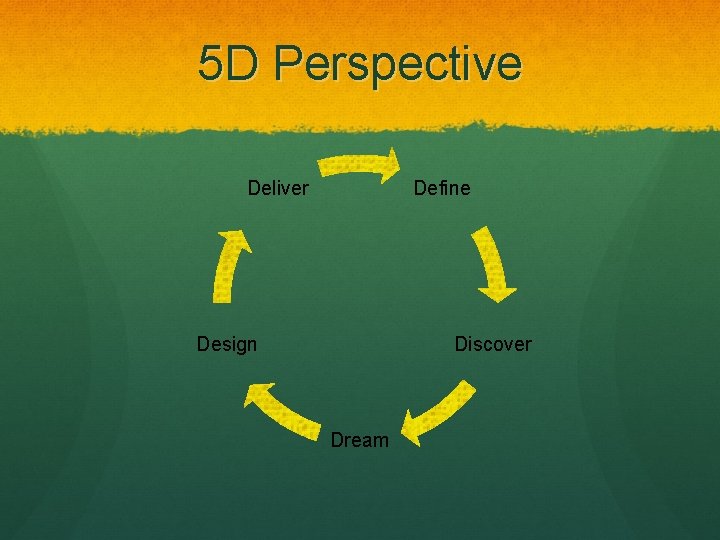
5 D Perspective Deliver Define Design Discover Dream
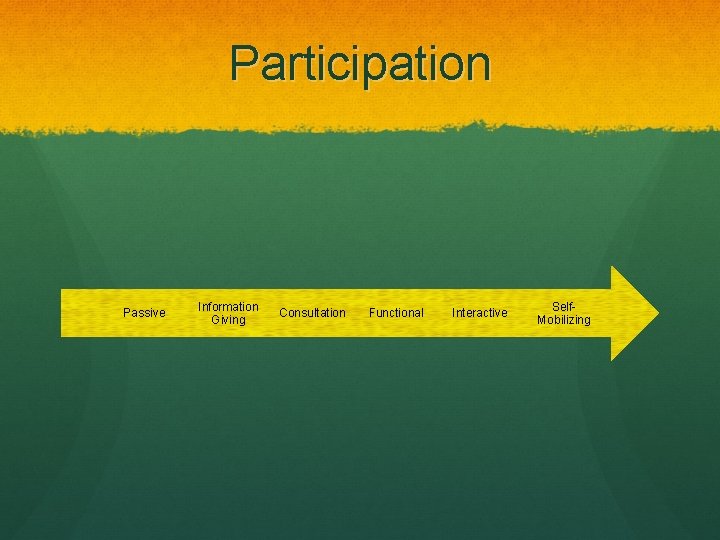
Participation Passive Information Giving Consultation Functional Interactive Self. Mobilizing
Application of AI Goals must be conducive to AI philosophy Group size should be complimentary to the community of inquiry and its members Facilitator of AI is not a leader or teacher, but a guide AI takes time Transformation is directly linked to enacting community visions.
AI Questions Open-ended Conversational Affirming Tell me about your best times in OKC growing up? Think about Southern Oaks and the best of what it is as a community. Now, tell me what your dream vision for the Southern Oaks community looks like? Use prompts not more questions.
AI is not Deficit based Problem focused Highly structured
AI Community Example Watch the following video on using AI in community practice and watch for the utilization of the principles and philosophy of AI. https: //www. youtube. com/watch? v=p. VBMMJ 0 RMao
Questions In what contexts do you think AI would be more beneficial? Why? Are there any contexts where AI would not be appropriate? Why or Why not? Think about your field practicum sites and surrounding communities, how can you envision AI being more useful in to them?
References Center for Appreciative Inquiry (2014). Principles of appreciative inquiry. Retrieved from: http: //www. centerforappreciativeinquiry. net/more-onai/principles-of-appreciative-inquiry/ University of Kansas (2015). Community Toolbox. Retrieved from: http: //ctb. ku. edu/en/table-of-contents/overview/models -for-community-health-and-development/assetdevelopment/main Cooperrider, D. & Whitney, D. (2005). Appreciative inquiry: A positive Revolution. San Francisco: Berrett-Koehler.
ABCD and Service Learning Core principles of social justice and equity Respect for the community and its individuals Paradigm shift – missionary mentality Paradigm shift – community-driven vs research-driven, funderdriven Conceptual framework/tools to understand communities
What do students learn from asset-based approach? Appreciate strengths of individuals, how they keep themselves healthy Understand community resources and how they provide for citizens’ well-being Understand how community residents perceive their health and define their concerns
- Slides: 26