
ASSESSMENT STRATEGIES SESSION 5 EFFECTIVE COMMUNICATION TEACHING LEARNING
![‘We may compare teaching to selling commodities. No one can sell unless someone buys…[yet]](https://slidetodoc.com/presentation_image_h/1fd0089ae9a25344cfc775f87e927612/image-7.jpg "‘We may compare teaching to selling commodities. No one can sell unless someone buys…[yet]")
- Slides: 29
ASSESSMENT STRATEGIES SESSION 5 EFFECTIVE COMMUNICATION: TEACHING, LEARNING AND ASSESSMENT STRATEGIES
OVERVIEW • Classroom assessment techniques (REVIEW) • Formal assessment tasks – Instructions – Criteria (GOAL) – Feedback (MEDAL, MISSION) – Rubrics (TELL) – Exemplars (SHOW)
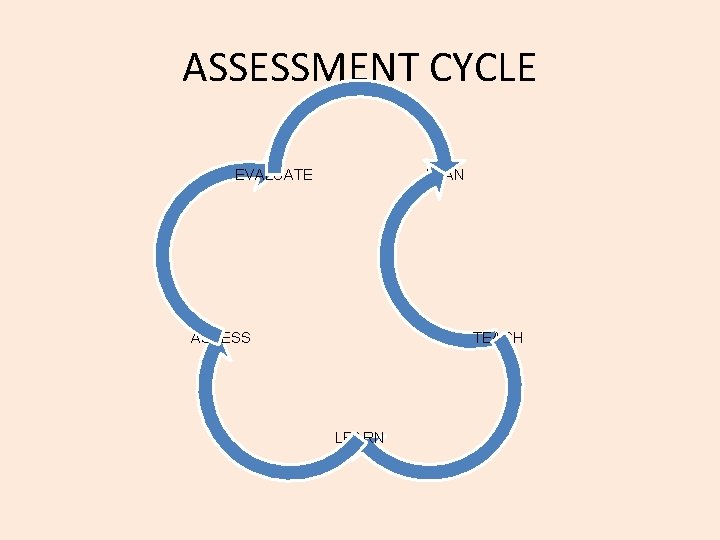
ASSESSMENT CYCLE EVALUATE PLAN ASSESS TEACH LEARN
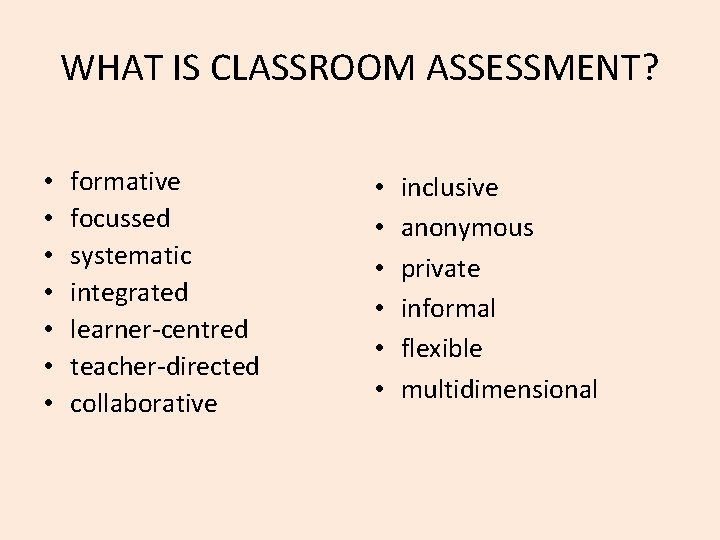
WHAT IS CLASSROOM ASSESSMENT? • • formative focussed systematic integrated learner-centred teacher-directed collaborative • • • inclusive anonymous private informal flexible multidimensional
WHAT ARE CATs? • Formative assessment tools for collecting data on student learning with a view to making it more efficient and effective. • Devices that provide a record of student feedback for future reference and learning • Procedures designed to get immediate and useful answers to very focused questions • A complement to formal evaluation • Teaching strategies
TECHNIQUES TO KNOW AND SHOW STUDENTS ARE LEARNING • • • The minute paper Muddiest point Studied vs learnt cycle Logs/ journals Buzz Electronic vote Flash boards Applications cards Two pluses and a wish
‘We may compare teaching to selling commodities. No one can sell unless someone buys…[yet] there are teachers who think they have done a good day’s teaching irrespective of what pupils have learned. ’ Dewey, 1933, p. 35
Useful book on this subject Classroom Assessment Techniques: a handbook for college teachers. Thomas A. Angelo, K. Patricia Cross San Francisco, Jossey-Bass 1993
FORMAL ASSESSMENT & EVALUATION
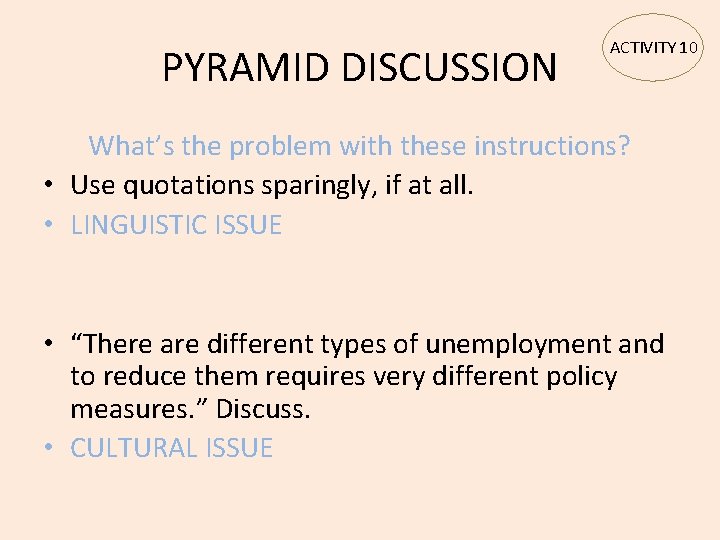
PYRAMID DISCUSSION ACTIVITY 10 What’s the problem with these instructions? • Use quotations sparingly, if at all. • LINGUISTIC ISSUE • “There are different types of unemployment and to reduce them requires very different policy measures. ” Discuss. • CULTURAL ISSUE
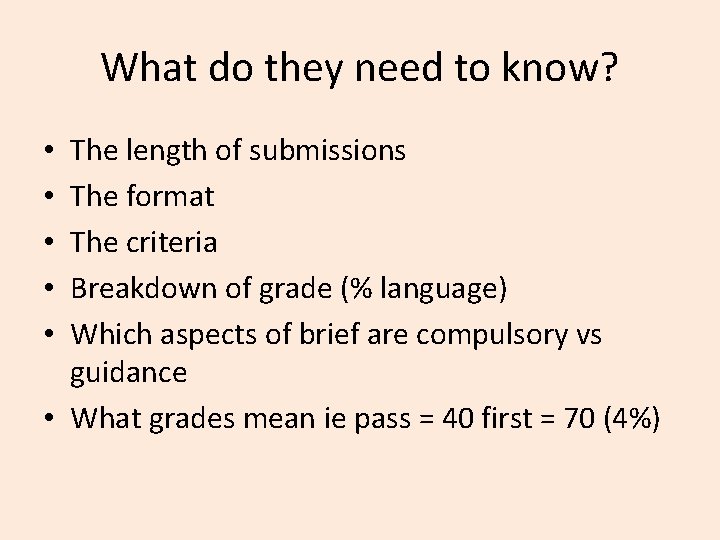
What do they need to know? The length of submissions The format The criteria Breakdown of grade (% language) Which aspects of brief are compulsory vs guidance • What grades mean ie pass = 40 first = 70 (4%) • • •
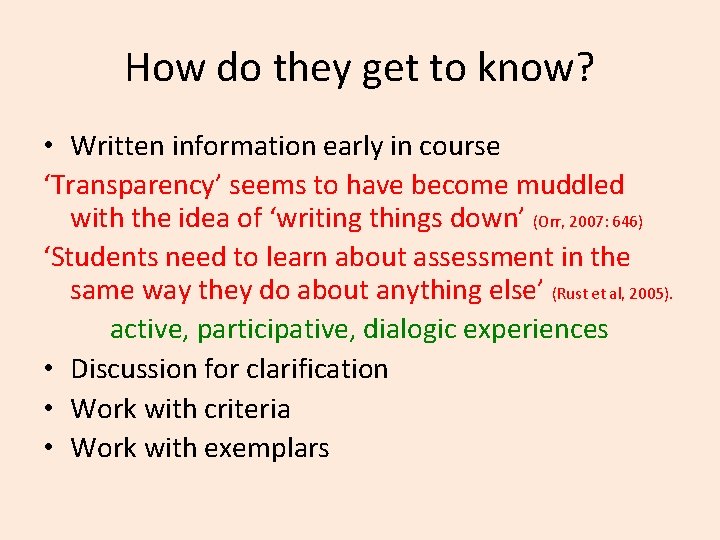
How do they get to know? • Written information early in course ‘Transparency’ seems to have become muddled with the idea of ‘writing things down’ (Orr, 2007: 646) ‘Students need to learn about assessment in the same way they do about anything else’ (Rust et al, 2005). active, participative, dialogic experiences • Discussion for clarification • Work with criteria • Work with exemplars
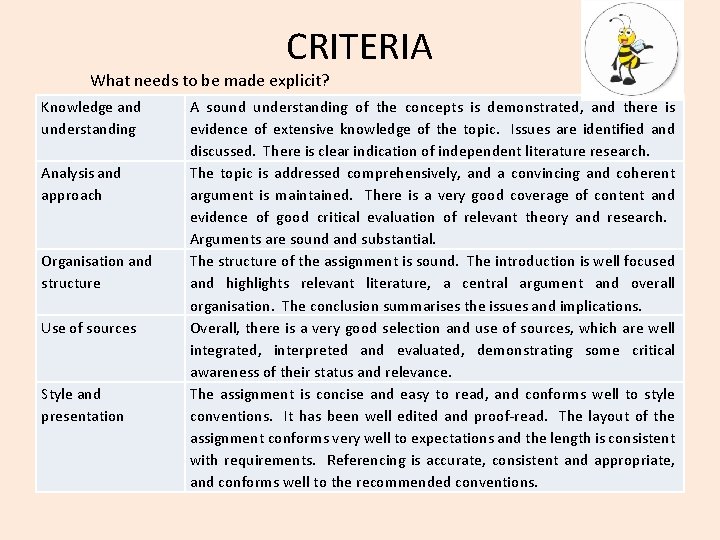
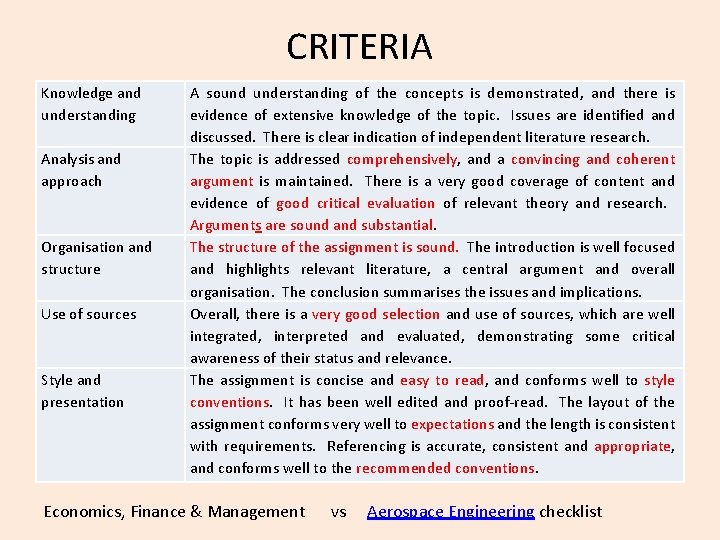
CRITERIA What needs to be made explicit? Knowledge and understanding Analysis and approach Organisation and structure Use of sources Style and presentation A sound understanding of the concepts is demonstrated, and there is evidence of extensive knowledge of the topic. Issues are identified and discussed. There is clear indication of independent literature research. The topic is addressed comprehensively, and a convincing and coherent argument is maintained. There is a very good coverage of content and evidence of good critical evaluation of relevant theory and research. Arguments are sound and substantial. The structure of the assignment is sound. The introduction is well focused and highlights relevant literature, a central argument and overall organisation. The conclusion summarises the issues and implications. Overall, there is a very good selection and use of sources, which are well integrated, interpreted and evaluated, demonstrating some critical awareness of their status and relevance. The assignment is concise and easy to read, and conforms well to style conventions. It has been well edited and proof-read. The layout of the assignment conforms very well to expectations and the length is consistent with requirements. Referencing is accurate, consistent and appropriate, and conforms well to the recommended conventions.
CRITERIA Knowledge and understanding Analysis and approach Organisation and structure Use of sources Style and presentation A sound understanding of the concepts is demonstrated, and there is evidence of extensive knowledge of the topic. Issues are identified and discussed. There is clear indication of independent literature research. The topic is addressed comprehensively, and a convincing and coherent argument is maintained. There is a very good coverage of content and evidence of good critical evaluation of relevant theory and research. Arguments are sound and substantial. The structure of the assignment is sound. The introduction is well focused and highlights relevant literature, a central argument and overall organisation. The conclusion summarises the issues and implications. Overall, there is a very good selection and use of sources, which are well integrated, interpreted and evaluated, demonstrating some critical awareness of their status and relevance. The assignment is concise and easy to read, and conforms well to style conventions. It has been well edited and proof-read. The layout of the assignment conforms very well to expectations and the length is consistent with requirements. Referencing is accurate, consistent and appropriate, and conforms well to the recommended conventions. Economics, Finance & Management vs Aerospace Engineering checklist
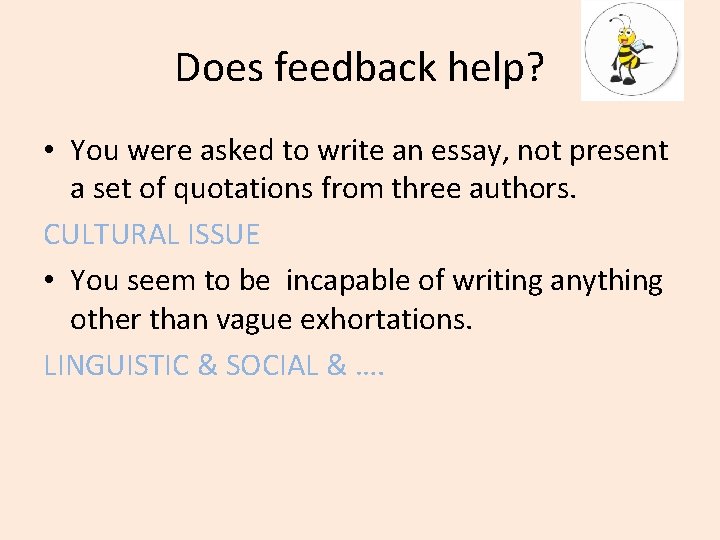
Does feedback help? • You were asked to write an essay, not present a set of quotations from three authors. CULTURAL ISSUE • You seem to be incapable of writing anything other than vague exhortations. LINGUISTIC & SOCIAL & ….
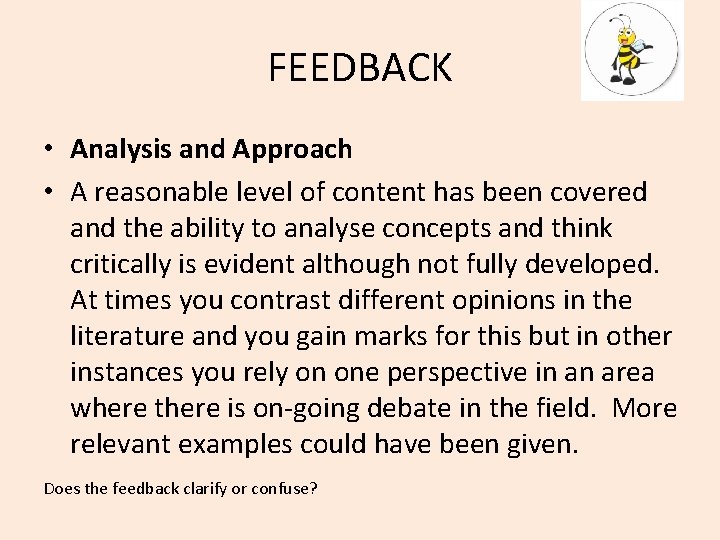
FEEDBACK • Analysis and Approach • A reasonable level of content has been covered and the ability to analyse concepts and think critically is evident although not fully developed. At times you contrast different opinions in the literature and you gain marks for this but in other instances you rely on one perspective in an area where there is on-going debate in the field. More relevant examples could have been given. Does the feedback clarify or confuse?
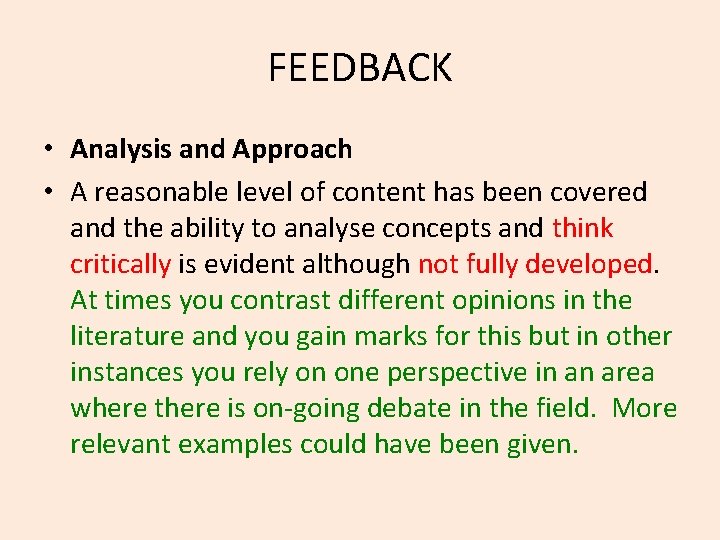
FEEDBACK • Analysis and Approach • A reasonable level of content has been covered and the ability to analyse concepts and think critically is evident although not fully developed. At times you contrast different opinions in the literature and you gain marks for this but in other instances you rely on one perspective in an area where there is on-going debate in the field. More relevant examples could have been given.
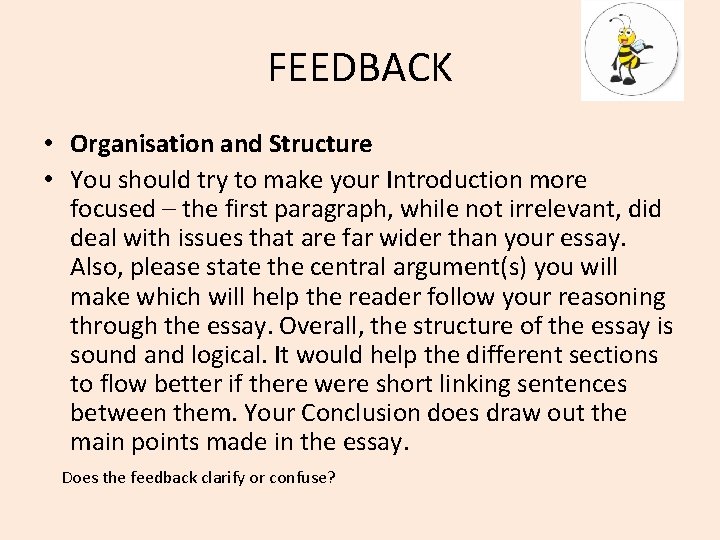
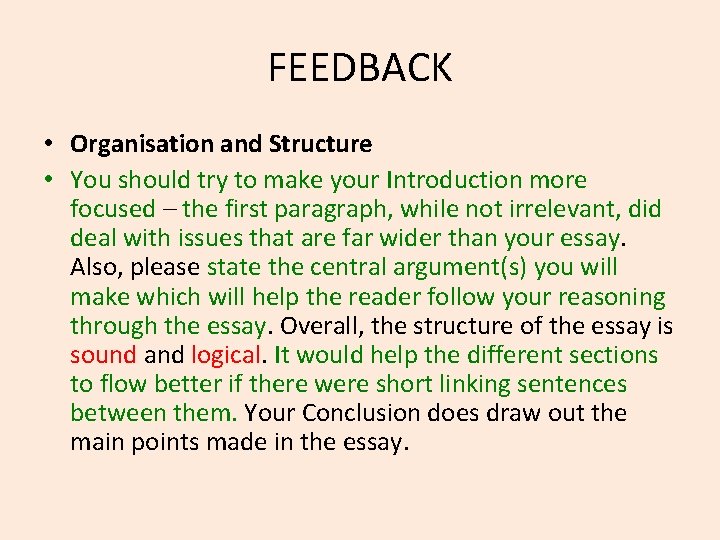
FEEDBACK • Organisation and Structure • You should try to make your Introduction more focused – the first paragraph, while not irrelevant, did deal with issues that are far wider than your essay. Also, please state the central argument(s) you will make which will help the reader follow your reasoning through the essay. Overall, the structure of the essay is sound and logical. It would help the different sections to flow better if there were short linking sentences between them. Your Conclusion does draw out the main points made in the essay. Does the feedback clarify or confuse?
FEEDBACK • Organisation and Structure • You should try to make your Introduction more focused – the first paragraph, while not irrelevant, did deal with issues that are far wider than your essay. Also, please state the central argument(s) you will make which will help the reader follow your reasoning through the essay. Overall, the structure of the essay is sound and logical. It would help the different sections to flow better if there were short linking sentences between them. Your Conclusion does draw out the main points made in the essay.
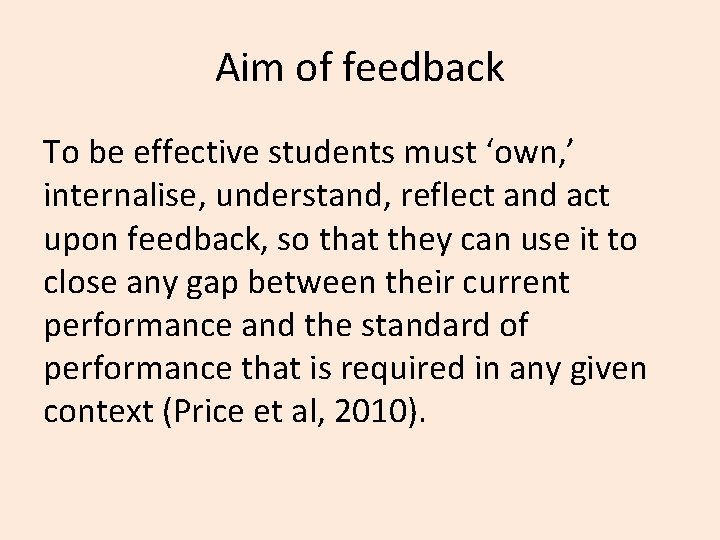
Aim of feedback To be effective students must ‘own, ’ internalise, understand, reflect and act upon feedback, so that they can use it to close any gap between their current performance and the standard of performance that is required in any given context (Price et al, 2010).
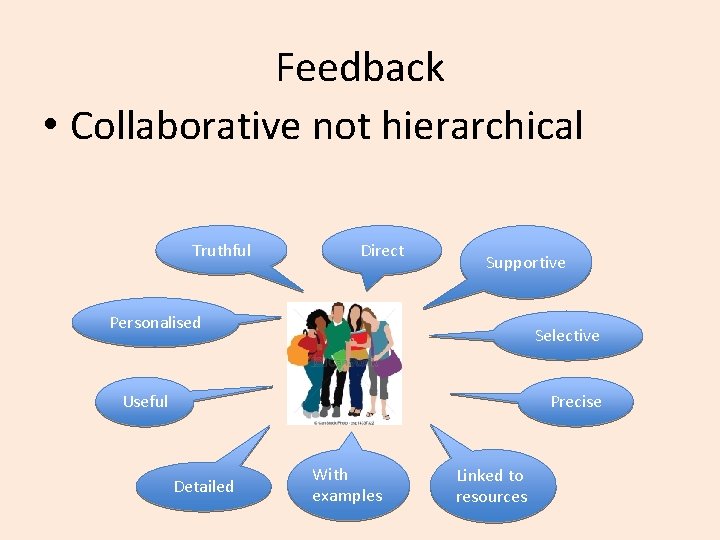
Feedback • Collaborative not hierarchical Truthful Direct Supportive Personalised Selective Useful Precise Detailed With examples Linked to resources
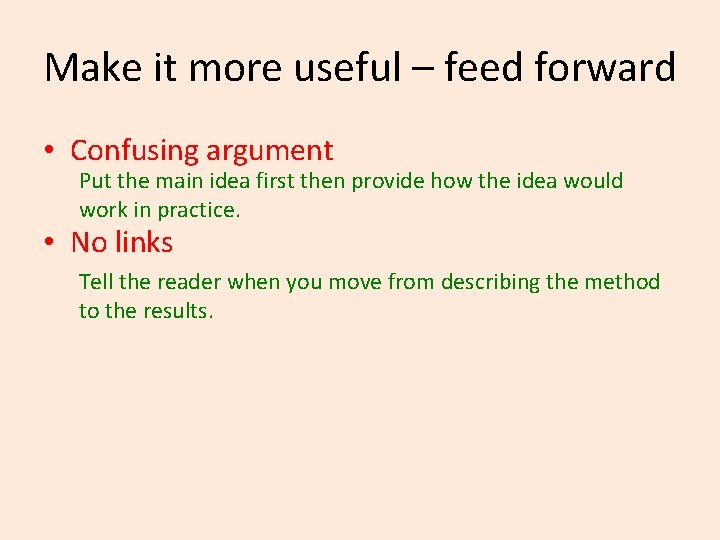
Make it more useful – feed forward • Confusing argument Put the main idea first then provide how the idea would work in practice. • No links Tell the reader when you move from describing the method to the results.
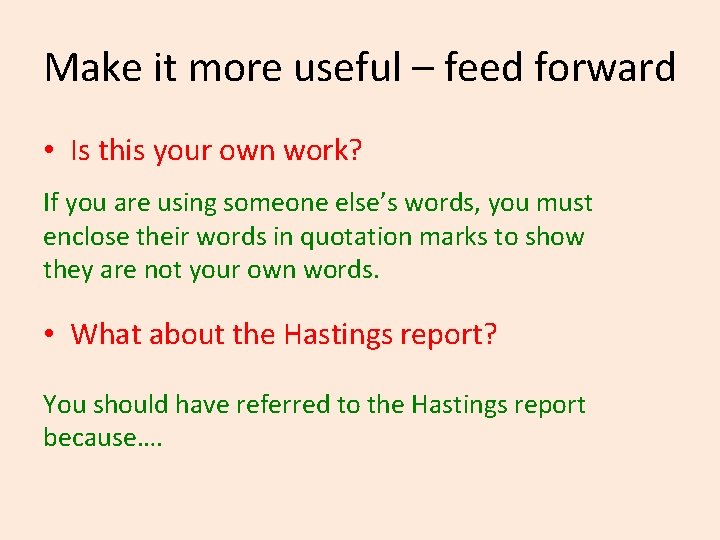
Make it more useful – feed forward • Is this your own work? If you are using someone else’s words, you must enclose their words in quotation marks to show they are not your own words. • What about the Hastings report? You should have referred to the Hastings report because….
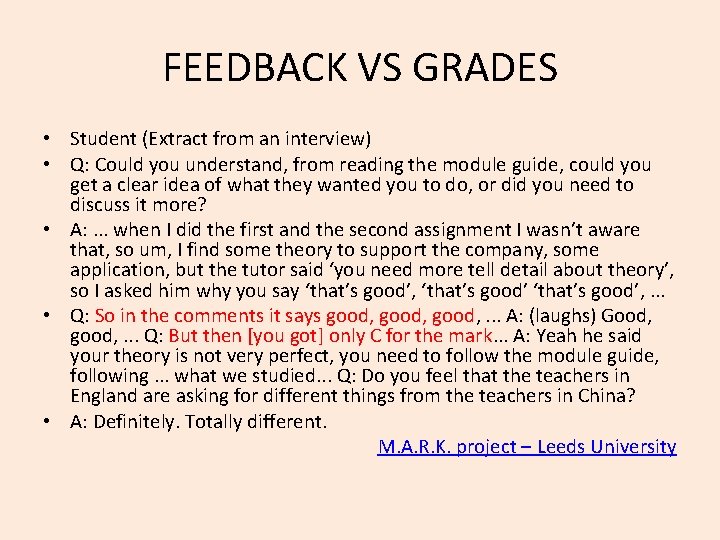
FEEDBACK VS GRADES • Student (Extract from an interview) • Q: Could you understand, from reading the module guide, could you get a clear idea of what they wanted you to do, or did you need to discuss it more? • A: . . . when I did the first and the second assignment I wasn’t aware that, so um, I find some theory to support the company, some application, but the tutor said ‘you need more tell detail about theory’, so I asked him why you say ‘that’s good’, . . . • Q: So in the comments it says good, . . . A: (laughs) Good, good, . . . Q: But then [you got] only C for the mark. . . A: Yeah he said your theory is not very perfect, you need to follow the module guide, following. . . what we studied. . . Q: Do you feel that the teachers in England are asking for different things from the teachers in China? • A: Definitely. Totally different. M. A. R. K. project – Leeds University
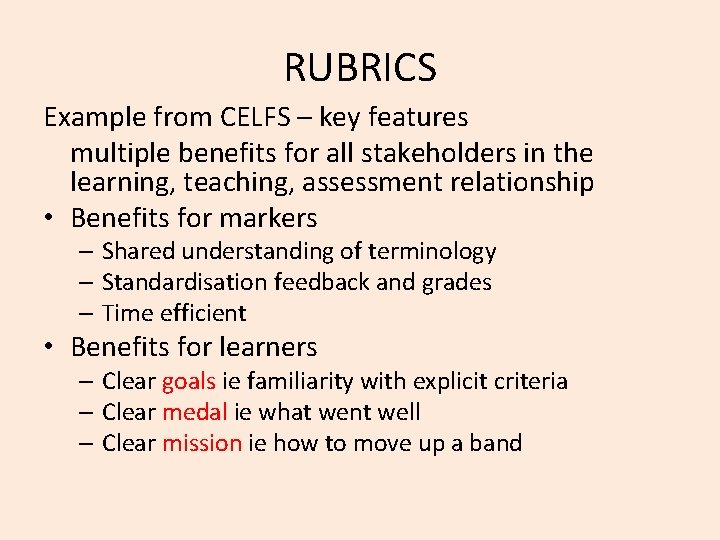
RUBRICS Example from CELFS – key features multiple benefits for all stakeholders in the learning, teaching, assessment relationship • Benefits for markers – Shared understanding of terminology – Standardisation feedback and grades – Time efficient • Benefits for learners – Clear goals ie familiarity with explicit criteria – Clear medal ie what went well – Clear mission ie how to move up a band
How do we use rubrics? • • tutor feedback (standardised) self-evaluation (plus points? ) peer evaluation (confidence, face & offence? ) peer evaluation once removed (exemplars)
EXEMPLARS • ‘key examples chosen so as to be typical of designated levels of quality or competence. The exemplars are not standards themselves but are indicative of them. . . they specify standards implicitly. ’(Sadler, 1989 cited in Handley et al, 2008, p 44)
How do we use exemplars? • Whole essays at each degree classification with comments for viewing on VLE (Law) • Recorded presentations with opportunity to use rubric to grade & compare with actual (AS) • Extracts from exemplars in teaching materials to highlight key features (EFM)
SOCIAL CONSTRUCTIVISM active, participative, dialogic experiences