
Assessment Rubric for Critical Thinking Academic Round Table
Assessment Rubric for Critical Thinking Academic Round Table Presentation January 30, 2009 ART Beach Retreat
Class Without CT Assessment Rubric for Critical Thinking § Didactic instruction where students are presented with factual information from a text book § Assessment is primarily multiple choice items where students are expected to regurgitate factual information January 30, 2009 ART Beach Retreat 2
Class With CT Assessment Rubric for Critical Thinking § Interactive learning environment where students not only learn facts but the relationship between the facts and the application of that information § Authentic assessment where students are able to model the applications of the discipline through simulations, projects, etc. January 30, 2009 ART Beach Retreat 3
Authentic Assessments Assessment Rubric for Critical Thinking § Authentic assessments serve dual purposes of § encouraging students to think critically and § providing assessment data for measuring improved student learning. § These assessment techniques fall into three general categories: § criterion-referenced rubrics, § student reports (reflection or self-assessments), and § student portfolios. January 30, 2009 ART Beach Retreat 4
Assessment Rubric for Critical Thinking § A global rubric template developed to provide a snapshot view of how student learning is being affected by the critical thinking initiative. January 30, 2009 ART Beach Retreat 5
Assessment Rubric for Critical Thinking § Designed to be flexible enough to address a number of student project modalities including written and oral communications. § Will evaluate the student’s use of critical thinking skills in the development of the paper as opposed to specifically evaluating the quality of student’s writing skills. January 30, 2009 ART Beach Retreat 6
Assessment Rubric for Critical Thinking ARC was designed by the QEP staff and the Faculty Champions to… § Enhance the QEP § Align with the College’s definition of critical thinking § Be flexible for use in multi-disciplines January 30, 2009 ART Beach Retreat 7
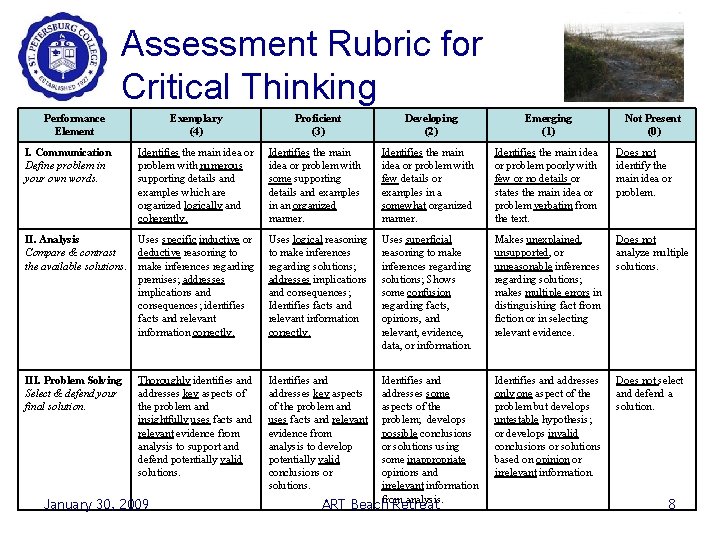
Assessment Rubric for Critical Thinking Performance Exemplary Proficient Assessment Rubric for Critical Thinking Element (4) (3) I. Communication Define problem in your own words. Identifies the main idea or problem with numerous supporting details and examples which are organized logically and coherently. Developing (2) Emerging (1) Not Present (0) Identifies the main idea or problem with some supporting details and examples in an organized manner. Identifies the main idea or problem with few details or examples in a somewhat organized manner. Identifies the main idea or problem poorly with few or no details or states the main idea or problem verbatim from the text. Does not identify the main idea or problem. II. Analysis Uses specific inductive or Compare & contrast deductive reasoning to the available solutions. make inferences regarding premises; addresses implications and consequences; identifies facts and relevant information correctly. Uses logical reasoning to make inferences regarding solutions; addresses implications and consequences; Identifies facts and relevant information correctly. Uses superficial reasoning to make inferences regarding solutions; Shows some confusion regarding facts, opinions, and relevant, evidence, data, or information. Makes unexplained, unsupported, or unreasonable inferences regarding solutions; makes multiple errors in distinguishing fact from fiction or in selecting relevant evidence. Does not analyze multiple solutions. III. Problem Solving Select & defend your final solution. Identifies and addresses key aspects of the problem and uses facts and relevant evidence from analysis to develop potentially valid conclusions or solutions. Identifies and addresses some aspects of the problem; develops possible conclusions or solutions using some inappropriate opinions and irrelevant information from analysis. Identifies and addresses only one aspect of the problem but develops untestable hypothesis; or develops invalid conclusions or solutions based on opinion or irrelevant information. Does not select and defend a solution. Thoroughly identifies and addresses key aspects of the problem and insightfully uses facts and relevant evidence from analysis to support and defend potentially valid solutions. January 30, 2009 ART Beach Retreat 8
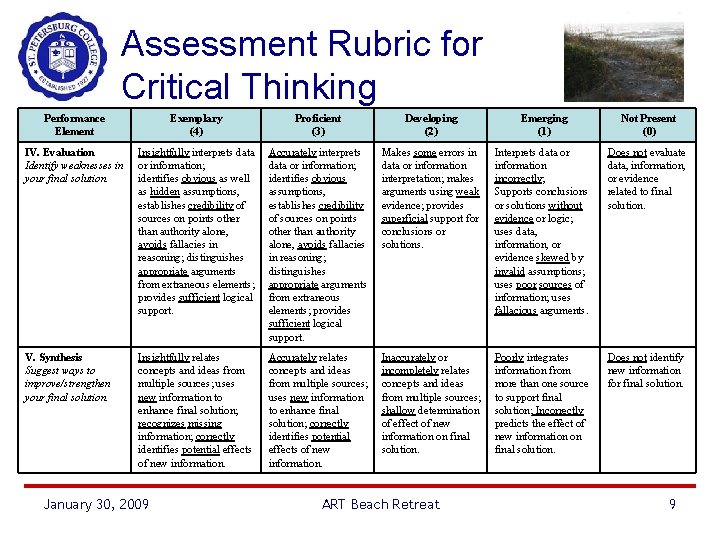
Assessment Rubric for Critical Thinking Performance Exemplary Proficient Assessment Rubric for Critical Thinking Element (4) (3) Developing (2) Emerging (1) Not Present (0) IV. Evaluation Identify weaknesses in your final solution. Insightfully interprets data or information; identifies obvious as well as hidden assumptions, establishes credibility of sources on points other than authority alone, avoids fallacies in reasoning; distinguishes appropriate arguments from extraneous elements; provides sufficient logical support. Accurately interprets data or information; identifies obvious assumptions, establishes credibility of sources on points other than authority alone, avoids fallacies in reasoning; distinguishes appropriate arguments from extraneous elements; provides sufficient logical support. Makes some errors in data or information interpretation; makes arguments using weak evidence; provides superficial support for conclusions or solutions. Interprets data or information incorrectly; Supports conclusions or solutions without evidence or logic; uses data, information, or evidence skewed by invalid assumptions; uses poor sources of information; uses fallacious arguments. Does not evaluate data, information, or evidence related to final solution. V. Synthesis Suggest ways to improve/strengthen your final solution. Insightfully relates concepts and ideas from multiple sources; uses new information to enhance final solution; recognizes missing information; correctly identifies potential effects of new information. Accurately relates concepts and ideas from multiple sources; uses new information to enhance final solution; correctly identifies potential effects of new information. Inaccurately or incompletely relates concepts and ideas from multiple sources; shallow determination of effect of new information on final solution. Poorly integrates information from more than one source to support final solution; Incorrectly predicts the effect of new information on final solution. Does not identify new information for final solution. January 30, 2009 ART Beach Retreat 9
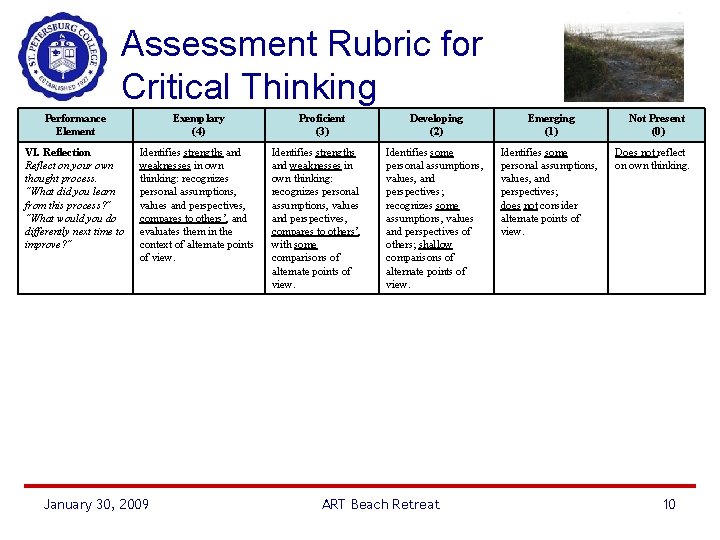
Assessment Rubric for Critical Thinking Performance Exemplary Proficient Assessment Rubric for Critical Thinking Element (4) (3) VI. Reflection Reflect on your own thought process. “What did you learn from this process? ” “What would you do differently next time to improve? ” Identifies strengths and weaknesses in own thinking: recognizes personal assumptions, values and perspectives, compares to others’, and evaluates them in the context of alternate points of view. January 30, 2009 Identifies strengths and weaknesses in own thinking: recognizes personal assumptions, values and perspectives, compares to others’, with some comparisons of alternate points of view. Developing (2) Emerging (1) Identifies some personal assumptions, values, and perspectives; recognizes some assumptions, values and perspectives of others; shallow comparisons of alternate points of view. Identifies some personal assumptions, values, and perspectives; does not consider alternate points of view. ART Beach Retreat Not Present (0) Does not reflect on own thinking. 10
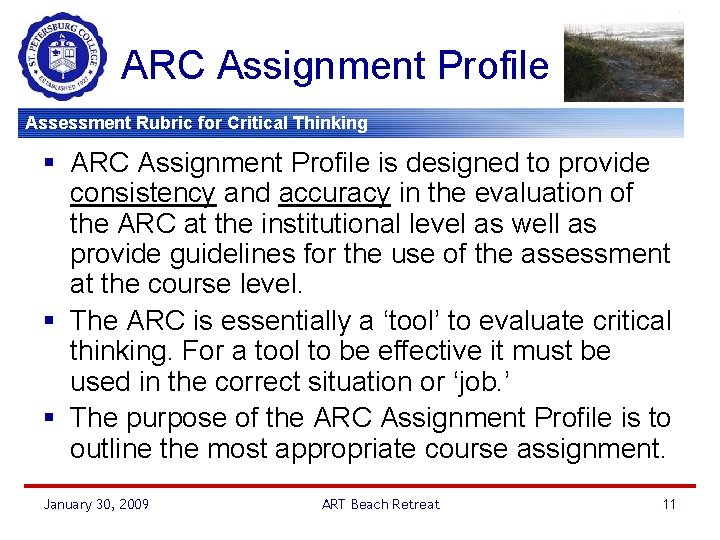
ARC Assignment Profile Assessment Rubric for Critical Thinking § ARC Assignment Profile is designed to provide consistency and accuracy in the evaluation of the ARC at the institutional level as well as provide guidelines for the use of the assessment at the course level. § The ARC is essentially a ‘tool’ to evaluate critical thinking. For a tool to be effective it must be used in the correct situation or ‘job. ’ § The purpose of the ARC Assignment Profile is to outline the most appropriate course assignment. January 30, 2009 ART Beach Retreat 11
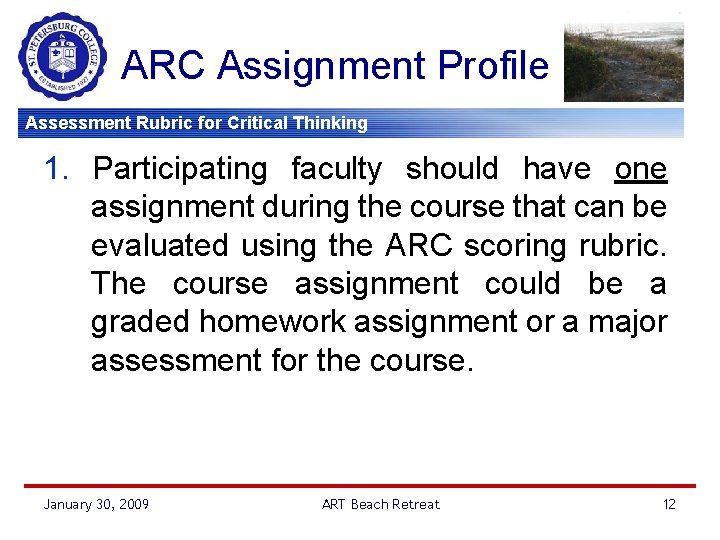
ARC Assignment Profile Assessment Rubric for Critical Thinking 1. Participating faculty should have one assignment during the course that can be evaluated using the ARC scoring rubric. The course assignment could be a graded homework assignment or a major assessment for the course. January 30, 2009 ART Beach Retreat 12
ARC Assignment Profile Assessment Rubric for Critical Thinking 2. The course assignment for the ARC should include all of the elements of the rubric and should be aligned with the task outlined for each element. Assignments that only evaluate some of the elements or are not aligned with the specific ARC tasks will be considered incomplete and not used in the institutional analysis. January 30, 2009 ART Beach Retreat 13
ARC Assignment Profile Assessment Rubric for Critical Thinking 3. Faculty may additional discipline specific rubric elements (such as grammar and punctuation in a composition class), but must maintain the ARC elements as listed. January 30, 2009 ART Beach Retreat 14
ARC Assignment Profile Assessment Rubric for Critical Thinking 4. Students should be provided a copy of the assignment rubric (ARC and any additional discipline specific elements). The specific elements and tasks include: § § § Communication: Define the problem in your own words. Analysis: Compare & contrast the available solutions within the scenario. Problem Solving: Select one of the available solutions and defend it as your final solution. Evaluation: Identify the weaknesses of your final solution. Synthesis: Suggest ways to improve/strengthen your final solution (may use information not contained within the scenario). Reflection: Reflect on your own thought process after completing the assignment. § § January 30, 2009 “What did you learn from this process? ” “What would you do differently next time to improve? ” ART Beach Retreat 15
ARC Assignment Profile Assessment Rubric for Critical Thinking 5. The evaluating scenario (selected or created) should be stated in such a manner to allow the student to address each of the tasks. The QEP team is willing to assist with the creation of the scenario or identify possible sources of existing scenario that could be used. January 30, 2009 ART Beach Retreat 16
ARC Assignment Profile Assessment Rubric for Critical Thinking 6. At the end of the semester, please send the completed student assignments to the Janice Thiel, QEP Director, TE 1 -111 (X 3110). Completed student assignments should include a copy of the scenario, the assignment provided to the student (with the rubric), the students work and the final graded rubric. January 30, 2009 ART Beach Retreat 17
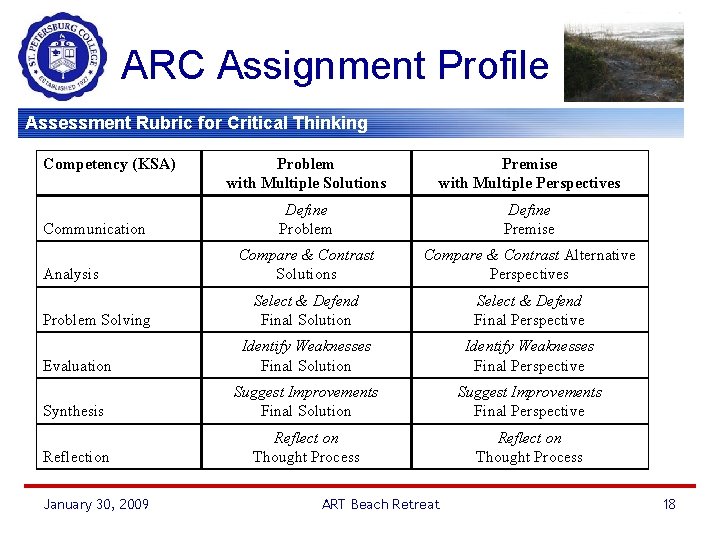
ARC Assignment Profile Assessment Rubric for Critical Thinking Competency (KSA) Problem with Multiple Solutions Premise with Multiple Perspectives Define Problem Define Premise Compare & Contrast Solutions Compare & Contrast Alternative Perspectives Select & Defend Final Solution Select & Defend Final Perspective Evaluation Identify Weaknesses Final Solution Identify Weaknesses Final Perspective Synthesis Suggest Improvements Final Solution Suggest Improvements Final Perspective Reflection Reflect on Thought Process Communication Analysis Problem Solving January 30, 2009 ART Beach Retreat 18
Sample Scenario (Deer) Assessment Rubric for Critical Thinking Three teenagers were seriously injured in a car accident when swerving to avoid a deer on a two -lane road near a small, rural town in Florida. The residents of the town have seen more and more deer enter the town’s populated areas over recent years. Local law enforcement has been called numerous times this year to remove the animals from backyards and neighborhood streets, and one deer even caused considerable damage as it entered a restaurant in town. The mayor has been charged by the city leaders to keep the town residents safe. January 30, 2009 ART Beach Retreat 19
Sample Scenario (Deer) Assessment Rubric for Critical Thinking Local crops have even been damaged by the animals. Some long time residents have requested that the hunting season and catch limits be extended in order to reduce the deer population. One city leader even proposed that the city purchase electronic devices to deter the deer from entering populated areas. Health concerns have recently been elevated as three deer carcasses were found at the edge of town and local law enforcement suspect that the animals had been poisoned. January 30, 2009 ART Beach Retreat 20
Sample Scenario (Deer) Assessment Rubric for Critical Thinking Possible Solutions: 1. Some long time residents have requested that the hunting season and catch limits be extended in order to reduce the deer population. 2. One city leader even proposed that the city purchase electronic devices to deter the deer from entering populated areas. 3. Health concerns have recently been elevated as three deer carcasses were found at the edge of town and local law enforcement suspect that the animals had been poisoned. January 30, 2009 ART Beach Retreat 21
Improving Scoring Consistency Assessment Rubric for Critical Thinking § § § Provide rubric to students prior to assessment Anonymous papers Anchor papers defining levels of proficiency for reference Use of multiple scorers Interrater reliability statistics during training and grading January 30, 2009 ART Beach Retreat 22
Assessment Rubric for Critical Thinking Academic Round Table Presentation January 30, 2009 ART Beach Retreat
- Slides: 23