
Assessment of Using Bentonite in Water Hardness Conents
Assessment of Using Bentonite in Water Hardness
Conents 1. Introduction 1. 1 Types of hardness 1. 2 Water softening methods 1. 3 Classification of bentonite 1. 4 Uses Of Bentonite 2. Methode 2. 1 Standard Solutions Preparations 2. 2 Experimental procedures 3. Results 4. Future Plans
Water is one of our most natural resources. Without it, there would be no life on earth.
Sources of water o Upland lakes and reservoirs o Rivers, canals and low land reservoirs o Rainwater harvesting or fog collection o Groundwater But that groundwater often be accompanied by elements of Ca and Mg causing water hardness Hard water is Contains dissolved salts of bicarbonates, sulphates and chlorides of calcium and magnesium. Hard water does not produce lather with soap solution.
1. 1 Types of hardness (i)Temporary hardness due to presence of soluble bicarbonates of calcium and magnesium. (ii)Permanent hardness due to presence of chlorides and sulphates of calcium and magnesium. Recent research tend to provide and maintain water sources and convert it from unusable to usable form, such as waste water and industrial water and treatment and desalination of sea water and remove the water hardness of the wells
1. 2 Water softening methods o Ion-exchange resin devices. o Lime softening. o Chelating agents. o Distillation and rain water. o Reverse osmosis. o Treatment with Bentonite. The Bentonite is one of the most usable softener for water is an absorbent aluminium phyllosilicate, impure clay consisting mostly of montmorillonite.
1. 3 Classification of bentonite 1 - Sodium bentonite 2 - Calcium bentonite 3 - Potassium Bentonite 1. 4 Use of Bentonite The first part as a water softener and purifier because of its special properties as it used as a detoxifier in the past , it is binding to heavy metal and remove it. The second part as a driller assistant as it has ability to expand ten times its volume when completely hydrated , it creates a very viscous , slippery , almost gel like slurry that act as lubricant for the rotary driller.
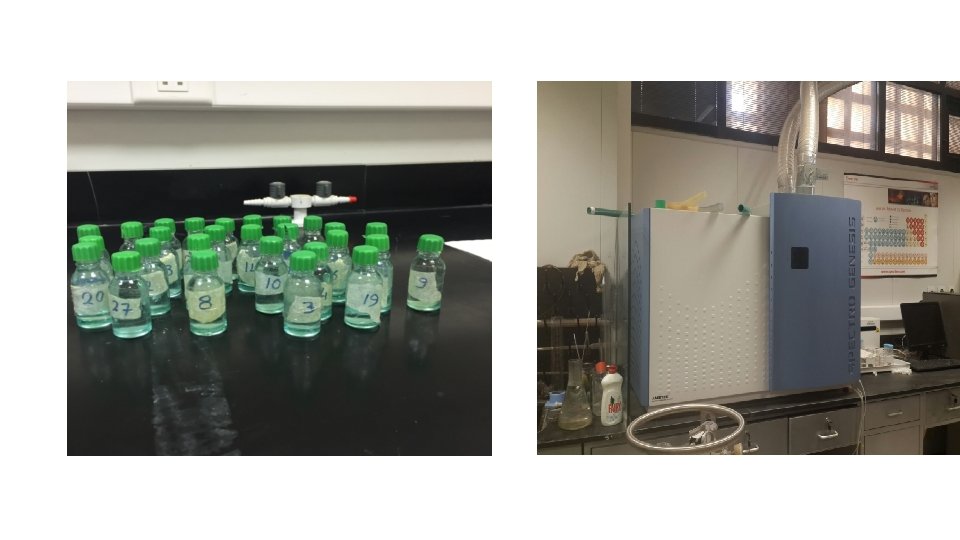
2. Methode 2. 1 Standard Solutions Preparations: Selected water wells was collected and synthetic hard-water with different concentrations were prepared of 10 g/L Ca, 10 g/L Mg and 10 g/L for both Ca and Mg 2. 2 Experimental procedures The capability of bentonite for Ca and Mg removal from aqueous solution was evaluated through adsorption kinetics. In a batch system, a working solution of Ca and Mg were prepared by diluting a sufficient volume of the stock solution to achieve the desired concentrations. For each adsorption data point, the dry adsorbents were accurately weighed and placed into the glass vials. The glass vials were then filled with the cation solution (with the specified concentration), sealed immediately and allowed to equilibrate in a water bath shaker with a constant temperature bath at 30◦C. After each experiment the solution was filtered and Ca and Mg concentration s were determined. The following parameters were investigated; effect of contact time (Equilibrium Time), initial concentration and mass of adsorbents. All experiments were repeated at different temperatures 40◦C, 50◦C and 60◦C.
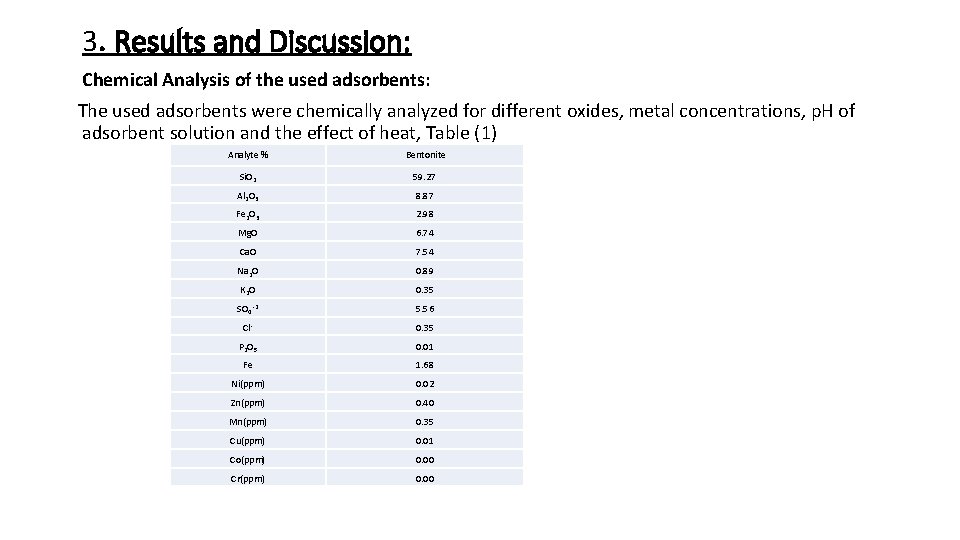
3. Results and Discussion: Chemical Analysis of the used adsorbents: The used adsorbents were chemically analyzed for different oxides, metal concentrations, p. H of adsorbent solution and the effect of heat, Table (1) Analyte % Bentonite Si. O 2 59. 27 Al 2 O 3 8. 87 Fe 2 O 3 2. 98 Mg. O 6. 74 Ca. O 7. 54 Na 2 O 0. 89 K 2 O 0. 35 SO 4 -2 5. 56 Cl- 0. 35 P 2 O 5 0. 01 Fe 1. 68 Ni(ppm) 0. 02 Zn(ppm) 0. 40 Mn(ppm) 0. 35 Cu(ppm) 0. 01 Co(ppm) 0. 00 Cr(ppm) 0. 00
4. Future Plans More Research on using different method , and materials with Referred to bentonite.
- Slides: 12