
Assessment of the impact of semiintensive shrimp farming
- Slides: 1
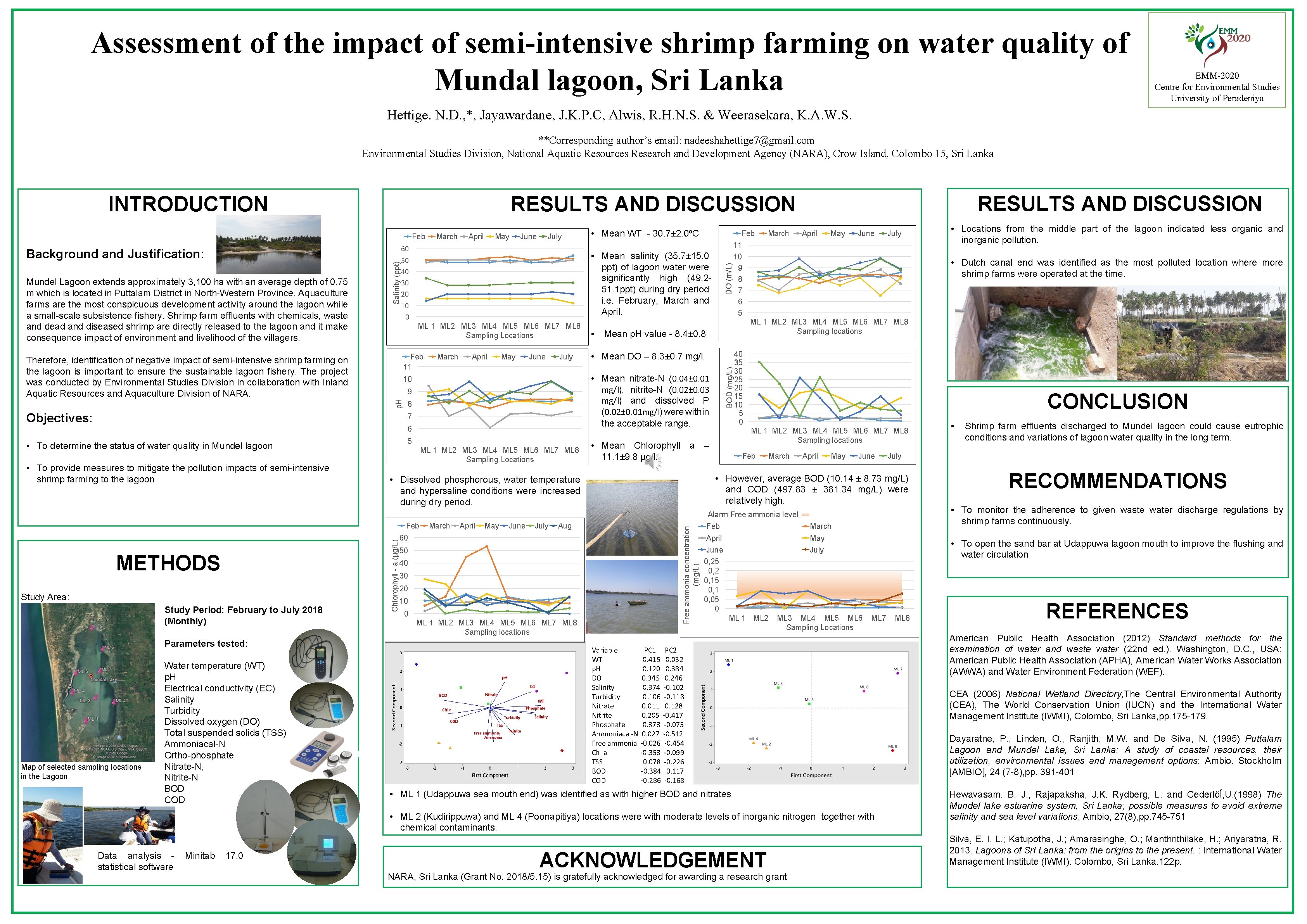
Assessment of the impact of semi-intensive shrimp farming on water quality of Mundal lagoon, Sri Lanka EMM-2020 Centre for Environmental Studies University of Peradeniya Hettige. N. D. , *, Jayawardane, J. K. P. C, Alwis, R. H. N. S. & Weerasekara, K. A. W. S. **Corresponding author’s email: nadeeshahettige 7@gmail. com Environmental Studies Division, National Aquatic Resources Research and Development Agency (NARA), Crow Island, Colombo 15, Sri Lanka INTRODUCTION Feb March April May June July 60 50 40 30 20 10 0 Feb 11 March April May June July p. H 9 8 7 6 5 • To determine the status of water quality in Mundel lagoon • To provide measures to mitigate the pollution impacts of semi-intensive shrimp farming to the lagoon • ML 1 ML 2 ML 3 ML 4 ML 5 ML 6 ML 7 ML 8 Sampling Locations DO (m/L) March April May June July 11 10 9 8 7 6 5 • Dutch canal end was identified as the most polluted location where more shrimp farms were operated at the time. Mean p. H value - 8. 4± 0. 8 • Mean DO – 8. 3± 0. 7 mg/l. 40 35 30 25 20 15 10 5 0 CONCLUSION ML 1 ML 2 ML 3 ML 4 ML 5 ML 6 ML 7 ML 8 Sampling locations • Mean Chlorophyll a – 11. 1± 9. 8 µg/l. Feb March April May June Study Area: Study Period: February to July 2018 (Monthly) Parameters tested: Map of selected sampling locations in the Lagoon Water temperature (WT) p. H Electrical conductivity (EC) Salinity Turbidity Dissolved oxygen (DO) Total suspended solids (TSS) Ammoniacal-N Ortho-phosphate Nitrate-N, Nitrite-N BOD Chlorophyll - a (µg/L) METHODS March April May June July Aug 60 50 40 30 20 10 0 ML 1 ML 2 ML 3 ML 4 ML 5 ML 6 ML 7 ML 8 Sampling locations Free ammonia concentration (mg/L) Alarm Free ammonia level Feb March April May June July ML 3 ML 4 ML 5 ML 6 Sampling Locations ML 7 Variable PC 1 PC 2 WT 0. 415 0. 032 p. H 0. 120 0. 384 DO 0. 345 0. 246 Salinity 0. 374 -0. 102 Turbidity 0. 106 -0. 118 Nitrate 0. 011 0. 128 Nitrite 0. 205 -0. 417 Phosphate 0. 373 -0. 075 Ammoniacal-N 0. 027 -0. 512 Free ammonia -0. 026 -0. 454 Chl a -0. 353 -0. 099 TSS 0. 078 -0. 226 BOD -0. 384 0. 117 COD -0. 286 -0. 168 • ML 1 (Udappuwa sea mouth end) was identified as with higher BOD and nitrates • ML 2 (Kudirippuwa) and ML 4 (Poonapitiya) locations were with moderate levels of inorganic nitrogen together with chemical contaminants. Data analysis statistical software Minitab 17. 0 ACKNOWLEDGEMENT NARA, Sri Lanka (Grant No. 2018/5. 15) is gratefully acknowledged for awarding a research grant Shrimp farm effluents discharged to Mundel lagoon could cause eutrophic conditions and variations of lagoon water quality in the long term. RECOMMENDATIONS • To monitor the adherence to given waste water discharge regulations by shrimp farms continuously. • To open the sand bar at Udappuwa lagoon mouth to improve the flushing and water circulation 0, 25 0, 2 0, 15 0, 1 0, 05 0 ML 1 ML 2 • July • However, average BOD (10. 14 ± 8. 73 mg/L) and COD (497. 83 ± 381. 34 mg/L) were relatively high. • Dissolved phosphorous, water temperature and hypersaline conditions were increased during dry period. • Locations from the middle part of the lagoon indicated less organic and inorganic pollution. ML 1 ML 2 ML 3 ML 4 ML 5 ML 6 ML 7 ML 8 Sampling locations • Mean nitrate-N (0. 04± 0. 01 mg/l), nitrite-N (0. 02± 0. 03 mg/l) and dissolved P (0. 02± 0. 01 mg/l) were within the acceptable range. 10 Objectives: Feb • Mean salinity (35. 7± 15. 0 ppt) of lagoon water were significantly high (49. 251. 1 ppt) during dry period i. e. February, March and April. ML 1 ML 2 ML 3 ML 4 ML 5 ML 6 ML 7 ML 8 Sampling Locations Therefore, identification of negative impact of semi-intensive shrimp farming on the lagoon is important to ensure the sustainable lagoon fishery. The project was conducted by Environmental Studies Division in collaboration with Inland Aquatic Resources and Aquaculture Division of NARA. • Mean WT - 30. 7± 2. 0ºC BOD (mg/L) Salinity (ppt) Background and Justification: Mundel Lagoon extends approximately 3, 100 ha with an average depth of 0. 75 m which is located in Puttalam District in North-Western Province. Aquaculture farms are the most conspicuous development activity around the lagoon while a small-scale subsistence fishery. Shrimp farm effluents with chemicals, waste and dead and diseased shrimp are directly released to the lagoon and it make consequence impact of environment and livelihood of the villagers. RESULTS AND DISCUSSION ML 8 REFERENCES American Public Health Association (2012) Standard methods for the examination of water and waste water (22 nd ed. ). Washington, D. C. , USA: American Public Health Association (APHA), American Water Works Association (AWWA) and Water Environment Federation (WEF). CEA (2006) National Wetland Directory, The Central Environmental Authority (CEA), The World Conservation Union (IUCN) and the International Water Management Institute (IWMI), Colombo, Sri Lanka, pp. 175 -179. Dayaratne, P. , Linden, O. , Ranjith, M. W. and De Silva, N. (1995) Puttalam Lagoon and Mundel Lake, Sri Lanka: A study of coastal resources, their utilization, environmental issues and management options: Ambio. Stockholm [AMBIO], 24 (7 -8), pp. 391 -401 Hewavasam. B. J. , Rajapaksha, J. K. Rydberg, L. and CederlöÍ, U. (1998) The Mundel lake estuarine system, Sri Lanka; possible measures to avoid extreme salinity and sea level variations, Ambio, 27(8), pp. 745 -751 Silva, E. I. L. ; Katupotha, J. ; Amarasinghe, O. ; Manthrithilake, H. ; Ariyaratna, R. 2013. Lagoons of Sri Lanka: from the origins to the present. : International Water Management Institute (IWMI). Colombo, Sri Lanka. 122 p.