
Assessment of the cardiovascular risks and health benefits
Assessment of the cardiovascular risks and health benefits of rosiglitazone David J. Graham, MD, MPH Office of Surveillance and Epidemiology Food and Drug Administration July 30, 2007 Center for Drug Evaluation and Research Joint Meeting of the Endocrinologic and Metabolic Drugs Advisory Committee and the Drug Safety and Risk Management Advisory Committee July 30, 2007
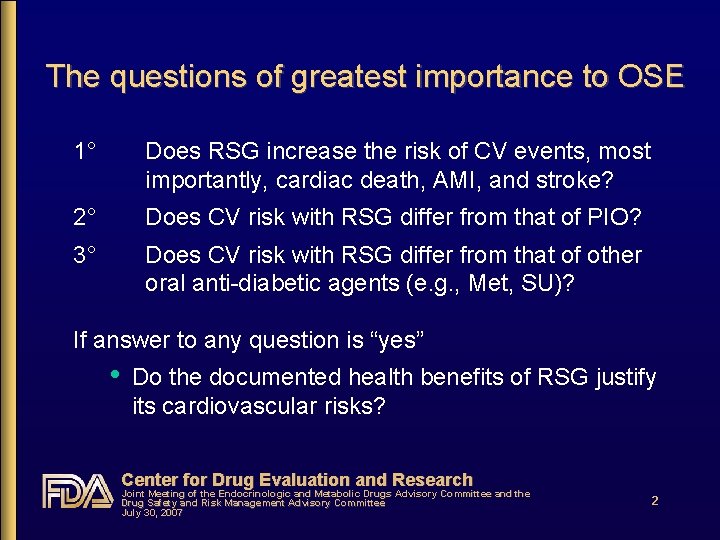
The questions of greatest importance to OSE 1° Does RSG increase the risk of CV events, most importantly, cardiac death, AMI, and stroke? 2° Does CV risk with RSG differ from that of PIO? 3° Does CV risk with RSG differ from that of other oral anti-diabetic agents (e. g. , Met, SU)? If answer to any question is “yes” • Do the documented health benefits of RSG justify its cardiovascular risks? Center for Drug Evaluation and Research Joint Meeting of the Endocrinologic and Metabolic Drugs Advisory Committee and the Drug Safety and Risk Management Advisory Committee July 30, 2007 2
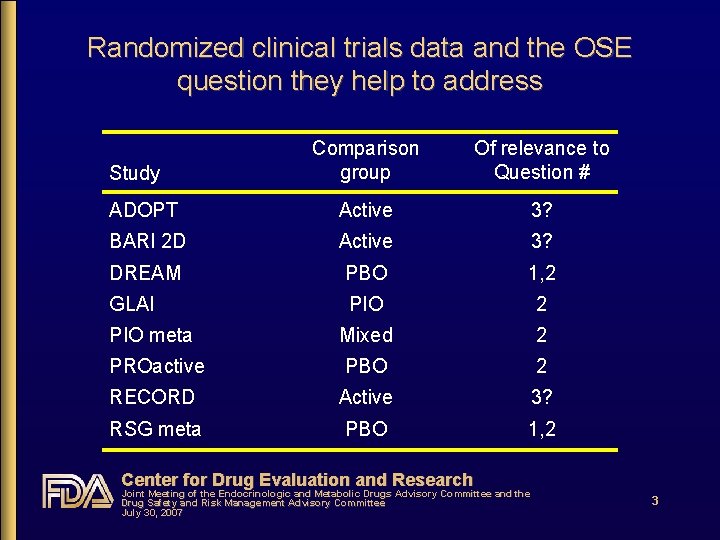
Randomized clinical trials data and the OSE question they help to address Comparison group Of relevance to Question # ADOPT Active 3? BARI 2 D Active 3? DREAM PBO 1, 2 GLAI PIO 2 PIO meta Mixed 2 PROactive PBO 2 RECORD Active 3? RSG meta PBO 1, 2 Study Center for Drug Evaluation and Research Joint Meeting of the Endocrinologic and Metabolic Drugs Advisory Committee and the Drug Safety and Risk Management Advisory Committee July 30, 2007 3
Does rosiglitazone use increase the risk of cardiac death, AMI and stroke? RSG meta-analysis DREAM Center for Drug Evaluation and Research Joint Meeting of the Endocrinologic and Metabolic Drugs Advisory Committee and the Drug Safety and Risk Management Advisory Committee July 30, 2007 4
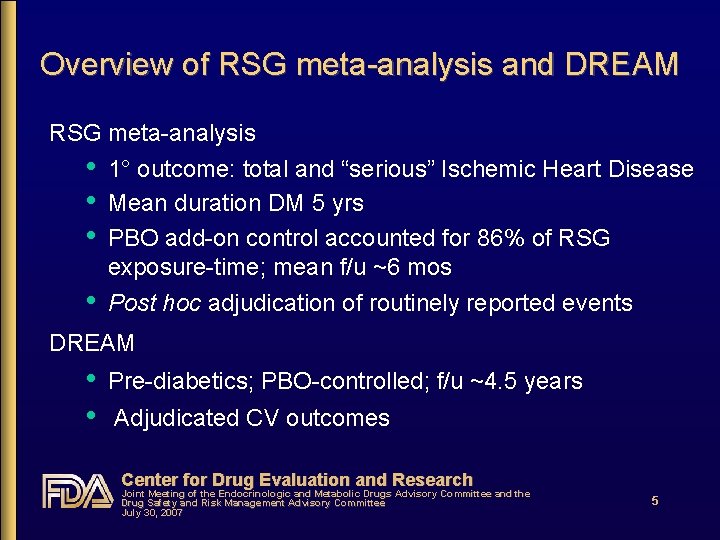
Overview of RSG meta-analysis and DREAM RSG meta-analysis • 1° outcome: total and “serious” Ischemic Heart Disease • Mean duration DM 5 yrs • PBO add-on control accounted for 86% of RSG exposure-time; mean f/u ~6 mos • Post hoc adjudication of routinely reported events DREAM • • Pre-diabetics; PBO-controlled; f/u ~4. 5 years Adjudicated CV outcomes Center for Drug Evaluation and Research Joint Meeting of the Endocrinologic and Metabolic Drugs Advisory Committee and the Drug Safety and Risk Management Advisory Committee July 30, 2007 5
Center for Drug Evaluation and Research Joint Meeting of the Endocrinologic and Metabolic Drugs Advisory Committee and the Drug Safety and Risk Management Advisory Committee July 30, 2007 6
Center for Drug Evaluation and Research Joint Meeting of the Endocrinologic and Metabolic Drugs Advisory Committee and the Drug Safety and Risk Management Advisory Committee July 30, 2007 7
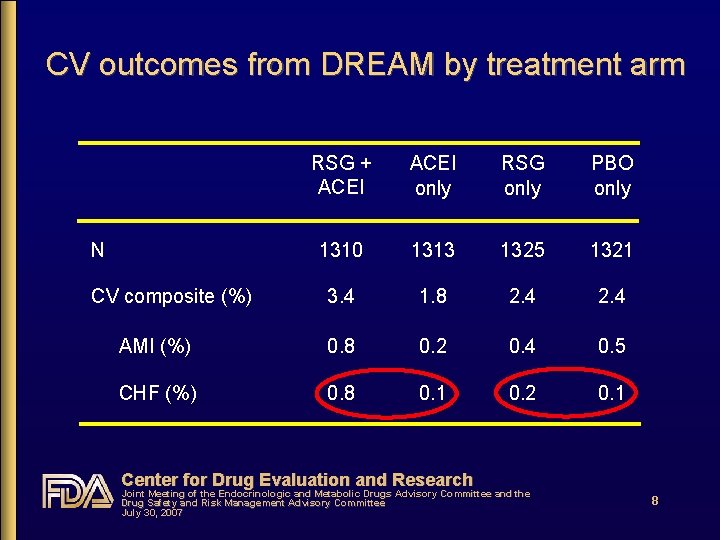
CV outcomes from DREAM by treatment arm RSG + ACEI only RSG only PBO only 1310 1313 1325 1321 3. 4 1. 8 2. 4 AMI (%) 0. 8 0. 2 0. 4 0. 5 CHF (%) 0. 8 0. 1 0. 2 0. 1 N CV composite (%) Center for Drug Evaluation and Research Joint Meeting of the Endocrinologic and Metabolic Drugs Advisory Committee and the Drug Safety and Risk Management Advisory Committee July 30, 2007 8
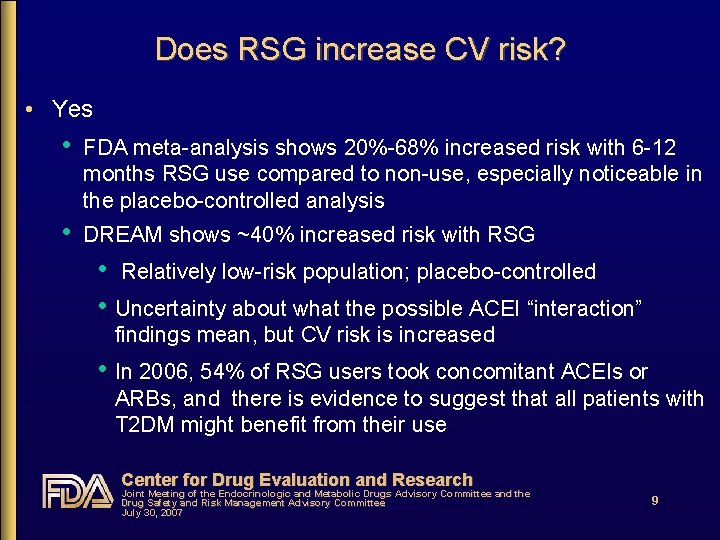
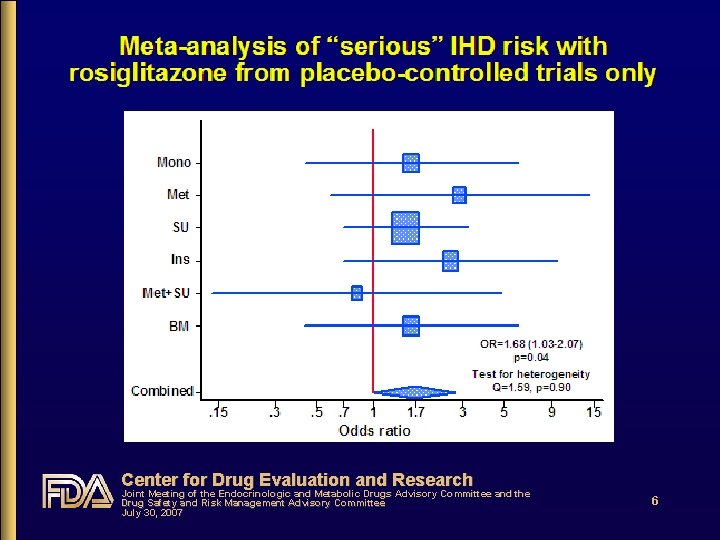
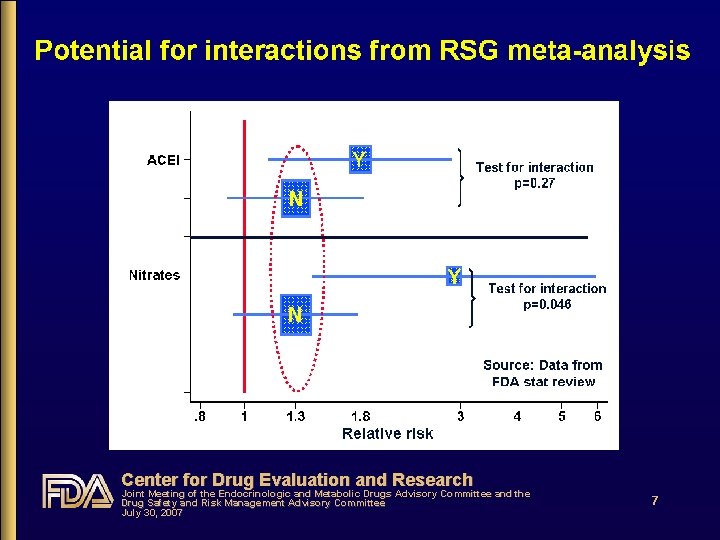
Does RSG increase CV risk? • Yes • FDA meta-analysis shows 20%-68% increased risk with 6 -12 months RSG use compared to non-use, especially noticeable in the placebo-controlled analysis • DREAM shows ~40% increased risk with RSG • Relatively low-risk population; placebo-controlled • Uncertainty about what the possible ACEI “interaction” findings mean, but CV risk is increased • In 2006, 54% of RSG users took concomitant ACEIs or ARBs, and there is evidence to suggest that all patients with T 2 DM might benefit from their use Center for Drug Evaluation and Research Joint Meeting of the Endocrinologic and Metabolic Drugs Advisory Committee and the Drug Safety and Risk Management Advisory Committee July 30, 2007 9
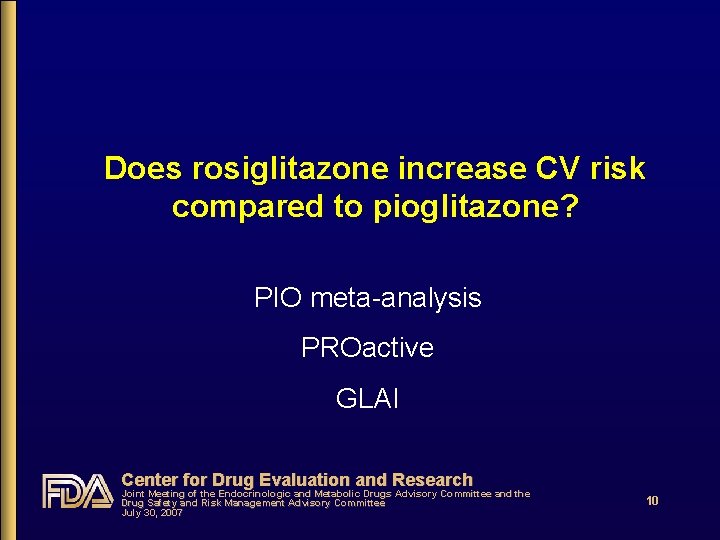
Does rosiglitazone increase CV risk compared to pioglitazone? PIO meta-analysis PROactive GLAI Center for Drug Evaluation and Research Joint Meeting of the Endocrinologic and Metabolic Drugs Advisory Committee and the Drug Safety and Risk Management Advisory Committee July 30, 2007 10
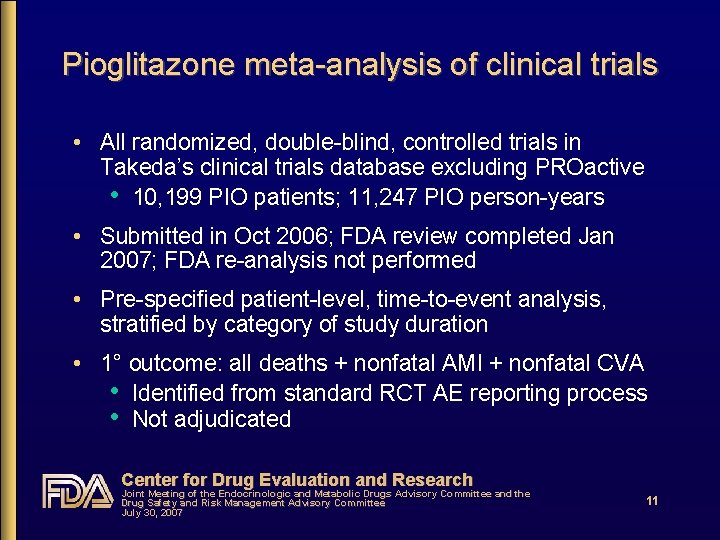
Pioglitazone meta-analysis of clinical trials • All randomized, double-blind, controlled trials in Takeda’s clinical trials database excluding PROactive • 10, 199 PIO patients; 11, 247 PIO person-years • Submitted in Oct 2006; FDA review completed Jan 2007; FDA re-analysis not performed • Pre-specified patient-level, time-to-event analysis, stratified by category of study duration • 1° outcome: all deaths + nonfatal AMI + nonfatal CVA • Identified from standard RCT AE reporting process • Not adjudicated Center for Drug Evaluation and Research Joint Meeting of the Endocrinologic and Metabolic Drugs Advisory Committee and the Drug Safety and Risk Management Advisory Committee July 30, 2007 11
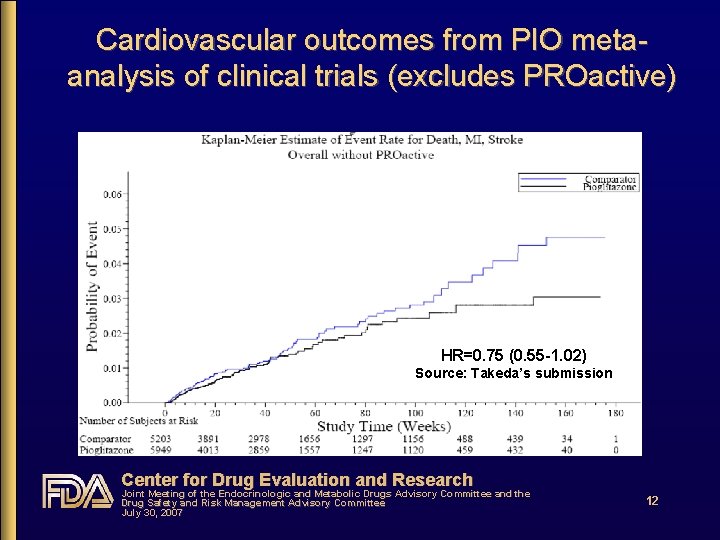
Cardiovascular outcomes from PIO metaanalysis of clinical trials (excludes PROactive) HR=0. 75 (0. 55 -1. 02) Source: Takeda’s submission Center for Drug Evaluation and Research Joint Meeting of the Endocrinologic and Metabolic Drugs Advisory Committee and the Drug Safety and Risk Management Advisory Committee July 30, 2007 12
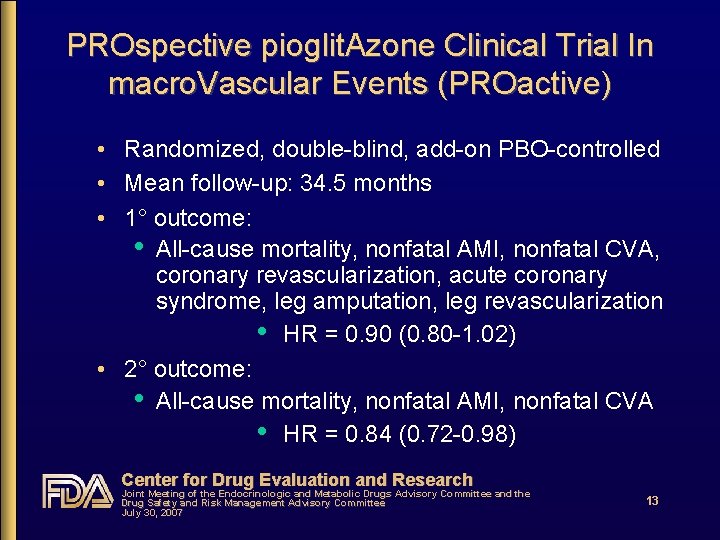
PROspective pioglit. Azone Clinical Trial In macro. Vascular Events (PROactive) • Randomized, double-blind, add-on PBO-controlled • Mean follow-up: 34. 5 months • 1° outcome: • All-cause mortality, nonfatal AMI, nonfatal CVA, coronary revascularization, acute coronary syndrome, leg amputation, leg revascularization • HR = 0. 90 (0. 80 -1. 02) • 2° outcome: • All-cause mortality, nonfatal AMI, nonfatal CVA • HR = 0. 84 (0. 72 -0. 98) Center for Drug Evaluation and Research Joint Meeting of the Endocrinologic and Metabolic Drugs Advisory Committee and the Drug Safety and Risk Management Advisory Committee July 30, 2007 13
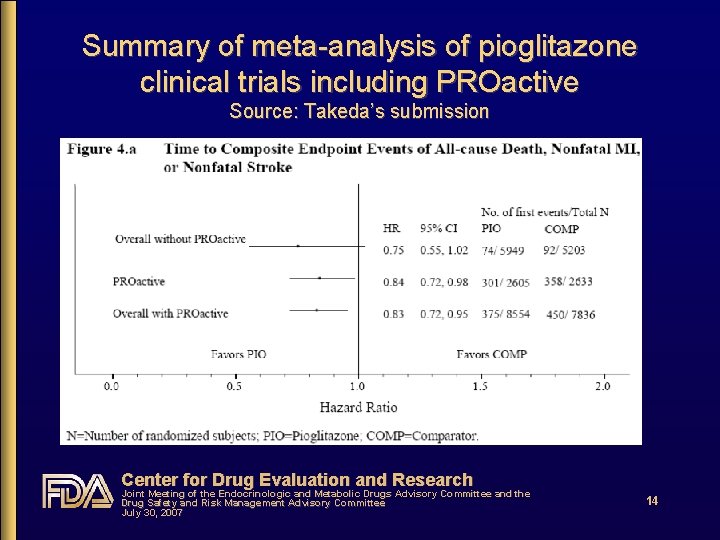
Summary of meta-analysis of pioglitazone clinical trials including PROactive Source: Takeda’s submission Center for Drug Evaluation and Research Joint Meeting of the Endocrinologic and Metabolic Drugs Advisory Committee and the Drug Safety and Risk Management Advisory Committee July 30, 2007 14
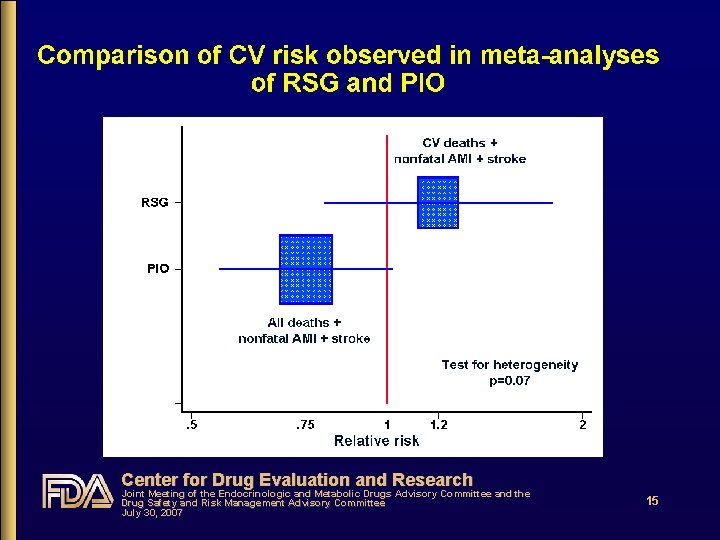
Center for Drug Evaluation and Research Joint Meeting of the Endocrinologic and Metabolic Drugs Advisory Committee and the Drug Safety and Risk Management Advisory Committee July 30, 2007 15
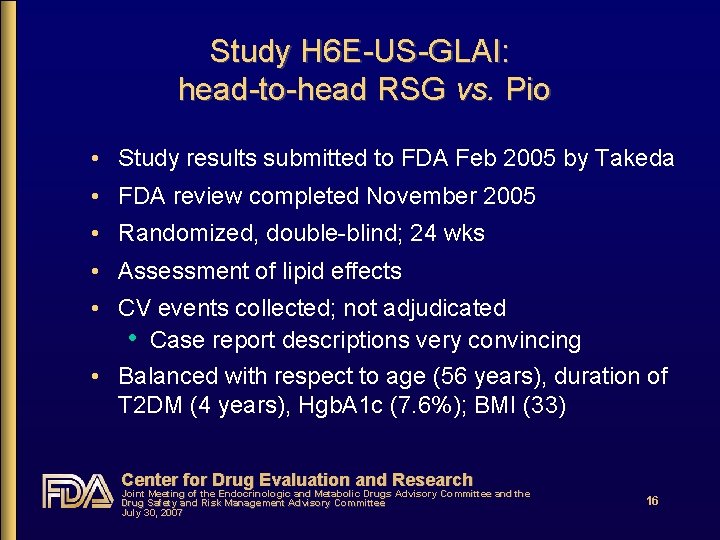
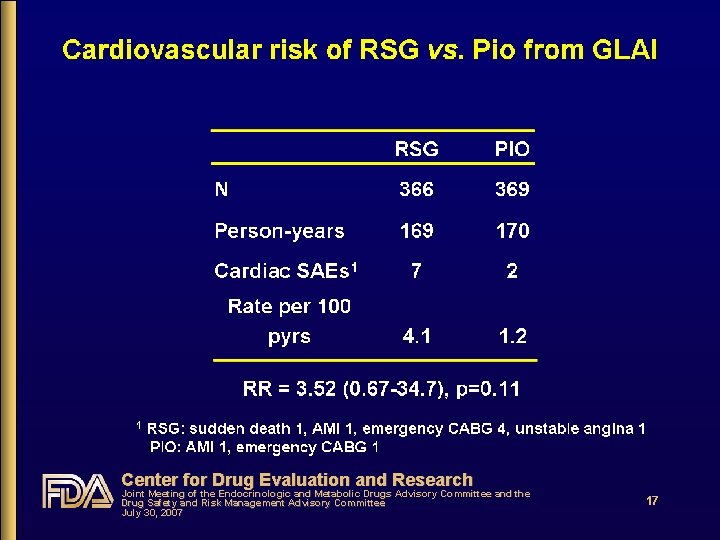
Study H 6 E-US-GLAI: head-to-head RSG vs. Pio • Study results submitted to FDA Feb 2005 by Takeda • FDA review completed November 2005 • Randomized, double-blind; 24 wks • Assessment of lipid effects • CV events collected; not adjudicated • Case report descriptions very convincing • Balanced with respect to age (56 years), duration of T 2 DM (4 years), Hgb. A 1 c (7. 6%); BMI (33) Center for Drug Evaluation and Research Joint Meeting of the Endocrinologic and Metabolic Drugs Advisory Committee and the Drug Safety and Risk Management Advisory Committee July 30, 2007 16
Center for Drug Evaluation and Research Joint Meeting of the Endocrinologic and Metabolic Drugs Advisory Committee and the Drug Safety and Risk Management Advisory Committee July 30, 2007 17
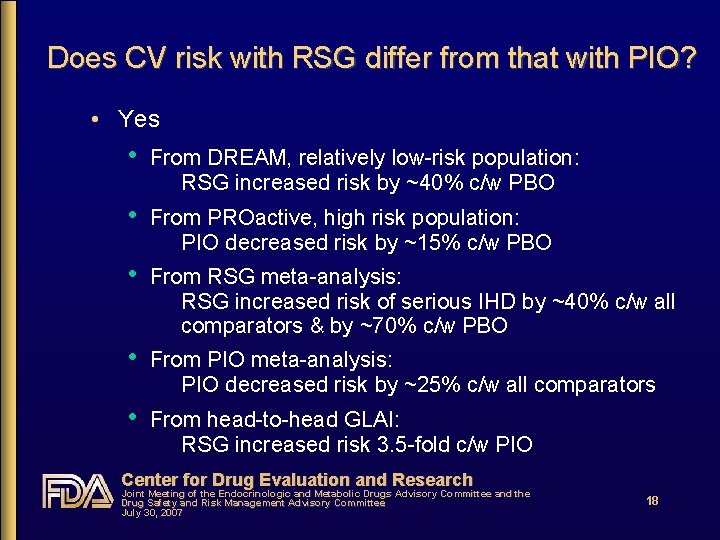
Does CV risk with RSG differ from that with PIO? • Yes • From DREAM, relatively low-risk population: RSG increased risk by ~40% c/w PBO • From PROactive, high risk population: PIO decreased risk by ~15% c/w PBO • From RSG meta-analysis: RSG increased risk of serious IHD by ~40% c/w all comparators & by ~70% c/w PBO • From PIO meta-analysis: PIO decreased risk by ~25% c/w all comparators • From head-to-head GLAI: RSG increased risk 3. 5 -fold c/w PIO Center for Drug Evaluation and Research Joint Meeting of the Endocrinologic and Metabolic Drugs Advisory Committee and the Drug Safety and Risk Management Advisory Committee July 30, 2007 18
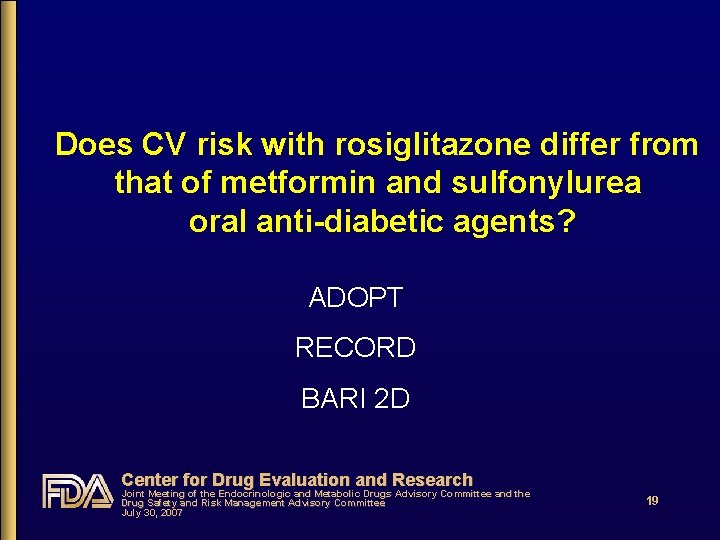
Does CV risk with rosiglitazone differ from that of metformin and sulfonylurea oral anti-diabetic agents? ADOPT RECORD BARI 2 D Center for Drug Evaluation and Research Joint Meeting of the Endocrinologic and Metabolic Drugs Advisory Committee and the Drug Safety and Risk Management Advisory Committee July 30, 2007 19
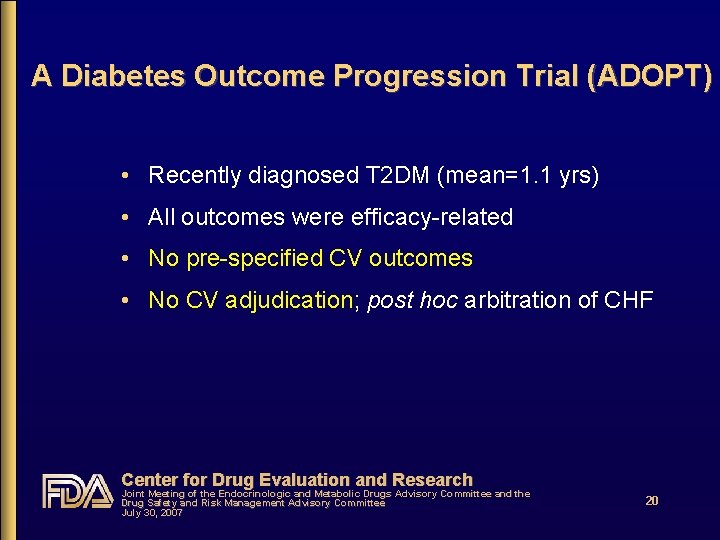
A Diabetes Outcome Progression Trial (ADOPT) • Recently diagnosed T 2 DM (mean=1. 1 yrs) • All outcomes were efficacy-related • No pre-specified CV outcomes • No CV adjudication; post hoc arbitration of CHF Center for Drug Evaluation and Research Joint Meeting of the Endocrinologic and Metabolic Drugs Advisory Committee and the Drug Safety and Risk Management Advisory Committee July 30, 2007 20
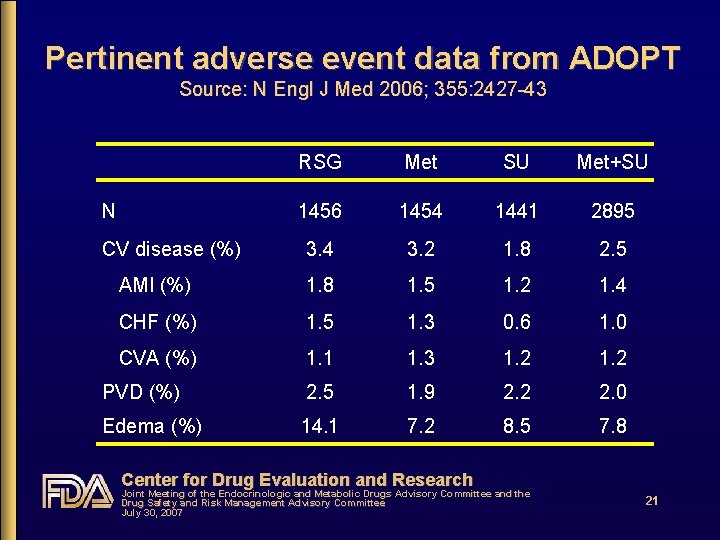
Pertinent adverse event data from ADOPT Source: N Engl J Med 2006; 355: 2427 -43 RSG Met SU Met+SU 1456 1454 1441 2895 3. 4 3. 2 1. 8 2. 5 AMI (%) 1. 8 1. 5 1. 2 1. 4 CHF (%) 1. 5 1. 3 0. 6 1. 0 CVA (%) 1. 1 1. 3 1. 2 PVD (%) 2. 5 1. 9 2. 2 2. 0 Edema (%) 14. 1 7. 2 8. 5 7. 8 N CV disease (%) Center for Drug Evaluation and Research Joint Meeting of the Endocrinologic and Metabolic Drugs Advisory Committee and the Drug Safety and Risk Management Advisory Committee July 30, 2007 21
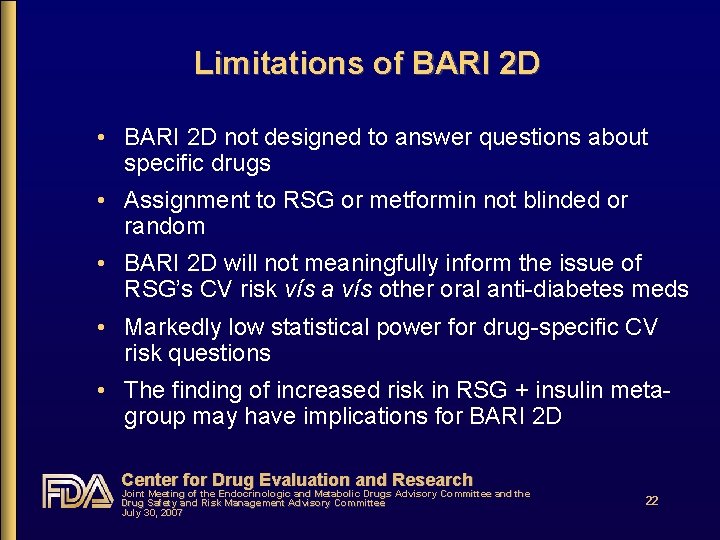
Limitations of BARI 2 D • BARI 2 D not designed to answer questions about specific drugs • Assignment to RSG or metformin not blinded or random • BARI 2 D will not meaningfully inform the issue of RSG’s CV risk vís a vís other oral anti-diabetes meds • Markedly low statistical power for drug-specific CV risk questions • The finding of increased risk in RSG + insulin metagroup may have implications for BARI 2 D Center for Drug Evaluation and Research Joint Meeting of the Endocrinologic and Metabolic Drugs Advisory Committee and the Drug Safety and Risk Management Advisory Committee July 30, 2007 22
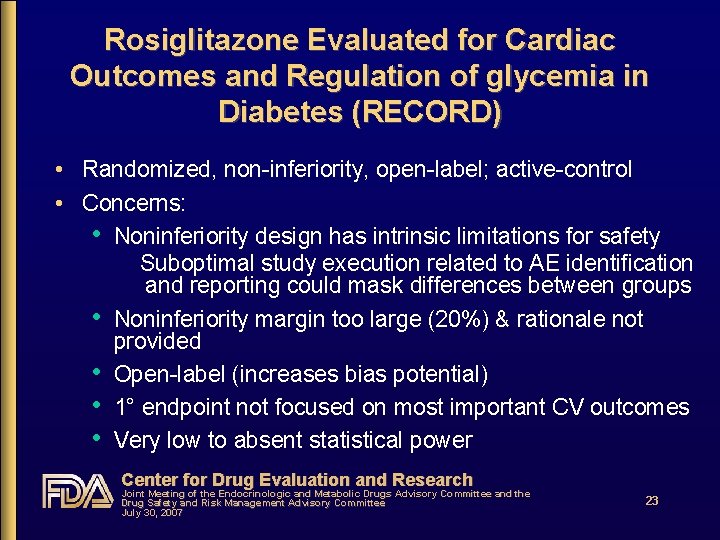
Rosiglitazone Evaluated for Cardiac Outcomes and Regulation of glycemia in Diabetes (RECORD) • Randomized, non-inferiority, open-label; active-control • Concerns: • Noninferiority design has intrinsic limitations for safety Suboptimal study execution related to AE identification and reporting could mask differences between groups • Noninferiority margin too large (20%) & rationale not provided • Open-label (increases bias potential) • 1° endpoint not focused on most important CV outcomes • Very low to absent statistical power Center for Drug Evaluation and Research Joint Meeting of the Endocrinologic and Metabolic Drugs Advisory Committee and the Drug Safety and Risk Management Advisory Committee July 30, 2007 23
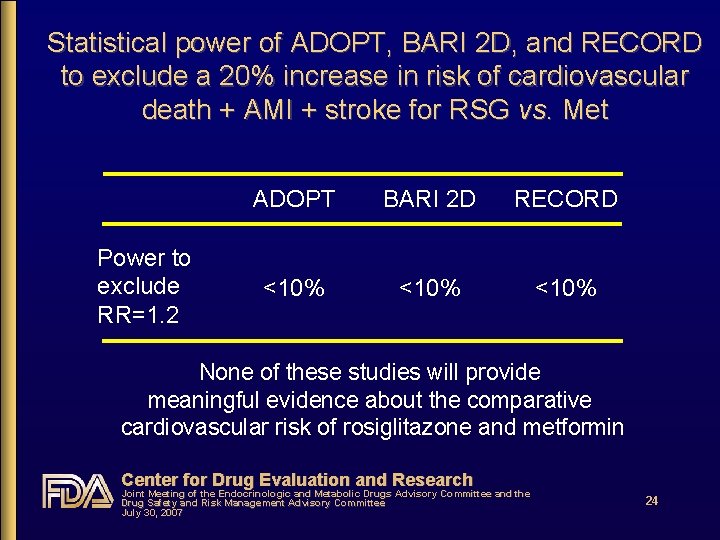
Statistical power of ADOPT, BARI 2 D, and RECORD to exclude a 20% increase in risk of cardiovascular death + AMI + stroke for RSG vs. Met Power to exclude RR=1. 2 ADOPT BARI 2 D RECORD <10% None of these studies will provide meaningful evidence about the comparative cardiovascular risk of rosiglitazone and metformin Center for Drug Evaluation and Research Joint Meeting of the Endocrinologic and Metabolic Drugs Advisory Committee and the Drug Safety and Risk Management Advisory Committee July 30, 2007 24
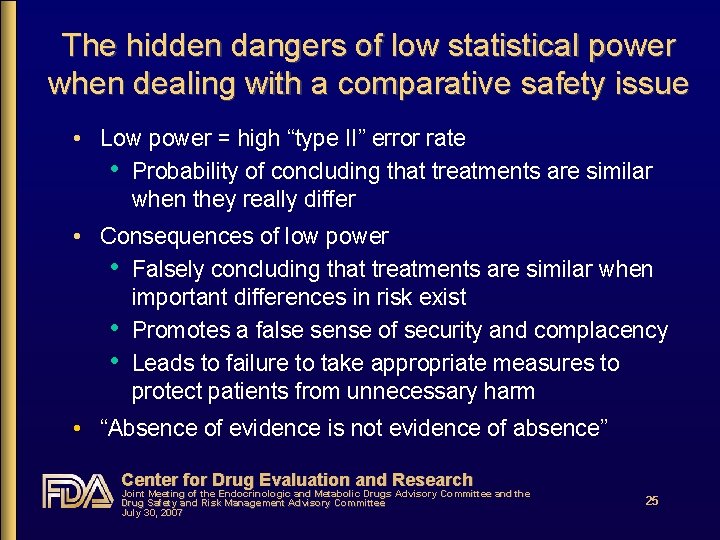
The hidden dangers of low statistical power when dealing with a comparative safety issue • Low power = high “type II” error rate • Probability of concluding that treatments are similar when they really differ • Consequences of low power • Falsely concluding that treatments are similar when important differences in risk exist • Promotes a false sense of security and complacency • Leads to failure to take appropriate measures to protect patients from unnecessary harm • “Absence of evidence is not evidence of absence” Center for Drug Evaluation and Research Joint Meeting of the Endocrinologic and Metabolic Drugs Advisory Committee and the Drug Safety and Risk Management Advisory Committee July 30, 2007 25
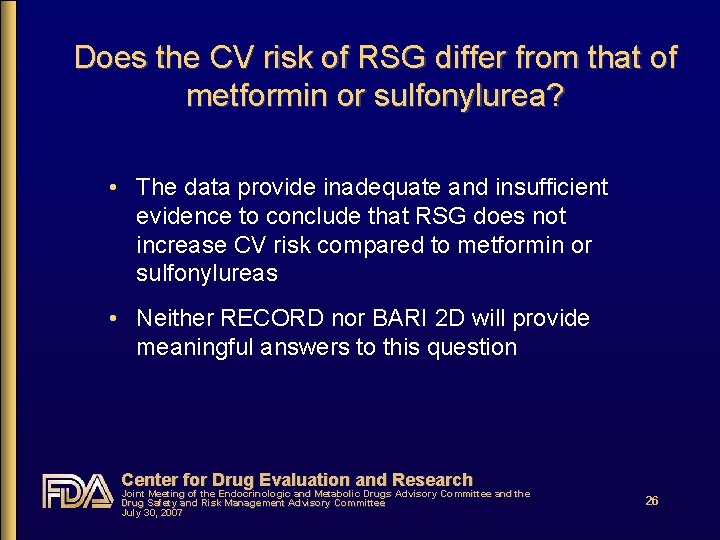
Does the CV risk of RSG differ from that of metformin or sulfonylurea? • The data provide inadequate and insufficient evidence to conclude that RSG does not increase CV risk compared to metformin or sulfonylureas • Neither RECORD nor BARI 2 D will provide meaningful answers to this question Center for Drug Evaluation and Research Joint Meeting of the Endocrinologic and Metabolic Drugs Advisory Committee and the Drug Safety and Risk Management Advisory Committee July 30, 2007 26
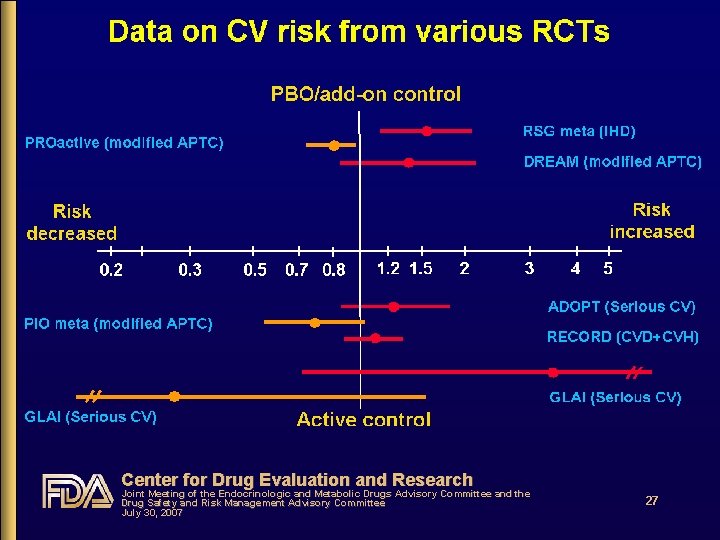
Center for Drug Evaluation and Research Joint Meeting of the Endocrinologic and Metabolic Drugs Advisory Committee and the Drug Safety and Risk Management Advisory Committee July 30, 2007 27
Population impact of cardiovascular risks and benefits of rosiglitazone use Center for Drug Evaluation and Research Joint Meeting of the Endocrinologic and Metabolic Drugs Advisory Committee and the Drug Safety and Risk Management Advisory Committee July 30, 2007 28
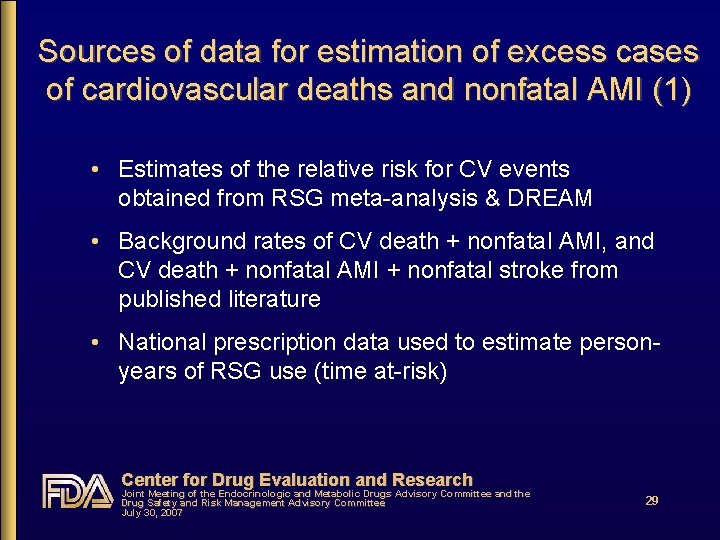
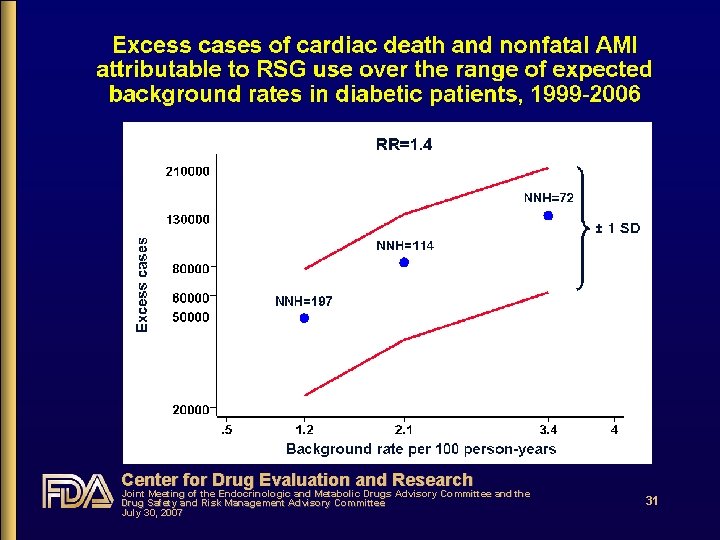
Sources of data for estimation of excess cases of cardiovascular deaths and nonfatal AMI (1) • Estimates of the relative risk for CV events obtained from RSG meta-analysis & DREAM • Background rates of CV death + nonfatal AMI, and CV death + nonfatal AMI + nonfatal stroke from published literature • National prescription data used to estimate personyears of RSG use (time at-risk) Center for Drug Evaluation and Research Joint Meeting of the Endocrinologic and Metabolic Drugs Advisory Committee and the Drug Safety and Risk Management Advisory Committee July 30, 2007 29
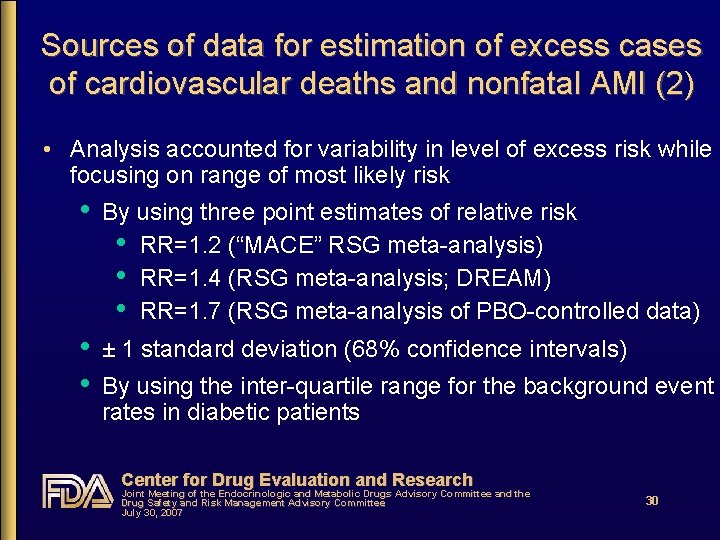
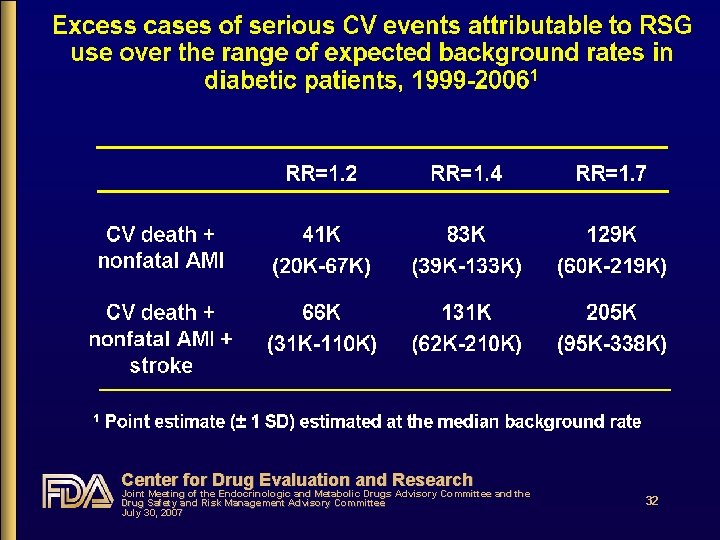
Sources of data for estimation of excess cases of cardiovascular deaths and nonfatal AMI (2) • Analysis accounted for variability in level of excess risk while focusing on range of most likely risk • By using three point estimates of relative risk • RR=1. 2 (“MACE” RSG meta-analysis) • RR=1. 4 (RSG meta-analysis; DREAM) • RR=1. 7 (RSG meta-analysis of PBO-controlled data) • • ± 1 standard deviation (68% confidence intervals) By using the inter-quartile range for the background event rates in diabetic patients Center for Drug Evaluation and Research Joint Meeting of the Endocrinologic and Metabolic Drugs Advisory Committee and the Drug Safety and Risk Management Advisory Committee July 30, 2007 30
Center for Drug Evaluation and Research Joint Meeting of the Endocrinologic and Metabolic Drugs Advisory Committee and the Drug Safety and Risk Management Advisory Committee July 30, 2007 31
Center for Drug Evaluation and Research Joint Meeting of the Endocrinologic and Metabolic Drugs Advisory Committee and the Drug Safety and Risk Management Advisory Committee July 30, 2007 32
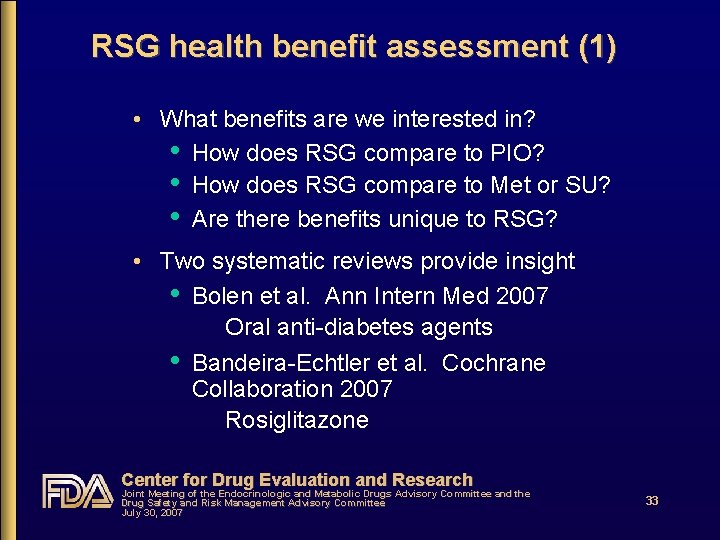
RSG health benefit assessment (1) • What benefits are we interested in? • How does RSG compare to PIO? • How does RSG compare to Met or SU? • Are there benefits unique to RSG? • Two systematic reviews provide insight • Bolen et al. Ann Intern Med 2007 Oral anti-diabetes agents • Bandeira-Echtler et al. Cochrane Collaboration 2007 Rosiglitazone Center for Drug Evaluation and Research Joint Meeting of the Endocrinologic and Metabolic Drugs Advisory Committee and the Drug Safety and Risk Management Advisory Committee July 30, 2007 33
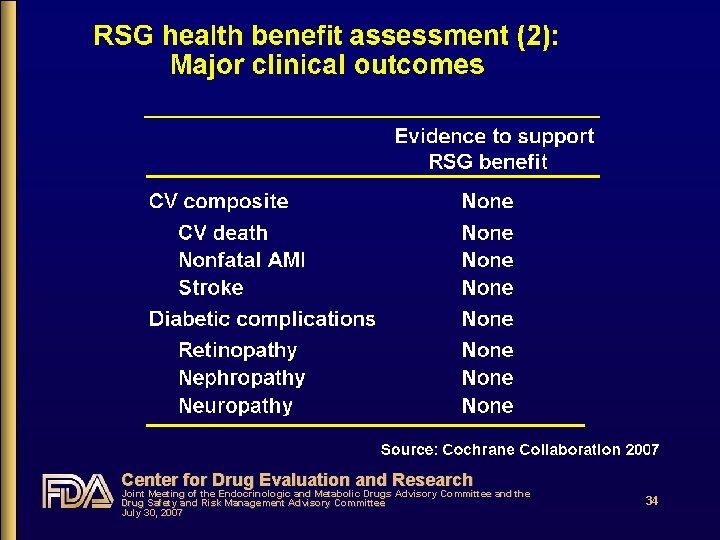
Center for Drug Evaluation and Research Joint Meeting of the Endocrinologic and Metabolic Drugs Advisory Committee and the Drug Safety and Risk Management Advisory Committee July 30, 2007 34
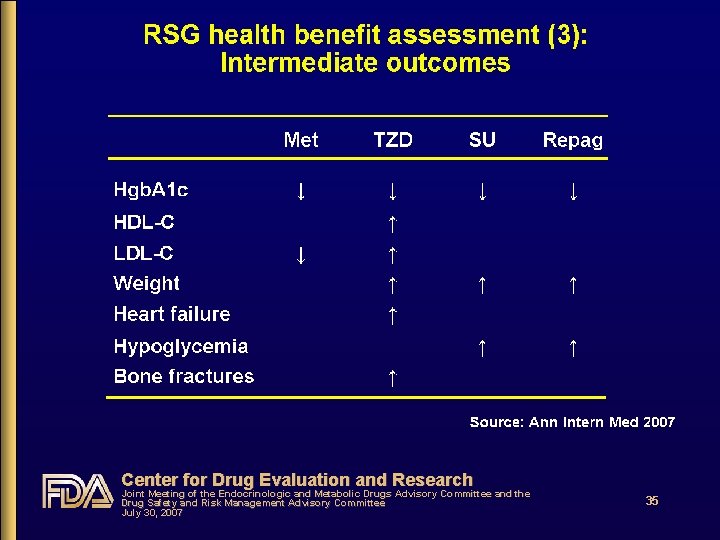
Center for Drug Evaluation and Research Joint Meeting of the Endocrinologic and Metabolic Drugs Advisory Committee and the Drug Safety and Risk Management Advisory Committee July 30, 2007 35
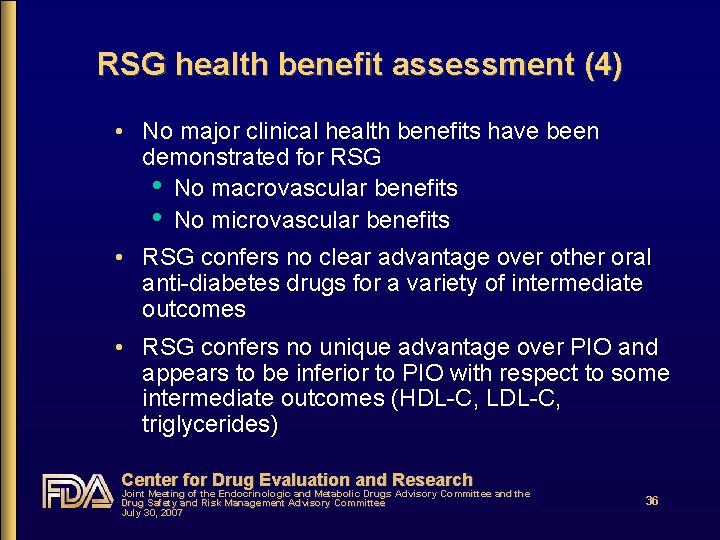
RSG health benefit assessment (4) • No major clinical health benefits have been demonstrated for RSG • No macrovascular benefits • No microvascular benefits • RSG confers no clear advantage over other oral anti-diabetes drugs for a variety of intermediate outcomes • RSG confers no unique advantage over PIO and appears to be inferior to PIO with respect to some intermediate outcomes (HDL-C, LDL-C, triglycerides) Center for Drug Evaluation and Research Joint Meeting of the Endocrinologic and Metabolic Drugs Advisory Committee and the Drug Safety and Risk Management Advisory Committee July 30, 2007 36
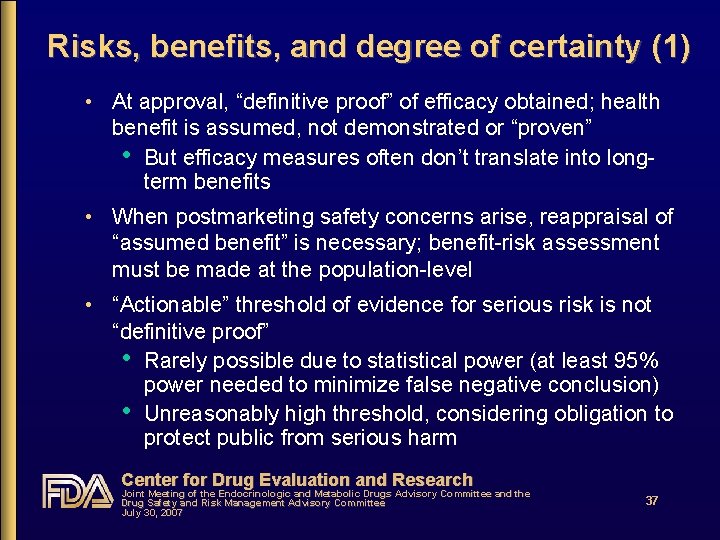
Risks, benefits, and degree of certainty (1) • At approval, “definitive proof” of efficacy obtained; health benefit is assumed, not demonstrated or “proven” • But efficacy measures often don’t translate into longterm benefits • When postmarketing safety concerns arise, reappraisal of “assumed benefit” is necessary; benefit-risk assessment must be made at the population-level • “Actionable” threshold of evidence for serious risk is not “definitive proof” • Rarely possible due to statistical power (at least 95% power needed to minimize false negative conclusion) • Unreasonably high threshold, considering obligation to protect public from serious harm Center for Drug Evaluation and Research Joint Meeting of the Endocrinologic and Metabolic Drugs Advisory Committee and the Drug Safety and Risk Management Advisory Committee July 30, 2007 37
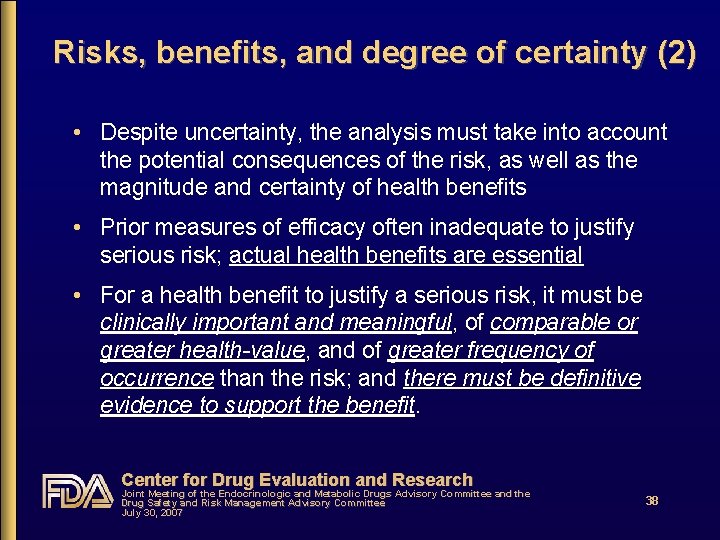
Risks, benefits, and degree of certainty (2) • Despite uncertainty, the analysis must take into account the potential consequences of the risk, as well as the magnitude and certainty of health benefits • Prior measures of efficacy often inadequate to justify serious risk; actual health benefits are essential • For a health benefit to justify a serious risk, it must be clinically important and meaningful, of comparable or greater health-value, and of greater frequency of occurrence than the risk; and there must be definitive evidence to support the benefit. Center for Drug Evaluation and Research Joint Meeting of the Endocrinologic and Metabolic Drugs Advisory Committee and the Drug Safety and Risk Management Advisory Committee July 30, 2007 38
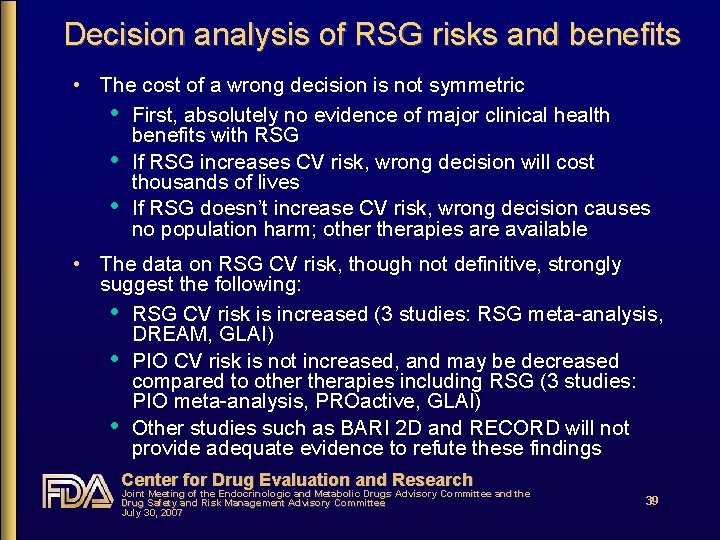
Decision analysis of RSG risks and benefits • The cost of a wrong decision is not symmetric • First, absolutely no evidence of major clinical health benefits with RSG • If RSG increases CV risk, wrong decision will cost thousands of lives • If RSG doesn’t increase CV risk, wrong decision causes no population harm; otherapies are available • The data on RSG CV risk, though not definitive, strongly suggest the following: • RSG CV risk is increased (3 studies: RSG meta-analysis, DREAM, GLAI) • PIO CV risk is not increased, and may be decreased compared to otherapies including RSG (3 studies: PIO meta-analysis, PROactive, GLAI) • Other studies such as BARI 2 D and RECORD will not provide adequate evidence to refute these findings Center for Drug Evaluation and Research Joint Meeting of the Endocrinologic and Metabolic Drugs Advisory Committee and the Drug Safety and Risk Management Advisory Committee July 30, 2007 39
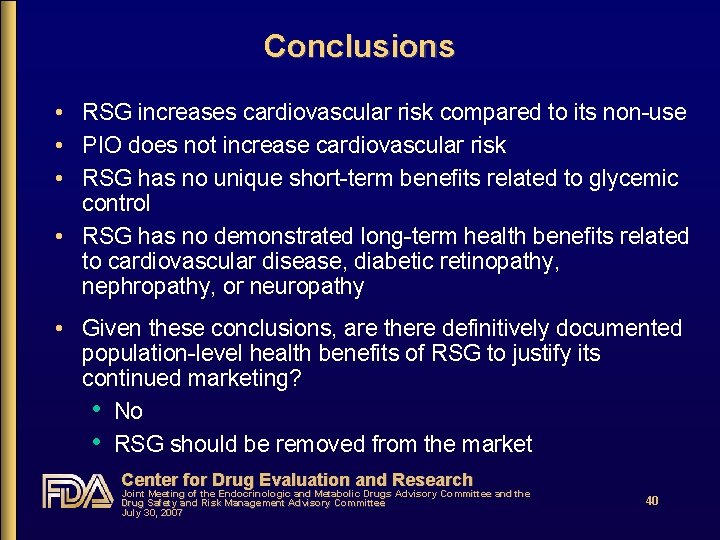
Conclusions • RSG increases cardiovascular risk compared to its non-use • PIO does not increase cardiovascular risk • RSG has no unique short-term benefits related to glycemic control • RSG has no demonstrated long-term health benefits related to cardiovascular disease, diabetic retinopathy, nephropathy, or neuropathy • Given these conclusions, are there definitively documented population-level health benefits of RSG to justify its continued marketing? • No • RSG should be removed from the market Center for Drug Evaluation and Research Joint Meeting of the Endocrinologic and Metabolic Drugs Advisory Committee and the Drug Safety and Risk Management Advisory Committee July 30, 2007 40
Acknowledgments Rizwan Ahmad, MD Mark Avigan, MD Gerald Dal Pan, MD, MHS Kate Gelperin, MD, MPH Joy Mele, MS Todd Sahlroot, Ph. D Ellis Unger, MD FDA library staff Center for Drug Evaluation and Research Joint Meeting of the Endocrinologic and Metabolic Drugs Advisory Committee and the Drug Safety and Risk Management Advisory Committee July 30, 2007 41
- Slides: 41