
Assessment of Reading Comprehension Cognitive Strategies Grace Oakley
- Slides: 14
Assessment of Reading Comprehension (Cognitive Strategies) Grace Oakley
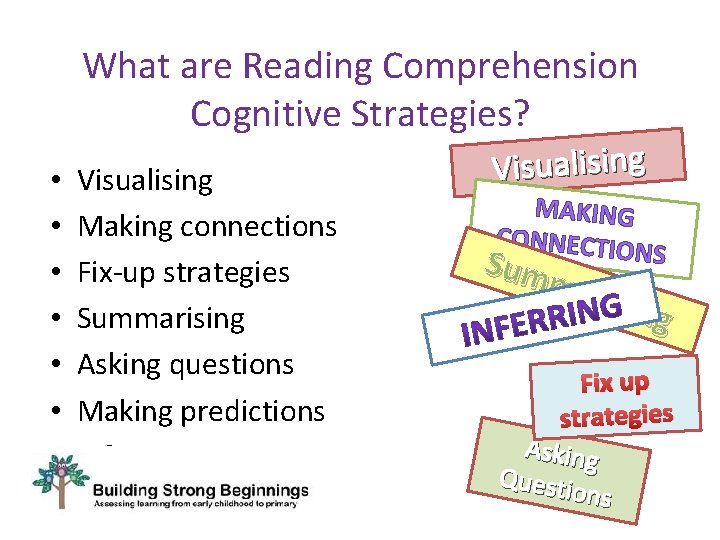
What are Reading Comprehension Cognitive Strategies? • • Visualising Making connections Fix-up strategies Summarising Asking questions Making predictions Inferring Visualising MAKING CONNECTIO NS Sum mar ising Fix up strategies Asking Questi ons
Framework for teaching CSI • Based on a review of the research, Duke and Pearson (2002, p. 208) suggested a framework for comprehension strategy instruction, based on Bruner’s (1990) notion of ‘scaffolding’ or ‘gradual release of responsibility’(GRR). • An explicit description of the strategy and how and when it should be used • Modelling of the strategy in action – Think alouds • Collaborative or guided use of the strategy – E. g. Reciprocal Teaching, Read-Along Guides • Independent use of the strategy
Children need to know • What the strategy is (declarative knowledge) • How to use it (procedural knowledge) • When and why to use it (conditional knowledge) • How to evaluate whether ‘it worked’ • (. . . so teachers need to assess children’s understanding of what, how, when, why. . . ) • See Almasi (2004) 4
Focus for today • Questioning – Questioning the author – Flip it (turning sentences into questions) – E. g. Making up inferential, evaluative questions • Visualising (creating mental imagery) – Picturing settings, characters – Picturing action, processes • Mind pictures • Story Wheel • Sketch to Stretch (see Read-Write-Think) http: //www. readwritethink. org/classroom-resources/lesson -plans/guided-comprehension-visualizing-using 229. html? tab=4 5
Assessment challenges • ‘Understanding what readers are thinking during reading remains a complex task’ (Israel, Bauserman & Block, 2005, p. 21). • What are they thinking before, during and after reading? ? • Assessment of processes difficult. Can be inferred to some extent from products. 6
Assessing children’s use of the strategies • Collect assessment data through – Artefacts – Talk – Observation • Evaluation – what does the data mean?
Think Alouds • Think Alouds – Children are taught to think aloud as they read – this can allow teacher to ‘see’ what they are thinking. Can also improve metacognition. – ‘Stop and Think Cards’ or stickers can be places in pre-selected places in text. – Technology can be used to facilitate this. 8
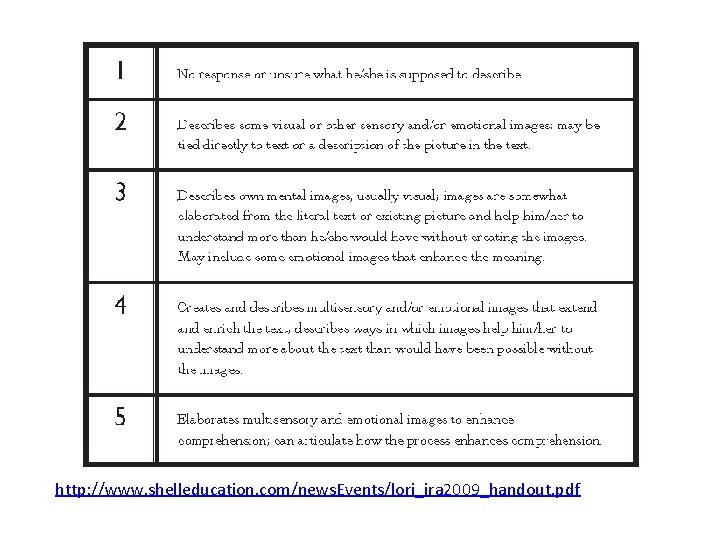
Using rubrics to guide assessment • Ellin Keane has developed some rubrics to assist teachers in assessing comprehension thinking strategies. 9
http: //www. shelleducation. com/news. Events/lori_ira 2009_handout. pdf
Assessing through the Arts • Drama • Drawing – Including drawing during read aloud • Video examples from: Into the Book • http: //reading. ecb. org/teacher/visualizing/ind ex. html
Interviews – Reflective Metacognitive Interviews – get children to describe how they did the work or read the text and why they did it that way. Bloom’s taxonomy can help teachers create probing questions. – Published interviews e. g. Metacognitive Strategy Interview (Schmidt, 1990). 25 multiple choice questions such as: Before I begin reading , it’s a good idea to: A) See how many pages are in the story B) Look up all the big words in the dictionary C) Make some guesses about what I think will happen in the story • D)Think about what has happened so far in the story • • 12
References Almasi, J. F. (2004). Teaching strategic processes in reading. NY: The Guilford Press. Athans, S. K. & Devine, D. A. (2008). Quality comprehension: A strategic model of reading instruction using read-along guides, grades 3 -6. Newark, DE: IRA Israel, S. E. , Bauserman, K. I. , & Block, C. C. (2005). Metacognitive assessment strategies. Thinking Classroom, 6(2), 21 -28. Keene, E. (2006). Assessing comprehension thinking strategies. Huntington Beach, California: Shell. Mokhtari, K. , & Reichard, C. A. (2002). Assessing students' metacognitive awareness of reading strategies. Journal of Educational Psychology, 94(249 -259). 13
Oakley, G. (2011). The assessment of reading comprehension cognitive strategies: Practices and perceptions of Western Australian teachers. Australian Journal of Language & Literacy, 34(3), 279 -293. Oczkus, L. (2009) Interactive think-aloud lessons: 25 surefire ways to engage students and improve comprehension. NY: Scholastic. Schmidt, M. C. (1990). A questionnaire to measure children's awareness of strategic reading processes. The Reading Teacher, 43(454 -461). Some websites http: //www. decd. sa. gov. au/northernadelaide/pages/comp/37986/? re. Fla g=1 http: //www. curriculumsupport. education. nsw. gov. au/literacy/assets/pdf /packages/combook. pdf