
Assessment of MBR for Bacteria Nitrogen Reduction Team
Assessment of MBR for Bacteria & Nitrogen Reduction Team 1 Emily Fauver, Nikko Baez, Camryn Davis, Lindsey Pressler
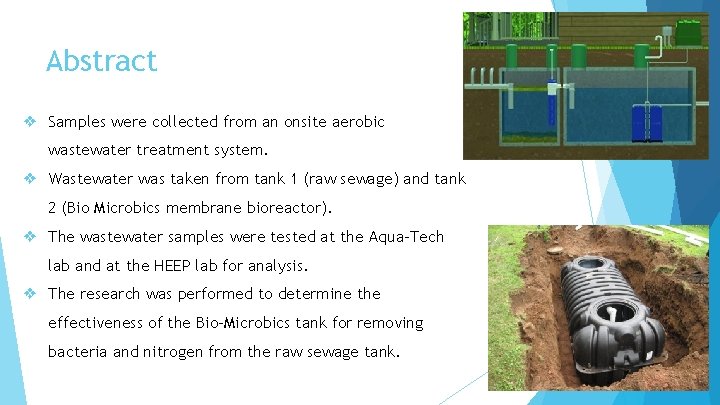
Abstract ❖ Samples were collected from an onsite aerobic wastewater treatment system. ❖ Wastewater was taken from tank 1 (raw sewage) and tank 2 (Bio Microbics membrane bioreactor). ❖ The wastewater samples were tested at the Aqua-Tech lab and at the HEEP lab for analysis. ❖ The research was performed to determine the effectiveness of the Bio-Microbics tank for removing bacteria and nitrogen from the raw sewage tank.
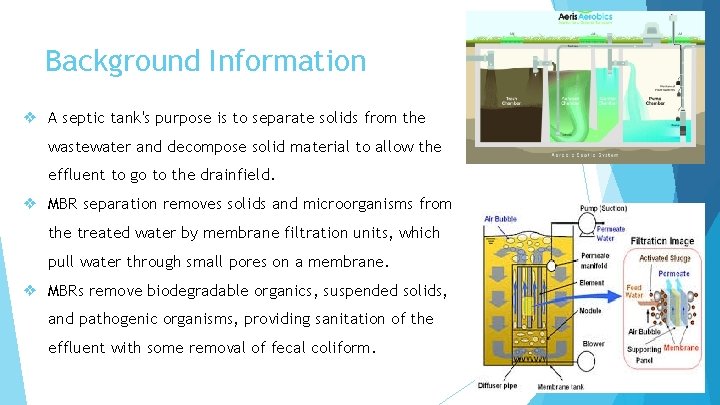
Background Information ❖ A septic tank's purpose is to separate solids from the wastewater and decompose solid material to allow the effluent to go to the drainfield. ❖ MBR separation removes solids and microorganisms from the treated water by membrane filtration units, which pull water through small pores on a membrane. ❖ MBRs remove biodegradable organics, suspended solids, and pathogenic organisms, providing sanitation of the effluent with some removal of fecal coliform.
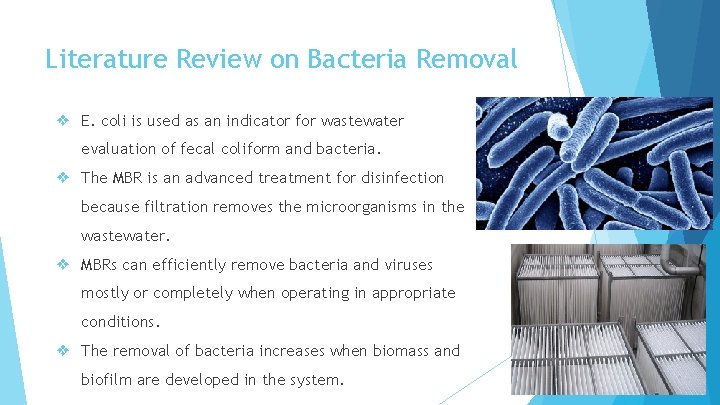
Literature Review on Bacteria Removal ❖ E. coli is used as an indicator for wastewater evaluation of fecal coliform and bacteria. ❖ The MBR is an advanced treatment for disinfection because filtration removes the microorganisms in the wastewater. ❖ MBRs can efficiently remove bacteria and viruses mostly or completely when operating in appropriate conditions. ❖ The removal of bacteria increases when biomass and biofilm are developed in the system.
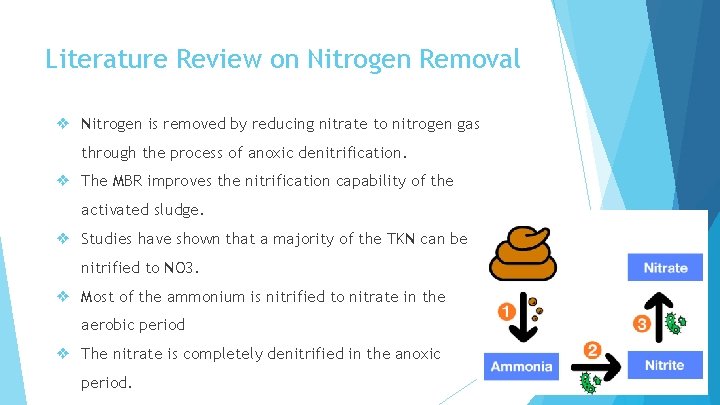
Literature Review on Nitrogen Removal ❖ Nitrogen is removed by reducing nitrate to nitrogen gas through the process of anoxic denitrification. ❖ The MBR improves the nitrification capability of the activated sludge. ❖ Studies have shown that a majority of the TKN can be nitrified to NO 3. ❖ Most of the ammonium is nitrified to nitrate in the aerobic period ❖ The nitrate is completely denitrified in the anoxic period.
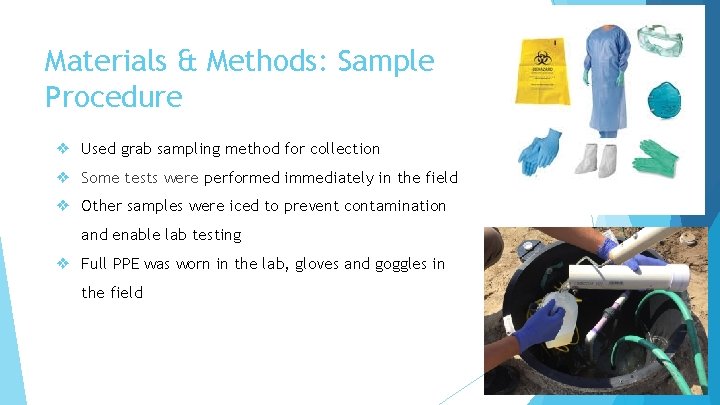
Materials & Methods: Sample Procedure ❖ Used grab sampling method for collection ❖ Some tests were performed immediately in the field ❖ Other samples were iced to prevent contamination and enable lab testing ❖ Full PPE was worn in the lab, gloves and goggles in the field
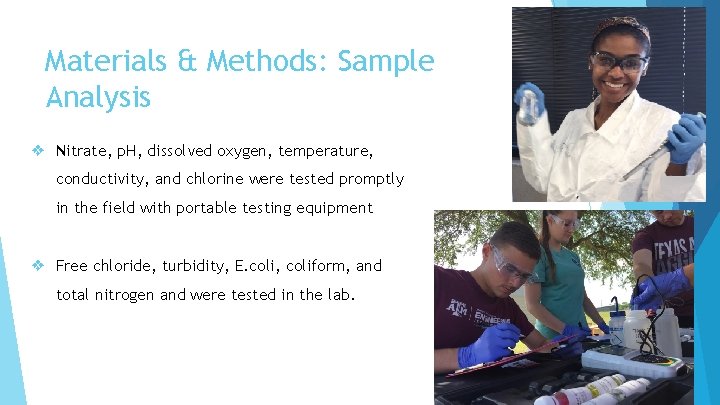
Materials & Methods: Sample Analysis ❖ Nitrate, p. H, dissolved oxygen, temperature, conductivity, and chlorine were tested promptly in the field with portable testing equipment ❖ Free chloride, turbidity, E. coli, coliform, and total nitrogen and were tested in the lab.
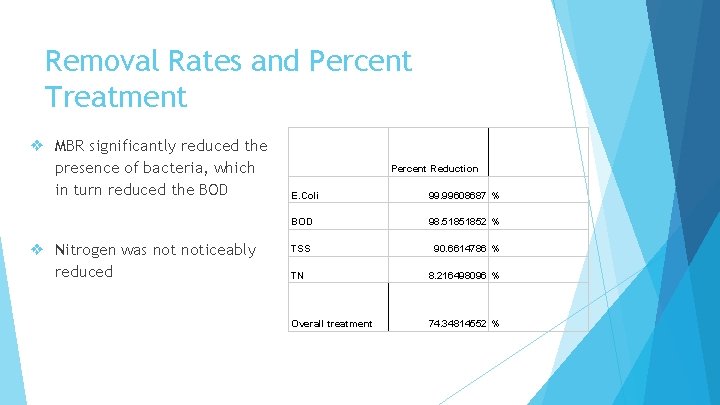
Removal Rates and Percent Treatment ❖ MBR significantly reduced the presence of bacteria, which in turn reduced the BOD ❖ Nitrogen was noticeably reduced Percent Reduction E. Coli 99. 99608687 % BOD 98. 51851852 % TSS 90. 6614786 % TN 8. 216498096 % Overall treatment 74. 34814552 %
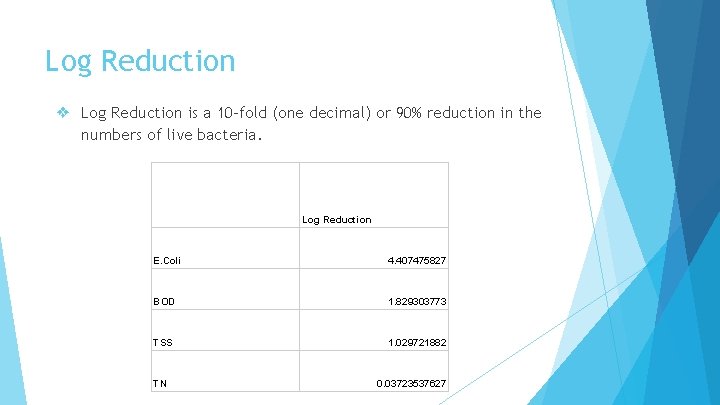
Log Reduction ❖ Log Reduction is a 10 -fold (one decimal) or 90% reduction in the numbers of live bacteria. Log Reduction E. Coli 4. 407475827 BOD 1. 829303773 TSS 1. 029721882 TN 0. 03723537627
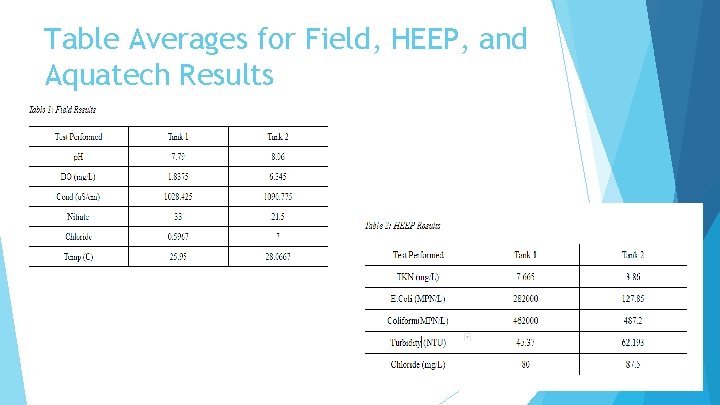
Table Averages for Field, HEEP, and Aquatech Results
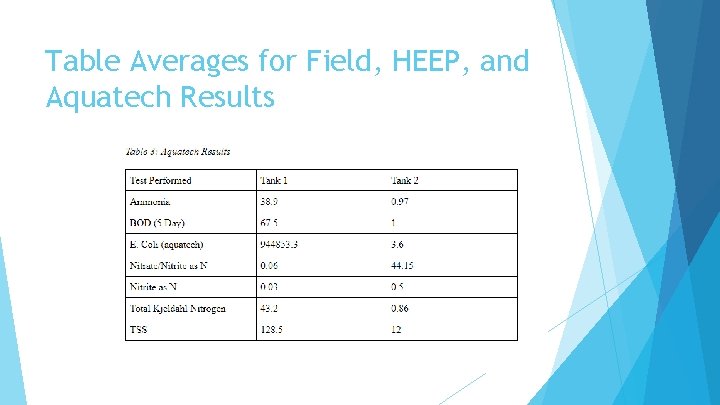
Table Averages for Field, HEEP, and Aquatech Results
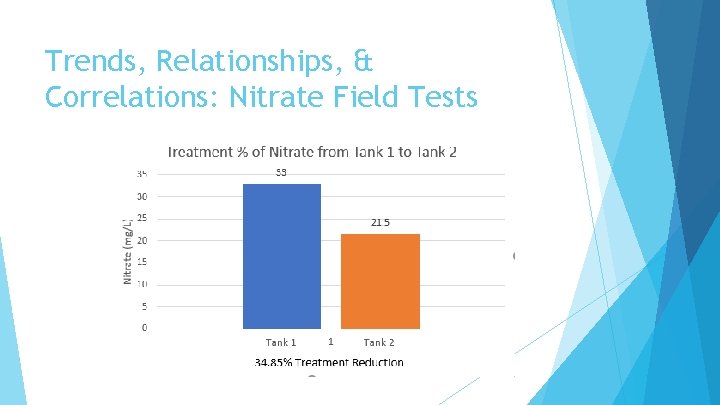
Trends, Relationships, & Correlations: Nitrate Field Tests
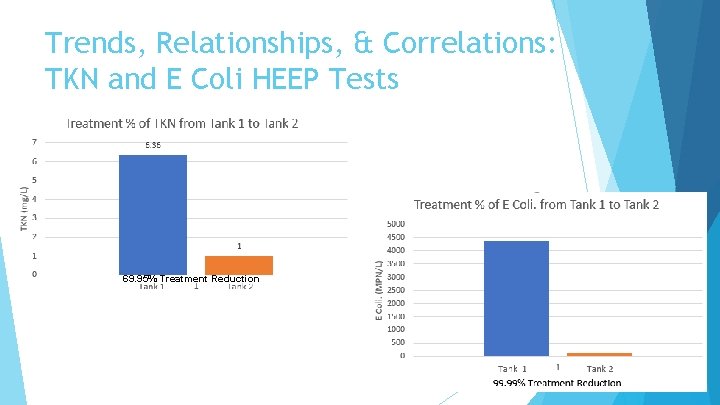
Trends, Relationships, & Correlations: TKN and E Coli HEEP Tests 69. 95% Treatment Reduction
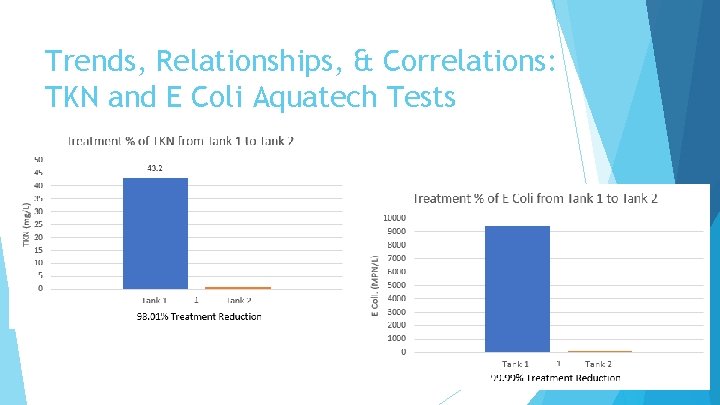
Trends, Relationships, & Correlations: TKN and E Coli Aquatech Tests
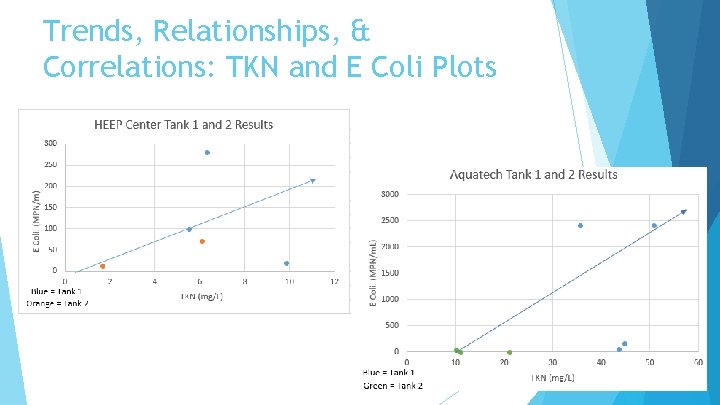
Trends, Relationships, & Correlations: TKN and E Coli Plots
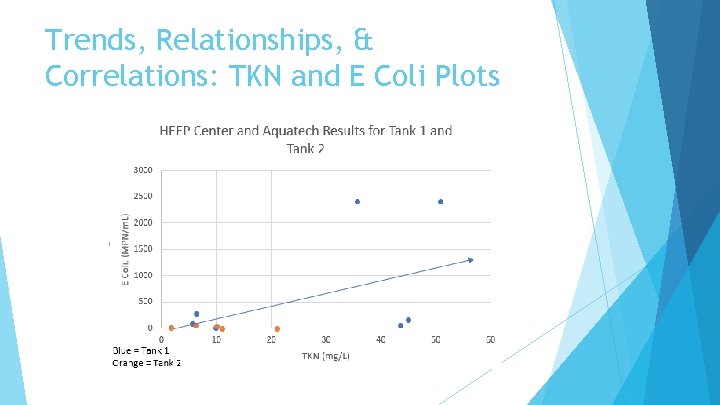
Trends, Relationships, & Correlations: TKN and E Coli Plots
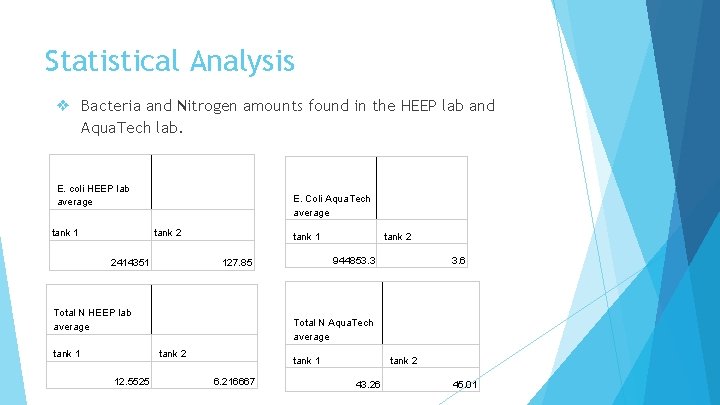
Statistical Analysis ❖ Bacteria and Nitrogen amounts found in the HEEP lab and Aqua. Tech lab. E. coli HEEP lab average tank 1 E. Coli Aqua. Tech average tank 2 2414351 tank 1 3. 6 Total N Aqua. Tech average tank 2 12. 5525 944853. 3 127. 85 Total N HEEP lab average tank 2 tank 1 6. 216667 tank 2 43. 26 45. 01
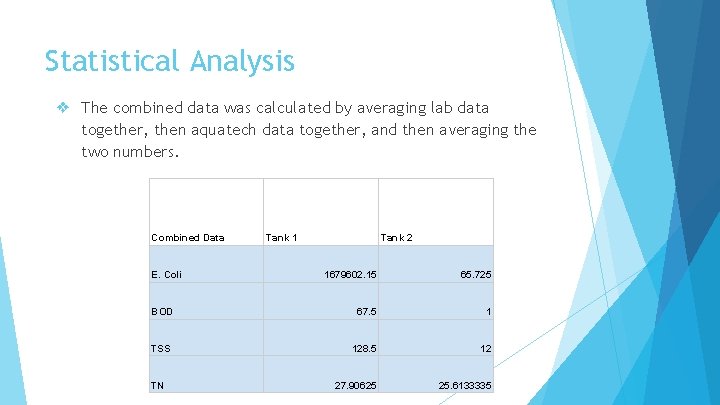
Statistical Analysis ❖ The combined data was calculated by averaging lab data together, then aquatech data together, and then averaging the two numbers. Combined Data E. Coli Tank 1 Tank 2 1679602. 15 65. 725 BOD 67. 5 1 TSS 128. 5 12 27. 90625 25. 6133335 TN
Results ❖ In tanks 1 and 2: ➢ The total Nitrogen values found in the HEEP lab are lower than the total Nitrogen values found in the Aqua. Tech lab. ➢ The E. coli values found in the HEEP lab are higher than the E. coli values found in the Aqua. Tech lab.
Summary/Conclusions ❖ The aerobic respiration that occurs in tank 2 does in fact increase microbial growth which aids in the reduction of nitrogen and bacteria within the MBR tank. ❖ Although there were differences in the values HEEP and Aquatech labs got from the samples tank two was usually the lower value. ❖ Tank two is effective at bacterial and nitrogen reduction from tank one
References ❖ HACH Company. (2017). Nitrogen, Simplified TKN (s-TKN™). Retrieved from http: //docs. wixstatic. com/ugd/f 35 ad 1_2 d 1 fbd 7550964562 ae 1 df 1 bb 277 d 9 ad 7. pdf ❖ https: //fishlab. com/nitrate/ ❖ https: //www. ncbi. nlm. nih. gov/pmc/articles/PMC 4931528/

- Slides: 22