
Assessment of Individuals with Intellectual Disabilities BeirneSmith et
Assessment of Individuals with Intellectual Disabilities Beirne-Smith et al. Mental Retardation, Seventh Edition (c) 2006 by Pearson Education. All Rights Reserved. Copyright © 2006 Pearson Education, Inc. Upper Saddle River, New Jersey 07458 All rights reserved.
Assessment of Intelligence Beirne-Smith et al. Mental Retardation, Seventh Edition (c) 2006 by Pearson Education. All Rights Reserved. Copyright © 2006 Pearson Education, Inc. Upper Saddle River, New Jersey 07458 All rights reserved.

Theories of Intelligence The PASS Model Unit 1: Attending Analyze, Problem Solve & Evaluate Arouse & Attend to Stimuli Unit 3: Planning Unit 2: Acquiring, Holding & Simultaneous Processing & Successive Processing Beirne-Smith et al. Mental Retardation, Seventh Edition (c) 2006 by Pearson Education. All Rights Reserved. Copyright © 2006 Pearson Education, Inc. Upper Saddle River, New Jersey 07458 All rights reserved.
Theories of Intelligence Information Processing Theories • Multiple Intelligences – Based on the idea that there are different types of intelligence – Examples include Gardner’s Theory of Multiple Intelligences and Greenspan’s Model of Personal Competence Beirne-Smith et al. Mental Retardation, Seventh Edition (c) 2006 by Pearson Education. All Rights Reserved. Copyright © 2006 Pearson Education, Inc. Upper Saddle River, New Jersey 07458 All rights reserved.
Theories of Intelligence Information Processing Theories • Gardner’s Theory of Multiple Intelligences – Proposes eight types of intelligences: linguistic, logical-mathematical, musical, spatial, bodily-kinesthetic, intrapersonal, interpersonal, and naturalistic – Few validations of this theory – Many educators have embraced it Beirne-Smith et al. Mental Retardation, Seventh Edition (c) 2006 by Pearson Education. All Rights Reserved. Copyright © 2006 Pearson Education, Inc. Upper Saddle River, New Jersey 07458 All rights reserved.
Theories of Intelligence Information Processing Theories • Greenspan’s Model of Personal Competence: – a tripartite model that includes conceptual, practical, and social intelligence – Conceptual intelligence: ability to think about and understand problems found in formal learning settings – Practical intelligence: performance of everyday skills – Social intelligence: individual’s social and interpersonal abilities Beirne-Smith et al. Mental Retardation, Seventh Edition (c) 2006 by Pearson Education. All Rights Reserved. Copyright © 2006 Pearson Education, Inc. Upper Saddle River, New Jersey 07458 All rights reserved.
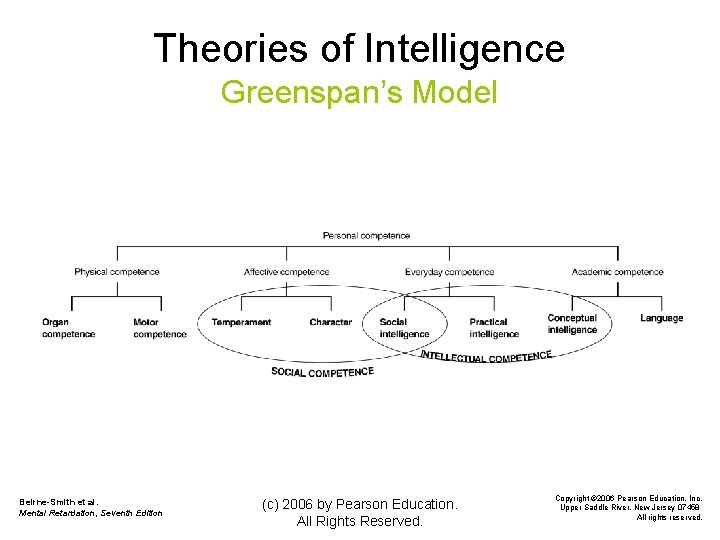
Theories of Intelligence Greenspan’s Model Beirne-Smith et al. Mental Retardation, Seventh Edition (c) 2006 by Pearson Education. All Rights Reserved. Copyright © 2006 Pearson Education, Inc. Upper Saddle River, New Jersey 07458 All rights reserved.
Nature vs. Nurture Is intelligence innate or acquired? • Few claim either nature or nurture are solely responsible. Most prefer an epigenetic explanation. • Researchers generally agree that upbringing affects cognitive development within the constraints of biological potential, but are divided as to the power and rigidity of those constraints. • Heritability is currently estimated to be around 50%, with the remaining 50% due to environmental influences. Beirne-Smith et al. Mental Retardation, Seventh Edition (c) 2006 by Pearson Education. All Rights Reserved. Copyright © 2006 Pearson Education, Inc. Upper Saddle River, New Jersey 07458 All rights reserved.
Intelligence Scores • the notion of IQ has changed dramatically since its inception • many of the terms once associated with intelligence and intelligence quotients are no longer accurate, but have remained in the American vocabulary Beirne-Smith et al. Mental Retardation, Seventh Edition (c) 2006 by Pearson Education. All Rights Reserved. Copyright © 2006 Pearson Education, Inc. Upper Saddle River, New Jersey 07458 All rights reserved.
Intelligence Scores Mental Age • The earliest and least sophisticated term for describing level of intellectual functioning • Describes the age equivalent of the person’s intellectual ability • This technique does not work for adults. Beginning in early adulthood, chronological age increases faster than mental age, making adults appear less apt than they really are. • Still used regularly in the media and legal proceedings Beirne-Smith et al. Mental Retardation, Seventh Edition (c) 2006 by Pearson Education. All Rights Reserved. Copyright © 2006 Pearson Education, Inc. Upper Saddle River, New Jersey 07458 All rights reserved.
Intelligence Scores Ratio Intelligence Quotient • No longer used in practice • Calculated by dividing one’s mental age by one’s chronological age and multiplying by 100 • Removes the mental age bias against adults • Does not allow for comparisons across age groups Beirne-Smith et al. Mental Retardation, Seventh Edition (c) 2006 by Pearson Education. All Rights Reserved. Copyright © 2006 Pearson Education, Inc. Upper Saddle River, New Jersey 07458 All rights reserved.
Intelligence Scores Deviation Intelligence Quotient • Derived by subtracting the mean raw score of the respective age group from the raw score of the person and then dividing that value by the raw score standard deviation for that age group • Allows for comparison across age groups • Most individually administered, norm-referenced intelligence tests used today have a mean (M) of 100 and a standard deviation (SD) of 15 Beirne-Smith et al. Mental Retardation, Seventh Edition (c) 2006 by Pearson Education. All Rights Reserved. Copyright © 2006 Pearson Education, Inc. Upper Saddle River, New Jersey 07458 All rights reserved.
Key Influences Galton, Pearson, & Cattell • The skills and abilities of these men blended to catapult testing into a scientific endeavor in the late 19 th century • Galton is considered the father of formal testing • Cattell coined the term “mental test. ” • Galton wanted to understand the inheritance of mental abilities • Cattell was interested in physiological differences • Pearson was a mathematician who was able to apply statistics to the ideas of Galton & Cattell. Beirne-Smith et al. Mental Retardation, Seventh Edition (c) 2006 by Pearson Education. All Rights Reserved. Copyright © 2006 Pearson Education, Inc. Upper Saddle River, New Jersey 07458 All rights reserved.
Key Influences Alfred Binet • Constructed the first effective intelligence test in early 20 th Century France • Purpose was to identify children with learning problems • Attempted to measure only “natural intelligence” and avoid measuring learning • Scales have been revised many times. Currently in use as the Stanford-Binet (5 th edition) Beirne-Smith et al. Mental Retardation, Seventh Edition (c) 2006 by Pearson Education. All Rights Reserved. Copyright © 2006 Pearson Education, Inc. Upper Saddle River, New Jersey 07458 All rights reserved.
Key Influences David Wechsler • Created a series of individually administered intelligence tests that have become the most-used vehicles in the industry • Believed intelligence is a unitary construct • Tests span from preschool to adulthood • Was developing a test for older adults at the time of his death in 1981. Beirne-Smith et al. Mental Retardation, Seventh Edition (c) 2006 by Pearson Education. All Rights Reserved. Copyright © 2006 Pearson Education, Inc. Upper Saddle River, New Jersey 07458 All rights reserved.
Wechsler Intelligence Scales Wechsler Preschool and Primary Scale of Intelligence (WPPSI-III) • Intended for use with children 2 years, 6 months through 7 years, 3 months of age • Primary purpose is to assist with the diagnosis of exceptionalities of young children • 15 subtests • Five composite scores: Verbal IQ; Performance IQ; Processing Speed Quotient; General Language Composite; and Full Scale IQ. Beirne-Smith et al. Mental Retardation, Seventh Edition (c) 2006 by Pearson Education. All Rights Reserved. Copyright © 2006 Pearson Education, Inc. Upper Saddle River, New Jersey 07458 All rights reserved.

Wechsler Intelligence Scales Wechsler Intelligence Scale for Children – WISC-IV • Intended for children and adolescents aged 6 years, 0 months through 16 years, 11 months • Purpose is to help with educational planning and placement, diagnosis of exceptionality, clinical and neuropsychological assessment, and educational and psychological research • 15 subtests • Yields a Verbal Comprehension Index (VCI) and a Perceptual Reasoning Index (PRI), as well as a Full Scale IQ Beirne-Smith et al. Mental Retardation, Seventh Edition (c) 2006 by Pearson Education. All Rights Reserved. Copyright © 2006 Pearson Education, Inc. Upper Saddle River, New Jersey 07458 All rights reserved.
Wechsler Intelligence Scales Wechsler Adult Intelligence Scale – WAIS-III • Intended for use with adults 16 years, 0 months of age and older • Used for clinical purposes • Provides three composite IQ scores: fullscale IQ, verbal IQ, and performance IQ • Fourteen subtests Beirne-Smith et al. Mental Retardation, Seventh Edition (c) 2006 by Pearson Education. All Rights Reserved. Copyright © 2006 Pearson Education, Inc. Upper Saddle River, New Jersey 07458 All rights reserved.
Stanford-Binet Fifth Edition • Intended for use across the life span • Used for clinical purposes • Provides three composite IQ scores: Full Scale IQ, Verbal IQ, and Nonverbal IQ; as well as 5 composite indices • Ten scored subtests Beirne-Smith et al. Mental Retardation, Seventh Edition (c) 2006 by Pearson Education. All Rights Reserved. Copyright © 2006 Pearson Education, Inc. Upper Saddle River, New Jersey 07458 All rights reserved.
Culture-Free Tests • Attempt to eliminate all cultural factors that might favor one group over another • Minimize the role of language and socially driven expectations • Emphasize nonverbal skills and abilities • Until the process of evaluating intellectual abilities can be clearly separated from cultural influences at both obvious and subtle levels, there may never be a truly “culture-free” test Beirne-Smith et al. Mental Retardation, Seventh Edition (c) 2006 by Pearson Education. All Rights Reserved. Copyright © 2006 Pearson Education, Inc. Upper Saddle River, New Jersey 07458 All rights reserved.
Tests Marketed for Culture Fair Use • • • Matrix Analogies Test Leiter International Performance Scale—Revised Universal Nonverbal Intelligence Test of Nonverbal Intelligence – Third Edition Comprehensive Test of Nonverbal Intelligence Nonverbal scales of many of the Wechsler tests (when administered in the respondent’s native language) Beirne-Smith et al. Mental Retardation, Seventh Edition (c) 2006 by Pearson Education. All Rights Reserved. Copyright © 2006 Pearson Education, Inc. Upper Saddle River, New Jersey 07458 All rights reserved.
Issues in Intelligence Testing • Lack of agreement about the definition of intelligence leads to a dissatisfaction with the assessment tools • Perception that test scores represent a fixed destiny leads to a desire to attack the quality of the test • Test results have been over-emphasized in making educational placement decisions and in the use of strict cut-off scores for diagnosis and services Beirne-Smith et al. Mental Retardation, Seventh Edition (c) 2006 by Pearson Education. All Rights Reserved. Copyright © 2006 Pearson Education, Inc. Upper Saddle River, New Jersey 07458 All rights reserved.
Issues in Intelligence Testing Score Changes • Although test scores typically remain fairly constant over the lifespan, some individuals’ scores will fluctuate in relation to situational variables such as motivation and stress. • As tests age, their norms groups become outdated. When a test is revised, it will be more difficult and will lead to lower scores for several years. Beirne-Smith et al. Mental Retardation, Seventh Edition (c) 2006 by Pearson Education. All Rights Reserved. Copyright © 2006 Pearson Education, Inc. Upper Saddle River, New Jersey 07458 All rights reserved.
Assessment of Adaptive Behavior Beirne-Smith et al. Mental Retardation, Seventh Edition (c) 2006 by Pearson Education. All Rights Reserved. Copyright © 2006 Pearson Education, Inc. Upper Saddle River, New Jersey 07458 All rights reserved.
AAMR Definitions • “the degree with which individuals meet the standards of personal independence and social responsibility expected for age and cultural group” (1983) • “the collection of conceptual, social, and practical skills that have been learned by people in order to function in their everyday lives” (2002) Beirne-Smith et al. Mental Retardation, Seventh Edition (c) 2006 by Pearson Education. All Rights Reserved. Copyright © 2006 Pearson Education, Inc. Upper Saddle River, New Jersey 07458 All rights reserved.
Conceptual Bases • Emphasizes what a person does in typical situations rather than what a person can do or might do under the best of circumstances • A dynamic, ever-changing construct • Influenced by such factors as cultural norms, age-related expectations, and a combination of anticipated and idiosyncratic behaviors Beirne-Smith et al. Mental Retardation, Seventh Edition (c) 2006 by Pearson Education. All Rights Reserved. Copyright © 2006 Pearson Education, Inc. Upper Saddle River, New Jersey 07458 All rights reserved.
Evolution of the Construct • Historically a biological construct • On a broad level, adaptation preserves the species • On an individual level, adaptation relates to the person’s behavioral responses to environmental demands • Work on the underlying construct is in the early stages, but seems to indicate multiple factors which are possibly hierarchical in nature Beirne-Smith et al. Mental Retardation, Seventh Edition (c) 2006 by Pearson Education. All Rights Reserved. Copyright © 2006 Pearson Education, Inc. Upper Saddle River, New Jersey 07458 All rights reserved.
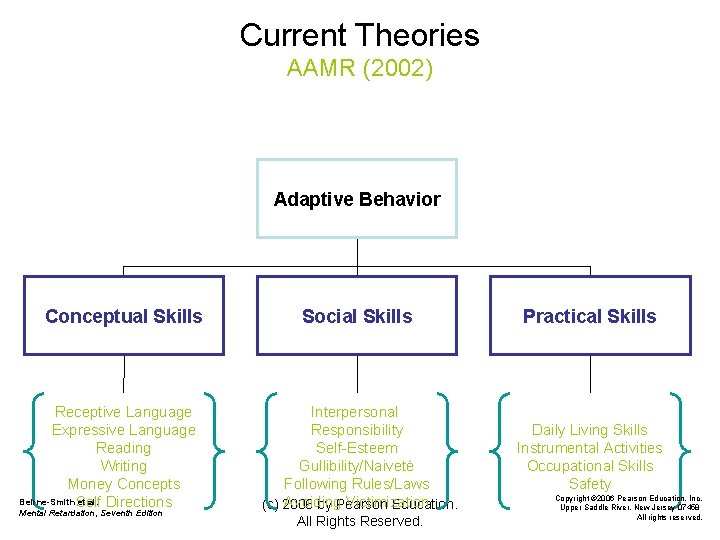
Current Theories AAMR (2002) Adaptive Behavior Conceptual Skills Receptive Language Expressive Language Reading Writing Money Concepts Beirne-Smith Self et al. Directions Mental Retardation, Seventh Edition Social Skills Practical Skills Interpersonal Responsibility Self-Esteem Gullibility/Naiveté Following Rules/Laws Avoiding Victimization (c) 2006 by Pearson Education. Daily Living Skills Instrumental Activities Occupational Skills Safety All Rights Reserved. Copyright © 2006 Pearson Education, Inc. Upper Saddle River, New Jersey 07458 All rights reserved.
Relationship to Intelligence Assessment Procedures • Intelligence assessment focuses on maximal performance; adaptive behavior assessment focuses on usual performance • Intelligence assessment focuses on higher order cognition; adaptive behavior focuses on everyday behaviors • Intelligence assessment is highly formal and structured; adaptive behavior assessment is usually based on semi-structured third-party interviews Beirne-Smith et al. Mental Retardation, Seventh Edition (c) 2006 by Pearson Education. All Rights Reserved. Copyright © 2006 Pearson Education, Inc. Upper Saddle River, New Jersey 07458 All rights reserved.
Key Influences Edgar Doll • A psychologist who worked at the Vineland Training School in New Jersey • Developed the Vineland Social Maturity Scale (1935), which is considered the first scientific assessment tool of its kind • Recognized the need to incorporate adaptive behavior (social maturity) into the consideration of mental retardation Beirne-Smith et al. Mental Retardation, Seventh Edition (c) 2006 by Pearson Education. All Rights Reserved. Copyright © 2006 Pearson Education, Inc. Upper Saddle River, New Jersey 07458 All rights reserved.
Major Instruments Vineland Adaptive Behavior Scales • Available in three versions: survey form, expanded edition, & classroom edition • Assess five major domains of adaptive behavior: communication, daily living skills, socialization, motor skills, and maladaptive behavior • A popular measure; many consider it among the best • Last revised in 1986; a revision is forthcoming Beirne-Smith et al. Mental Retardation, Seventh Edition (c) 2006 by Pearson Education. All Rights Reserved. Copyright © 2006 Pearson Education, Inc. Upper Saddle River, New Jersey 07458 All rights reserved.
Major Instruments AAMR Adaptive Behavior Scales – Second Edition • Available in two versions – School and Residential/Community, which function independently of one another • Comprised of two parts: Personal Responsibility and Social Adaptation • Latest revisions were in 1993; a new revision is forthcoming Beirne-Smith et al. Mental Retardation, Seventh Edition (c) 2006 by Pearson Education. All Rights Reserved. Copyright © 2006 Pearson Education, Inc. Upper Saddle River, New Jersey 07458 All rights reserved.
Issues in Adaptive Behavior Assessment • Available instruments fail to cover all aspects of adaptive behavior • The correlation between intelligence and adaptive behavior leaves room for debate over primacy • Tools must be appropriate for the cultural context • The interview format allows for variation among raters and respondents • There is no clear consensus regarding the role of maladaptive behavior in adaptive behavior development and assessment Beirne-Smith et al. Mental Retardation, Seventh Edition (c) 2006 by Pearson Education. All Rights Reserved. Copyright © 2006 Pearson Education, Inc. Upper Saddle River, New Jersey 07458 All rights reserved.
Other Types of Assessment Beirne-Smith et al. Mental Retardation, Seventh Edition (c) 2006 by Pearson Education. All Rights Reserved. Copyright © 2006 Pearson Education, Inc. Upper Saddle River, New Jersey 07458 All rights reserved.
Educational Assessment • Progress Monitoring – Frequent, data-based measures of IEP goal attainment • Transition Planning – Assessment of occupational interests and aptitudes that begins by age 14 • High-Stakes Testing – Participation in state and local standardized assessments, which may include accommodations or alternate assessments Beirne-Smith et al. Mental Retardation, Seventh Edition (c) 2006 by Pearson Education. All Rights Reserved. Copyright © 2006 Pearson Education, Inc. Upper Saddle River, New Jersey 07458 All rights reserved.
Adult Assessment • The Supports Intensity Scale – designed to assess the types of supports required for successful functioning in a variety of life areas • Informal Assessments – Often used in adult education programs • Formal Assessments – Often used when requesting services or disability benefits Beirne-Smith et al. Mental Retardation, Seventh Edition (c) 2006 by Pearson Education. All Rights Reserved. Copyright © 2006 Pearson Education, Inc. Upper Saddle River, New Jersey 07458 All rights reserved.
Legal Assessments • Diminished Capacity – ability to establish either criminal intent or the motivation to engage in criminal behavior and to understand it as such (a finding of diminished capacity requires a diagnosis of a mental disorder) • Competence to Stand Trial – Ability to understand the charges, the legal process, and to assist his/her attorney in the defense – Should include intellectual testing; perceptual-motor examination; achievement test; adaptive behavior/skills; socioemotional scale; and an instrument specifically designed for the assessment of competence • Malingering – Feigning mental retardation to avoid culpability – One tool available: The Validity Indicator Profile Beirne-Smith et al. Mental Retardation, Seventh Edition (c) 2006 by Pearson Education. All Rights Reserved. Copyright © 2006 Pearson Education, Inc. Upper Saddle River, New Jersey 07458 All rights reserved.
- Slides: 37