
Assessment of Indian Railways Track Ballast in the
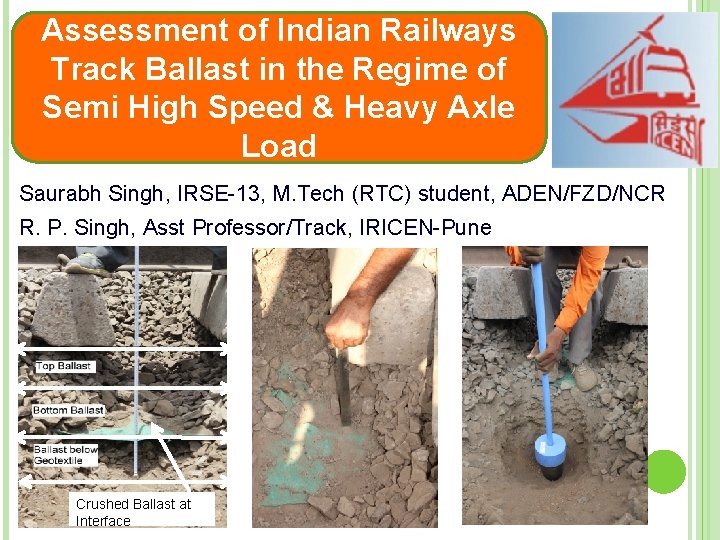
Assessment of Indian Railways Track Ballast in the Regime of Semi High Speed & Heavy Axle Load Saurabh Singh, IRSE-13, M. Tech (RTC) student, ADEN/FZD/NCR R. P. Singh, Asst Professor/Track, IRICEN-Pune Crushed Ballast at Interface

FIELD INVESTIGATIONS AND BALLAST SAMPLING FOR LAB TESTINGS Top Ballast Bottom Ballast Sub Ballast 2

FIELD INVESTIGATIONS AND BALLAST SAMPLING FOR LAB TESTINGS From Each Location 3 different samples were collected. (Top Ballast, Bottom Ballast & Sub Ballast) Each Sample is about 15 -20 Kg. Details of Sampling Locations : C Rly, BSL Divn, AK - BSL Section Geotextile was laid in 2007 and 2012 along with BCM on experimental basis. The Geotextile used is green net and not as per international standards. Sr Samp Road Chaina No. le No. Lattitude Longitude ge Date of Years GMT Deep after Passed Screening DS 1 30 DN 495/6 20˚ 53. 393' 76˚ 12. 779' March’ 07 9 347 2 34 DN 496. 00 20˚ 53. 337' 76˚ 13. 365' March’ 07 9 347 3 35 DN 496/6 20˚ 53. 334' 76˚ 13. 289' March’ 07 9 347 4 37 DN 486. 30 20˚ 54. 271' 76˚ 07. 784' March’ 07 9 347 5 4 UP 472. 00 20˚ 54. 910' 75˚ 59. 907' April’ 12 4 226. 92 6 12 UP 468. 00 20˚ 56. 397' 75˚ 58. 531' April’ 12 4 226. 92 3
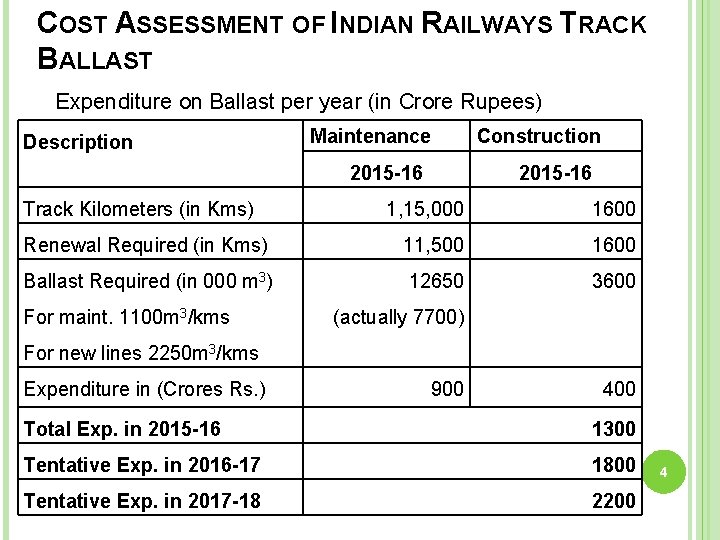
COST ASSESSMENT OF INDIAN RAILWAYS TRACK BALLAST Expenditure on Ballast per year (in Crore Rupees) Description Maintenance 2015 -16 Track Kilometers (in Kms) Construction 2015 -16 1, 15, 000 1600 Renewal Required (in Kms) 11, 500 1600 Ballast Required (in 000 m 3) 12650 3600 For maint. 1100 m 3/kms (actually 7700) For new lines 2250 m 3/kms Expenditure in (Crores Rs. ) 900 400 Total Exp. in 2015 -16 1300 Tentative Exp. in 2016 -17 1800 Tentative Exp. in 2017 -18 2200 4
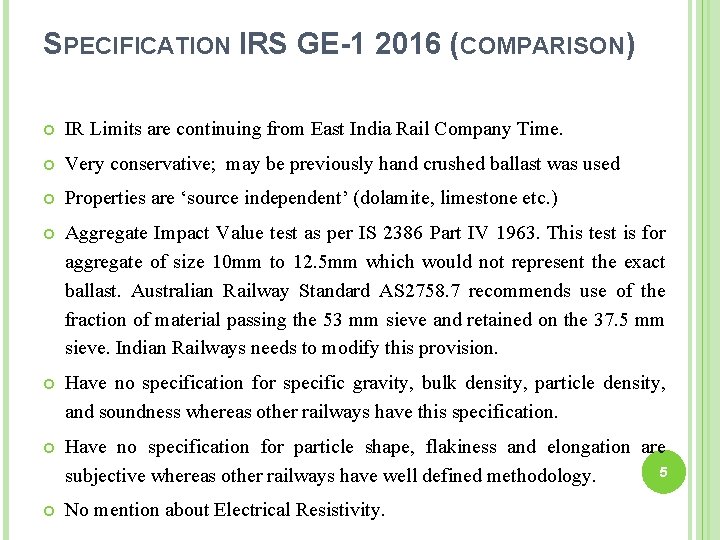
SPECIFICATION IRS GE-1 2016 (COMPARISON) IR Limits are continuing from East India Rail Company Time. Very conservative; may be previously hand crushed ballast was used Properties are ‘source independent’ (dolamite, limestone etc. ) Aggregate Impact Value test as per IS 2386 Part IV 1963. This test is for aggregate of size 10 mm to 12. 5 mm which would not represent the exact ballast. Australian Railway Standard AS 2758. 7 recommends use of the fraction of material passing the 53 mm sieve and retained on the 37. 5 mm sieve. Indian Railways needs to modify this provision. Have no specification for specific gravity, bulk density, particle density, and soundness whereas other railways have this specification. Have no specification for particle shape, flakiness and elongation are 5 subjective whereas other railways have well defined methodology. No mention about Electrical Resistivity.
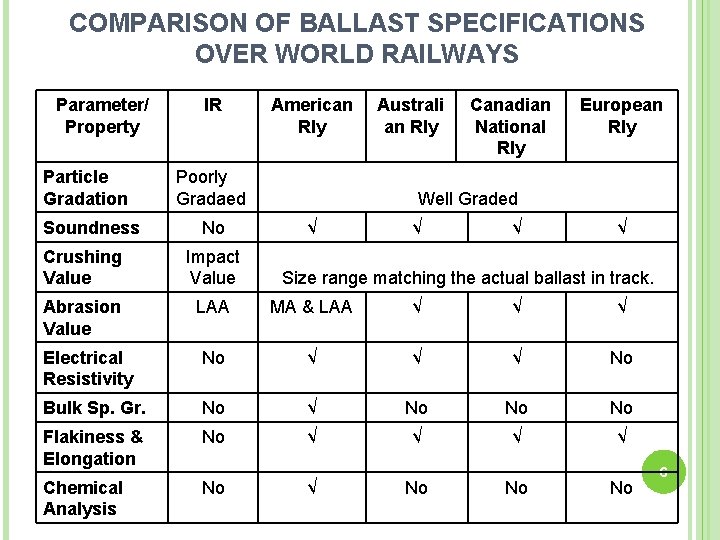
COMPARISON OF BALLAST SPECIFICATIONS OVER WORLD RAILWAYS Parameter/ Property Particle Gradation Soundness IR American Rly Poorly Gradaed No Australi an Rly Canadian National Rly European Rly Well Graded √ √ Crushing Value Impact Value Abrasion Value LAA MA & LAA √ √ √ Electrical Resistivity No √ √ √ No Bulk Sp. Gr. No √ No No No Flakiness & Elongation No √ √ Chemical Analysis No Size range matching the actual ballast in track. √ No No No 6
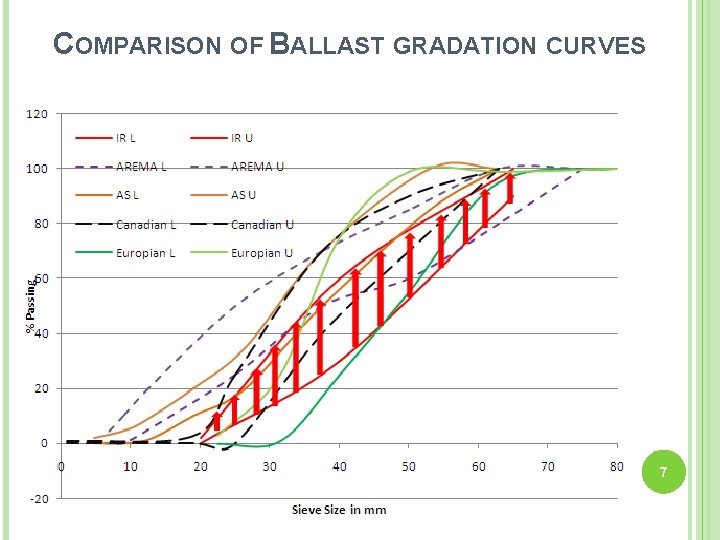
COMPARISON OF BALLAST GRADATION CURVES 7
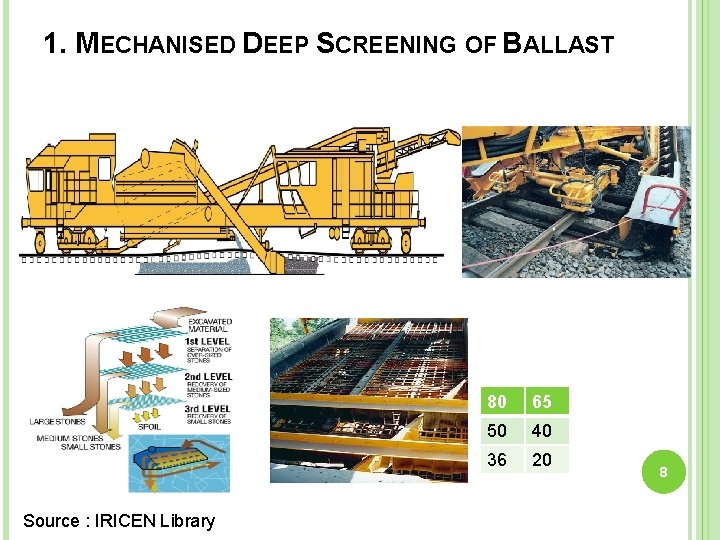
1. MECHANISED DEEP SCREENING OF BALLAST Source : IRICEN Library 80 65 50 40 36 20 8
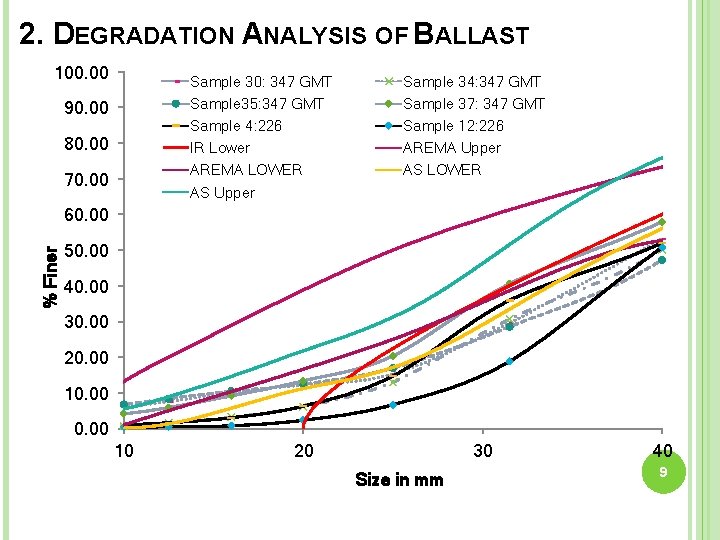
2. DEGRADATION ANALYSIS OF BALLAST 100. 00 Sample 30: 347 GMT Sample 35: 347 GMT Sample 4: 226 IR Lower AREMA LOWER AS Upper 90. 00 80. 00 70. 00 Sample 34: 347 GMT Sample 37: 347 GMT Sample 12: 226 AREMA Upper AS LOWER % Finer 60. 00 50. 00 40. 00 30. 00 20. 00 10 20 30 Size in mm 40 9
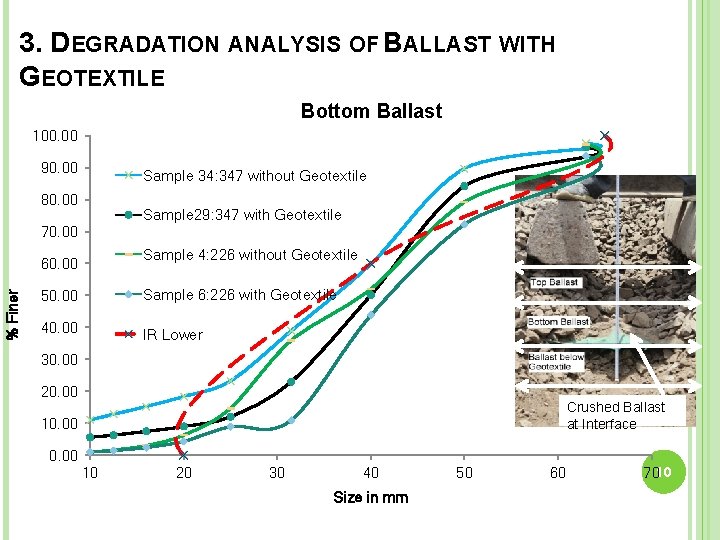
3. DEGRADATION ANALYSIS OF BALLAST WITH GEOTEXTILE Bottom Ballast 100. 00 90. 00 Sample 34: 347 without Geotextile 80. 00 Sample 29: 347 with Geotextile 70. 00 Sample 4: 226 without Geotextile % Finer 60. 00 50. 00 Sample 6: 226 with Geotextile 40. 00 IR Lower 30. 00 20. 00 Crushed Ballast at Interface 10. 00 10 20 30 40 Size in mm 50 60 7010
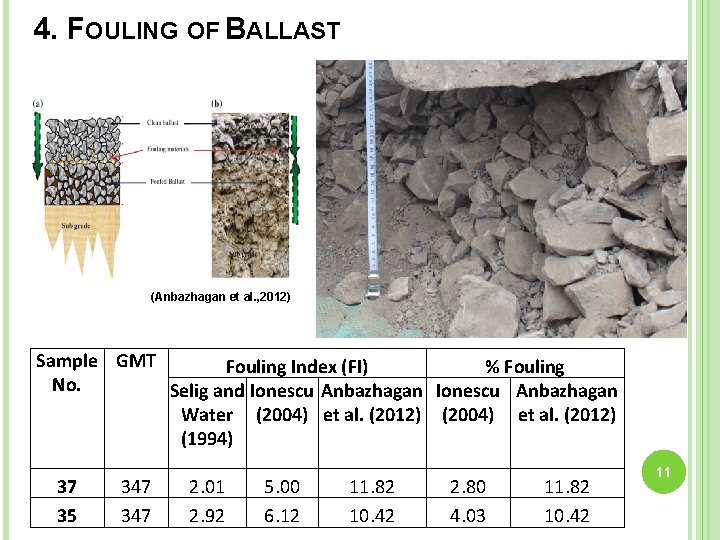
4. FOULING OF BALLAST (Anbazhagan et al. , 2012) Sample GMT Fouling Index (FI) % Fouling No. Selig and Ionescu Anbazhagan Water (2004) et al. (2012) (1994) 37 35 347 2. 01 2. 92 5. 00 6. 12 11. 82 10. 42 2. 80 4. 03 11. 82 10. 42 11
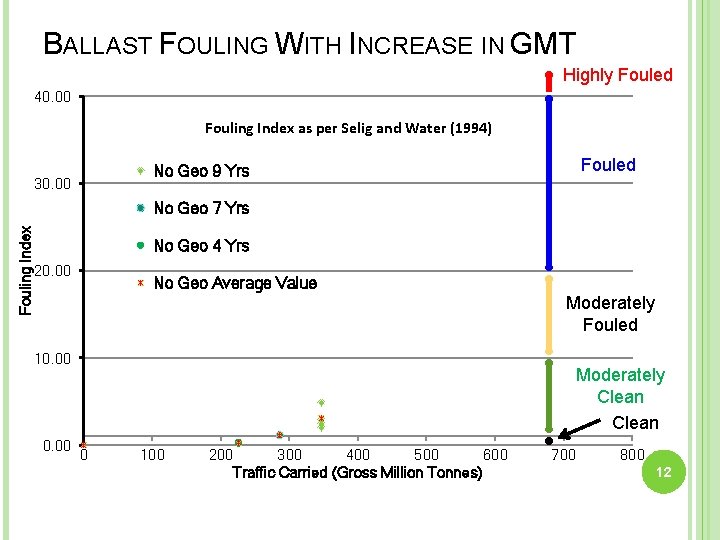
Fouling Index BALLAST FOULING WITH INCREASE IN GMT Traffic Carried (Gross Million Tonnes) 12
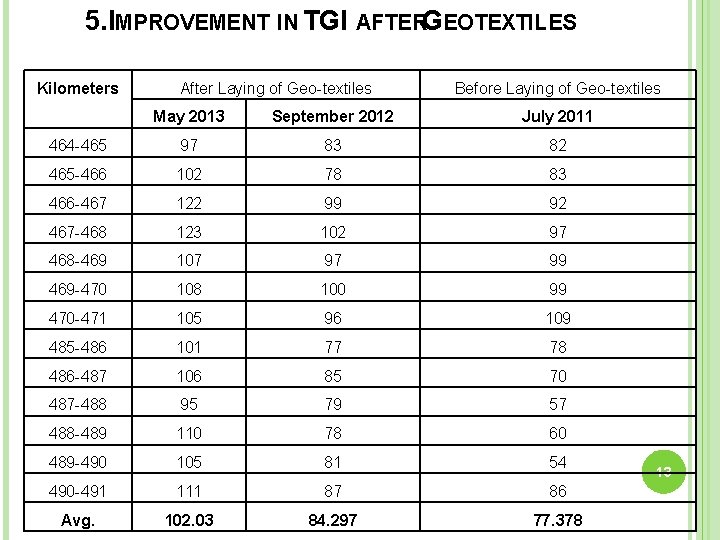
5. IMPROVEMENT IN TGI AFTERGEOTEXTILES Kilometers After Laying of Geo-textiles Before Laying of Geo-textiles May 2013 September 2012 July 2011 464 -465 97 83 82 465 -466 102 78 83 466 -467 122 99 92 467 -468 123 102 97 468 -469 107 97 99 469 -470 108 100 99 470 -471 105 96 109 485 -486 101 77 78 486 -487 106 85 70 487 -488 95 79 57 488 -489 110 78 60 489 -490 105 81 54 490 -491 111 87 86 Avg. 102. 03 84. 297 77. 378 13
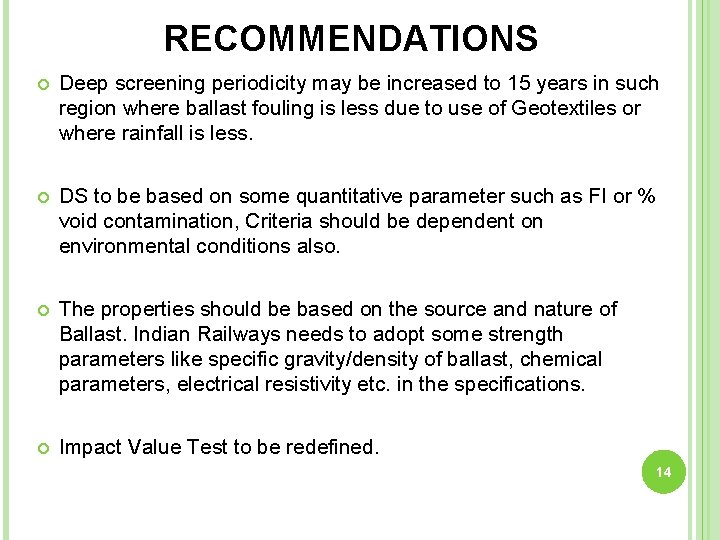
RECOMMENDATIONS Deep screening periodicity may be increased to 15 years in such region where ballast fouling is less due to use of Geotextiles or where rainfall is less. DS to be based on some quantitative parameter such as FI or % void contamination, Criteria should be dependent on environmental conditions also. The properties should be based on the source and nature of Ballast. Indian Railways needs to adopt some strength parameters like specific gravity/density of ballast, chemical parameters, electrical resistivity etc. in the specifications. Impact Value Test to be redefined. 14
Value Engineering 15
- Slides: 15