
Assessment of fetal status Prof Dr Rabea M
Assessment of fetal status {Prof. Dr. Rabea M. Ali
fetal assessment determination of the well-being of the fetus. Indications 1. High-risk pregnancy (a woman has had complications in a previous pregnancy or has a pre-existing health condition such as diabetes mellitus or heart disease) 2. Problems during pregnancy, such as fetal growth problems, Rh sensitization, or high blood pressure 3. Decreased movement of the fetus 4. Pregnancy that goes past 42 weeks (post-term pregnancy) 5. Multiple pregnancy with certain complications
Types of fetal assessment q fetal movement counts (“kick counts) Fetal movement counting (also called “kick counts”) is a test that the woman can do at home. There are different ways kick counts can be done. the health care professional will tell her how often to do it and when to notify him or her. Daily fetal movement counting, such as the Cardiff “count-toten” method using kick charts, is a way of screening for fetal well-being, by which a woman counts daily fetal movements to assess the condition of her baby.
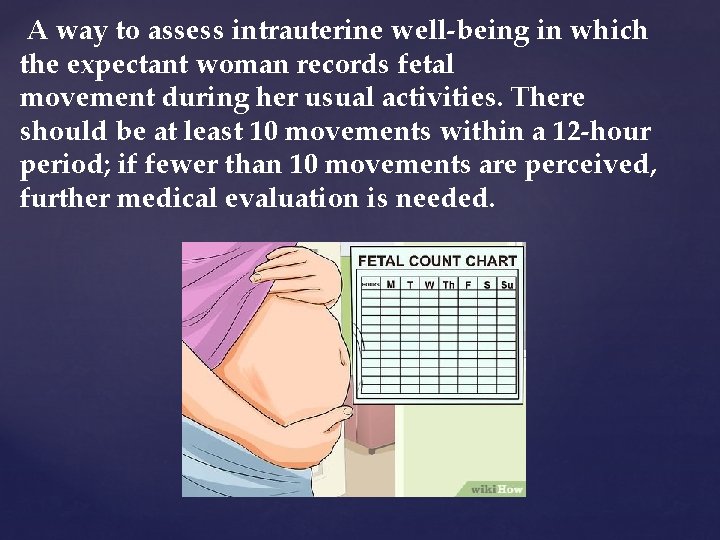
A way to assess intrauterine well-being in which the expectant woman records fetal movement during her usual activities. There should be at least 10 movements within a 12 -hour period; if fewer than 10 movements are perceived, further medical evaluation is needed.
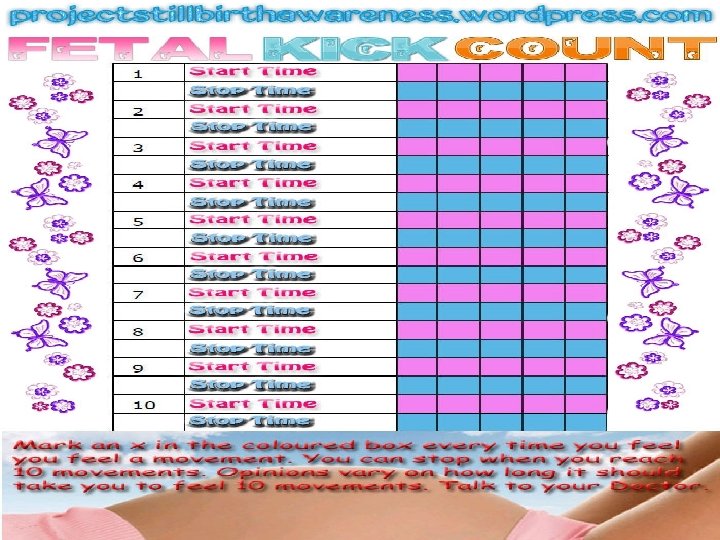
INSTRUCTIONS v Choose one period during the day to count. should choose a time when the baby is normally active. v Count at the same time every day. v chart how long it takes to reach 10 movements. v Count all recognizable movements. This may be a kick, a punch, rolling, stretching, etc. If you feel a short flurry of kicks, count that as one movement. Do not count hiccups.
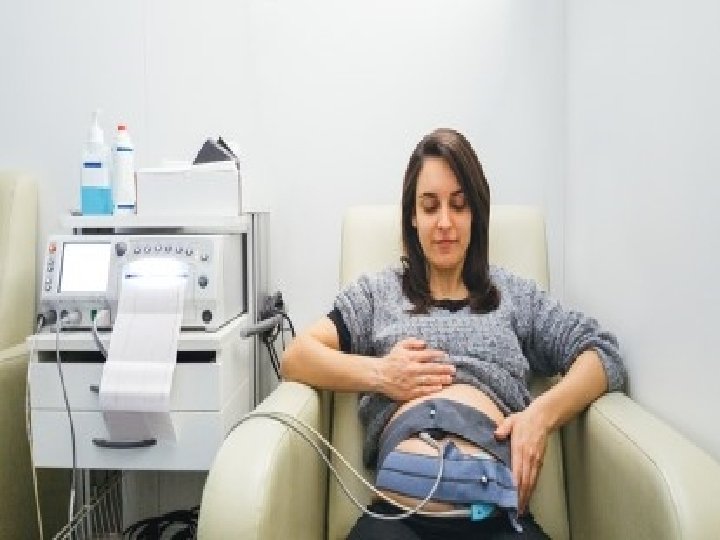
The non-stress test measures the fetal heart rate in response to fetal movement over time. The term “non-stress” means that during the test, nothing is done to place stress on the fetus. This test may be done in the health care professional’s office or in a hospital. The test is done while woman are reclining or lying down and usually takes at least 20 minutes. A belt with a sensor that measures the fetal heart rate is placed around the abdomen. The fetal heart rate is recorded by a machine.
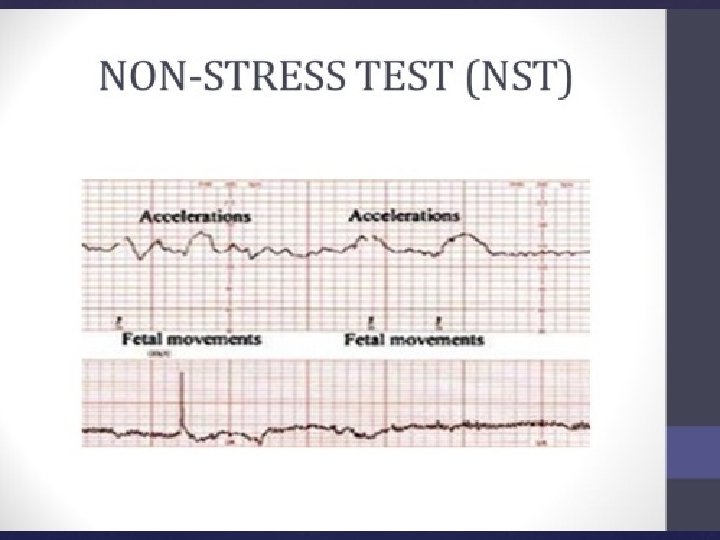
Results mean : If two or more accelerations occur within a 20 minute period, the result is considered reactive or “reassuring. ” A reactive result means that for now, it does not appear that there any problems. A nonreactive result is one in which not enough accelerations are detected in a 40 -minute period. It can mean several things. It may mean that the fetus was asleep during the test. If this happens, the test may last 40 more minutes, or the fetus may be stimulated to move with sound projected over the mother’s abdomen. A nonreactive result can occur if the woman has taken certain medications. It also can mean that the fetus is not getting enough oxygen.
Biophysical profile A biophysical profile (BPP) may be done when results of other tests are non-reassuring. It uses a scoring system to evaluate fetal well-being in these five areas: 1. Fetal heart rate 2. Fetal breathing movements 3. Fetal body movements 4. Fetal muscle tone 5. Amount of amniotic fluid
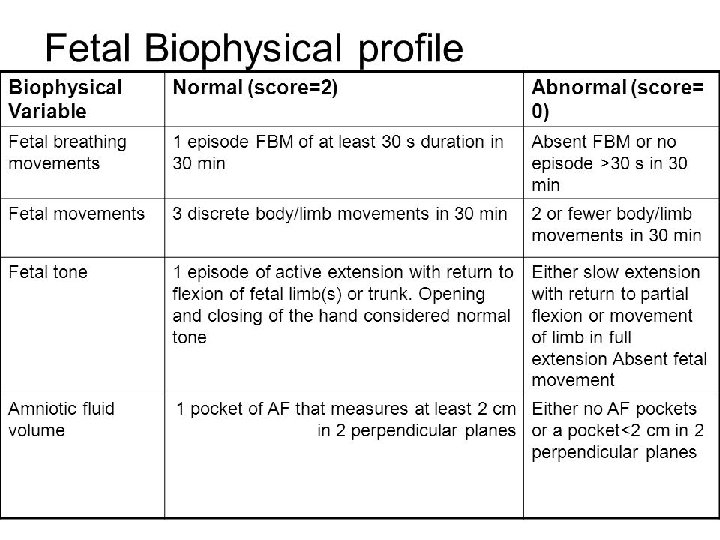
A BPP involves monitoring the fetal heart rate (the same way it is done in a non-stress test) as well as an ultrasound exam. During an ultrasound exam, a device called a transducer is rolled gently over the abdomen while woman are reclining or lying down. The transducer creates sound waves that bounce off of the internal structures of the body. The transducer receives these echoes, which are converted into images displayed on a computer screen for the technician to view.
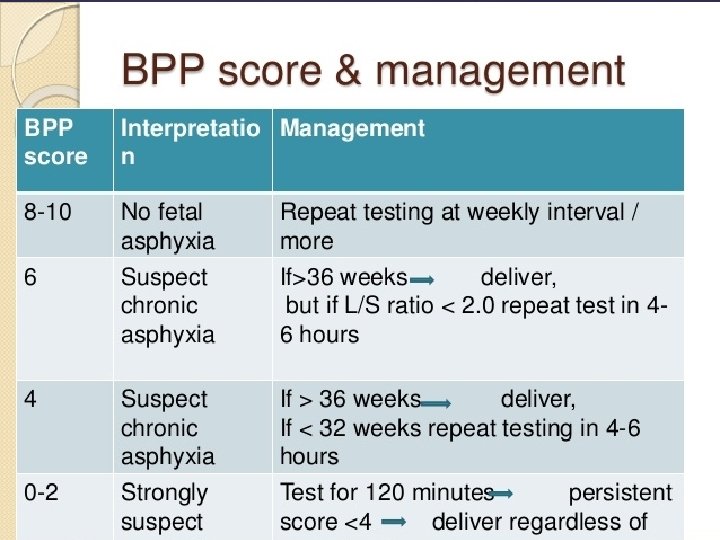
A score of 8– 10 is reassuring. A score of 6 is equivocal (neither reassuring nor non reassuring). If have an equivocal score, depending on how far along woman are in her pregnancy, may have another BPP within the next 12– 24 hours, or it may be decided to deliver the baby. A score of 4 or less means that further testing is needed. Sometimes, it means that the baby should be delivered early or right away.
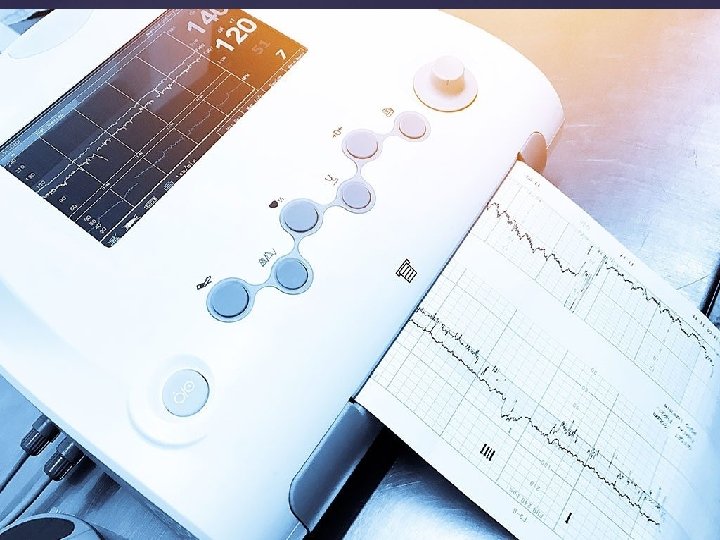
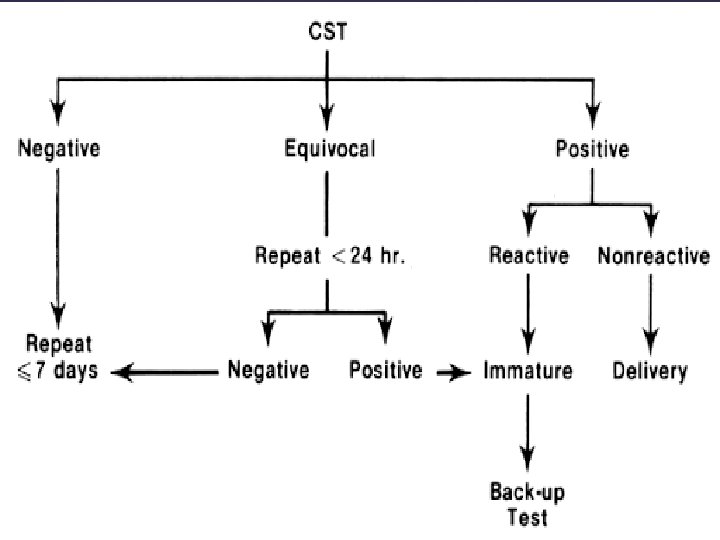
Contraction stress test A contraction stress test (CST) is performed near the end of pregnancy (34 weeks' gestation) to determine how well the fetus will cope with the contractions of childbirth. The aim is to induce contractions and monitor the fetus to check for heart rate abnormalities using a cardiotocograph. A CST is one type of antenatal fetal surveillance technique.
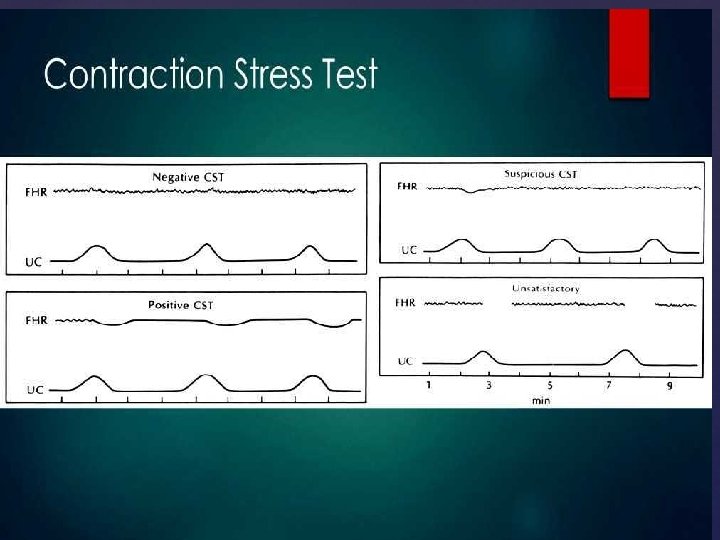
Uses The CST is used for its high negative predictive value. A negative result is highly predictive of fetal wellbeing and tolerance of labor. The test has a poor positive predictive value with falsepositive results in as many as 30% of cases. A positive CST indicates high risk of fetal death due to hypoxia and is a contraindication to labor. Patient's obstetricians usually consider operative delivery in such situations.
Contraindication This "stress test" is usually not performed if there any signs of 1. Premature birth 2. placenta previa, vasaprevia 3. Cervical incompetence 4. Multiple gestation. 5. previous classic cesarean section 6. Other contraindications include but are not limited to previous uterine incision with scarring, previous myomectomy entering the uterine cavity, and PROM. Any contraindication to labor is contraindication to CST.
CST is performed weekly. as the fetus is assumed to be healthy after a negative test and should remain so for another week. This test is done in hospital or clinic setting. External fetal monitors are put in place and then either nipple stimulation or IV Pitocin (oxytocin) is used to stimulate uterine contractions.
Nipple stimulation This is a procedure that relies on endogenous release of oxytocin following nipple stimulation, and is conducted by the patient. The nurse instructs the patient on the procedure, as follows. One nipple is massaged gently through clothing until a contraction begins, or for a maximum of 2 minutes. If at least 3 contractions in 10 minutes is not achieved, then the patient rests for 5 minutes and the other nipple is stimulated.
Oxytocin challenge test (OCT) If adequate contractions (at least 3 in 10 minutes) cannot be achieved with nipple stimulation, an oxytocin challenge test may be performed. It involves the intravenous administration of exogenous oxytocin to the pregnant woman. The target is to achieve around three contractions every ten minutes
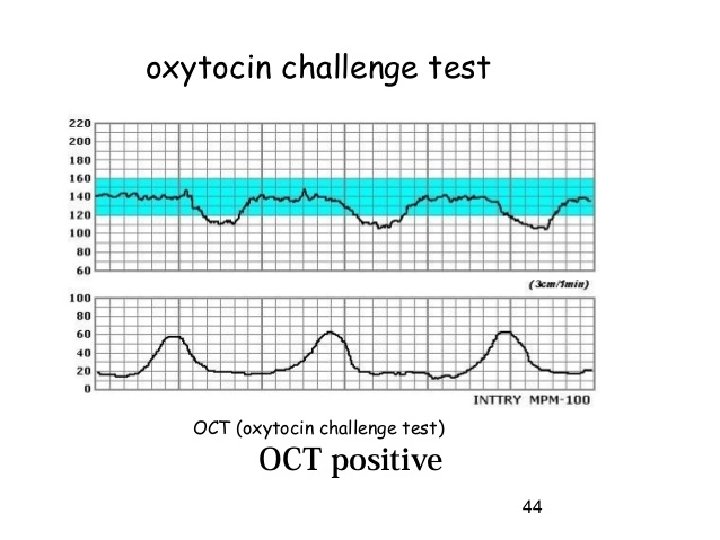
The contraction stress test helps the health care professional see how the fetal heart rate reacts when the uterus contracts. The contraction stress test sometimes is used if other test results are positive or unclear. In this test, belts with sensors that detect the fetal heart rate and uterine contractions are placed across the abdomen. To make the uterus contract mildly, pregnant woman may be asked to rub her nipples through clothing or may be during given oxytocin.
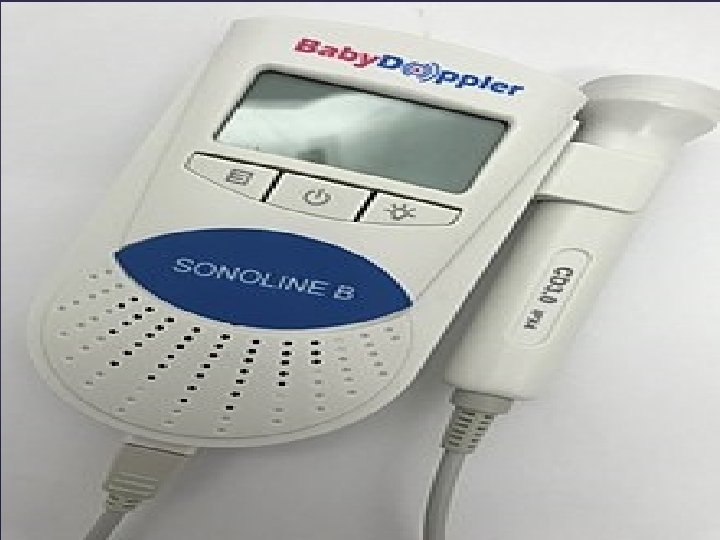
Doppler ultrasound exam of the umbilical artery A Doppler fetal monitor is a handheld ultrasound transducer used to detect the fetal heartbeat for prenatal care. It uses the Doppler effect to provide an audible simulation of the heartbeat. Some models also display the heart rate in beats per minute (BPM). Use of this monitor is sometimes known as Doppler auscultation. The Doppler fetal monitor is commonly referred to simply as a Doppler or fetal Doppler. It may be classified as a form of Doppler ultrasonography (although usually not technically graphy but rather soundgenerating).

- Slides: 30