
Assessment of Abdomen CHAPTER 9 Examination Inspection Auscultation
Assessment of Abdomen
CHAPTER 9 Examination • Inspection • Auscultation • Percussion • Palpation
CHAPTER 9 Abdominal Structure and Function Abdominal quadrants • Upper right quadrant • Upper left quadrant • Lower right quadrant • Lower left quadrant
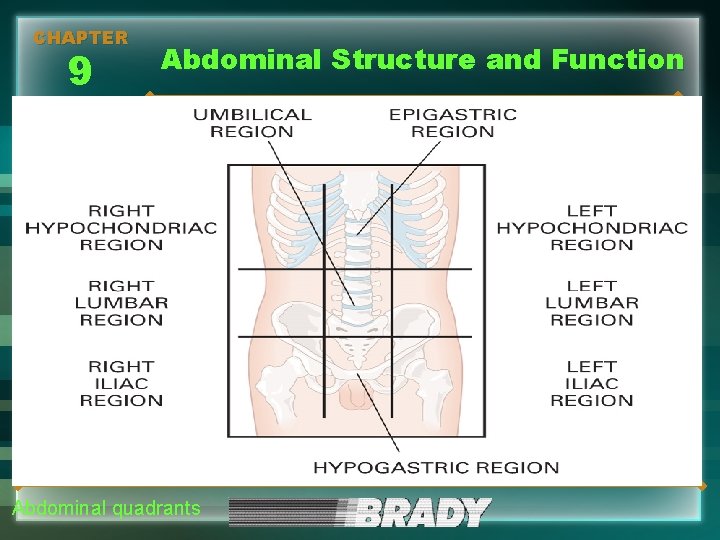
CHAPTER 9 Abdominal Structure and Function Abdominal quadrants
CHAPTER 9 Equipment needed The only equipment needed are: • Stethoscope • cloth or plastic ruler • Pencil • Examination table • Light • Small pillow • Drapes to cover the patient
CHAPTER 9 • • • Subjective History Appetite Dysphagia Food intolerance Nausea /Vomiting Bowel habits Past abdominal history • Medications • Nutritional Abdominal pain • Onset • Location • Duration • Characteristics • Associated findings • Relieving factors • Tx attempted
CHAPTER 9 The Examination • Client – Empty bladder, disrobe & gown, supine, head on pillow, knees bent, arms at side or across chest, have pt ID any area of pain • Nurse – Warm hands & stethoscope, warm environment, good lighting, approach slowly, monitor pt’s face during exam, tender areas last • Inspect, Auscultate, Percuss, Palpate- light & deep
CHAPTER 9 Inspection Contour - flat, rounded. Symmetry. Umbilicus Skin - texture, color, lesions, veins, turgor Surface motion - pulsations or peristalsis Respiratory movement Hair distribution Demeanor
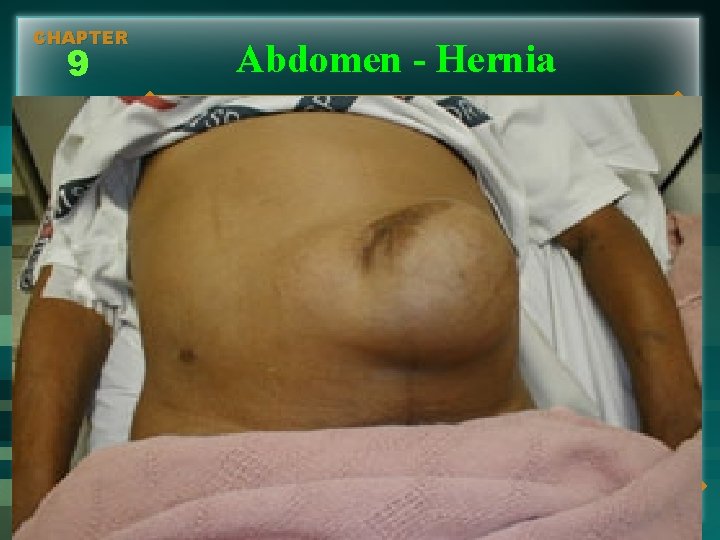
CHAPTER 9 Abdomen - Hernia
CHAPTER 9 Auscultation • Use diaphragm high pitched • hold lightly against skin • Begin RLQ (ileocecal valve area) • Bowel sounds • character & frequency • originate from air & fluid movement thru small intestines • hi pitched, gurgling, cascading, irregular, • 5 -30 times/min, depends on last time pt ate
CHAPTER 9 Auscultation cont. • Findings – Normal – hypoactive - absent, slow ie) surgery, inflammation – hyperactive - loud, rushing, tinkling – hyper peristalsis, ”stomach growling” • Listen for 5 minutes before deciding absent
CHAPTER 9 Auscultation cont. • Vascular sounds – Bruits- pulsatile blowing sound with artery occlusion (use firmer pressure) – aorta – renal – iliac – femoral – Venous hum- periumbilical region – Peritoneal friction rub
CHAPTER 9 • Liver • Spleen • Kidney • Aorta Palpation--Specific Organs
CHAPTER 9 Special Procedures • Blumberg sign (Appendix test) – Rebound tenderness • Murphy’s sign (Gallbladder test) • Hernias
- Slides: 14