
Assessment Literacy A course for increasing rigor reliability
Assessment Literacy A course for increasing rigor, reliability and validity of classroom assessments.
OBJECTIVES Participants will be able to: 1. Create an assessment’s purpose statement. 2. Identify what is to be measured. 3. Develop a basic plan to create an assessment’s blueprint. 2
Components • The components of this Assessment Literacy Course are being presented in isolated and multi formatted learning exercises – for learning the process from parts to whole. • Looking at all the parts to make putting assessments together smoothly. 3
Group Work Depth of Knowledge Pretest Based on your understanding of Depth of Knowledge, assign the appropriate level to the following assessment questions. Depth of Knowledge Pretest Purpose: This will serve as a formative assessment of participants in the Assessment Literacy Course. Results of the assessment will be used to create a guide for instruction and content in the course. This will facilitate educator achievement in increasing rigor, reliability, and validity of assessments offered in each grade level. 4

Depth of Knowledge Level 1: Recall and Reproduction Tasks at this level require recall of facts or rote application of simple procedures. The task does not require any cognitive effort beyond remembering the right response or formula. Copying, computing, defining, and recognizing are typical Level 1 tasks. Level 2: Skills and Concepts At this level, a student must make some decisions about his or her approach. Tasks with more than one mental step such as comparing, organizing, summarizing, predicting, and estimating are usually Level 2. 5

Depth of Knowledge Level 3: Strategic Thinking At this level of complexity, students must use planning and evidence, and thinking is more abstract. A task with multiple valid responses where students must justify their choices would be Level 3. Examples include solving non-routine problems, designing an experiment, or analyzing characteristics of a genre. Level 4: Extended Thinking Level 4 tasks require the most complex cognitive effort. Students synthesize information from multiple sources, often over an extended period of time, or transfer knowledge from one domain to solve problems in another. Designing a survey and interpreting the results, analyzing multiple texts by to extract themes, or writing an original myth in an ancient style would all be examples of Level 4. 6
Group Work Depth of Knowledge Pretest Based on your understanding of Depth of Knowledge, assign the appropriate level to the following assessment questions. Depth of Knowledge Pretest Purpose: This will serve as a formative assessment of participants in the Assessment Literacy Course. Results of the assessment will be used to create a guide for instruction and content in the course. This will facilitate educator achievement in increasing rigor, reliability, and validity of assessments offered in each grade level. 7
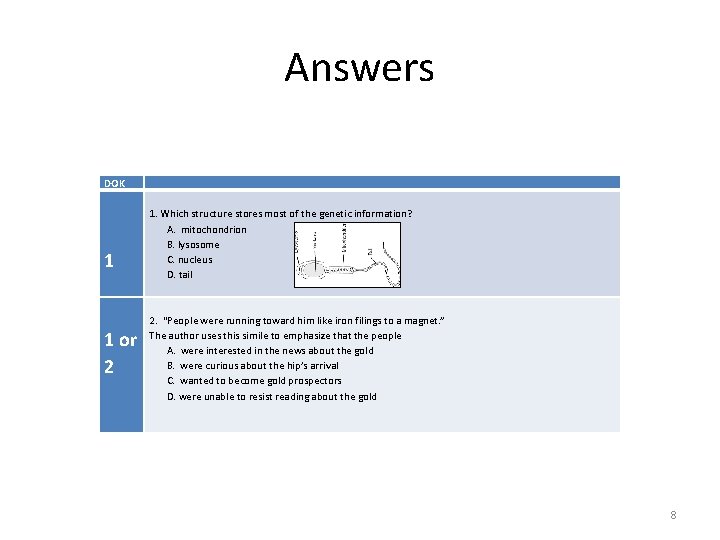
Answers DOK 1 1 or 2 1. Which structure stores most of the genetic information? A. mitochondrion B. lysosome C. nucleus D. tail 2. “People were running toward him like iron filings to a magnet. ” The author uses this simile to emphasize that the people A. were interested in the news about the gold B. were curious about the hip’s arrival C. wanted to become gold prospectors D. were unable to resist reading about the gold 8
PM 2 What Does It mean to “Design” an Assessment? 9 9
Design • What is the ultimate purpose of the assessment? • What is it that needs to be measured? – Academic Standards • Depth of knowledge • Time allotment • Diverse opportunities for demonstration of knowledge 10
MODULE 1. 1 PURPOSE STATEMENT 11
PURPOSE STATEMENT PM 3 PURPOSE The primary purpose of assessment is to improve students' learning and teachers' teaching as both respond to the information it provides. Assessment for learning is an ongoing process that arises out of the interaction between teaching and learning. 12 12
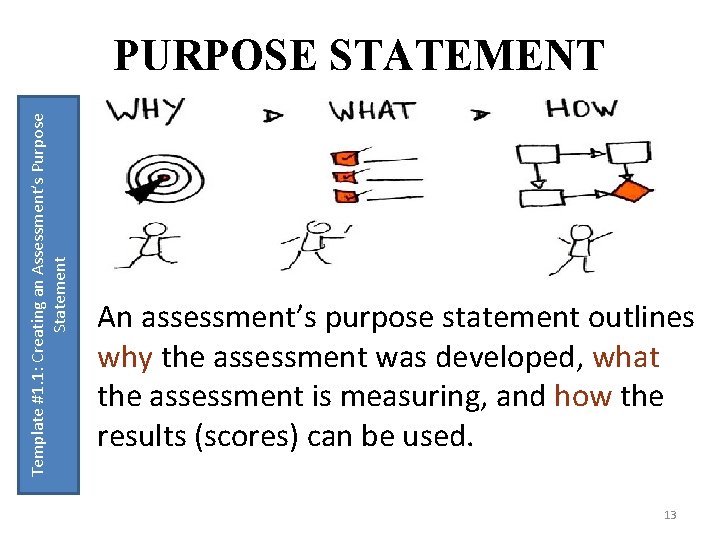
Template #1. 1: Creating an Assessment’s Purpose Statement PURPOSE STATEMENT An assessment’s purpose statement outlines why the assessment was developed, what the assessment is measuring, and how the results (scores) can be used. 13 13
Purpose Statements The purpose statement can be brief and help guide the assessment creator to stay focused on what items need to be on the test. 14
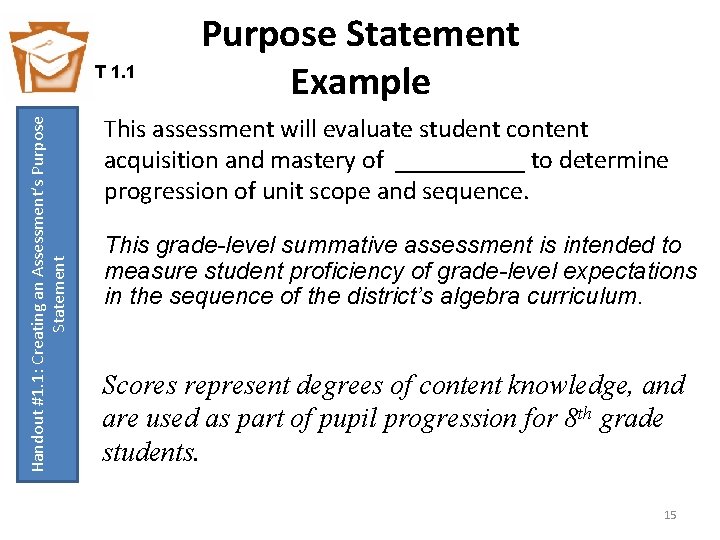
Handout #1. 1: Creating an Assessment’s Purpose Statement T 1. 1 Purpose Statement Example This assessment will evaluate student content acquisition and mastery of _____ to determine progression of unit scope and sequence. This grade-level summative assessment is intended to measure student proficiency of grade-level expectations in the sequence of the district’s algebra curriculum. Scores represent degrees of content knowledge, and are used as part of pupil progression for 8 th grade students. 15 19
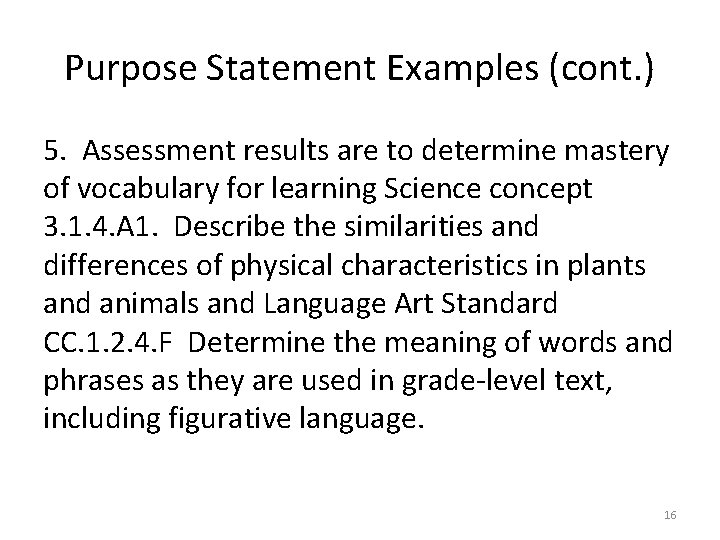
Purpose Statement Examples (cont. ) 5. Assessment results are to determine mastery of vocabulary for learning Science concept 3. 1. 4. A 1. Describe the similarities and differences of physical characteristics in plants and animals and Language Art Standard CC. 1. 2. 4. F Determine the meaning of words and phrases as they are used in grade-level text, including figurative language. 16
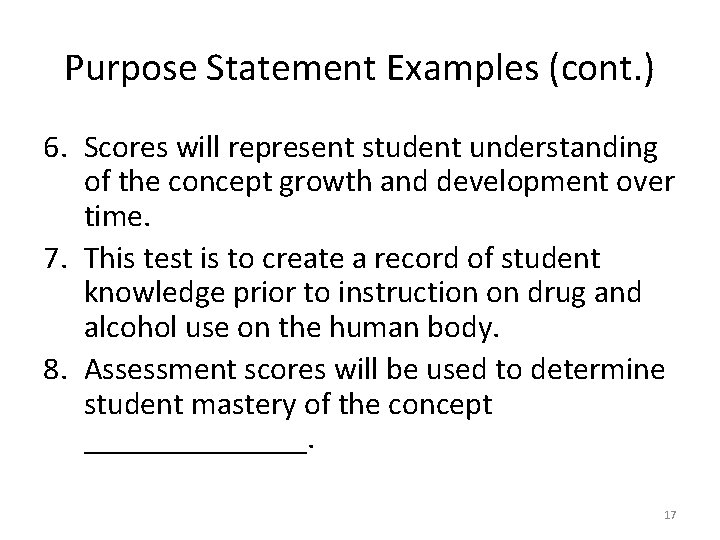
Purpose Statement Examples (cont. ) 6. Scores will represent student understanding of the concept growth and development over time. 7. This test is to create a record of student knowledge prior to instruction on drug and alcohol use on the human body. 8. Assessment scores will be used to determine student mastery of the concept _______. 17
Group Work “Creating a Purpose Statement” Participants will use a pre-existing assessment or create a new assessment 18
TARGETED CONTENT 19
Targeted Content An assessment’s targeted content is found in the district curriculum. Select: • Big idea/enduring understanding statements within the content area. • Essential questions • The essential knowledge and skills for which students are expected to demonstrate achievement. 20 27
Group Work “Identifying Content” Participants will use a pre-existing assessment or create a new assessment. Write a simple statement of what standard or concept (Big ideas, essential questions) the assessment measures. 21
Module 1. 3 BLUEPRINTS -THE PLAN 22
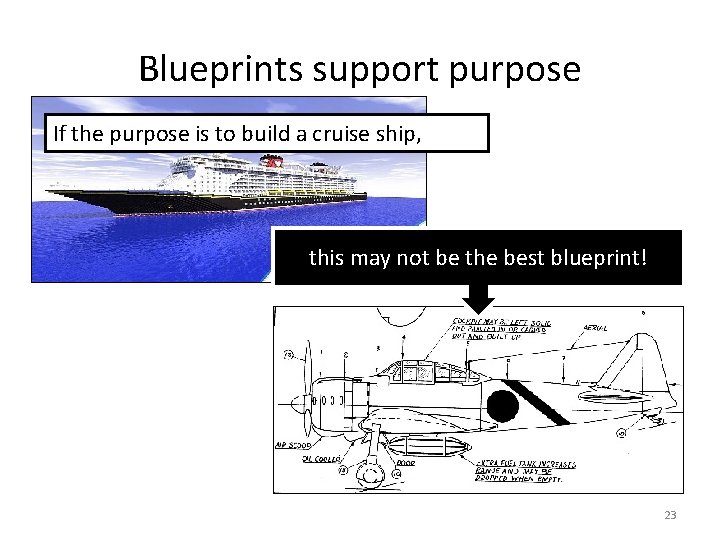
Blueprints support purpose If the purpose is to build a cruise ship, this may not be the best blueprint! 23 23
Blueprint considerations • Number and types of items on the final assessment; • Content, skills, and any other attribute to be measured; • Intended level of difficulty; DOK • Mode of administration • Timing of the total administration/separate sections or subparts • Directions for examinees. 24 24
Terms you will need to know to keep going! SR-Selected Response: items that are multiple choice, true-false, matching, any item where the test-taker has a bank of answers from which they choose an answer. SCR-Short Constructed Response/Short Answer: the testtaker provides a one word or short phrase answer ECR-Extended Constructed Response: the test-taker writes a paragraph or two, or develops an authentic response within a class period’s time length PT- Performance Task: the test-taker develops a response that takes several class periods or the response is gathered over a period of time, as in a portfolio assessment. 25
Formalizing the Process The following slides are presented to assist in formalizing the process of creating an assessment. 26
Group Work 2. Build- Item Type Pretest • Purpose: This will serve as a formative assessment of participants in the Assessment Literacy Course. Results of the assessment will be used to create a guide for instruction and content in the course. This will facilitate educator achievement in increasing rigor, reliability, and validity of assessments offered in each grade level. • Directions: Based on your knowledge of item types, assign the appropriate type to the following questions. 27
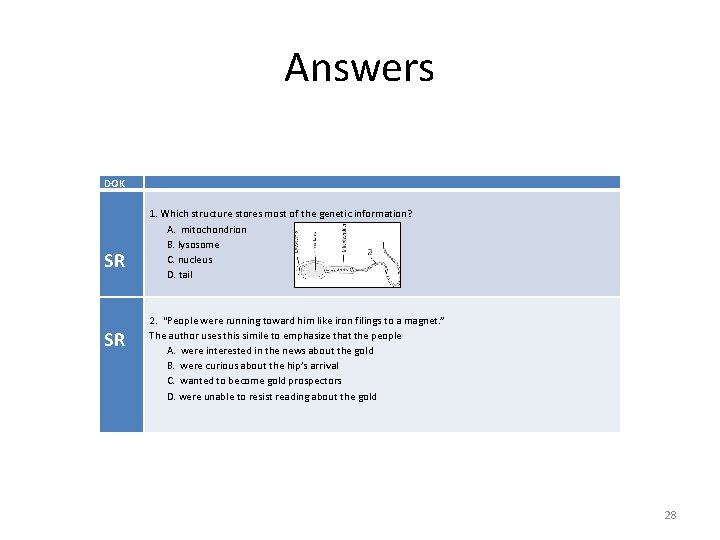
Answers DOK SR SR 1. Which structure stores most of the genetic information? A. mitochondrion B. lysosome C. nucleus D. tail 2. “People were running toward him like iron filings to a magnet. ” The author uses this simile to emphasize that the people A. were interested in the news about the gold B. were curious about the hip’s arrival C. wanted to become gold prospectors D. were unable to resist reading about the gold 28
Create a Blueprint • Blueprints can be simple or very formal. • Does not matter the format, just make one. • This will assist in providing the variety of questions and depth of knowledge range in the assessment. • This is the basis for “common assessments” 29
Template 1. 3: Procedural Steps QC Checklist q. Number and types of items on the final assessment q. Content, skills, and any other attribute to be measured; q. Intended level of difficulty; DOK q. Mode of administration q. Timing of the total administration/separate sections or subparts q. Directions for examinees. 30 64
Group Work “Developing A Blueprint” Using the 10 question assessment that was just used in the last group work task, create a blueprint for that assessment. 31
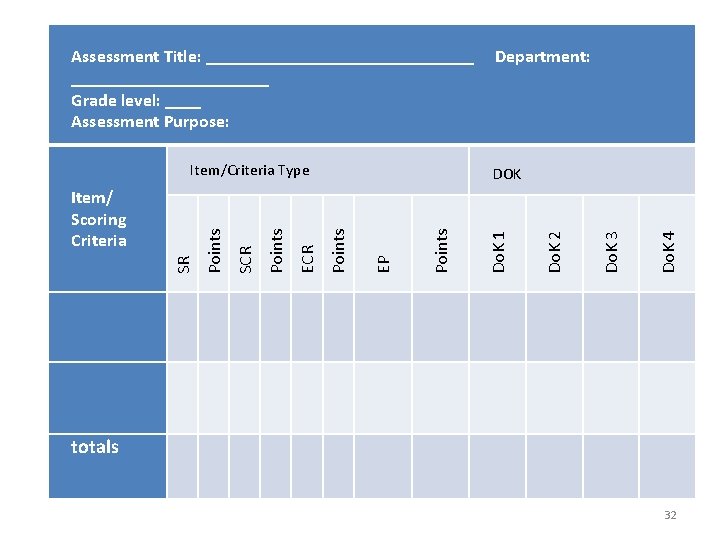
Assessment Title: _______________ Grade level: ____ Assessment Purpose: Do. K 4 Do. K 3 Do. K 2 Do. K 1 Points EP DOK Points ECR Points SCR SR Item/ Scoring Criteria Points Item/Criteria Type Department: totals 32
End Module 1 - Design Thank you 33
- Slides: 33