
Assessment Learning Teaching Second Year Algebra with CAS
Assessment Learning Teaching Second Year Algebra with CAS
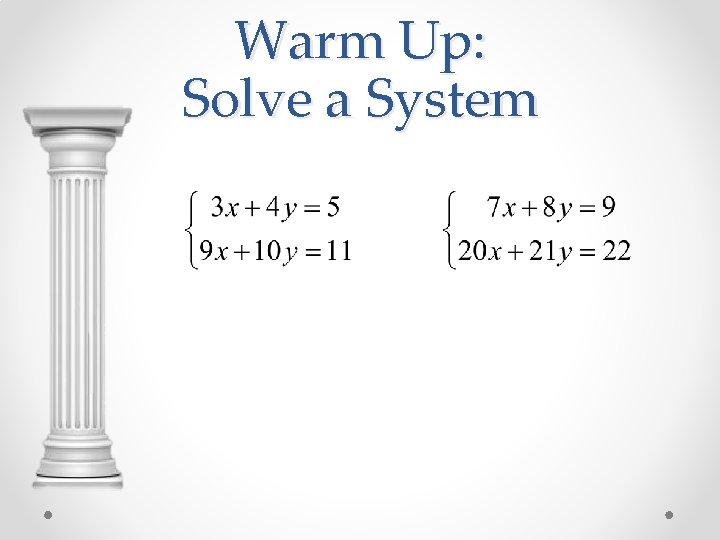
Warm Up: Solve a System
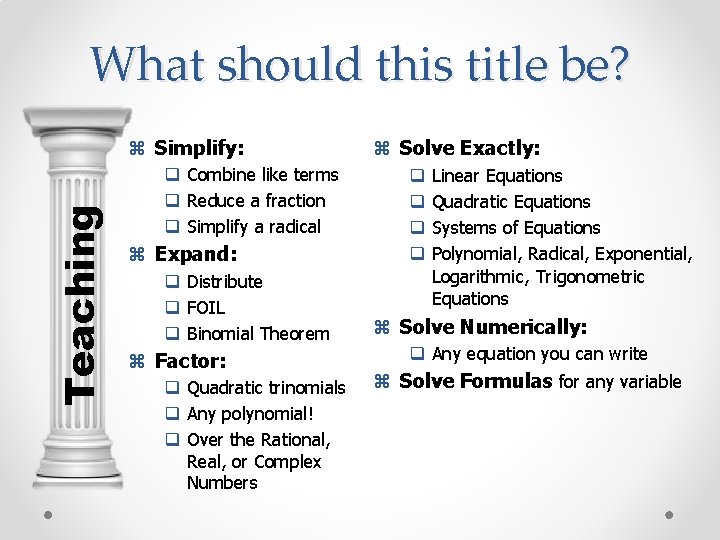
What should this title be? Teaching z Simplify: q Combine like terms q Reduce a fraction q Simplify a radical z Expand: q Distribute q FOIL q Binomial Theorem z Factor: q Quadratic trinomials q Any polynomial! q Over the Rational, Real, or Complex Numbers z Solve Exactly: q q Linear Equations Quadratic Equations Systems of Equations Polynomial, Radical, Exponential, Logarithmic, Trigonometric Equations z Solve Numerically: q Any equation you can write z Solve Formulas for any variable
Teaching A Deliberately Provocative Statement “If algebra is useful only for finding roots of equations, slopes, tangents, intercepts, maxima, minima, or solutions to systems of equations in two variables, then it has been rendered totally obsolete by cheap, handheld graphing calculators -- dead -- not worth valuable school time that might instead be devoted to art, music, Shakespeare, or science. ” -- E. Paul Goldenberg Computer Algebra Systems in Secondary Mathematics Education
Learning How to Learn • In a world that is constantly changing, what skills do students need? o Apply their knowledge o Generalize o Recognize situations and the tools they have to address them

What We Teaching The “Real World” Algebra Problem Situation Algebraic Model Interpretation Solution Kutzler, B. (2001). What Math Should We Teach When We Teach Math With CAS? http: //b. kutzler. com/downloads/what_math_should_we_teach. pdf
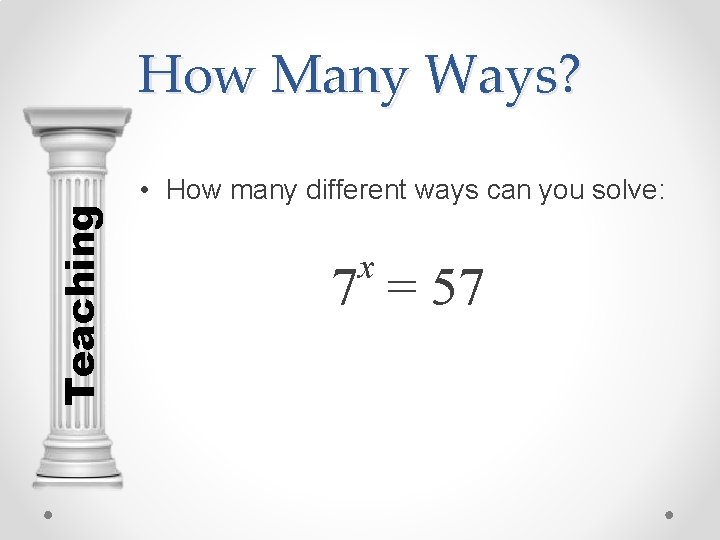
Teaching How Many Ways? • How many different ways can you solve: x 7 = 57
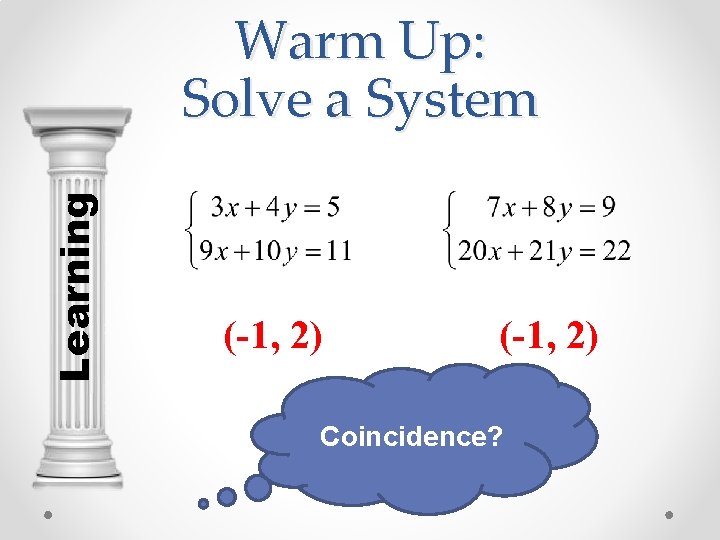
Learning Warm Up: Solve a System (-1, 2) Coincidence?
Learning Generalize! • Can you write another example with the same pattern? • Can you describe the pattern o In words? o In algebraic notation? • Can you solve the general situation?
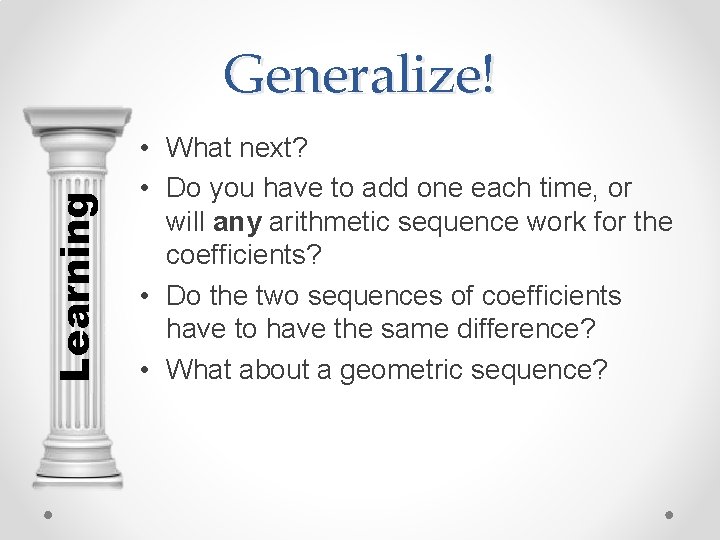
Learning Generalize! • What next? • Do you have to add one each time, or will any arithmetic sequence work for the coefficients? • Do the two sequences of coefficients have to have the same difference? • What about a geometric sequence?
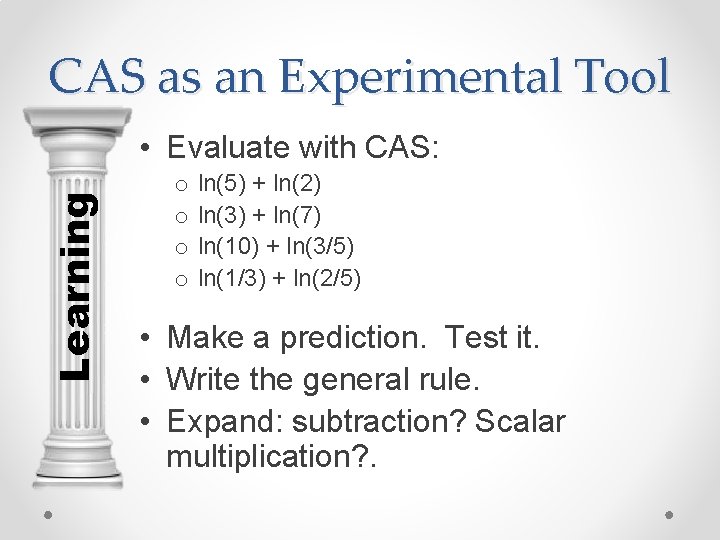
CAS as an Experimental Tool Learning • Evaluate with CAS: o o ln(5) + ln(2) ln(3) + ln(7) ln(10) + ln(3/5) ln(1/3) + ln(2/5) • Make a prediction. Test it. • Write the general rule. • Expand: subtraction? Scalar multiplication? .

Learning Generalize UCSMP Advanced Algebra, 3 rd Edition, p. 418
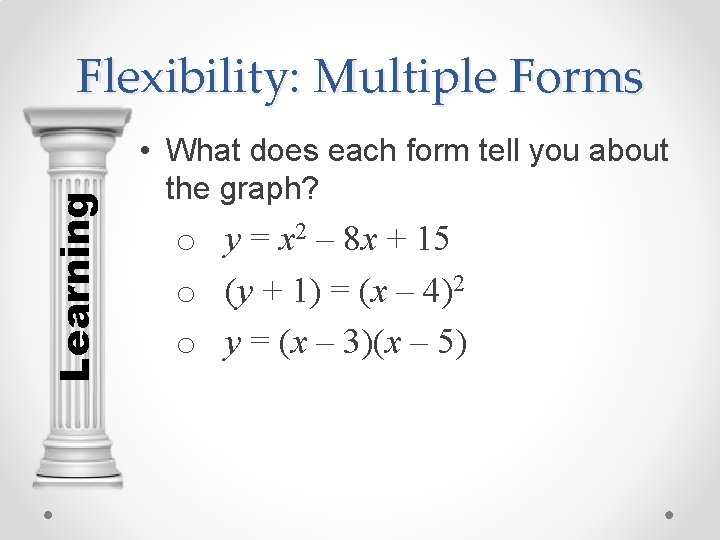
Learning Flexibility: Multiple Forms • What does each form tell you about the graph? o y = x 2 – 8 x + 15 o (y + 1) = (x – 4)2 o y = (x – 3)(x – 5)
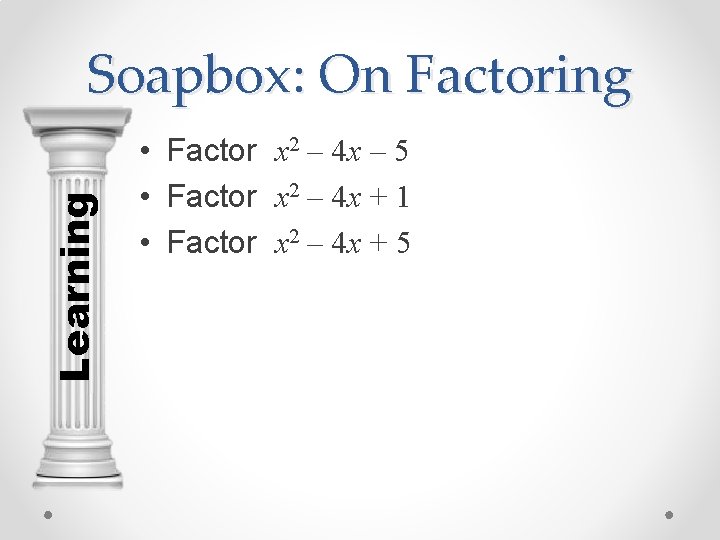
Learning Soapbox: On Factoring • Factor x 2 – 4 x – 5 • Factor x 2 – 4 x + 1 • Factor x 2 – 4 x + 5
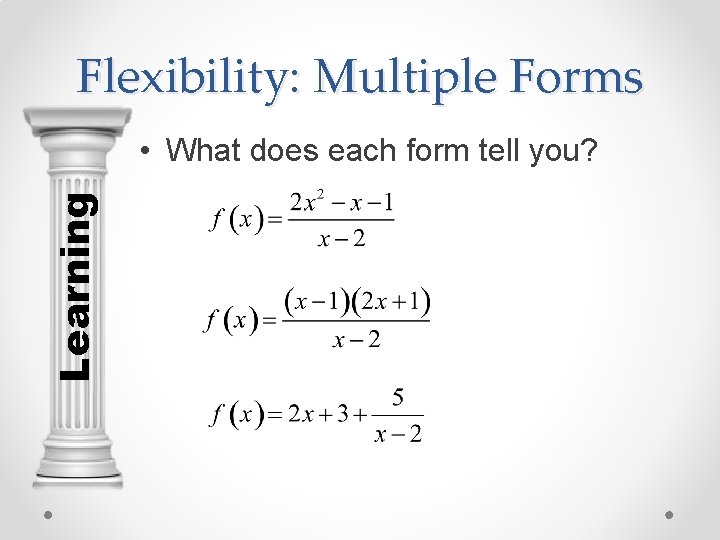
Flexibility: Multiple Forms Learning • What does each form tell you?
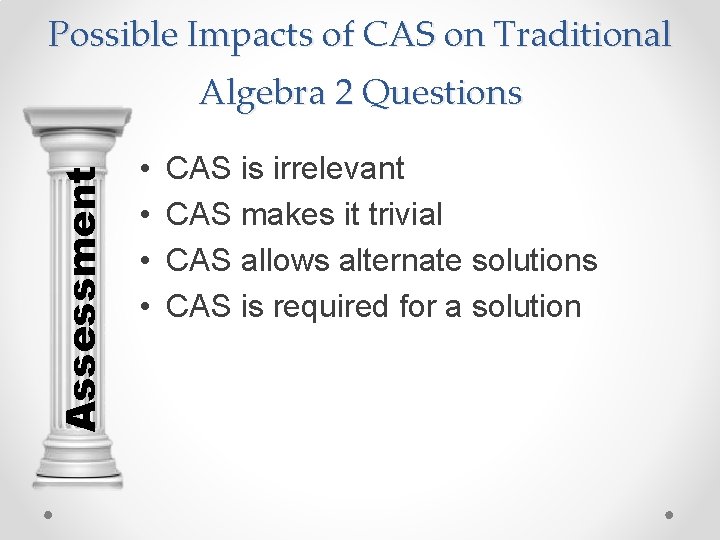
Possible Impacts of CAS on Traditional Assessment Algebra 2 Questions • • CAS is irrelevant CAS makes it trivial CAS allows alternate solutions CAS is required for a solution
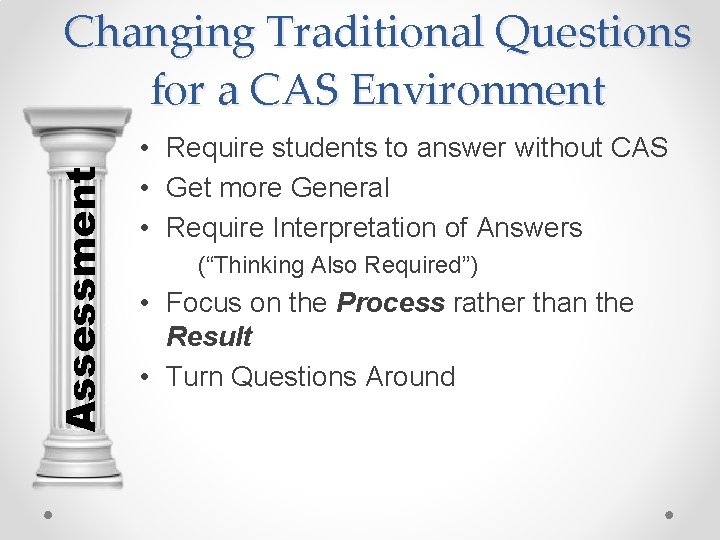
Assessment Changing Traditional Questions for a CAS Environment • Require students to answer without CAS • Get more General • Require Interpretation of Answers (“Thinking Also Required”) • Focus on the Process rather than the Result • Turn Questions Around
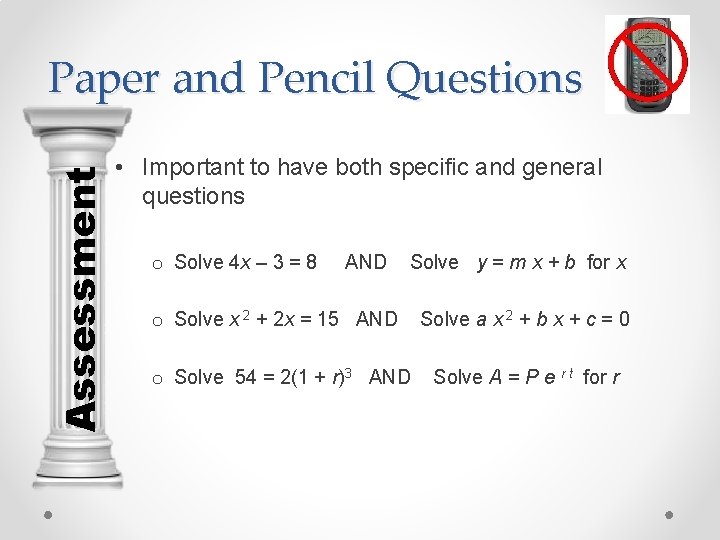
Assessment Paper and Pencil Questions • Important to have both specific and general questions o Solve 4 x – 3 = 8 AND Solve y = m x + b for x o Solve x 2 + 2 x = 15 AND o Solve 54 = 2(1 + r)3 AND Solve a x 2 + b x + c = 0 Solve A = P e r t for r
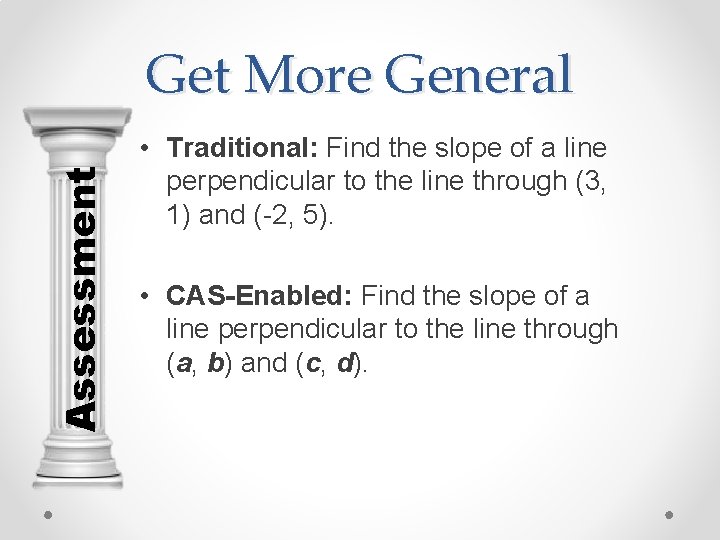
Assessment Get More General • Traditional: Find the slope of a line perpendicular to the line through (3, 1) and (-2, 5). • CAS-Enabled: Find the slope of a line perpendicular to the line through (a, b) and (c, d).
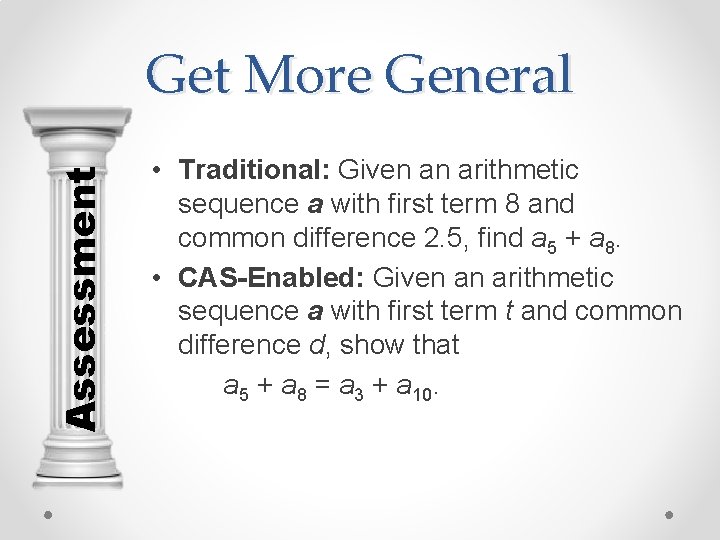
Assessment Get More General • Traditional: Given an arithmetic sequence a with first term 8 and common difference 2. 5, find a 5 + a 8. • CAS-Enabled: Given an arithmetic sequence a with first term t and common difference d, show that a 5 + a 8 = a 3 + a 10.
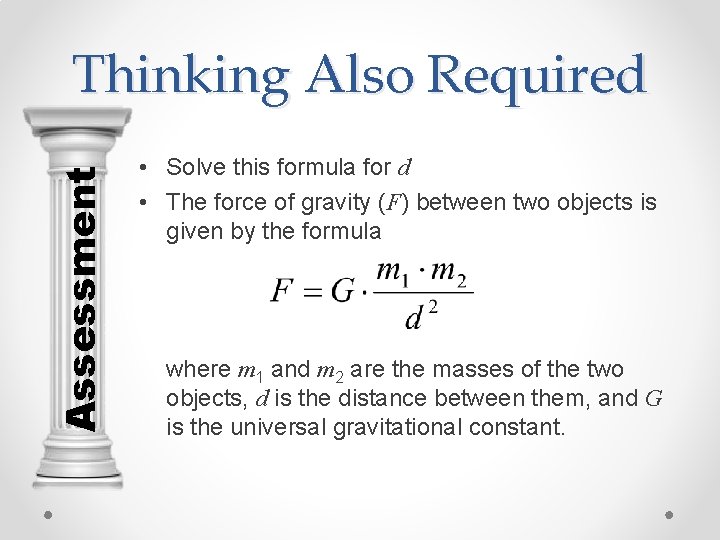
Assessment Thinking Also Required • Solve this formula for d • The force of gravity (F) between two objects is given by the formula where m 1 and m 2 are the masses of the two objects, d is the distance between them, and G is the universal gravitational constant.
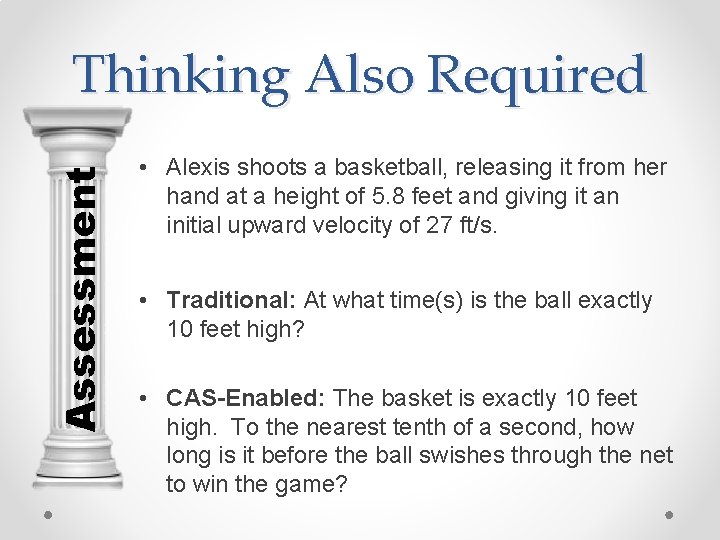
Assessment Thinking Also Required • Alexis shoots a basketball, releasing it from her hand at a height of 5. 8 feet and giving it an initial upward velocity of 27 ft/s. • Traditional: At what time(s) is the ball exactly 10 feet high? • CAS-Enabled: The basket is exactly 10 feet high. To the nearest tenth of a second, how long is it before the ball swishes through the net to win the game?
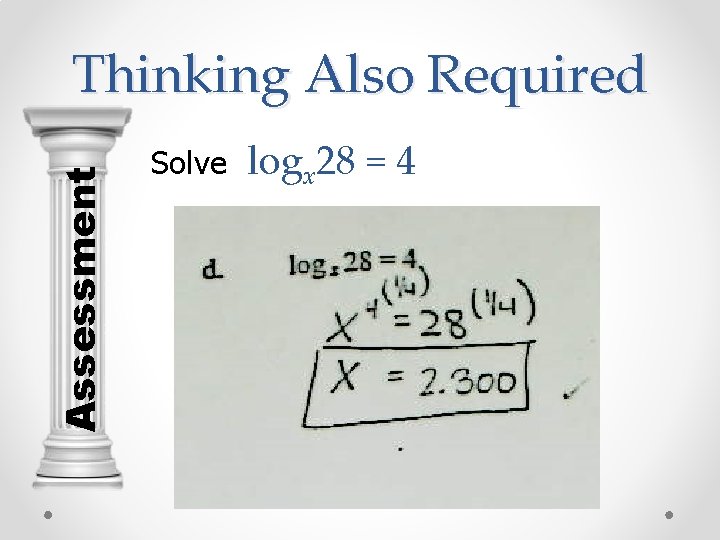
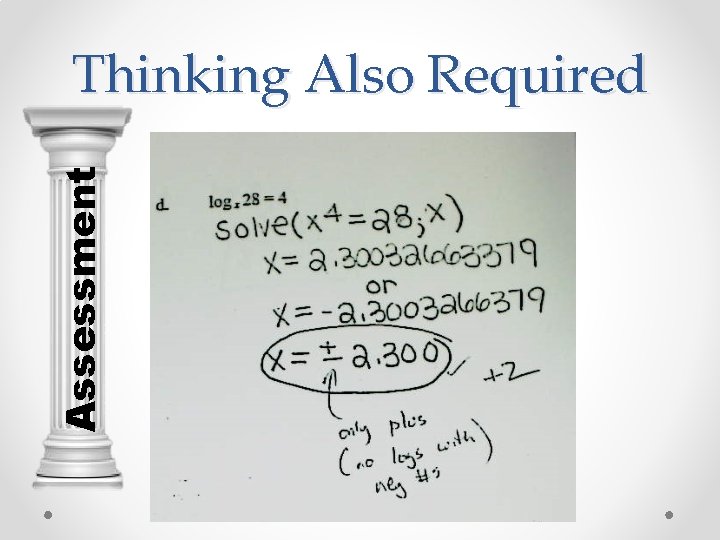
Assessment Thinking Also Required Solve logx 28 = 4
Assessment Thinking Also Required
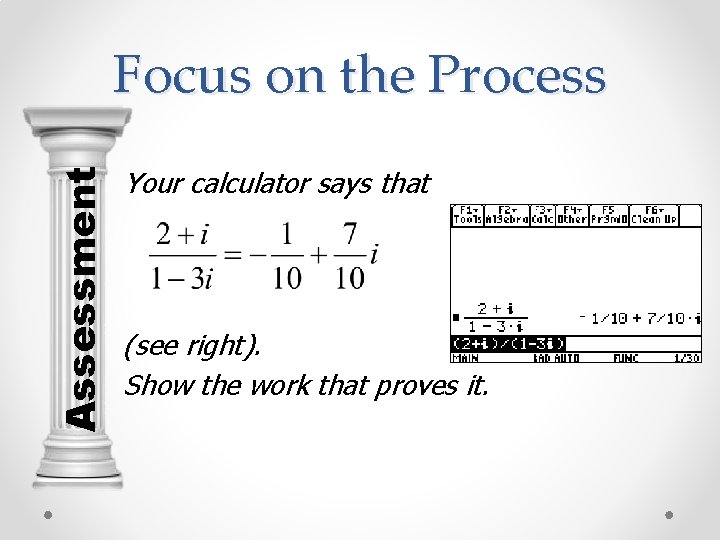
Assessment Focus on the Process Your calculator says that (see right). Show the work that proves it.
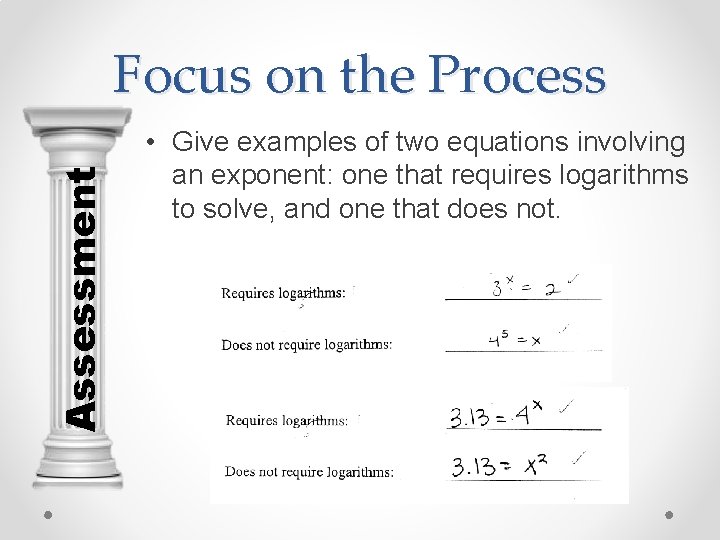
Assessment Focus on the Process • Give examples of two equations involving an exponent: one that requires logarithms to solve, and one that does not.
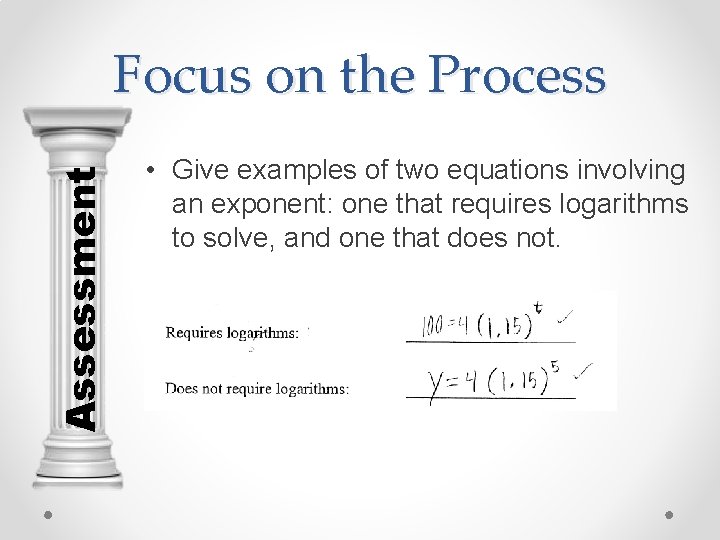
Assessment Focus on the Process • Give examples of two equations involving an exponent: one that requires logarithms to solve, and one that does not.

Assessment Focus on the Process • Give examples of two equations involving an exponent: one that requires logarithms to solve, and one that does not.
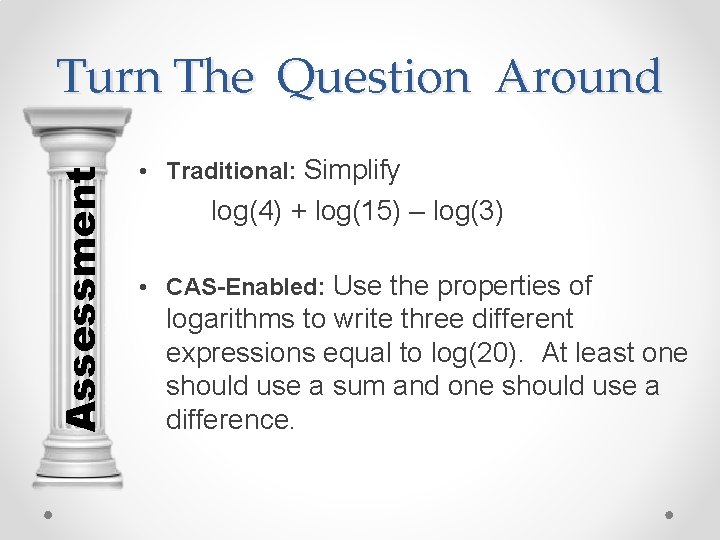
Assessment Turn The Question Around • Traditional: Simplify log(4) + log(15) – log(3) • CAS-Enabled: Use the properties of logarithms to write three different expressions equal to log(20). At least one should use a sum and one should use a difference.
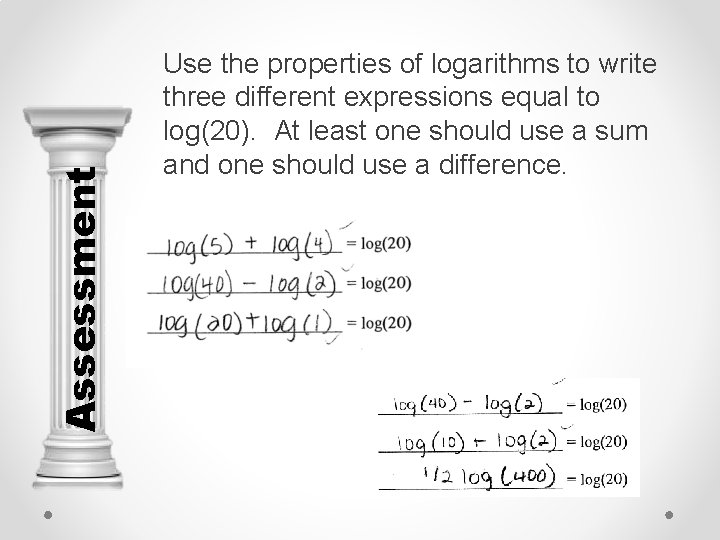
Assessment Use the properties of logarithms to write three different expressions equal to log(20). At least one should use a sum and one should use a difference.
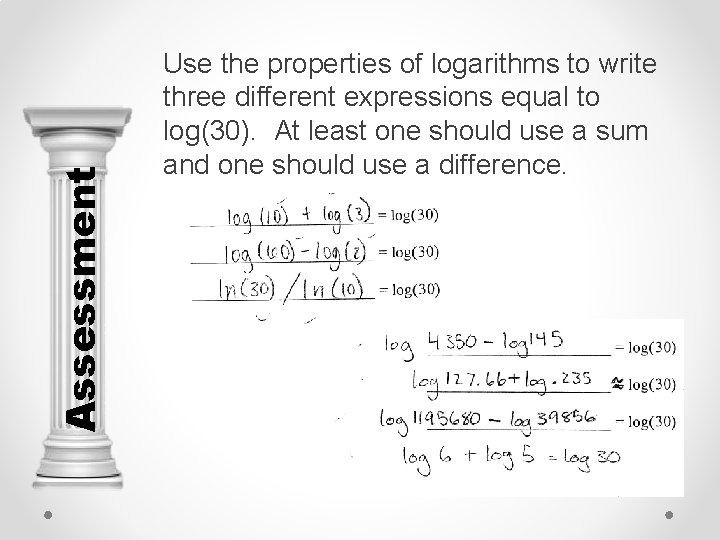
Assessment Use the properties of logarithms to write three different expressions equal to log(30). At least one should use a sum and one should use a difference.
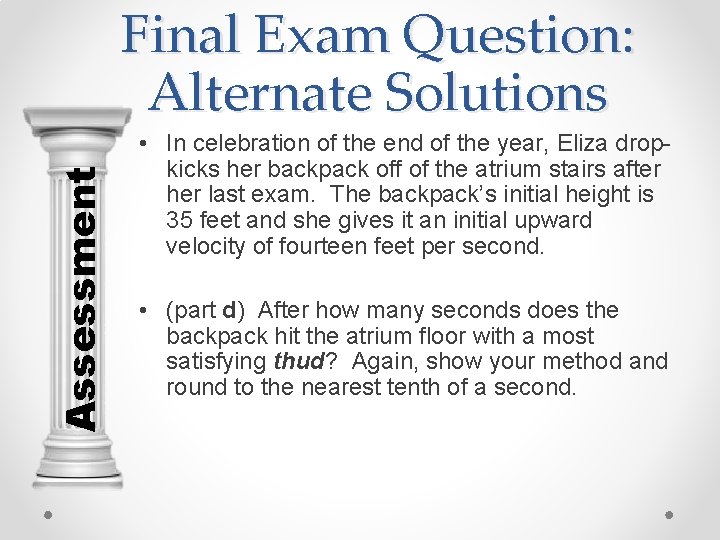
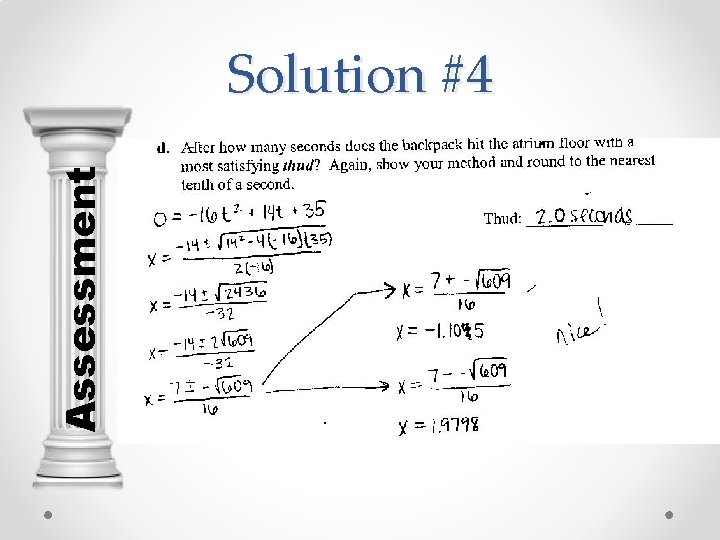
Assessment Final Exam Question: Alternate Solutions • In celebration of the end of the year, Eliza dropkicks her backpack off of the atrium stairs after her last exam. The backpack’s initial height is 35 feet and she gives it an initial upward velocity of fourteen feet per second. • (part d) After how many seconds does the backpack hit the atrium floor with a most satisfying thud? Again, show your method and round to the nearest tenth of a second.
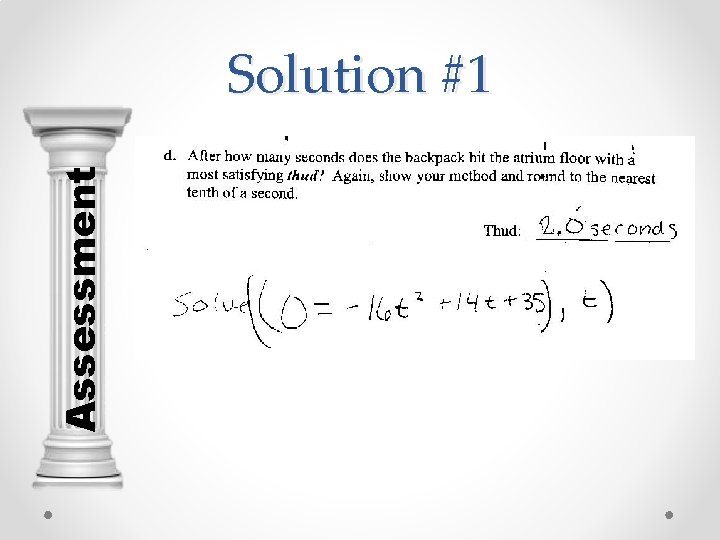
Assessment Solution #1
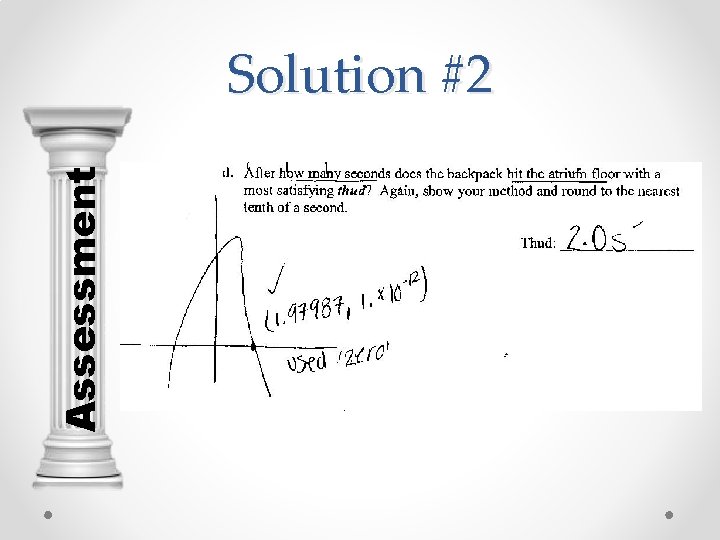
Assessment Solution #2
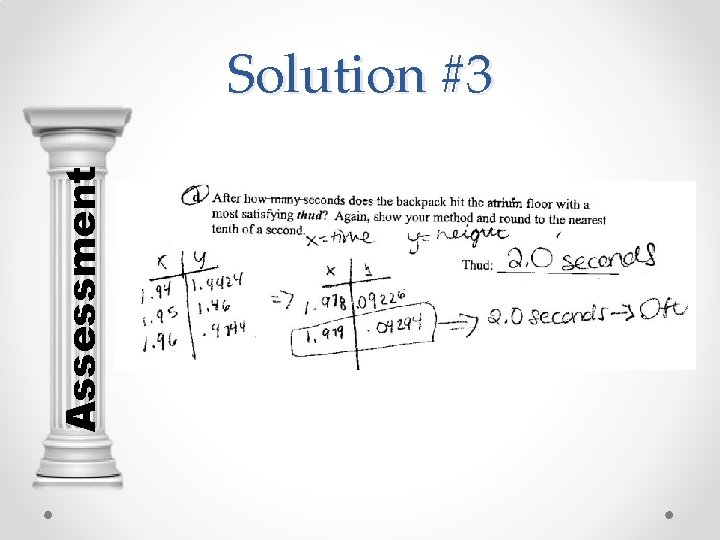
Assessment Solution #3
Assessment Solution #4
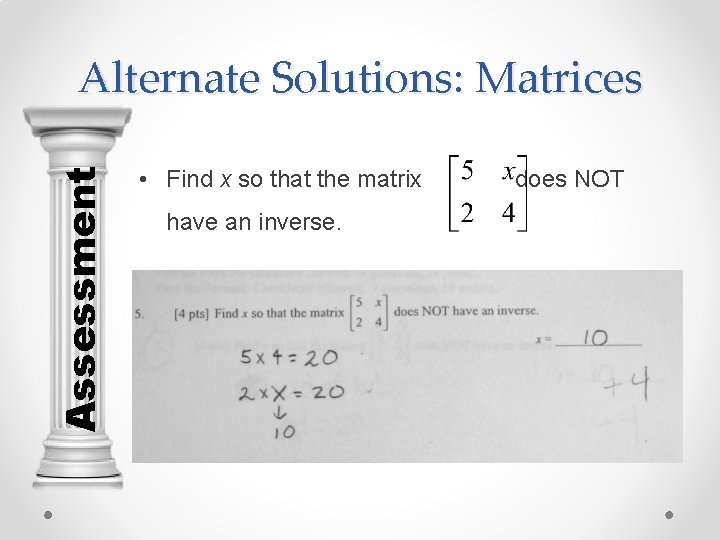
Assessment Alternate Solutions: Matrices • Find x so that the matrix have an inverse. does NOT
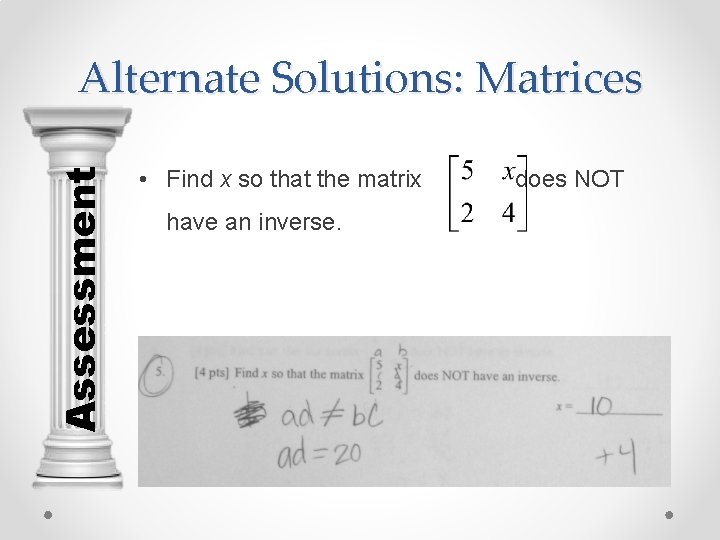
Assessment Alternate Solutions: Matrices • Find x so that the matrix have an inverse. does NOT
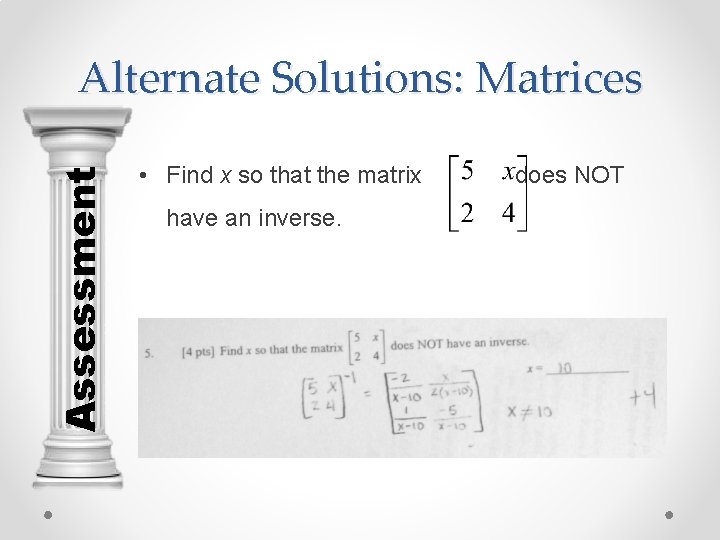
Assessment Alternate Solutions: Matrices • Find x so that the matrix have an inverse. does NOT
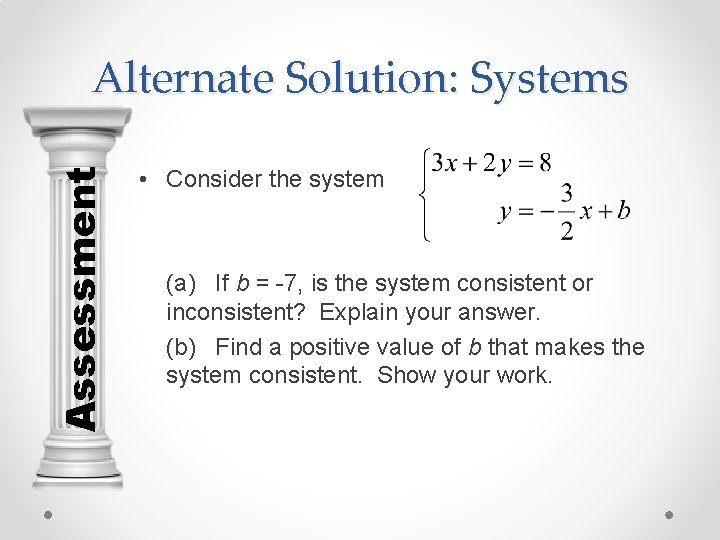
Assessment Alternate Solution: Systems • Consider the system (a) If b = -7, is the system consistent or inconsistent? Explain your answer. (b) Find a positive value of b that makes the system consistent. Show your work.
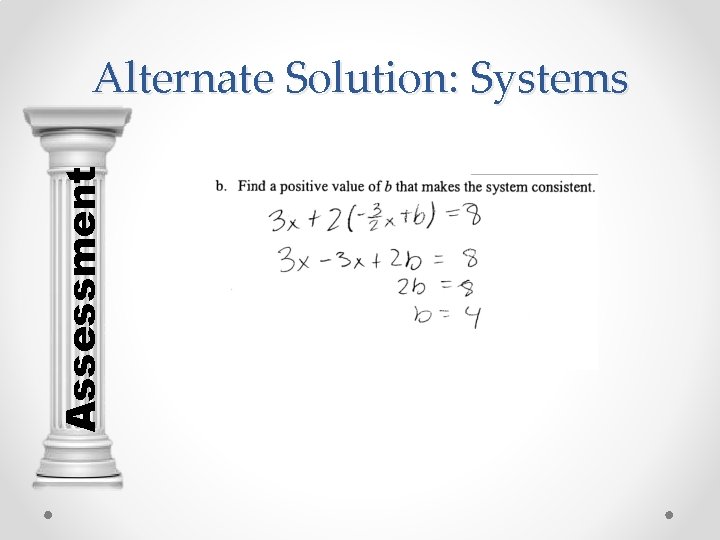
Assessment Alternate Solution: Systems
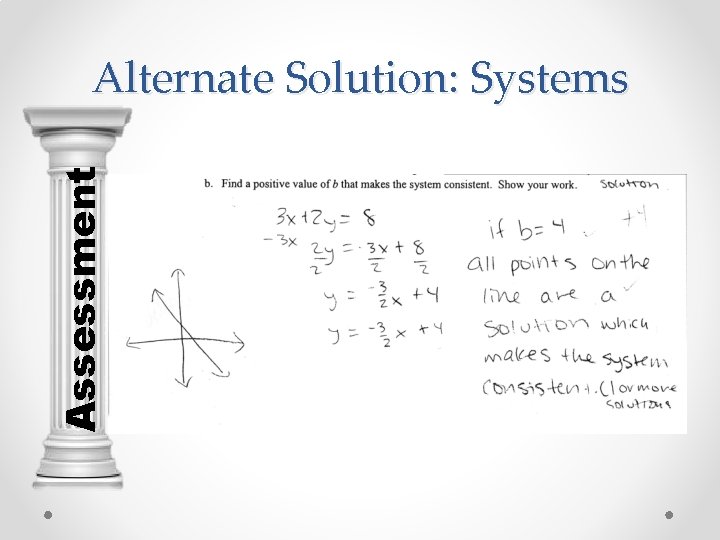
Assessment Alternate Solution: Systems
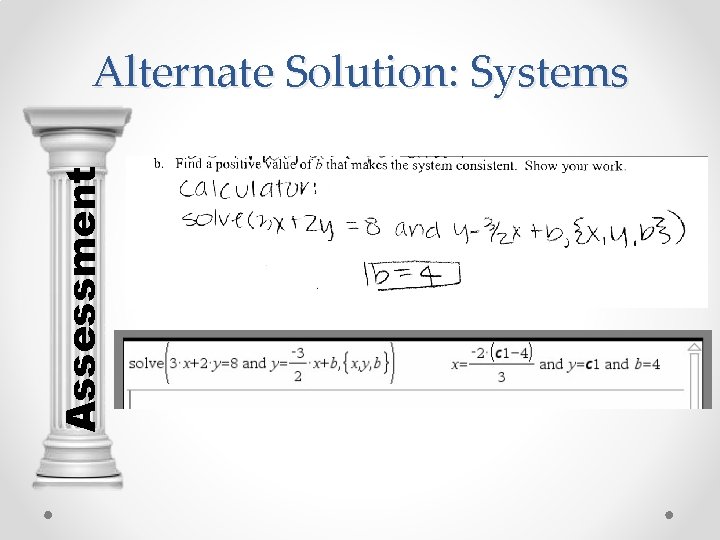
Assessment Alternate Solution: Systems
Assessment CAS is Required • The algebra is too complicated • The symbolic manipulation gets in the way of comprehension
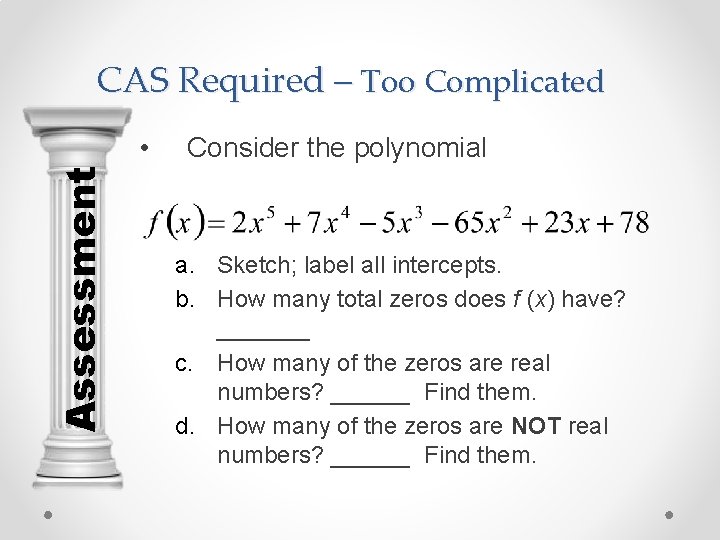
CAS Required – Too Complicated Assessment • Consider the polynomial a. Sketch; label all intercepts. b. How many total zeros does f (x) have? _______ c. How many of the zeros are real numbers? ______ Find them. d. How many of the zeros are NOT real numbers? ______ Find them.
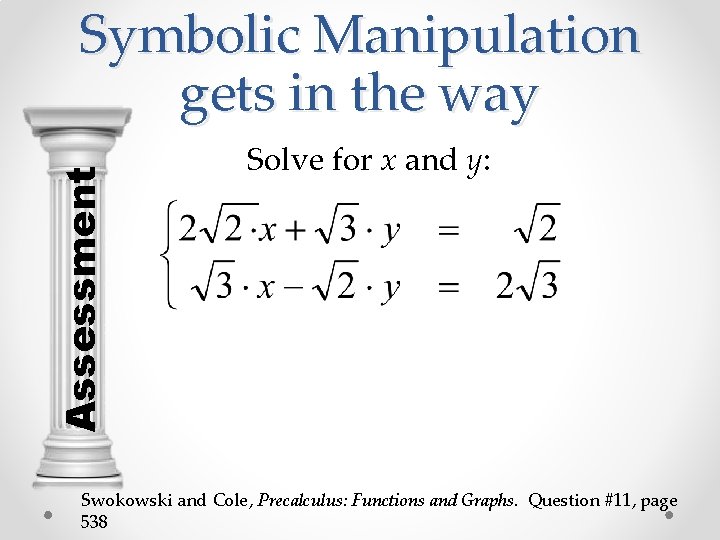
Assessment Symbolic Manipulation gets in the way Solve for x and y: Swokowski and Cole, Precalculus: Functions and Graphs. Question #11, page 538
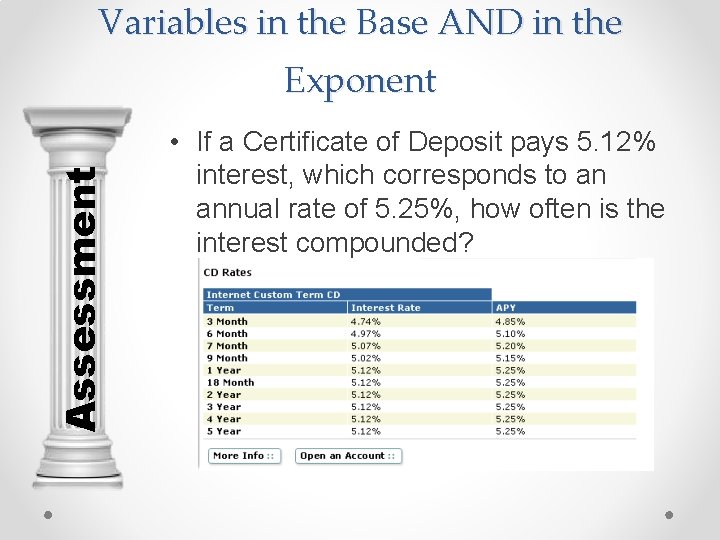
Variables in the Base AND in the Assessment Exponent • If a Certificate of Deposit pays 5. 12% interest, which corresponds to an annual rate of 5. 25%, how often is the interest compounded?
Algebra 2 with CAS • Can be a stronger course • Can focus on flexibility rather than rote skills • Can be a lot of fun
Second Year Algebra with CAS Lunch is in Regency A, Gold Level 11: 15 Assessment Teaching michael@mbuescher. com Hathaway Brown School Cleveland, Ohio Learning Michael Buescher
- Slides: 49