
Assessment in the Affective Domain Affective Domain describes

Assessment in the Affective Domain
Affective Domain describes learning objectives that emphasize a feeling tone, an emotion, or a degree of acceptance or rejection.
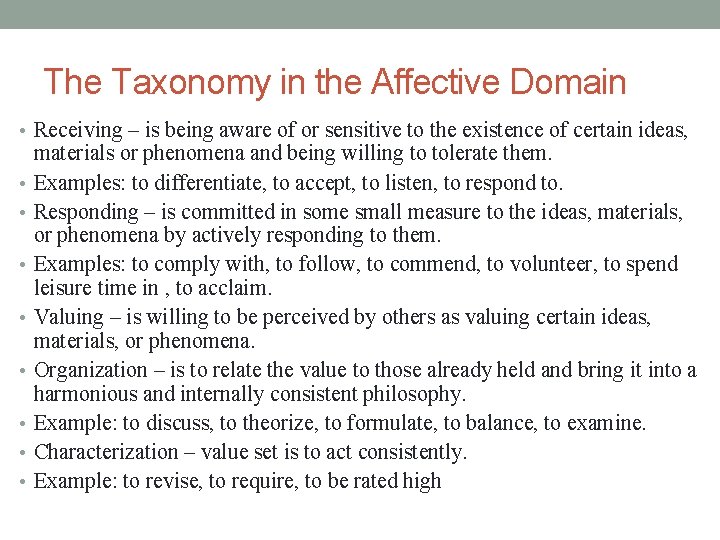
The Taxonomy in the Affective Domain • Receiving – is being aware of or sensitive to the existence of certain ideas, • • materials or phenomena and being willing to tolerate them. Examples: to differentiate, to accept, to listen, to respond to. Responding – is committed in some small measure to the ideas, materials, or phenomena by actively responding to them. Examples: to comply with, to follow, to commend, to volunteer, to spend leisure time in , to acclaim. Valuing – is willing to be perceived by others as valuing certain ideas, materials, or phenomena. Organization – is to relate the value to those already held and bring it into a harmonious and internally consistent philosophy. Example: to discuss, to theorize, to formulate, to balance, to examine. Characterization – value set is to act consistently. Example: to revise, to require, to be rated high

Affective Learning Competencies
Instructional objectives ü specific statement of the learners behavior or outcomes that are expected to be exhibited by a student after completing a unit of instruction. ( Gabuyo, 2013) ü indicators that suggest the nature of students knowledge. (Raagas, 2010)
What then are instructional objectives? • Instructional objectives are specific, measurable, short term, observable students behaviors. • Objectives are the foundation to meet the lesson goals. • Think of objectives to reach your goals. • Not to restrict spontaneity or constrain the vision of education in the discipline.

The Taxonomy in the Affective Domain Level/ Definition Examples Receiving Being aware of or attending to something in the environment. Individual would read a book passage about civil rights. Responding Showing some new behaviors as a result of experience. Individual would answer questions about the book, read another book by the same author, another book about civil rights. Valuing Showing some definite involvement or commitment. The individual might demonstrate this by voluntarily attending a lecture on civil rights. Organization Integrating a new value into one's general set of values, giving it some ranking among one's general priorities. The individual might arrange a civil rights rally. Characterization by value Acting consistently with the new value. The individual is firmly committed to the value, perhaps becoming a civil rights leader.
• Some examples or behavioral terms that can be used to express learning competencies or objectives in the affective domain
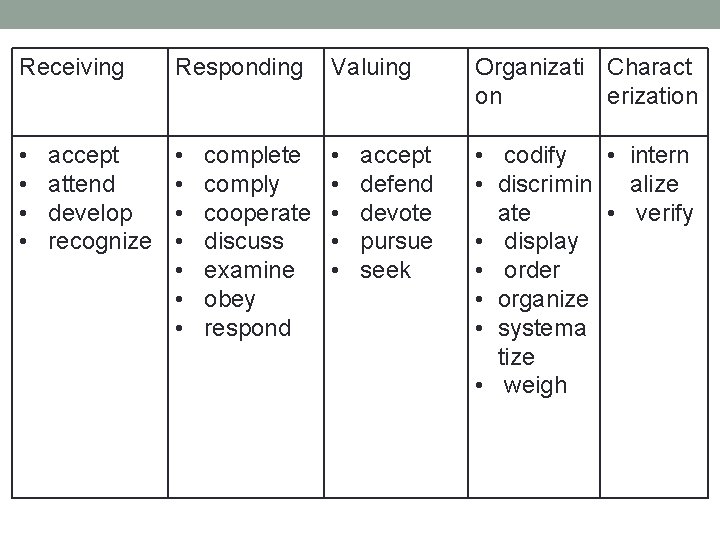
Receiving Responding Valuing Organizati Charact on erization • • • • • codify • intern • discrimin alize ate • verify • display • order • organize • systema tize • weigh accept attend develop recognize complete comply cooperate discuss examine obey respond accept defend devote pursue seek
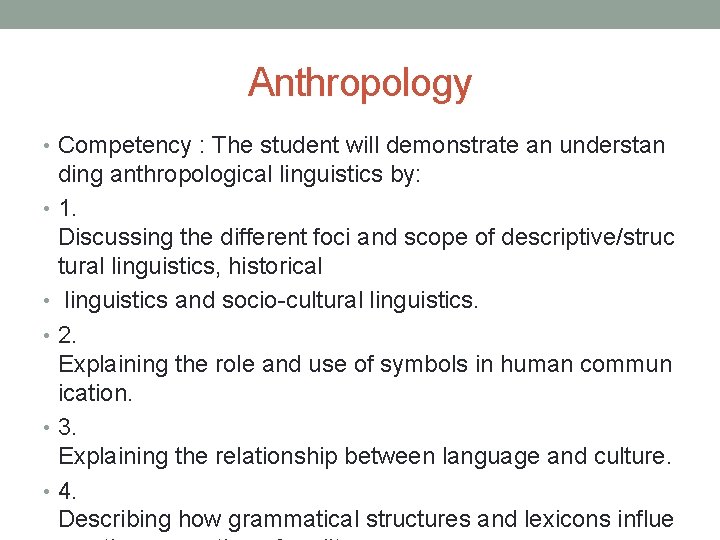
Anthropology • Competency : The student will demonstrate an understan ding anthropological linguistics by: • 1. Discussing the different foci and scope of descriptive/struc tural linguistics, historical • linguistics and socio cultural linguistics. • 2. Explaining the role and use of symbols in human commun ication. • 3. Explaining the relationship between language and culture. • 4. Describing how grammatical structures and lexicons influe

• Thank You for Listening : -)
- Slides: 11