
Assessment in K to 12 BEP DEp Ed
Assessment in K to 12 BEP DEp. Ed Order 8, s. 2015
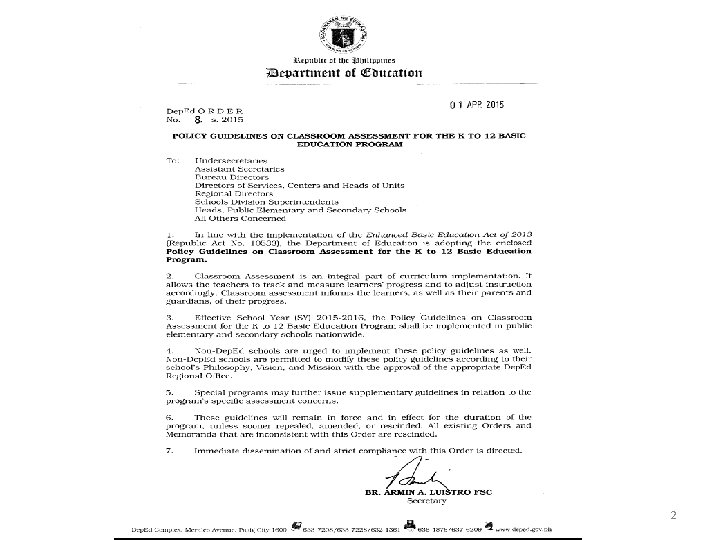
gretel 2015 2
Assessment: What is it? Classroom assessment • Is a process that is used to keep track of learner's progress in relation to learning standards in the development of 21 st century skills; • to promote self-reflection and personal accountability among students about their own learning and to provide bases for the profiling of student performance on the learning competencies and standards of the curriculum. Dep. Ed Order No. 8, 2015 DEPARTMENT OF EDUCATION 3
Assessment: What is it? Classroom assessment • An on-going process of identifying, gathering, organizing, and interpreting quantitative and qualitative information about what learners know and can do. Dep. Ed Order No. 8, 2015 DEPARTMENT OF EDUCATION 4
Assessment: What is it? • Activities that allow the teacher to obtain more specific information about each learner’s knowledge and skills relative to the instructional objectives of the class • A is a process of gathering information to make decisions about the learners (T gather information about the learner; T makes decision about the learner). Slide from Dr. F. Pado DEPARTMENT OF EDUCATION 5
Assessment: What is it? Assessment may refer to: • Testing • Other forms of measurement and appraisal, including observations, interviews, and reports from knowledgeable sources Slide from Dr. F. Pado DEPARTMENT OF EDUCATION 6
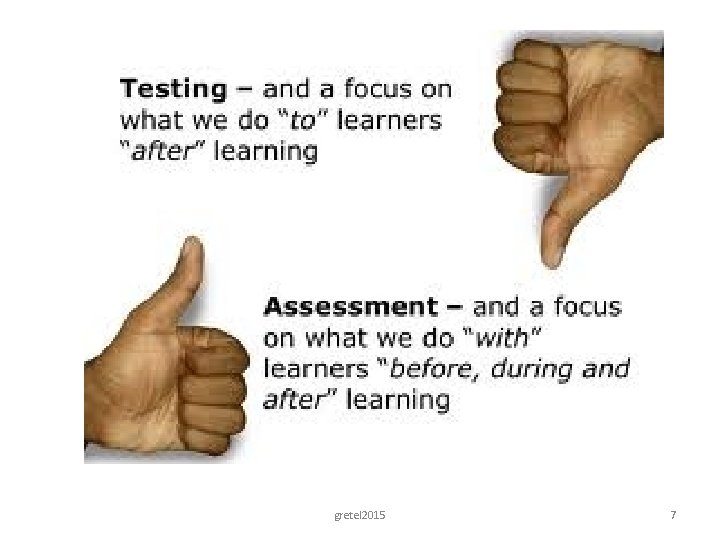
gretel 2015 7
Two Types of Assessment Formative assessment is assessment for learning. Its focus is on future achievement. Summative assessment is assessment of learning. It assesses what has been learnt in the past. Dep. Ed Order No. 8, 2015 DEPARTMENT OF EDUCATION 8
Individual vs Collaborative Formative Assessment Individual Formative Assessment – Enables learners to demonstrate independently what has been learned or mastered through a range of activities such as check-up, quizzes, written exercises, performances, models and even electronic presentations. Collaborative Formative Assessment (peer assessment) – allows students to support each other’s learning. Discussions, role playing, games, and other group activities may also be used as performance-based formative assessment wherein learners support and extend each other’s learning. DEPARTMENT OF EDUCATION 9
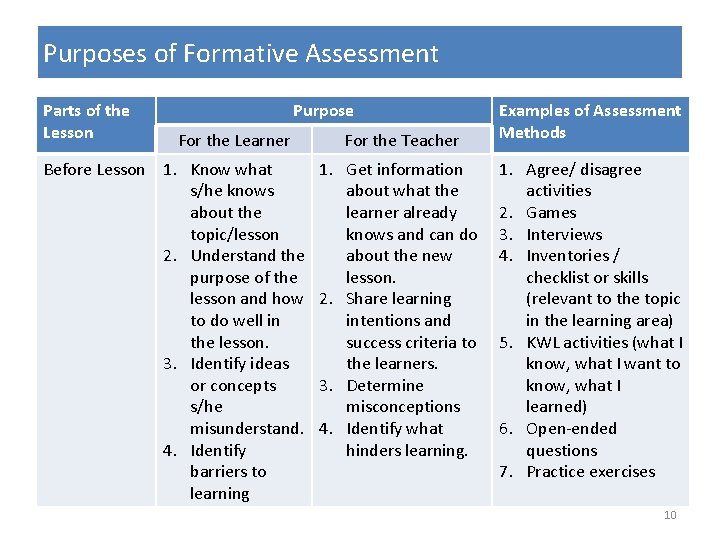
Purposes of Formative Assessment Parts of the Lesson Purpose For the Learner Before Lesson 1. Know what s/he knows about the topic/lesson 2. Understand the purpose of the lesson and how to do well in the lesson. 3. Identify ideas or concepts s/he misunderstand. 4. Identify barriers to learning For the Teacher 1. Get information about what the learner already knows and can do about the new lesson. 2. Share learning intentions and success criteria to the learners. 3. Determine misconceptions 4. Identify what hinders learning. Examples of Assessment Methods 1. Agree/ disagree activities 2. Games 3. Interviews 4. Inventories / checklist or skills (relevant to the topic in the learning area) 5. KWL activities (what I know, what I want to know, what I learned) 6. Open-ended questions 7. Practice exercises 10
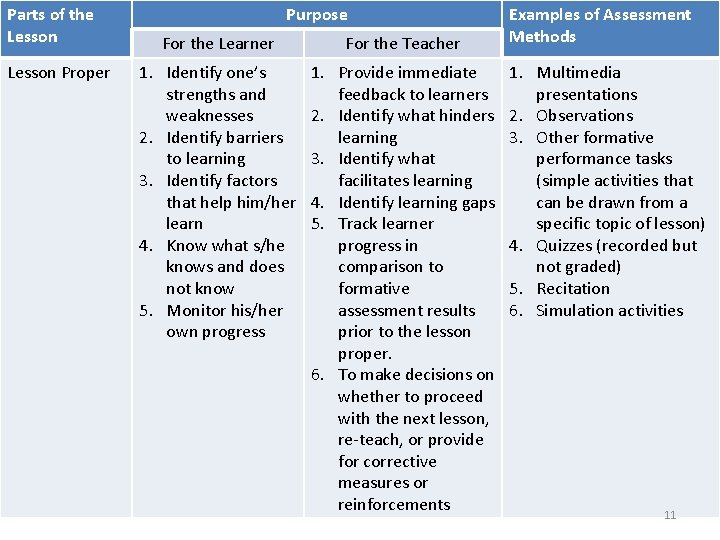
Parts of the Lesson Purpose For the Learner For the Teacher Purposes of Formative Assessment Lesson Proper 1. Identify one’s strengths and weaknesses 2. Identify barriers to learning 3. Identify factors that help him/her learn 4. Know what s/he knows and does not know 5. Monitor his/her own progress 1. Provide immediate feedback to learners 2. Identify what hinders learning 3. Identify what facilitates learning 4. Identify learning gaps 5. Track learner progress in comparison to formative assessment results prior to the lesson proper. 6. To make decisions on whether to proceed with the next lesson, re-teach, or provide for corrective measures or reinforcements Examples of Assessment Methods 1. Multimedia presentations 2. Observations 3. Other formative performance tasks (simple activities that can be drawn from a specific topic of lesson) 4. Quizzes (recorded but not graded) 5. Recitation 6. Simulation activities 11
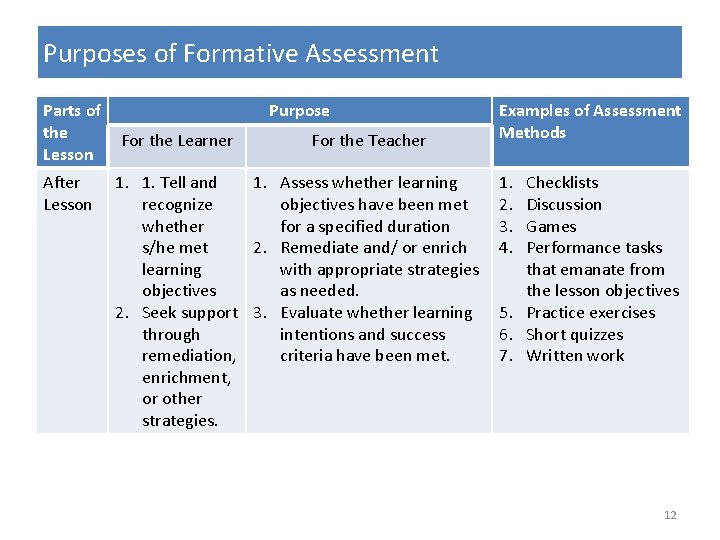
Purposes of Formative Assessment Parts of the Lesson After Lesson Purpose For the Learner For the Teacher 1. 1. Tell and 1. Assess whether learning recognize objectives have been met whether for a specified duration s/he met 2. Remediate and/ or enrich learning with appropriate strategies objectives as needed. 2. Seek support 3. Evaluate whether learning through intentions and success remediation, criteria have been met. enrichment, or other strategies. Examples of Assessment Methods 1. 2. 3. 4. Checklists Discussion Games Performance tasks that emanate from the lesson objectives 5. Practice exercises 6. Short quizzes 7. Written work 12

Summative Assessment – Measures the different ways learners used and apply all relevant knowledge, understanding and skills. – Spaced properly over a quarter – Helps teachers determine how well learners can demonstrate content knowledge and competencies articulated in the learning standards. – Learners synthesize their knowledge, understanding, and skills during summative assessments. – Results are used as bases for computing grades DEPARTMENT OF EDUCATION 13
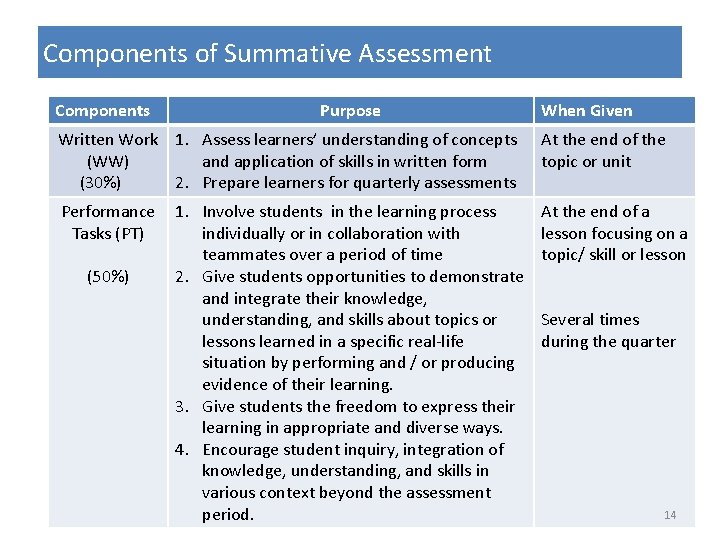
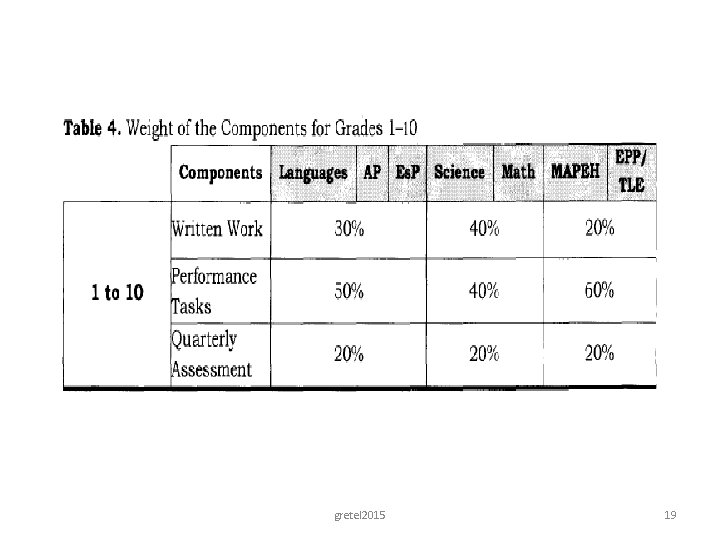
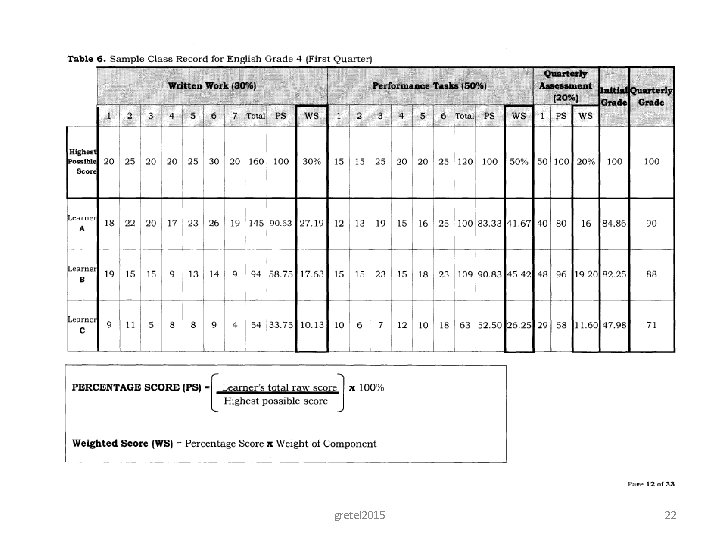
Components of Summative Assessment Components Purpose Written Work 1. Assess learners’ understanding of concepts (WW) and application of skills in written form (30%) 2. Prepare learners for quarterly assessments Performance Tasks (PT) (50%) 1. Involve students in the learning process individually or in collaboration with teammates over a period of time 2. Give students opportunities to demonstrate and integrate their knowledge, understanding, and skills about topics or lessons learned in a specific real-life situation by performing and / or producing evidence of their learning. 3. Give students the freedom to express their learning in appropriate and diverse ways. 4. Encourage student inquiry, integration of knowledge, understanding, and skills in various context beyond the assessment period. When Given At the end of the topic or unit At the end of a lesson focusing on a topic/ skill or lesson Several times during the quarter 14
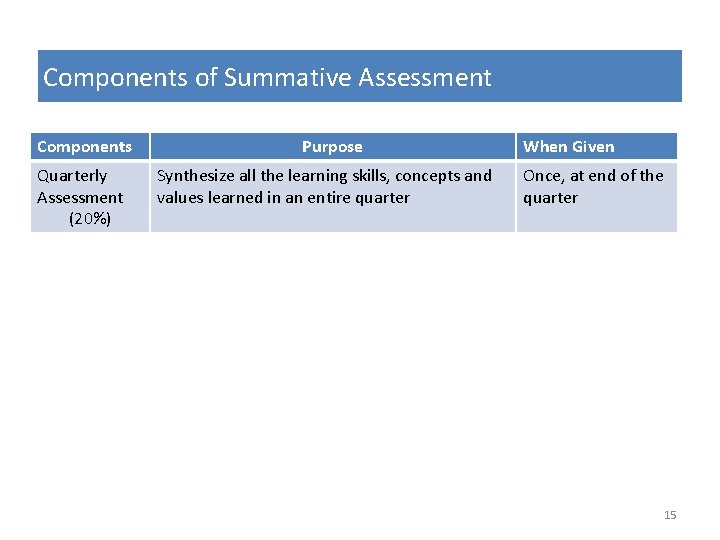
Components of Summative Assessment Components Quarterly Assessment (20%) Purpose Synthesize all the learning skills, concepts and values learned in an entire quarter When Given Once, at end of the quarter 15
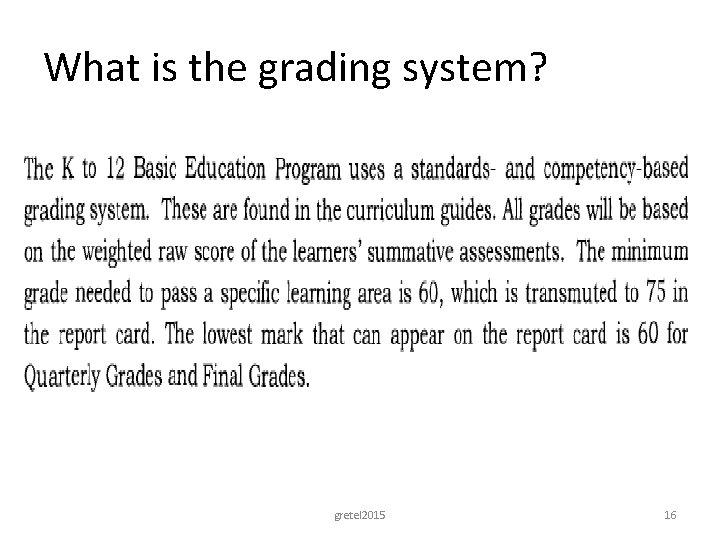
What is the grading system? gretel 2015 16
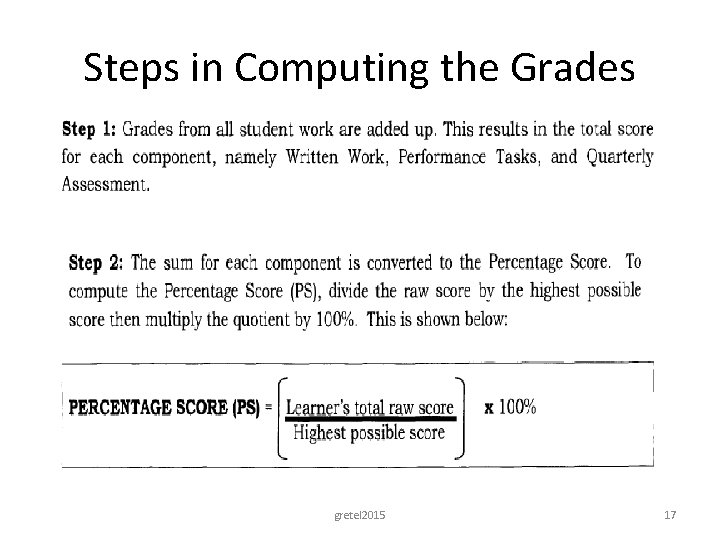
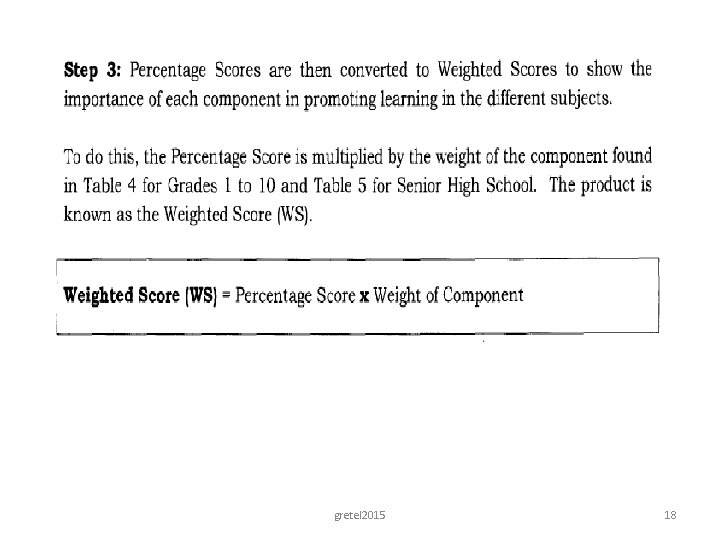
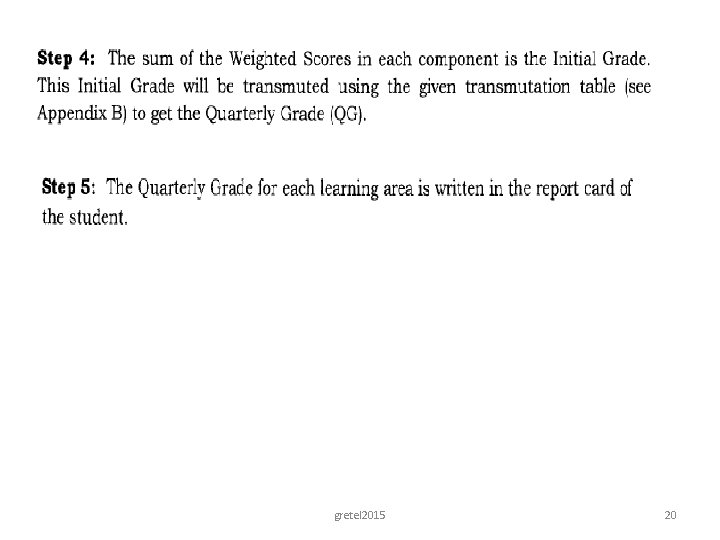
Steps in Computing the Grades gretel 2015 17
gretel 2015 18
gretel 2015 19
gretel 2015 20
gretel 2015 21
gretel 2015 22
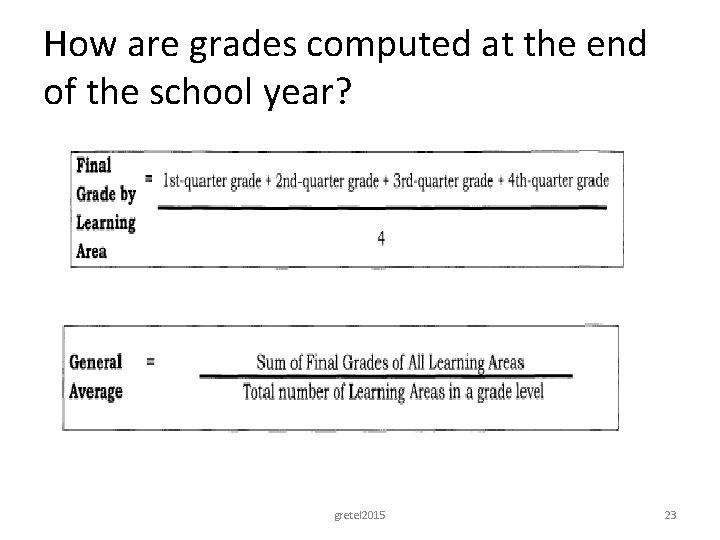
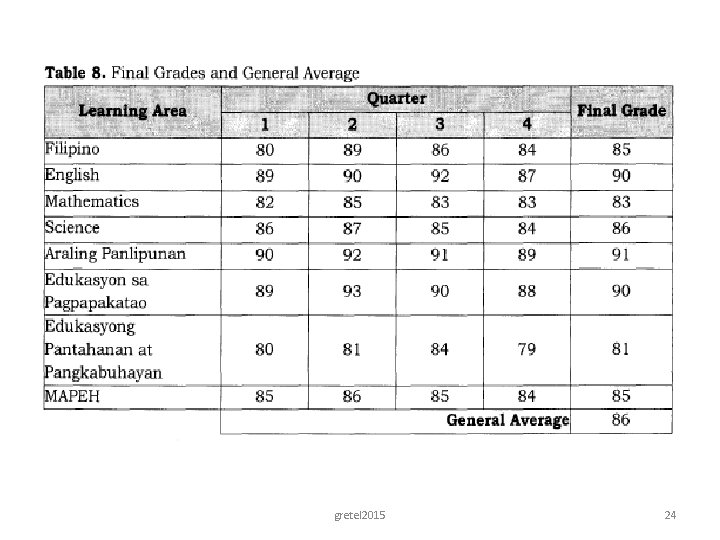
How are grades computed at the end of the school year? gretel 2015 23
gretel 2015 24
How is learner’s progress reported? • A summary of a learner’s progress is shown quarterly and discussed with the parents. gretel 2015 25
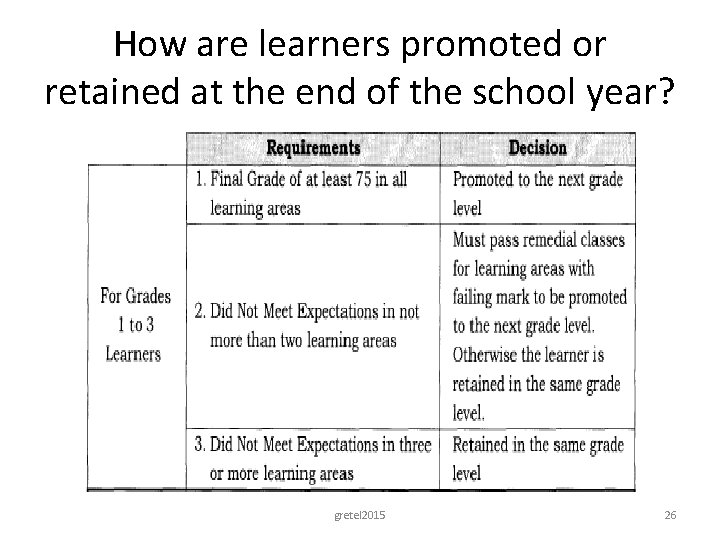
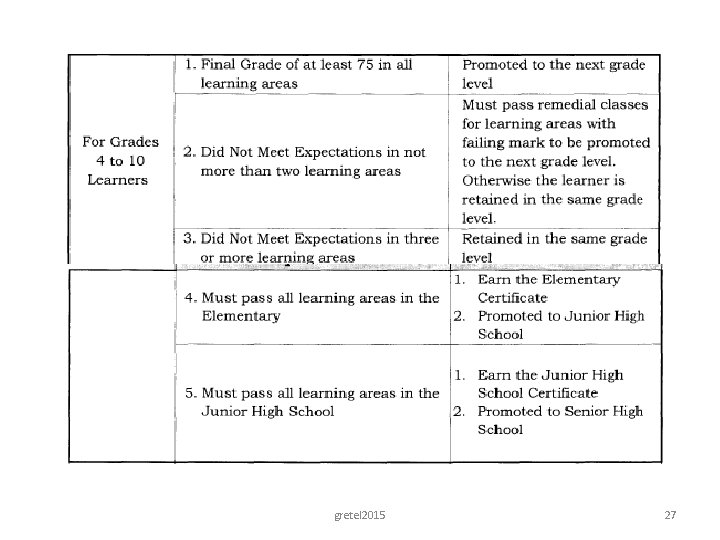
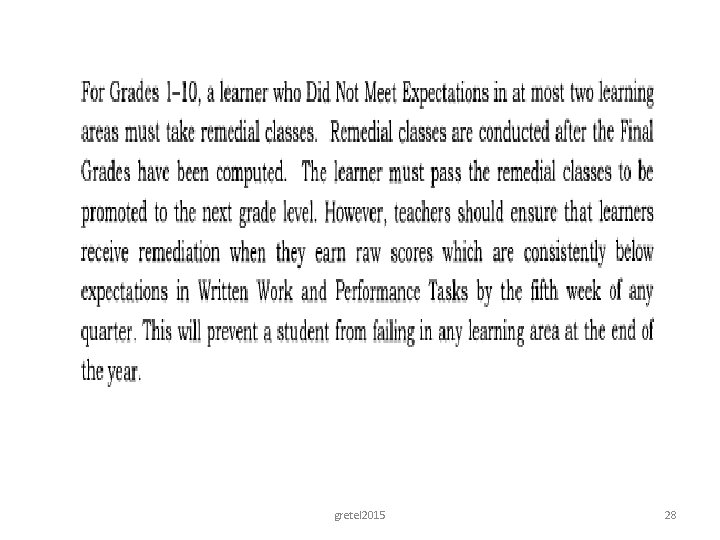
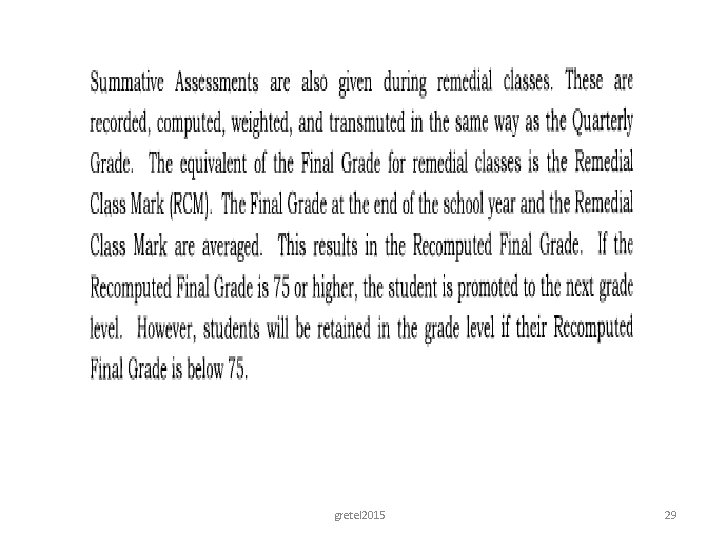
How are learners promoted or retained at the end of the school year? gretel 2015 26
gretel 2015 27
gretel 2015 28
gretel 2015 29
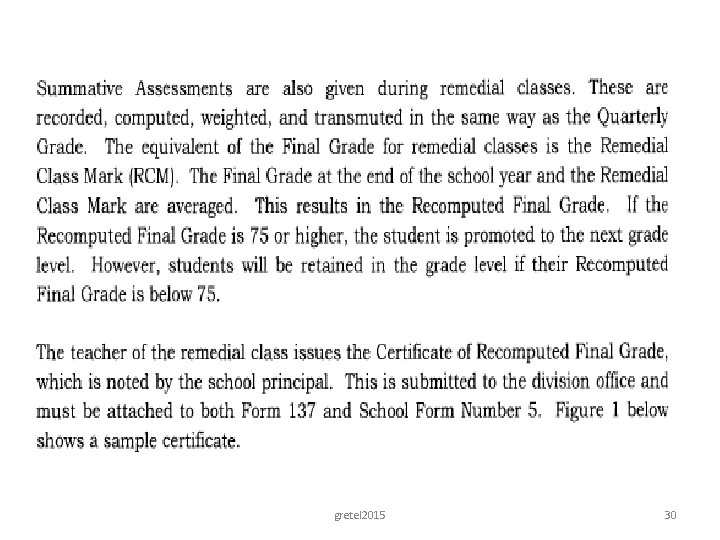
gretel 2015 30
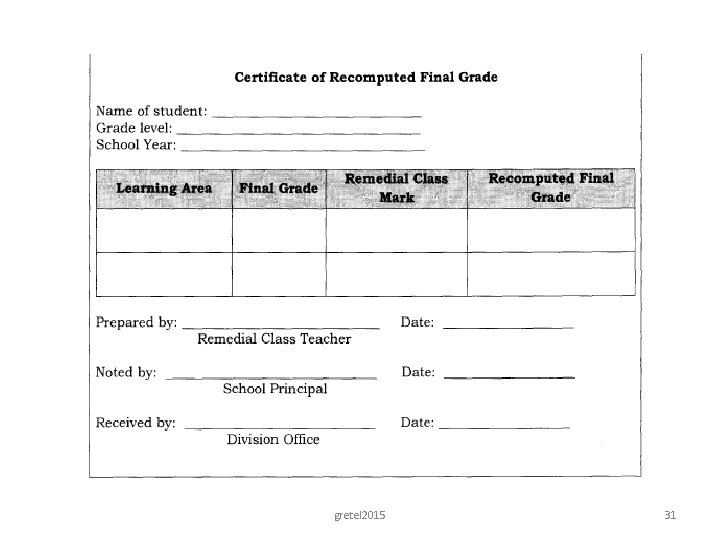
gretel 2015 31
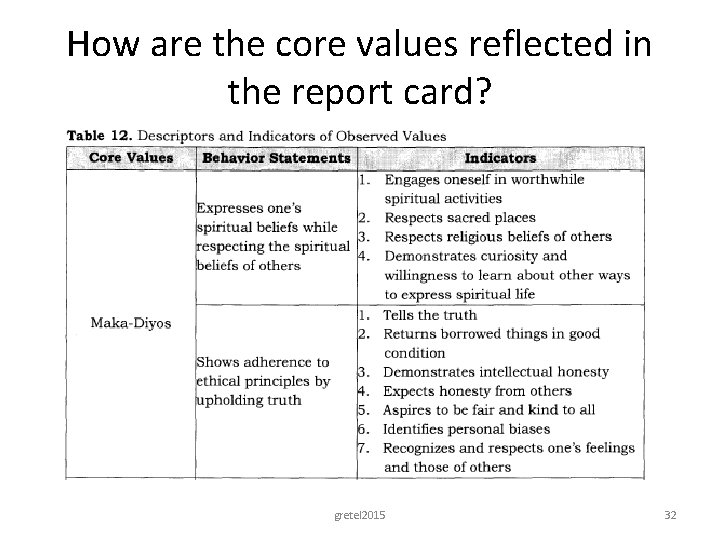
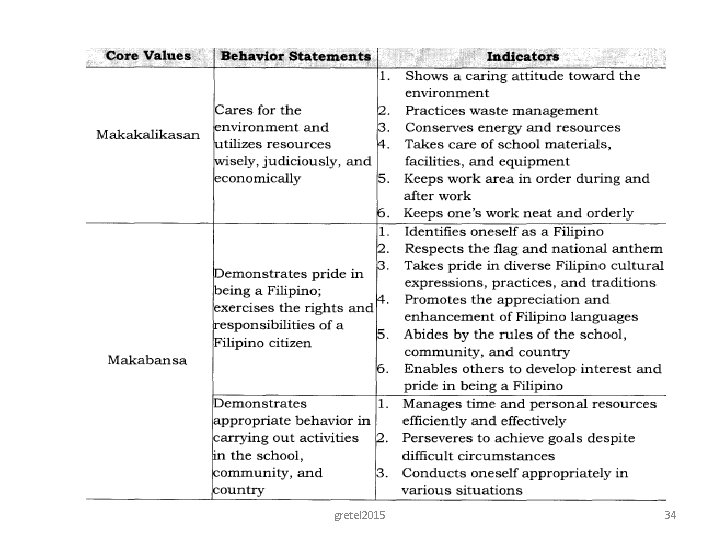
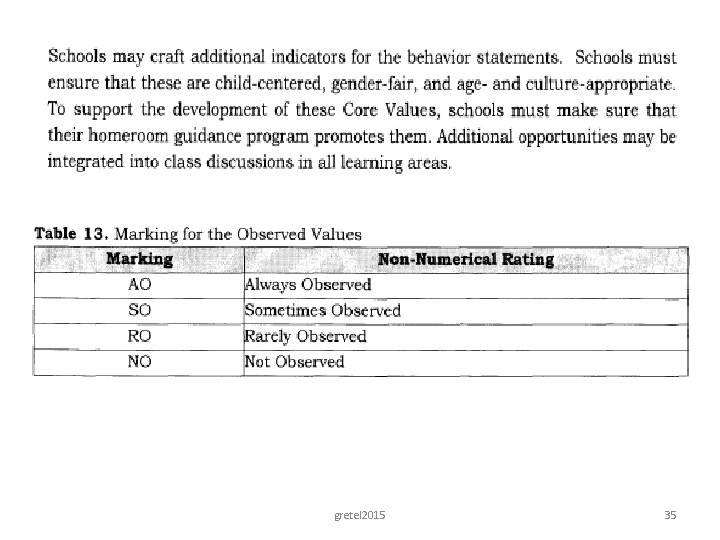
How are the core values reflected in the report card? gretel 2015 32
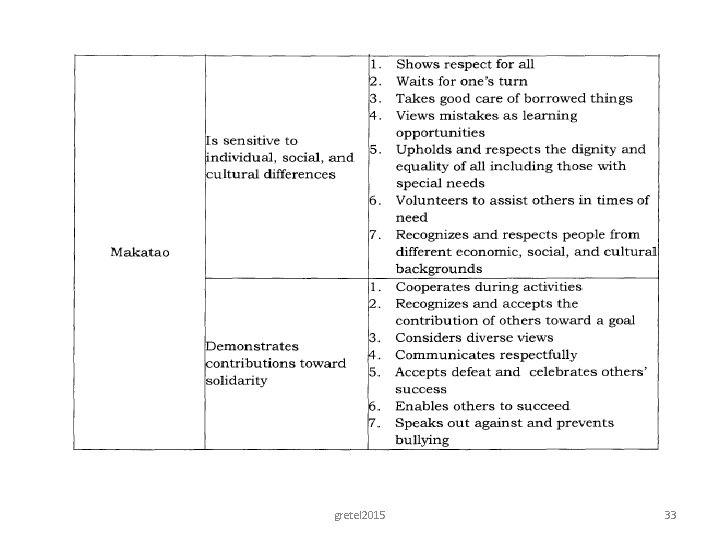
gretel 2015 33
gretel 2015 34
gretel 2015 35
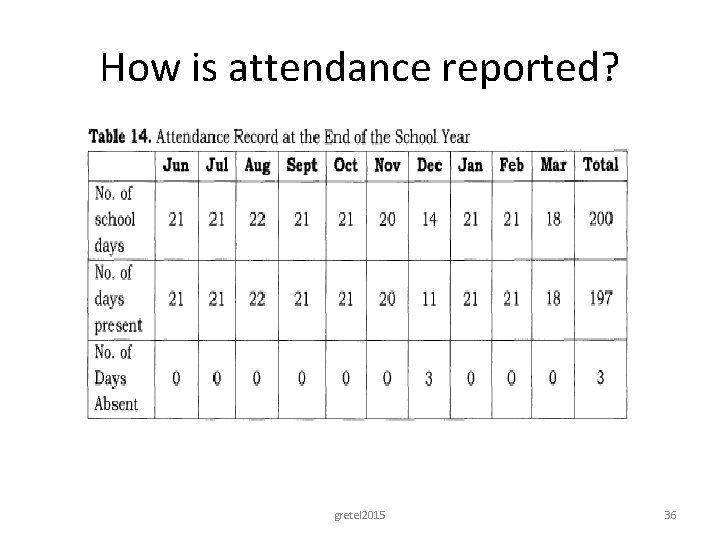
How is attendance reported? gretel 2015 36
gretel 2015 37
- Slides: 37