
Assessment in Counseling Part A Nature and Use


- Slides: 25
Assessment in Counseling (Part A): Nature and Use of Psychological Tests in Counseling PSY 504: Psychological Measurement
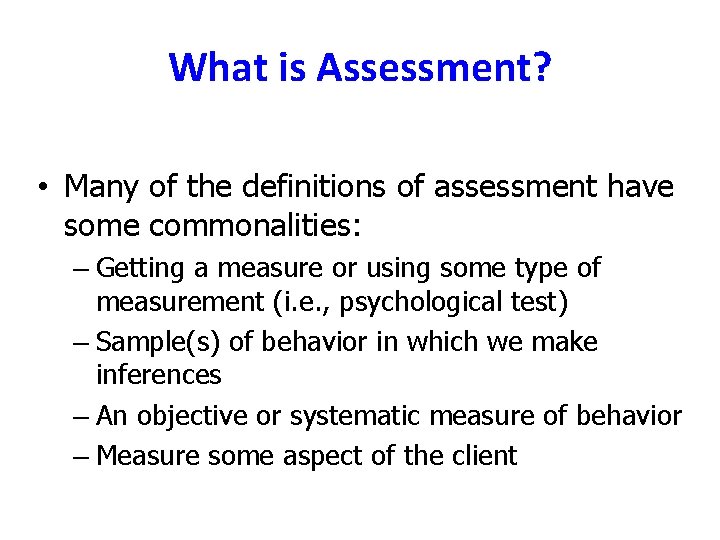
What is Assessment? • Many of the definitions of assessment have some commonalities: – Getting a measure or using some type of measurement (i. e. , psychological test) – Sample(s) of behavior in which we make inferences – An objective or systematic measure of behavior – Measure some aspect of the client
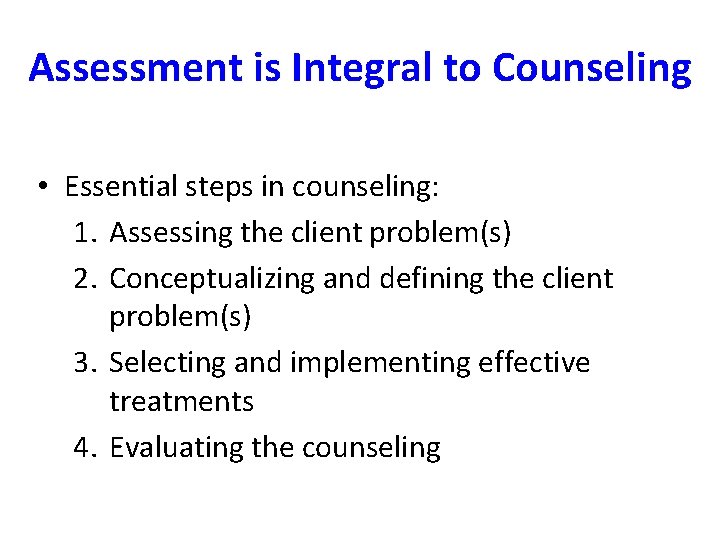
Assessment is Integral to Counseling • Essential steps in counseling: 1. Assessing the client problem(s) 2. Conceptualizing and defining the client problem(s) 3. Selecting and implementing effective treatments 4. Evaluating the counseling
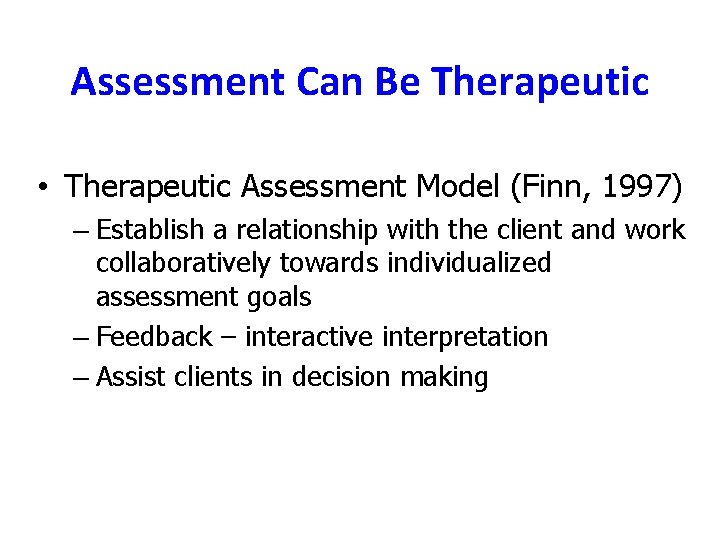
Assessment Can Be Therapeutic • Therapeutic Assessment Model (Finn, 1997) – Establish a relationship with the client and work collaboratively towards individualized assessment goals – Feedback – interactive interpretation – Assist clients in decision making
What Do Counselors Need to Know About Assessment? 1. Skill in practice and knowledge of theory relevant to the testing context and type of counseling specialty 2. A thorough understanding of testing theory, techniques of test construction, test reliability and validity 3. A working knowledge of sampling techniques, norms, and descriptive, correlational and predictive statistics 4. Ability to review, select, and administer tests appropriate for clients or students and the context of the counseling practice
What Do Counselors Need to Know About Assessment? 5. Skills in administration of tests and interpretation of test scores 6. Knowledge of the impact of diversity on testing accuracy, including age, gender, ethnicity, race, disability, and linguistic differences 7. Knowledge and skill in the professionally responsible use of assessment and evaluation practice
Uses and Varieties of Psychological Tests • Major precipitant for psychological tests was for the identification of “mentally retarded persons” – Binet-Simon scale (published in 1905) ratio of mental age to chronological age (intelligence quotient – IQ) • Stanford-Binet scale (published in 1916) – Education - detection of intellectual deficiencies and achievement/ability remains important
Uses and Varieties of Psychological Tests • Selection and classification of industrial personnel • Selection and classification of military personnel – World War I & II – First group-administered intelligence tests • Army Alpha – routine testing (language) • Army Beta – nonlanguage for use with illiterate or non. English
Uses and Varieties of Psychological Tests • Educational and vocational plans/needs – Frank Parsons – “father of guidance” • Developed one of the first approaches to career counseling – Understand the person and the world of work, and match the person • Emotional well-being and effective interpersonal relations • Self-understanding and personal development • Tests are also important for research
What is a Psychological Test? – Behavior Sample • An objective and standardized measure of a sample of behavior • Test items do not need to resemble closely the behavior the test is to predict – Simply need an empirical correspondence • Tests are behavior samples from which predictions regarding other behavior can be made • Capacity = potential for learning
What is a Psychological Test? Standardization • Standardization – uniformity of procedure in administering and scoring the test – Directions for administration must be followed • Norms – “normal or average performance” – An individual test score is interpreted by comparing it with the scores of others who have taken the same test – Established by administering a new test to a large, representative sample of the type of persons for whom it is designed for (i. e. , standardization sample)
What is a Psychological Test? – Objective Measurement of Difficulty • Administration, scoring, and interpretation of scores are objective insofar as they are independent of the subjective judgment of the particular examiner • Determination of difficulty level, arrangement, selection of items for inclusion in a test – Item Analysis – discussed later in the semester
What is a Psychological Test? – Reliability & Validity • Reliability = consistency • Validity = the degree to which the test actually measures what it purports to measure – Tells what the test is measuring
Why Control the Use of Psychological Tests? • Two principal reasons for controlling the use of psychological tests – 1) ensure that the test is given by a qualified examiner and that the scores are properly used – 2) prevent general familiarity with the test content (in order to avoid invalidation)
Why Control the Use of Psychological Tests? – Qualified Examiner • Three major reasons – 1) selection of test – 2) administration and scoring – 3) interpretation of scores
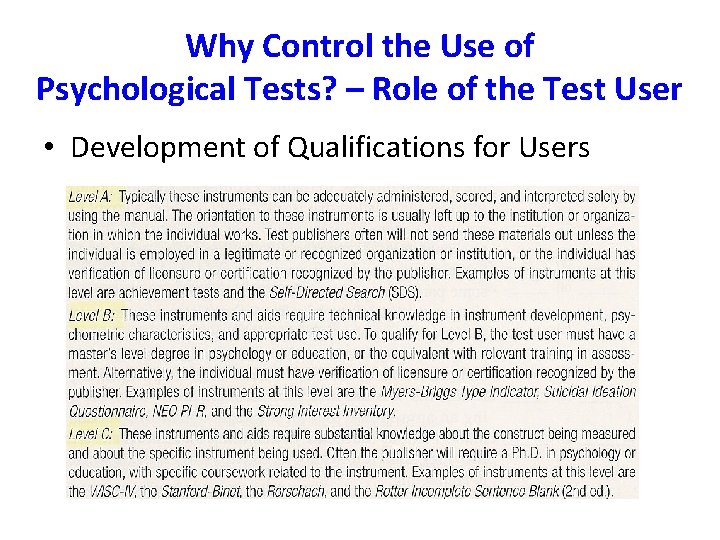
Why Control the Use of Psychological Tests? – Role of the Test User • The test user is anyone who uses test scores as one source of information in reaching practical decisions – May or may not be the examiner who administers and scores the test
Why Control the Use of Psychological Tests? – Role of the Test User • Development of Qualifications for Users
Why Control the Use of Psychological Tests? – Security of Test Content & Communication of Test Information • Test content should be restricted in order to prevent efforts to fake scores or invalidation from familiarity • Communication – Dispel the mystery/unknown of tests – Technical procedures – e. g. , reliability, validity; often provided in test manual – Familiarize with testing procedures, dispel anxiety, and ensure best performance – Feedback provided to test takers on their performance
Test Administration • Advance Preparation of Examiners • Testing Conditions • Rapport & Test-Taker Orientation – Rapport – the examiner’s efforts to arouse the test takers’ interest in the test, elicit their cooperation, and encourage them to respond in an appropriate manner – Provide each test taker an explanation, or materials, in advance that explain the purpose and nature of the tests
Examiner and Situational Variables • Test results may be influenced by the examiner’s behavior immediately preceding and during test administration – e. g. , warm vs. cold; rigid vs. aloof – Examiner characteristics may have different effects on different examinees • Examiner’s own expectations – self-fulfilling prophecy • Test takers’ activities and/or emotional disposition preceding the test • Feedback effects on subsequent test performance
Test-Taker’s Perspective • One purpose of rapport is to reduce test anxiety – Being well mannered, organized, and smooth testing techniques help greatly • Relation between anxiety and performance is nonlinear – Inverse “U” – slight amount of anxiety is beneficial while a large amount is detrimental – “freezes up” • anxiety poor testing OR • poor study skills poor testing anxiety – Elimination of emotionality (i. e. , physiological) and worry (i. e. , cognitive), and improvement of study skills appears to help best
Effects of Training on Test Performance • Coaching – not good – intensive, massed drill on items similar to those on the test – Might improve test performance, but without corresponding improvement in criterion behavior • Reduces test validity • Test orientation/sophistication – okay – purpose is to reduce influence of test-specific factors • Broad Cognitive Skills – good – development of applicable intellectual skills, work habits, and problem-solving strategies – Both test scores and criterion performance improved
Sources of Information about Tests • Mental Measurements Yearbook – Established and edited by Oscar K. Buros through 1978 (first edition published in 1939) – Covers nearly all commercially available psychological, educational, and vocational tests published in English – Provides critical reviews by one or more test experts and a detailed description with relevant references • Test Collection of Bibliographies by the Educational Testing Service (ETS) • Standards for Educational and Psychological Testing by the APA