
Assessment for Learning within the PLC Framework Technical


























- Slides: 70
Assessment for Learning within the PLC Framework Technical Assistance for Title I Schools in Corrective Action and Restructuring Session 3 April 2009 Presented by Gail Varney and Erin Sullivan Title I School Improvement Coordinators
Essential Questions/Agenda Wednesday Morning & Early Afternoon • How do we make learning targets clear for teachers and students? • How will teachers know if students have mastered learning targets? • What do researchers say about effective assessment? • How are teachers using formative assessment effectively? • How can collaborative teams create and utilize common assessments that monitor and promote student learning?
Essential Questions/Agenda Wednesday Afternoon After Breakout Groups Administrators What are the administrators’ roles in the assessment process? Teachers How do we effectively assess what students have learned? How do teachers involve students and parents?
Essential Questions/Agenda Thursday Morning Data Teams How do collaborative teams collect, analyze, and use data? Acuity How can Acuity be utilized as an instructional tool?
Essential Questions/Agenda Thursday Afternoon Writing Roadmap How can Writing Roadmap be customized and used in formative assessment? The Balanced Assessment System/Cycle What does the BIG PICTURE of assessment for learning look like? What does balanced assessment look like in your school?
4 Questions Asked in a PLC 1. What is it we want students to learn? 2. How will we know each student is learning? 3. How will we respond when some of our students don’t learn? 4. How will we extend and enrich the learning for students who are already proficient?
Deconstructing the CSOs Identifying the learning targets embedded in each objective so it is clear what the CSO is asking students to KNOW, UNDERSTAND, and be able to DO: – Knowledge – Reasoning – Performance Skills – Product
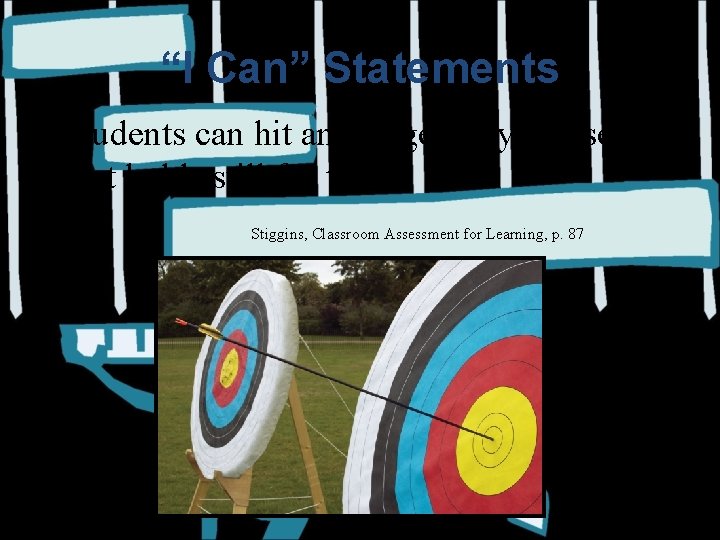
“I Can” Statements Students can hit any target they can see that holds still for them. Stiggins, Classroom Assessment for Learning, p. 87
Student Friendly Language • I can make inferences. This means I can use information I already know and information from what I read to draw a reasonable conclusion. (7 th grade) • I can make inferences. This means I can use information I already know and make a guess that is based on clues in the text. (2 nd grade)
Another Way I am learning to I am make inferences. combining information I already know with details or clues within a passage to make a guess.
Who Benefits? Rachel’s mom: “What did you do in school today? ” Rachel: “Well, we did reading. ” Rachel’s mom: “What did you learn in reading? ” Rachel: “I don’t know. We read. ” Brad’s mom: “What did you do in school today? ” Brad: “Well, we did reading. ” Brad’s mom: “What did you learn in reading? ” Brad: “We learned how to compare two characters in a story. ” Chappuis and Chappuis, 2006
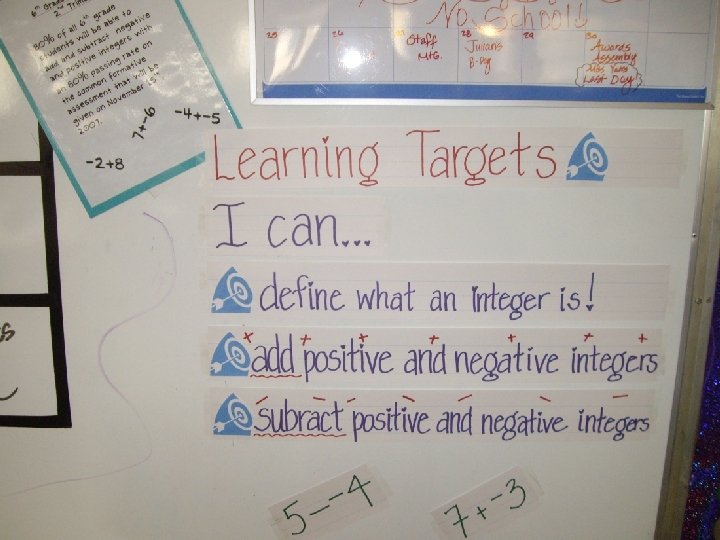
Process for Developing “I Can” Statements 1. Identify word(s) that need to be defined. 2. Write a definition for the word(s. ) 3. Rewrite the definition as “I can” or “I am learning to” statements. 4. Try it out and refine as needed. 5. Teach students how to develop statements.
Example of the Process Summarize the information in texts. 1. Word to be defined: Summarize: To give a brief statement of the main points, main events or important ideas 2. Student-friendly language: “I can summarize information in texts. This means that I can make a short statement of the main points or the big ideas of what I read. ”
Practice Developing “I Can” Statements Activity – In pairs, pick one of the deconstructed CSOs. – Define main points, key skills or concepts in each target that might be unclear to students. – Rewrite as “I Can” or “I am learning to” statements. – Give your “I Can” statements to another pair at your table. Provide feedback to each other on the clarity of statements.
Student Checklist Samples Westerville • http: //www. westerville. k 12. oh. us/administrative. D epartment. aspx? aid=22 Grande Rapids • http: //www. grandforks. k 12. nd. us/education/components/docmgr/d efault. php? sectiondetailid=13380&PHPSESSID= 1 aff 3 a 6129 e 195 da 443 fba 9 fe 426690 b
Think-Pair-Share How would you use “I Can” statements as a parent involvement component?
4 Questions Asked in a PLC 1. What is it we want students to learn? 2. How will we know each student is learning? 3. How will we respond when some of our students don’t learn? 4. How will we extend and enrich the learning for students who are already proficient?
MATCHING ASSESSMENTS WITH LEARNING TARGETS
Learning Target/Method Match • Accuracy in formative assessment requires matching the kinds of learning targets to the appropriate assessment method: – Selected Response – Extended Written Response – Performance/Product – Personal Communication
Selected Response Students select answer from choices provided – Multiple Choice – True/False – Matching – Short Answer – Fill-in the Blank
Extended Written Response • Written response to a prompt or task • Several sentences in length • Scoring – Rubric – Checklist
Performance/Product • Complex performance • Complex products • Evaluation – Performance task or exercise – Scoring guide or rubric
Personal Communication • Assessment through interacting with students • Informal assessment • Used to provide descriptive feedback • Evaluation – Short answers – either right or wrong – More complex – scoring guide or rubric
Target/Method Match Activity 1. Attached are four scenarios, each relating to a different type of student learning target: content knowledge, reasoning, performance skills and products. An example of each type of target is included below the scenario. 2. For each type of learning target, answer the four questions. 3. Based on your discussion, put a large "X" in the boxes that represent the best fit of method to target type. Put an “O" in the boxes that represent a partial fit. 4. Compare your response to the other groups. Do you agree or disagree?
Target/Method Match Your Learning Targets Activity 1. Work in pairs. 2. Take one of your deconstructed CSOs. 3. Decide which method would be the best for assessing the ultimate target. 4. Determine in which situations the embedded targets would need to be assessed separately. 5. If they need to be assessed separately, determine the best method.
Debrief • What did you learn from these activities? • Do you have any questions or comments you would like to share with the group?
Reviewing the Research
“To the surprise of some educators, major reviews of the research on the effects of classroom assessment indicate that it might be one of the most powerful weapons in a teacher’s arsenal. ” Robert J. Marzano (Classroom Assessment & Grading that Work 2006)
What Do Researchers Say? Activity 1. Each team member choose a quote card from the “Research Quotes” envelope. 2. Read your quote aloud. 3. After each one is read aloud, come to a group consensus on what the most compelling arguments you could make to your staff for focusing on formative assessment. 4. Groups will be asked to share.
What Does Formative Assessment Look Like?
Balanced Assessment for Learning Assessment of Learning
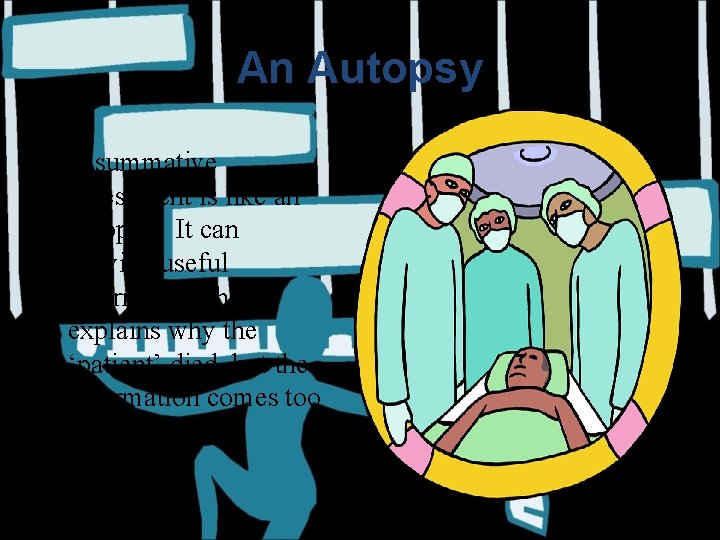
An Autopsy A summative assessment is like an autopsy. It can provide useful information that explains why the ‘patient’ died, but the information comes too late!
Brainstorm Activity • Individually, brainstorm a list of all the formative assessments that you use. • In a group, compare your lists and add any that you think of as you discuss the lists. • Have one of the members of your group act as recorder to make a master list.
Classroom and Common Formative Assessments
Classroom vs. Common Assessments Classroom Assessments for Learning Common Formative Assessments • Ongoing student & teacher assessment • MOST formative • Minute by minute, day by day, and weekly descriptive feedback • Collaboratively developed & curriculum embedded • Written by teams of teachers • Unit driven, with focus on specific learning targets of the unit
Classroom Formative vs. Common Formative Assessments Activity From the list you generated, determine which assessments would be simply classroom formative assessments and which might potentially be common formative assessments.
Amy’s Assessments… Amy Rice 6 th/7 th Grade Math Teacher Keyser Primary/Middle School Keyser, WV
M. O. 7. 1. 5 Analyze and solve grade-appropriate real-world problems with whole numbers, integers, decimals, fractions and percents including problems involving – discounts, – interest, – taxes, – tips, – percent increase or decrease, and – justify solutions including using estimation and reasonableness.
Scenario 1 You are a real estate agent working for Century 1. You have been working with this company for five years and now earn a 3. 5% commission rate and a base salary of $800 a month. Using the newspaper ads provided select three properties to sell and determine your commission for each.
Scenario 2 It’s your lucky day. All three properties have sold! Calculate your monthly earnings.
Scenario 3 Being a financially responsible adult, you are investing 15% of this month’s earnings. How much is this investment? How much interest will you earn at a simple interest rate of 4% if you leave the money in the bank for 5 years?
Scenario 4 On your way home, you experience car trouble. The mechanic determines repairs will cost $850. What percent of this month’s earnings will this repair cost?
Scenario 5 To celebrate your record sales, the boss has decided to take you to lunch. You are determined to keep your meal under $20 including the tip but it’s a celebration so you will be having an appetizer. Use the menu provided to show your meal selection. Don’t forget the 6% sales tax.
Scenario 6 Tomorrow is your brother’s birthday and you are at the mall shopping. Gamestop has Nintendo Wii games on clearance for 25% off. If the Wii Mario Cart with Mario Wheel is originally priced at $59. 79, what will you pay including 6% sales tax?
Assessment Strategies • Cooperative Learning Teams • Kagan Structures – Numbered Heads – Pairs Check – Showdown – Quiz-Trade • John Strebe’s program – Class Chorus – Team Challenges – Quizzes with Team Consensus
Formative Assessment Scenarios Activity 1. Divide the scenarios between members of your team. 2. Read silently. 3. Then group-share a summary of how each scenario shows formative assessment. 4. As a group, come up with a novel way a teacher in your school is or could be using formative assessment. 5. A group rep will be asked to share.
“If all students are expected to demonstrate the same knowledge and skills, regardless of the teacher to which they are assigned, it only makes sense that teachers must work together to assess student learning. ” Dufour, Eaker and Many
Common Assessments Are… • Formal and informal measures of essential student learning • Activities that are standardized across the discipline, across the district • Assessments that are administered in a systematic and timely manner • Assessments for which results are disaggregated, analyzed, compared and contrasted
Common Assessments Are Not… • • Pacing guides Number of pages or chapters covered Textbook specific Teacher evaluation tools
What are the Fears about Common Assessments? • Results will be used to evaluate teacher performance. • Results will be shared with others. • Negative student results will lead to punitive actions. • Autonomy regarding instructional styles and strategies will be compromised. • Personal standards will be compromised.
Benefits of Common Assessments • • Focus shifts to learning instead of teaching. Teachers work in collaboration – not isolation. Sharing the load saves teachers time. Common goals, similar pacing, & consistent standards improve achievement. • Teachers see where more support, additional resources, etc. are needed.
Common Assessment in a PLC
Process for Common Assessment Monitor for learning of individual and collective results Create a plan for appropriate intervention Tally and review common assessment results Instruction and ongoing assessment Intervention Assessment Instruction and ongoing assessment Design formative & summative assessments Revise curriculum, instruction and assessments as needed Assess again – monitoring for results Repeat intervention loop as needed Identify the target of the assessment Erkens, 2008
Assessment Loop • Identify the targets of the assessment. • Design formative and summative assessment. • Provide instruction and ongoing assessment. • Monitor learning of individual and collective results. • Tally and review common assessment results.
Intervention Loop • Create a plan for appropriate interventions. • Provide instruction and ongoing assessment. • Assess again – monitoring for results. • Repeat intervention loop as needed.
Key Criteria for Effective Assessment • Establish the purpose of each assessment and communicate how the results will be used and by whom. • Be clear with students about what learning targets they are responsible for learning. • Use an appropriate assessment method (selected response, essay, performance assessment, or personal communication) with procedures that ensure the accuracy of results. • Effectively communicate the results to maximize further learning. • Involve students (and parents) where appropriate in the assessment process.
Value of Developing Common Assessment • • Requires all members to participate May utilize format of the state test We know what students are learning Provides feedback to each teacher on how his or her students achieved in relation to an agreed upon standard • Physical versus an autopsy
Myths about Common Assessments Common assessments will require lockstep pacing and uniform instruction. 2. Common assessments will limit us to a narrow focus or lower-level skills. 3. We are already assessing too much. Common assessment will add to the burden. 4. If we focus on student achievement on assessments we diminish our efforts to develop the whole student. 1.
Benefits to Teachers • In addition to improving student achievement, teachers actually benefit from common formative assessments. – Clarifies curriculum and intervention strategies – Enhances communication between teachers about student learning – Creates opportunities for teachers to sharpen pedagogy and deepen understanding of content Tom Many, Learningby Doing
Committing to Common Assessments Activity: Plus/Delta Use the Plus column to list the benefits for teachers, students and parents of common assessments. Use the Delta column to determine things that will need to change in order to implement common assessments. *Put the information on a chart so it may be shared with the other groups.
How do you get your staff on THIS Bus?