
Assessment for learning quotes and questions Professor Ranald

- Slides: 16
Assessment for learning: quotes and questions Professor Ranald Macdonald • • FSEDA, FHEA National Teaching Fellow Chair, SEDA Research Committee Associate Director, Centre for Promoting Learner Autonomy • Head of Strategic Development Learning and Teaching Institute Sheffield Hallam University, UK r. macdonald@shu. ac. uk
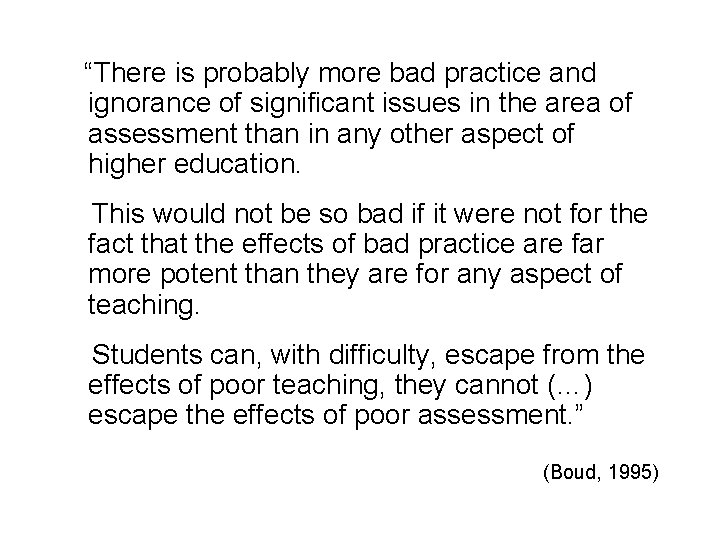
“There is probably more bad practice and ignorance of significant issues in the area of assessment than in any other aspect of higher education. This would not be so bad if it were not for the fact that the effects of bad practice are far more potent than they are for any aspect of teaching. Students can, with difficulty, escape from the effects of poor teaching, they cannot (…) escape the effects of poor assessment. ” (Boud, 1995)
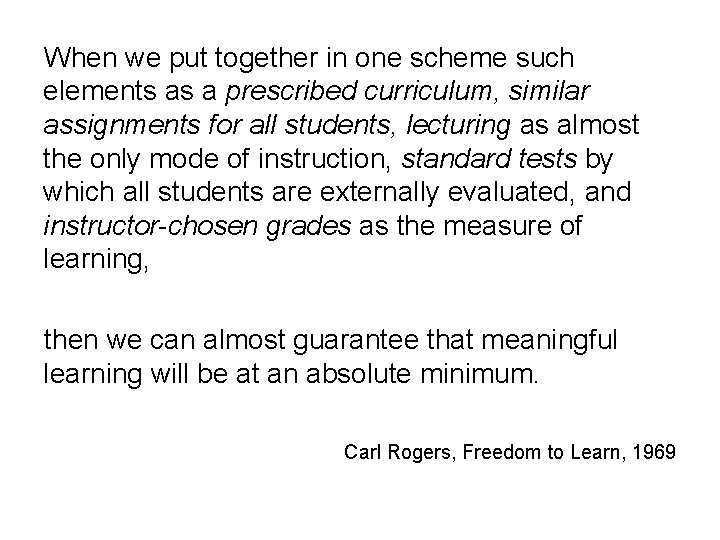
When we put together in one scheme such elements as a prescribed curriculum, similar assignments for all students, lecturing as almost the only mode of instruction, standard tests by which all students are externally evaluated, and instructor-chosen grades as the measure of learning, then we can almost guarantee that meaningful learning will be at an absolute minimum. Carl Rogers, Freedom to Learn, 1969
What for you is the main issue with respect to assessment? Why?
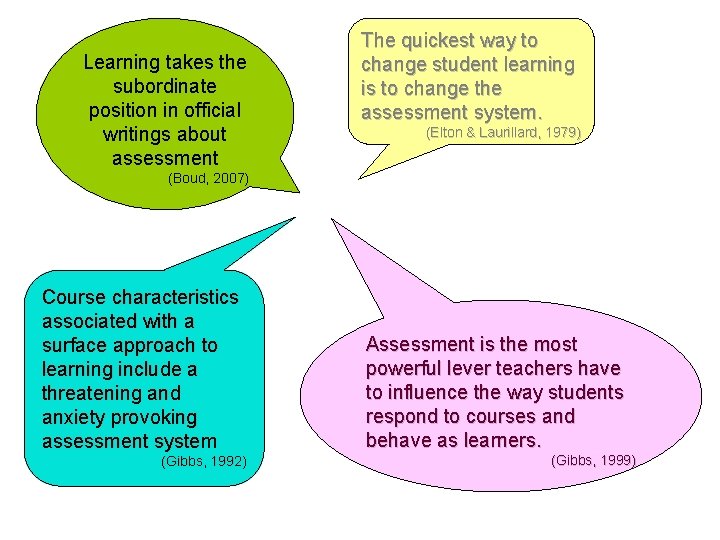
Learning takes the subordinate position in official writings about assessment The quickest way to change student learning is to change the assessment system. (Elton & Laurillard, 1979) (Boud, 2007) Course characteristics associated with a surface approach to learning include a threatening and anxiety provoking assessment system (Gibbs, 1992) Assessment is the most powerful lever teachers have to influence the way students respond to courses and behave as learners. (Gibbs, 1999)
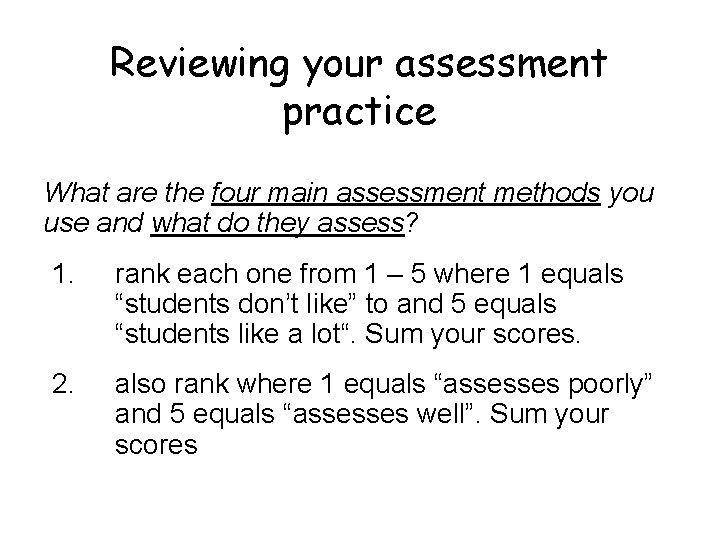
Reviewing your assessment practice What are the four main assessment methods you use and what do they assess? 1. rank each one from 1 – 5 where 1 equals “students don’t like” to and 5 equals “students like a lot“. Sum your scores. 2. also rank where 1 equals “assesses poorly” and 5 equals “assesses well”. Sum your scores
Institutions encourage assessment practice that promotes effective learning (QAA Code of Practice on the assessment of students, General Principle 3, 2006)
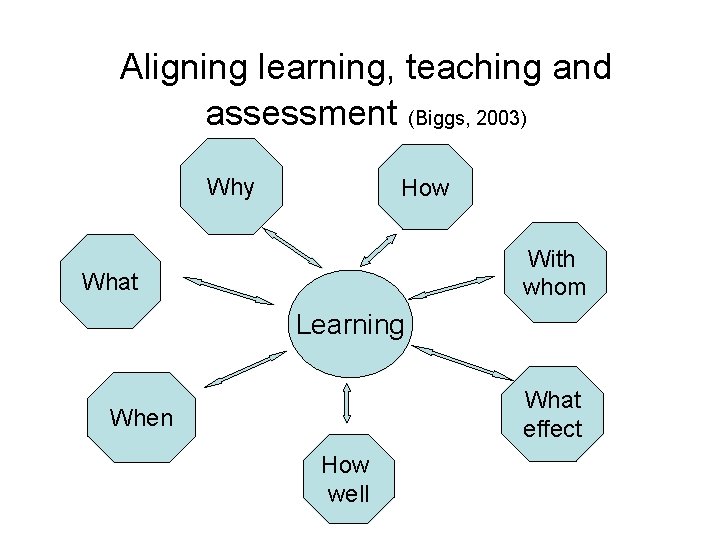
Aligning learning, teaching and assessment (Biggs, 2003) Why How With whom What Learning What effect When How well
Institutions provide appropriate and timely feedback to students on assessed work in a way that promotes learning and facilitates improvement but does not increase the burden of assessment. (QAA Code of Practice on the assessment of students, General Principle 9, 2006)
• Summative assessment is high stakes – encouraging students to conceal ignorance and suggest competence • Formative assessment should emphasise providing useful feedback – low stakes – it is more helpful when learners are open about their limitations and don’t try to conceal ignorance or bury mistakes (P. Knight, 2001)
Which aspects of your assessment practice would you like to change and why? How would the change improve student learning and how would you know? Activity What would be the benefits to you and your students of making the change? What is stopping you making the change?
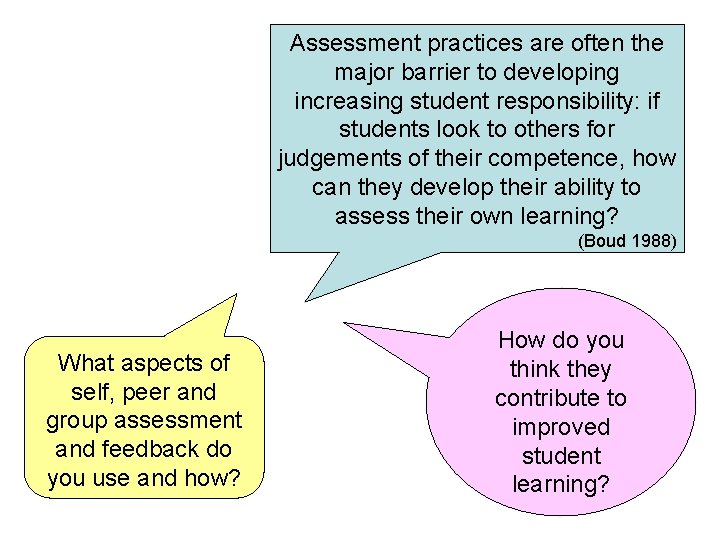
Assessment practices are often the major barrier to developing increasing student responsibility: if students look to others for judgements of their competence, how can they develop their ability to assess their own learning? (Boud 1988) What aspects of self, peer and group assessment and feedback do you use and how? How do you think they contribute to improved student learning?
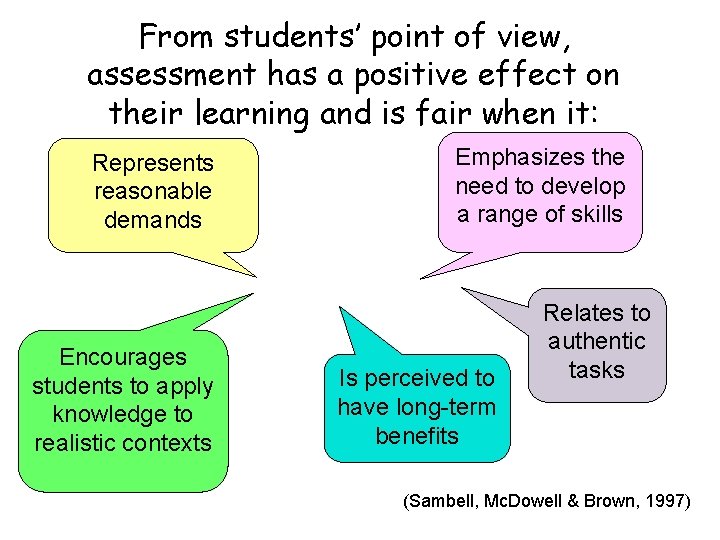
From students’ point of view, assessment has a positive effect on their learning and is fair when it: Represents reasonable demands Encourages students to apply knowledge to realistic contexts Emphasizes the need to develop a range of skills Is perceived to have long-term benefits Relates to authentic tasks (Sambell, Mc. Dowell & Brown, 1997)
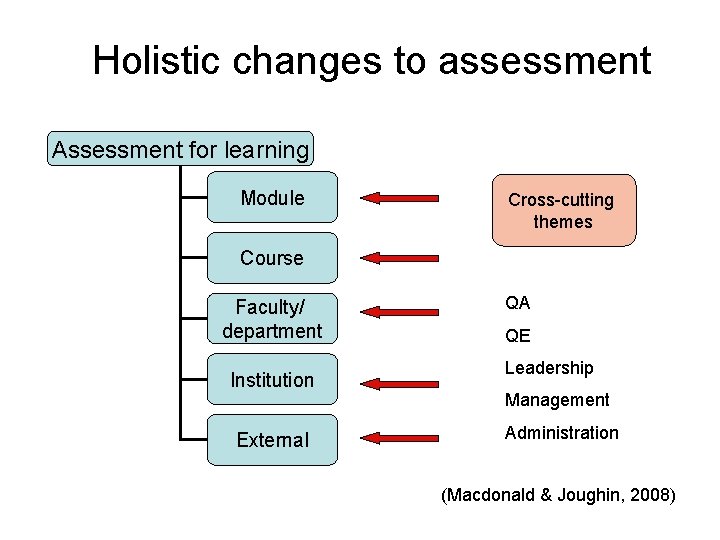
Holistic changes to assessment Assessment for learning Module Cross-cutting themes Course Faculty/ department Institution External QA QE Leadership Management Administration (Macdonald & Joughin, 2008)
http: //ranald. pbwiki. com