
Assessment for Differentiation Day Two Using Differentiated Instruction

- Slides: 77
Assessment for Differentiation: Day Two Using Differentiated Instruction to Increase Student Achievement January 6, 2009 West Georgia RESA
Housekeeping • Questions • Breaks • Cell phones
Review Day One • Review at your tables the four formative assessment categories discussed in Day One. • Make a list of classroom assessment strategies that you’ve have used since Day One, and place them in each category. • Develop a list of questions/concerns • you have in regards to formative • assessment strategies.
Standard • Participants will be able to use assessment data to plan and implement differentiated instruction.
Essential Question • What strategies will enable me to implement differentiated instruction in my classroom?
Activator: 5 -3 -1 • Individually, write 5 words that come to your mind about differentiation. • In pairs, write 3 words that best represent your ideas on differentiation. • Finally, decide on the 1 word that best reflects your thoughts on differentiation.
Pre-assessment • Using the continuum on the handout “Classroom Practices Pre-Assessment” rate your own instructional practices. • This is a self-assessment that you will NOT turn in.
So…what is differentiation?
DIFFERENTIATION ala. . . WEBSTER “…to make unlike; to develop specialized differences in…” TOMLINSON “…shaking up what goes on in the classroom so all students can access the curriculum at their level of understanding. ”
DIFFERENTIATION ala… West Georgia RESA In a standards-based classroom, learning outcomes aligned to content standards are held constant, and all students are expected to attain proficiency in them. Flexibility is provided in the time and support each student needs to meet the standard. Teachers follow a cycle of instruction— assessment, planning, instruction, assessment, and re-teaching--so all students meet specific, clearly stated and understood, high academic standards in each content area.
Differentiated instruction… “is a belief system, a philosophy of teaching. Not a formula or recipe. ” Tomlinson and Mc. Tighe (2006)
So…Why differentiate?
Why differentiate? Because… “Equal treatment of unequals is the greatest injustice of all. ” Edmund Burke. 18 th century British statesman
Can you remember a time when “one size fits all” instruction was not appropriate for you?
WHEN WE TEACH THE SAME THING TO ALL KIDS AT THE SAME TIME, and IN THE SAME WAY 1/3 ALREADY KNOW IT, 1/3 GET IT, AND 1/3 NEVER WILL. • SO… 2/3 OF THE KIDS ARE WASTING THEIR TIME. --Scott Willis
So…What can you differentiate?
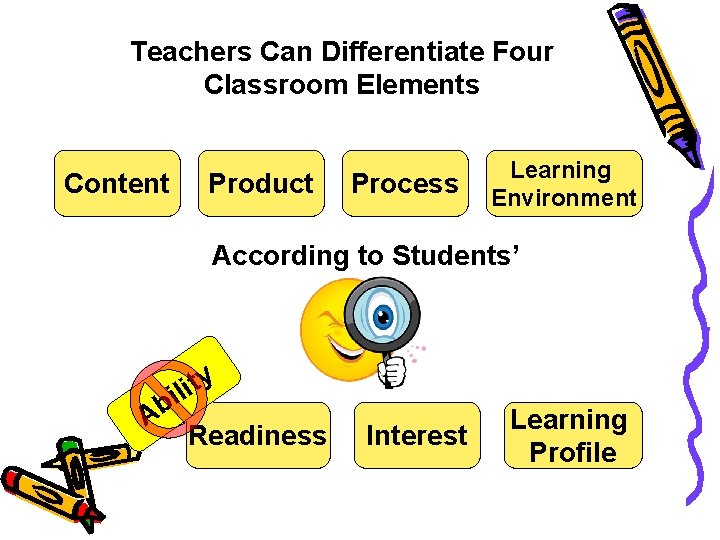
Teachers Can Differentiate Four Classroom Elements Content Product Process Learning Environment According to Students’ Ab y t i il Readiness Interest Learning Profile
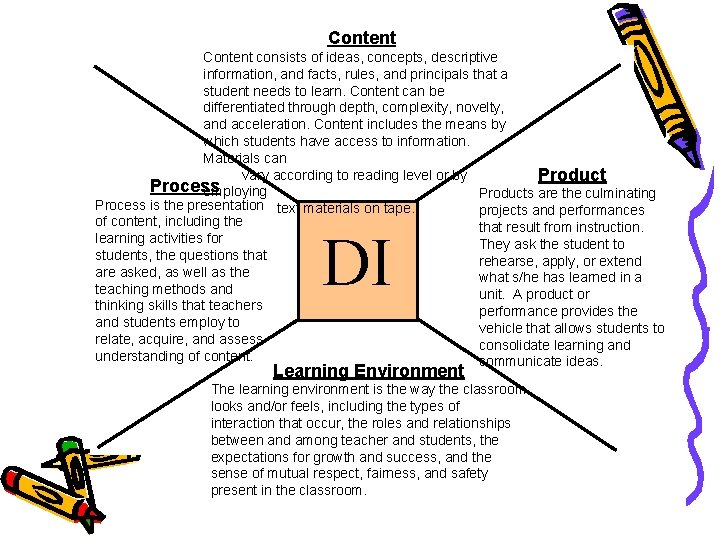
Content consists of ideas, concepts, descriptive information, and facts, rules, and principals that a student needs to learn. Content can be differentiated through depth, complexity, novelty, and acceleration. Content includes the means by which students have access to information. Materials can vary according to reading level or by Product Process employing Products are the culminating Process is the presentation text materials on tape. projects and performances of content, including the that result from instruction. learning activities for They ask the student to students, the questions that rehearse, apply, or extend are asked, as well as the what s/he has learned in a teaching methods and unit. A product or thinking skills that teachers performance provides the and students employ to vehicle that allows students to relate, acquire, and assess consolidate learning and understanding of content. communicate ideas. DI Learning Environment The learning environment is the way the classroom looks and/or feels, including the types of interaction that occur, the roles and relationships between and among teacher and students, the expectations for growth and success, and the sense of mutual respect, fairness, and safety present in the classroom.
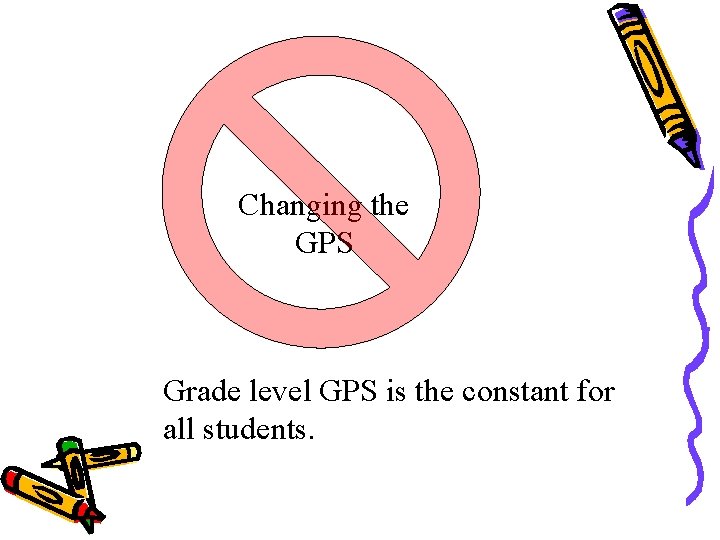
Changing the GPS Grade level GPS is the constant for all students.
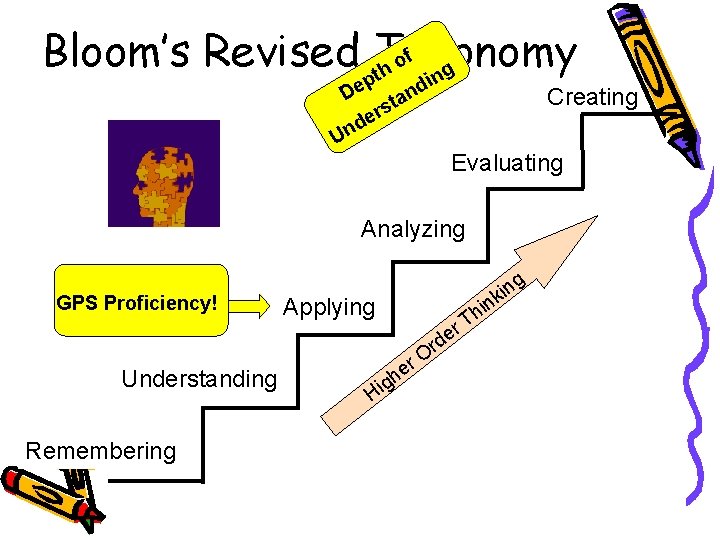
f Bloom’s Revised p. Taxonomy o th ing De tand rs e d n U Creating Evaluating Analyzing GPS Proficiency! Understanding Remembering Applying h ing k in T r de e r O r H igh
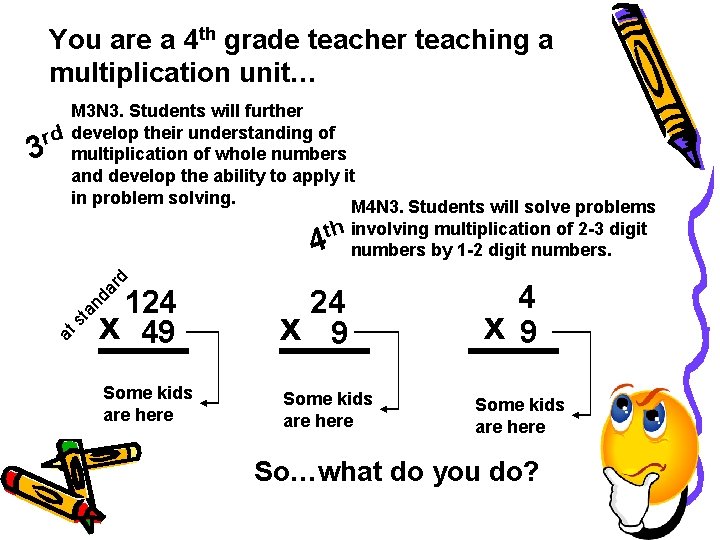
You are a 4 th grade teacher teaching a multiplication unit… M 3 N 3. Students will further rd develop their understanding of multiplication of whole numbers and develop the ability to apply it in problem solving. M 4 N 3. Students will solve problems th involving multiplication of 2 -3 digit numbers by 1 -2 digit numbers. 3 rd 4 24 x 9 Some kids are here at st an da 124 x 49 x 4 9 Some kids are here So…what do you do?
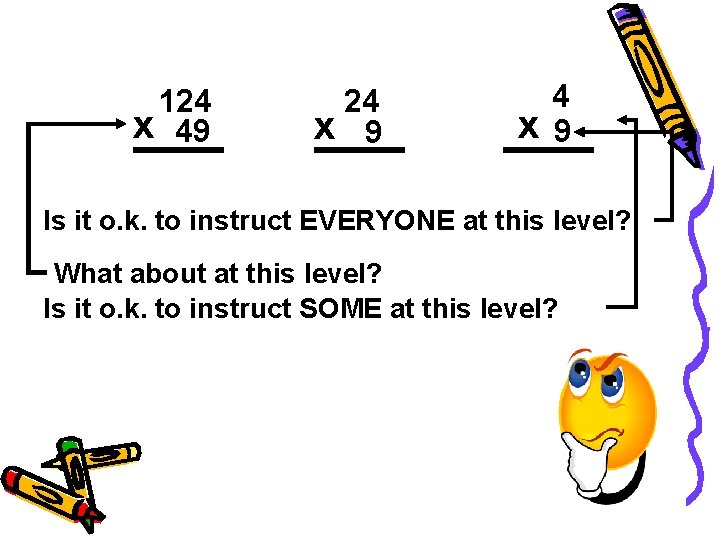
124 x 49 24 x 9 x 4 9 Is it o. k. to instruct EVERYONE at this level? What about at this level? Is it o. k. to instruct SOME at this level?
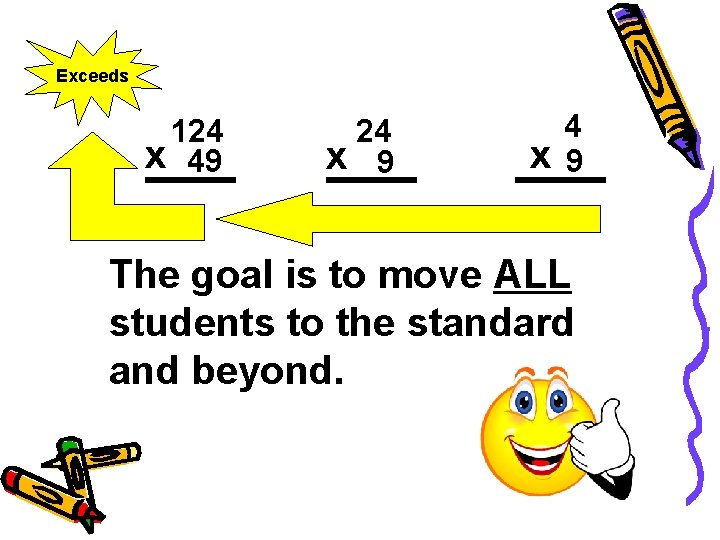
Exceeds 124 x 49 24 x 9 x 4 9 The goal is to move ALL students to the standard and beyond.
So…How do you differentiate instruction?
Three Steps to Differentiation • Use formative assessment • Analyze data and determine flexible groups • Choose a strategy
Flexible Groups • Purposeful reordering of students into a variety of different groups for a short amount of time based on assessment data • To ensure all students work on appropriate tasks and work with a number of different students on a regular basis •
Flexible Groups • Criteria for grouping—readiness, interest, learning profile • Tasks will vary from group to group
Flexible Groups • Readiness – – Homogeneous groups based upon students’ prior knowledge and depth of understanding of the standard • Interests or Student Choice – Interest Groups – Students are grouped according to predetermined hobbies, talents, preferences, etc. – Student Choice– Students are allowed to choose who to work with and/ or – what activity to complete
Flexible Groups • Learning Profile – – Homogeneous groups designated according to students’ strongest mode of learning and/ or expression, such as visual, auditory, tactile/kinesthetic – Other learning profiles include mastery, interpersonal, selfexpressive, and understanding
So…let’s look at some proven strategies for effective differentiation!
Strategy #1: Tiered Assignments
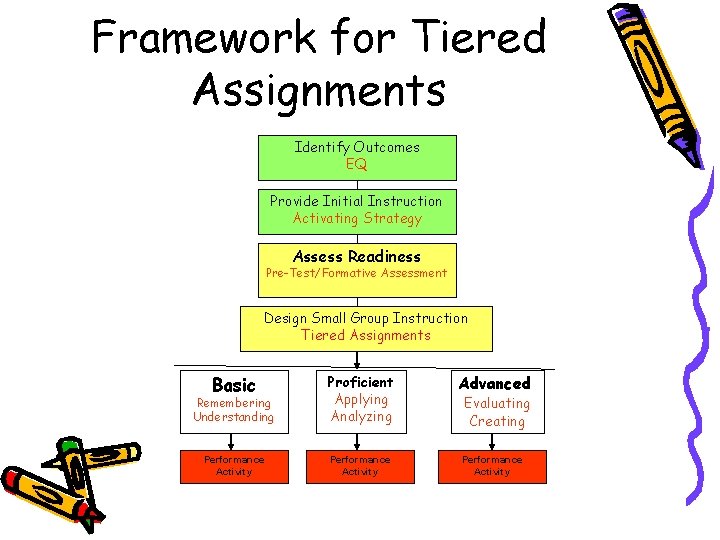
Framework for Tiered Assignments Identify Outcomes EQ Provide Initial Instruction Activating Strategy Assess Readiness Pre-Test/Formative Assessment Design Small Group Instruction Tiered Assignments Basic Remembering Understanding Proficient Applying Analyzing Advanced Performance Activity Evaluating Creating
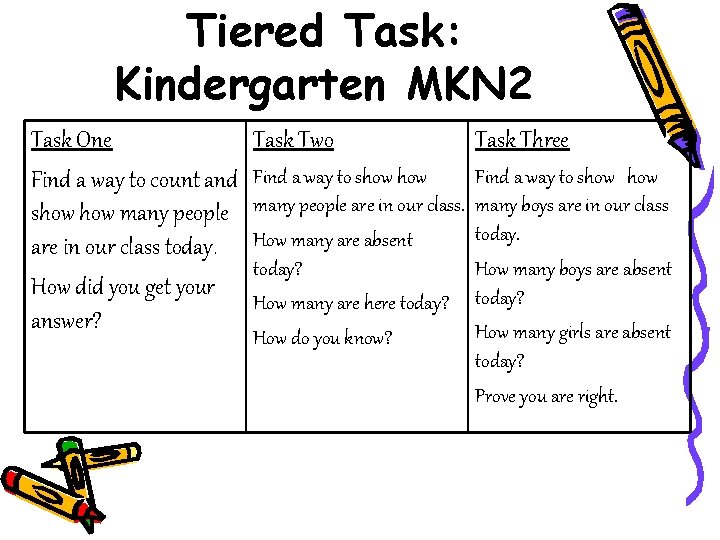
Tiered Task: Kindergarten MKN 2 Task One Find a way to count and show many people are in our class today. How did you get your answer? Task Two Task Three Find a way to show many people are in our class. How many are absent today? How many are here today? How do you know? Find a way to show many boys are in our class today. How many boys are absent today? How many girls are absent today? Prove you are right.
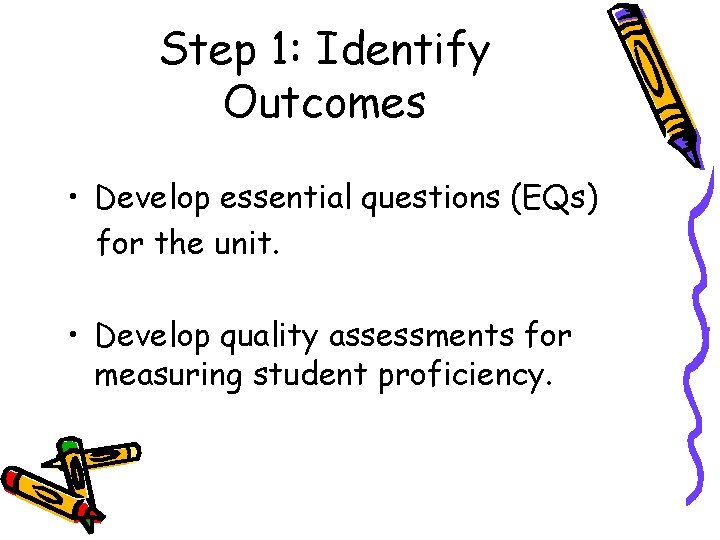
Step 1: Identify Outcomes • Develop essential questions (EQs) for the unit. • Develop quality assessments for measuring student proficiency.
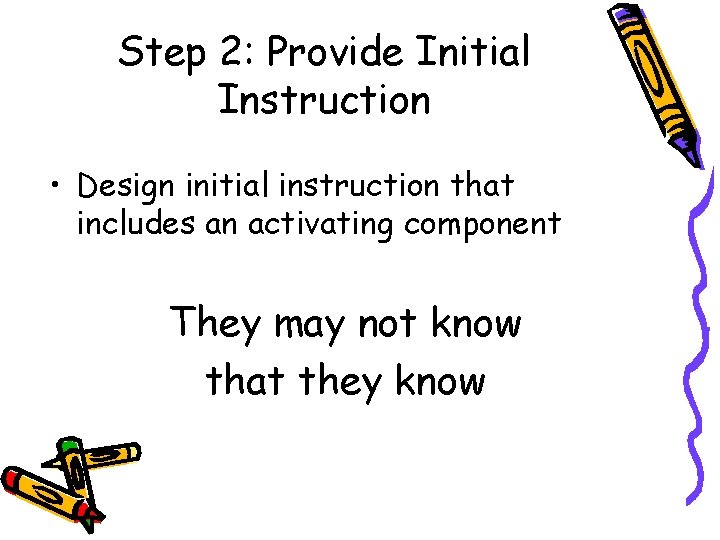
Step 2: Provide Initial Instruction • Design initial instruction that includes an activating component They may not know that they know
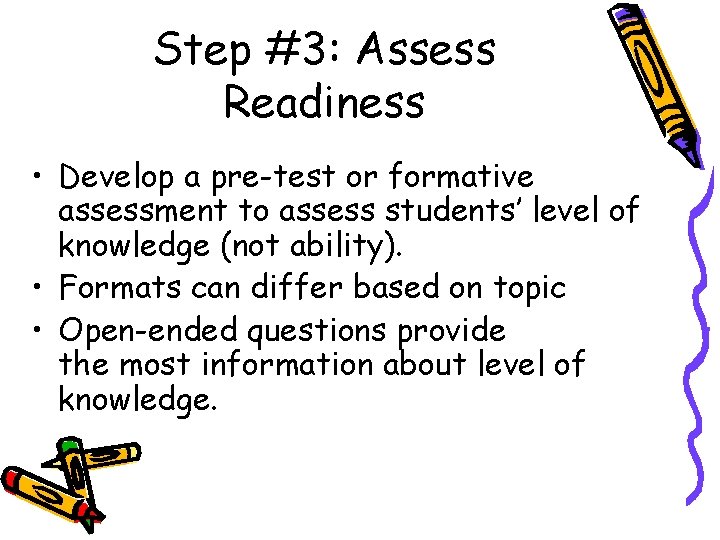
Step #3: Assess Readiness • Develop a pre-test or formative assessment to assess students’ level of knowledge (not ability). • Formats can differ based on topic • Open-ended questions provide the most information about level of knowledge.
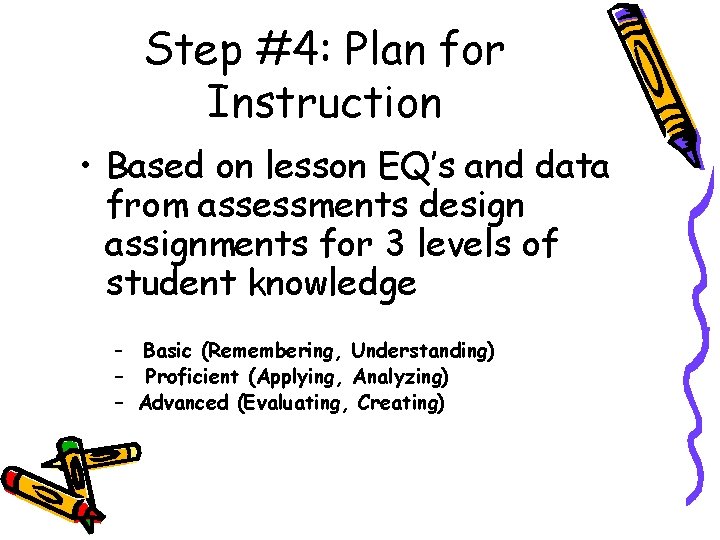
Step #4: Plan for Instruction • Based on lesson EQ’s and data from assessments design assignments for 3 levels of student knowledge Basic (Remembering, Understanding) – Proficient (Applying, Analyzing) – Advanced (Evaluating, Creating) –
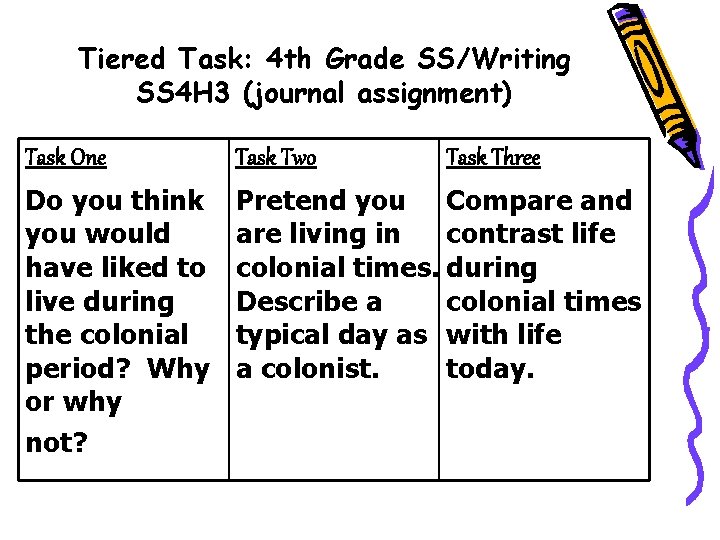
Tiered Task: 4 th Grade SS/Writing SS 4 H 3 (journal assignment) Task One Task Two Task Three Do you think you would have liked to live during the colonial period? Why or why not? Pretend you Compare and are living in contrast life colonial times. during Describe a colonial times typical day as with life a colonist. today.
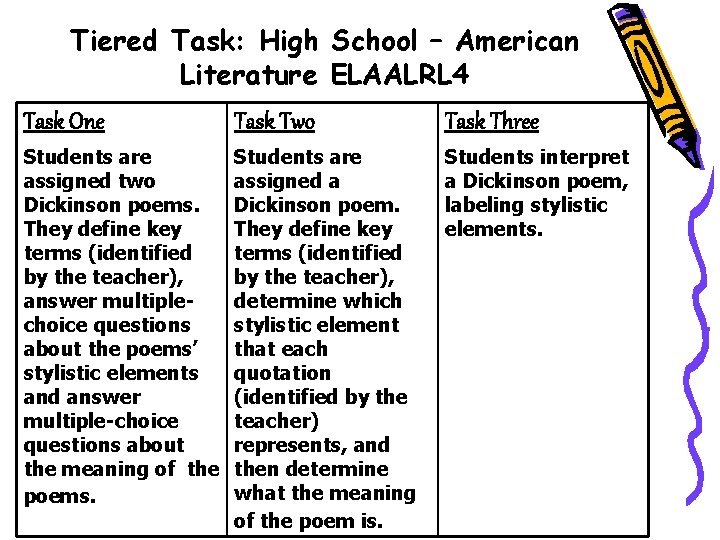
Tiered Task: High School – American Literature ELAALRL 4 Task One Task Two Task Three Students are assigned two Dickinson poems. They define key terms (identified by the teacher), answer multiplechoice questions about the poems’ stylistic elements and answer multiple-choice questions about the meaning of the poems. Students are assigned a Dickinson poem. They define key terms (identified by the teacher), determine which stylistic element that each quotation (identified by the teacher) represents, and then determine what the meaning of the poem is. Students interpret a Dickinson poem, labeling stylistic elements.
Tiered Task: Your Turn Task One Task Two Task Three
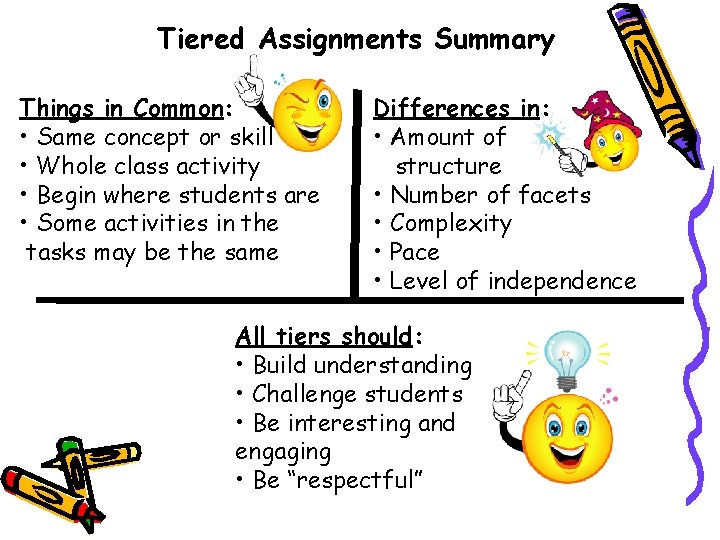
Tiered Assignments Summary Things in Common: • Same concept or skill • Whole class activity • Begin where students are • Some activities in the tasks may be the same Differences in: • Amount of structure • Number of facets • Complexity • Pace • Level of independence All tiers should: • Build understanding • Challenge students • Be interesting and engaging • Be “respectful”
Strategy #2: Scaffolding
What is Scaffolding? • Many of us probably think of a scaffold as a temporary framework that supports a building during construction. When the structure is sturdy enough to stand on its own, the scaffold is removed. In an educational sense, scaffolding, in the form of coaching or modeling, supports students as they develop new skills or learn new concepts. When the student achieves competence, the support is removed. The student continues to develop the skills or knowledge on his or her own. » Joe Banaszynski
Scaffolding • Koos Winnips, defines the process as "providing support to student learning and then retreating that support so that the student becomes selfreliant. " • "You learn to swim, " he says, "as the tube slowly deflates. ”
Scaffolding • Scaffolding does not have to be classified as differentiation. • It can be a strategy used to support all learners. • However, if some children receive the support and others do not, then it can be considered a strategy for differentiation.
Scaffolding Step by Step 1. Simplify the task to make it more manageable and achievable for a child which will reduce frustration and risk 2. Provide clear direction in order to help the child focus on achieving the goal
Step by Step 4. Clearly indicate differences between the child’s work and the standard 5. Model and clearly define the expectations of the activity to be performed 6. Systematically remove supports over time as the student becomes more self-reliant.
Examples of Scaffolding Strategies • There are endless ways to scaffold learning. We will look at three possibilities: – Task Analysis – Graphic Organizers – Story Maps
Task Analysis • Breaking a task down into its component parts • Forces the student to move systematically through the task instead of being overwhelmed
Scaffolding with Graphic Organizers 1. Teach the structure 2. Start with partially completed organizer 3. Give locations of answers • Paragraph 3 • Page 234 4. Use alternate text 5. Include a work or picture bank
Story Maps • Struggling students have difficulty organizing their thoughts during learning tasks. • This is especially true in their efforts to comprehend reading materials. • “Teachers can greatly enhance the likelihood of reading success for students with learning disabilities by simply using a story map as a scaffold for virtually every reading assignment in the differentiated classroom. ” • William Bender
Story Maps • The predictable components of a story are used to create the map. • Reading in subject content areas does not involve the same components as a story but the story map concept can be altered to assist students in reading content texts.
Strategy #3: Acceleration/Previewing
Remediation • Taking students back to concepts and skills they have not mastered and re-teaching those concepts. • Remediation usually offers a repeat of strategies at a slower pace.
Research on Remediation • The longer a student is in a traditional remedial program, the further they fall below grade level. • At-risk learners consistently experience trouble “putting it all together” because of the continuous stopping and restarting of concepts/skills. • Remediation consistently produces negative effects on self-esteem and motivation.
Achievement is: • 25% IQ • 25% Opportunities and Experience • 50% Motivation and Self-Esteem • Prior knowledge of a topic is… a better predictor of comprehension than an intelligence score or an achievement score. Max Thompson, metanalysis
Acceleration An instructional model that addresses the root cause of learning difficulty for many students - that is the lack of: – prior knowledge – experiences – vocabulary These are necessary to make connections to new knowledge and skills.
Ø Vocabulary instruction on specific words relevant to what students are learning can increase student achievement by 33 %. (Robert Marzano, et, al, 2001) Ø Development of vocabulary increases when students have visual images of word meanings and when the words are categorized in groups. Ø Students should develop mental maps of words, their meanings, and their different contexts.
Vocabulary Research Findings • The mental image becomes stored in categories, enhancing retrieval and recall of information when through specific Do notlearned give students isolatedvocabulary word lists to activities. look up definitions and write sentences. Use research-based • We read for comprehension, not just to call the words. Phonemic awareness is integral vocabulary strategies for to reading, butlearning specific new vocabulary instruction is a words! powerful tool for raising learning and achievement. • Direct instruction on words that are critical to new content produces the most powerful learning.
Acceleration • What is it? – It’s providing some prior knowledge to students BEFORE it is presented in the regular lesson. – It provides students with advance organizers, helps activate prior knowledge, and provides vocabulary that students need to understand a new concept or skill. – It acts as scaffolding for new learning.
Acceleration • What it is not… – Acceleration is not pre-teaching! – Remediation
Acceleration • It’s like/reminds me of… – Using fertilizer on plants to help them sprout or grow more quickly. – Seeing the preview to a movie or TV show
Acceleration • When is it used… – 2 -3 days (no more than a week) prior to teaching a new concept – Prior to the application of new knowledge – When they need to be pushed beyond their current performance level – In small groups or with whole class
Acceleration • Step 1 – Decide key vocabulary to be taught within the unit • Step 2 – Teach the vocabulary using a variety of strategies • Step 3 – Use advance organizers and activating strategies to link prior knowledge to concepts being taught • Step 4 – Use vocabulary in context of teaching the lesson
Strategy #4: Choice Boards
Choice Boards • Choice boards are organizers that contain a variety of activities. Students can choose one or several activities to complete as they learn a skill or develop a product. • Choice boards can be organized so that students are required to choose options that focus on several different skills.
When to Use Choice? • Students need to have demonstrated some level of knowledge of the standard prior to having choices. • Choice requires a degree of independence. • Students need to know enough to make informed decisions.
Task Rotation • The Task Rotation Strategy accommodates and challenges learners to meet standards in all four learning preferences. – – Mastery Understanding Interpersonal Self-Expressive • These learning preferences are based on the work of the Carl Gustav Jung.
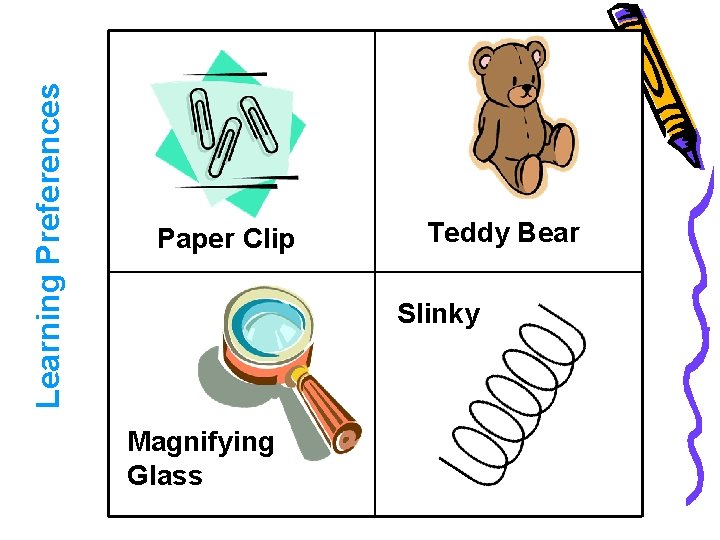
Learning Preferences Mastery exercise—practice Organizing and managing information, follow procedures, recall and restate Paper Clip Understanding explain – prove Explaining the relationship between Magnifying concepts, conducting research, Glass determine cause and effect Interpersonal experience— personalize Identifying and make use of feelings; empathizing, examining beliefs and Teddy Bear values Self-Expressive Slinky explore—produce Creating unique products, solving non-routine problems, using art or poetry to express ideas, hypothesizing
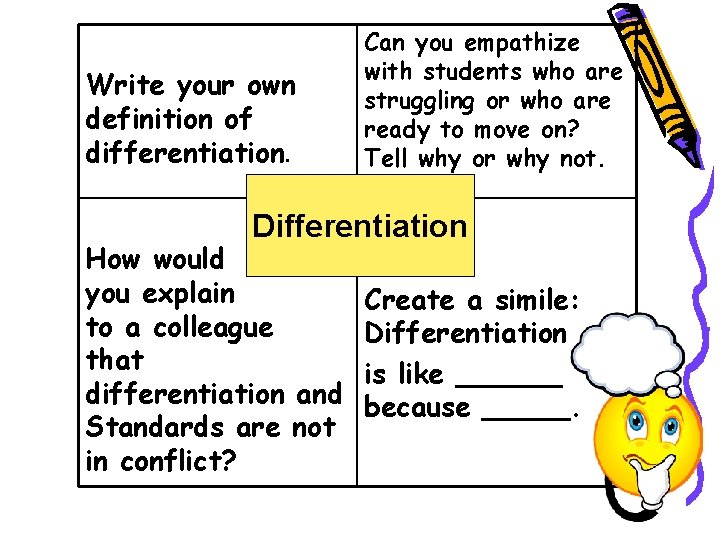
Write your own definition of differentiation. Can you empathize with students who are struggling or who are ready to move on? Tell why or why not. Differentiation How would you explain to a colleague that differentiation and Standards are not in conflict? Create a simile: Differentiation is like ______ because _____.
Think-tac-toe • A collection of activities from which students can choose to do to demonstrate their understanding. • Presented in the form of a nine square grid similar to a tic-tac-toe board and students may be expected to complete from one to “three in a row”. • The activities vary in content, process, and product and can be tailored to address different levels of student readiness, interests, and learning styles. • In place of lengthy activities, the tic-tactoe board may also be used with shorter, open-ended questions posed at varying levels of Blooms Taxonomy.
Strategy #5: Stations
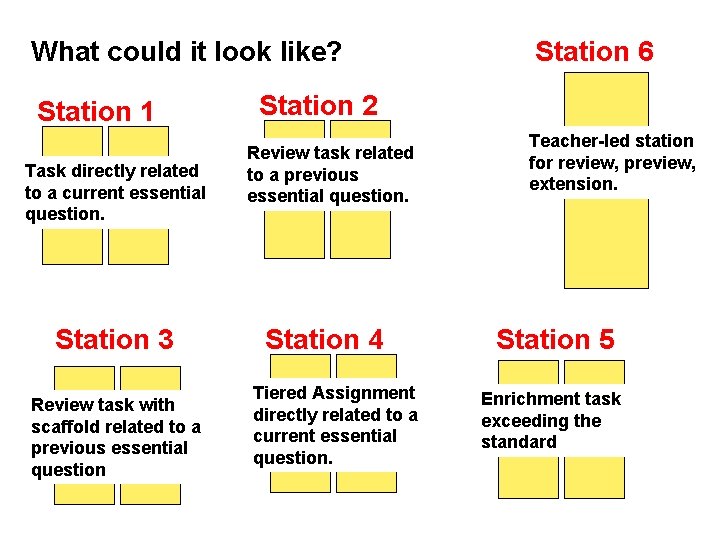
Stations • Involves setting up different spots in the classroom where students work on various tasks simultaneously • These stations invite flexible grouping because not all students need to go to all stations all the time
What could it look like? Station 1 Task directly related to a current essential question. Station 3 Review task with scaffold related to a previous essential question Station 6 Station 2 Review task related to a previous essential question. Station 4 Tiered Assignment directly related to a current essential question. Teacher-led station for review, preview, extension. Station 5 Enrichment task exceeding the standard
Managing a Differentiated Classroom “Hot Spots” ? ? ? • Grading • Procedures • Co-teaching • Planning/Time • Others
Summarizer • Reflection Statements • #1. What is the relationship of assessment to differentiation? • #2. How do assessment and differentiation together work to improve student learning and achievement?
Evaluation Forms • Please give us honest feedback about the value of this training for you in your current teaching position. • We DO look at responses!