
Assessment coordinators EYFS update Baseline Ofsted Data EYFSP

Assessment coordinators EYFS update • • • Baseline Ofsted Data EYFSP Early Years Pupil Premium
Reception Baseline To enable progress to be measured from when a cohort of children start school, we are introducing a new Reception Baseline – This will be a short, teacher-administered, age appropriate assessment conducted in the first few weeks of a child starting school. – Schools will be able to choose from a range of baselines in September 2015 – a list of suppliers will be available in January 2015. – The reception baseline will be the only measure used to assess progress for children who start reception in September 2016 and beyond. – From September 2016, teachers will be no longer required to carry out and submit data on the Early Years Foundation Stage Profile.
Taken from: Stephen Anwyll, Ofqual AAIA Annual Conference Bournemouth 2. 10. 14 Re EYFS Questions How can ‘perverse incentives’ be avoided with the Reception Baseline in a context of high stakes school accountability? Main challenges to the system Ofsted: competing demands on assessment data (e. g. Rec. Baseline at pupil level) and inconsistency of approach during period of change
Ofsted School Inspection Handbook July 2014, for use from September 198. In relation to particular ages or groups of pupils, inspectors must consider the following: • Evaluation of achievement in the Early Years Foundation Stage should take account of the proportions of children who have made typical progress or more from their starting points. An example of typical progress for a child would be to start Nursery or Reception displaying the knowledge, skills and understanding that are typical for her/his age and then to meet the early learning goals by the end of Reception. Children who meet all the early learning goals but who started at a lower level of development than is typical for their age might be said to be making rapid progress. However, a child starting school at a higher level of development who meets all the early learning goals but exceeds none of them is unlikely to have made enough progress. Evaluation of achievement should also consider attainment at the end of Reception in comparison with Early Years Foundation Stage Profile national figures and in terms of how well it prepares children for Key Stage 1.
• For those schools where children are aged three and four years and move to primary school before any nationally comparable assessments are made, the judgement should be based on an evaluation of children’s learning and progress relative to their age and evidence of their starting points. • Evaluation of achievement in Key Stage 1 should take account of the proportions of pupils who have made typical progress or more from their starting points. For 2014/15, as a broad rule of thumb, Year 2 children who reached a good level of development at the end of Reception ought to be reaching at least the expected standard by the end of Key Stage 1 (so attaining at least Level 2 b in the 2015 assessments). Children exceeding the early learning goals at the end of Reception ought to be exceeding the expected standard at the end of Key Stage 1 and be reaching high standards. Inspectors should take into account of how well pupils with a lower starting point have made up ground, and the breadth and depth of progress made by the most able.
Now in ‘good’ criteria… • Children who join the school at a level below what is typical for their age, but not significantly so, catch up quickly. Any gaps between the attainment of groups, including those for whom the school receives additional funding, and all children nationally are closing. • Parents and carers contribute to initial assessments of children’s starting points when they join the school and they are kept well informed about their children’s progress. Parents are encouraged to support and share information about their children’s learning and development at home. See: The effectiveness of the early years provision: the quality and standards Ofsted handbook p. 75
Good practice DVDs http: //www. ofsted. gov. uk/resources/goodpractice? keywords=eyfs&remit =all&type=all They cover outstanding EYFS practice in a variety of settings e. g. • Reception -Mead Hill. • Nursery Peasdown St John and Chelsea Open air Nursery. • Assessment All very informative around the practical use of observations to inform planning and adult interaction.
EYFS Data - summer 2014 Route to EYPT Nursery reports Rochdale Schools Intranet >Schools Data > School Specific > Your School > Summer 14 EYPT. Route to EYFSP data Rochdale Schools Intranet > Schools Data > School Specific > Your School > EYFSP 2014 > Final Reports • • • Setting summary scores LA summary scores Setting summary by term of birth FSM Summary Non FSM Summary Boys Girls National/LA/setting summary ATPS National/LA/setting summary %GLD- now added EYFSP 2013 – extra data now in your school’s folder Additional reports- in % now in 2013 EYFSP final reports folders: • Boys/Girls/FSM/Non FSM This will make it easier for you to begin to look at trends over time.
EYPT reports • Your 2014 EYPT report for Nursery is available in your school specific data folder on the rs intranet. This will include ‘on entry’/ ‘on exit’ comparisons for your setting and ‘on exit’ in relation to the LA picture. • In 2013 we generated EYPT Reception reports but now find that KEYPAS EYFS Profile reports contain a wide range of useful reports including a Local and National comparison. In addition, schools are able to interrogate their own EYPT data in great detail on SIMS. • For this reason, and at a time of limited capacity, we did not produce EYPT reception school reports for 2014.
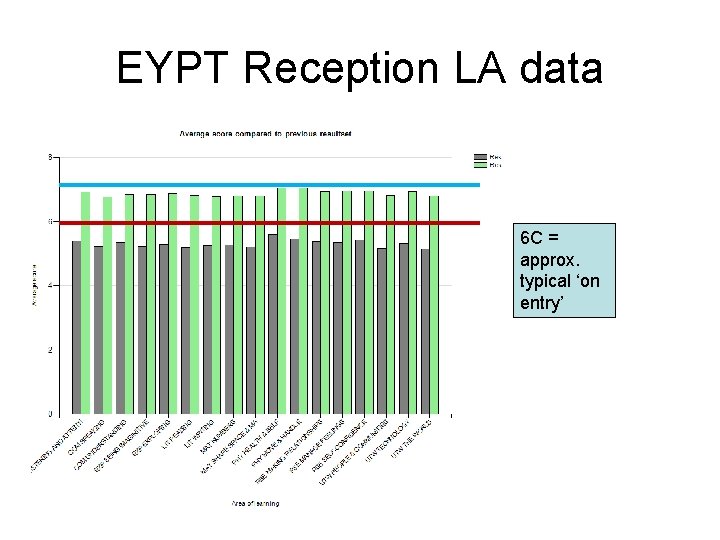
EYPT Reception LA data 6 C = approx. typical ‘on entry’
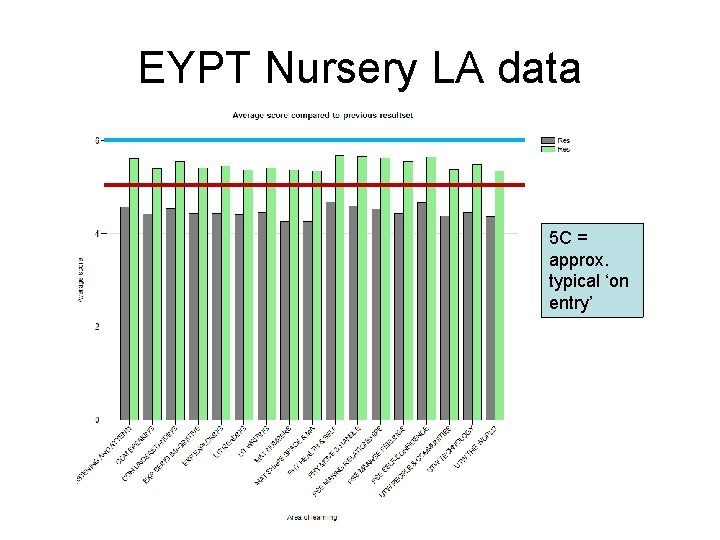
EYPT Nursery LA data 5 C = approx. typical ‘on entry’
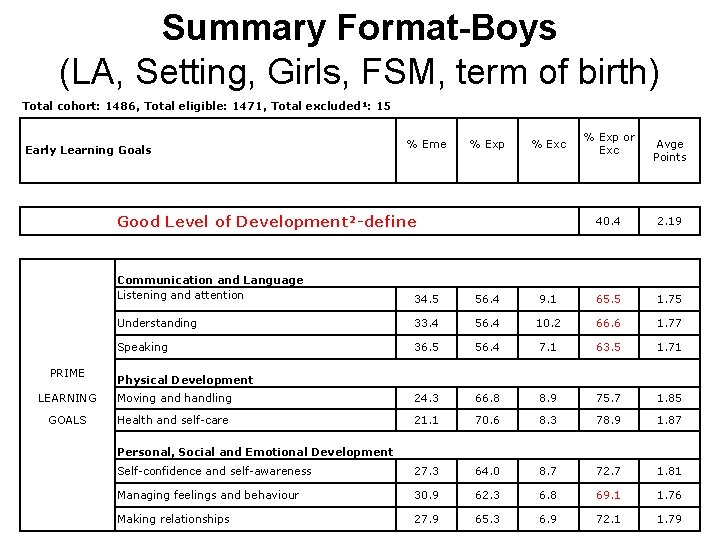
Summary Format-Boys (LA, Setting, Girls, FSM, term of birth) Total cohort: 1486, Total eligible: 1471, Total excluded¹: 15 Early Learning Goals % Eme % Exp Good Level of Development²-define % Exc % Exp or Exc Avge Points 40. 4 2. 19 Communication and Language Listening and attention 34. 5 56. 4 9. 1 65. 5 1. 75 Understanding 33. 4 56. 4 10. 2 66. 6 1. 77 Speaking 36. 5 56. 4 7. 1 63. 5 1. 71 PRIME Physical Development LEARNING Moving and handling 24. 3 66. 8 8. 9 75. 7 1. 85 GOALS Health and self-care 21. 1 70. 6 8. 3 78. 9 1. 87 Personal, Social and Emotional Development Self-confidence and self-awareness 27. 3 64. 0 8. 7 72. 7 1. 81 Managing feelings and behaviour 30. 9 62. 3 6. 8 69. 1 1. 76 Making relationships 27. 9 65. 3 6. 9 72. 1 1. 79
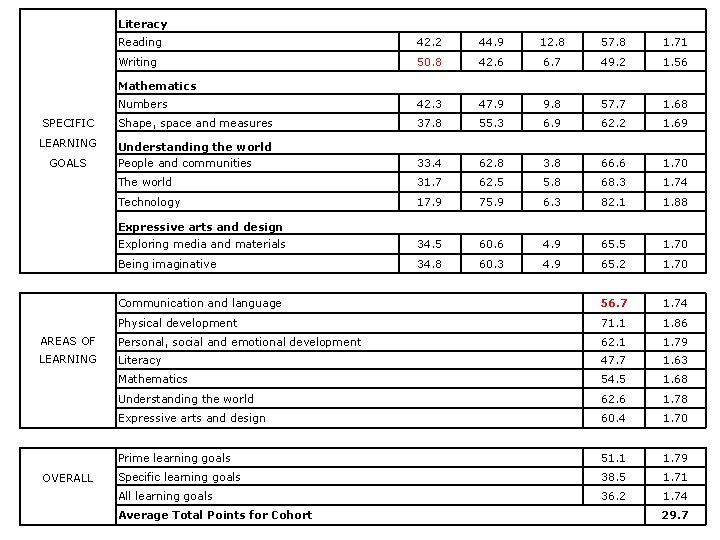
Literacy Reading 42. 2 44. 9 12. 8 57. 8 1. 71 Writing 50. 8 42. 6 6. 7 49. 2 1. 56 Mathematics Numbers 42. 3 47. 9 9. 8 57. 7 1. 68 SPECIFIC Shape, space and measures 37. 8 55. 3 6. 9 62. 2 1. 69 LEARNING Understanding the world People and communities 33. 4 62. 8 3. 8 66. 6 1. 70 The world 31. 7 62. 5 5. 8 68. 3 1. 74 Technology 17. 9 75. 9 6. 3 82. 1 1. 88 Expressive arts and design Exploring media and materials 34. 5 60. 6 4. 9 65. 5 1. 70 Being imaginative 34. 8 60. 3 4. 9 65. 2 1. 70 GOALS Communication and language 56. 7 1. 74 Physical development 71. 1 1. 86 AREAS OF Personal, social and emotional development 62. 1 1. 79 LEARNING Literacy 47. 7 1. 63 Mathematics 54. 5 1. 68 Understanding the world 62. 6 1. 78 Expressive arts and design 60. 4 1. 70 Prime learning goals 51. 1 1. 79 Specific learning goals 38. 5 1. 71 All learning goals 36. 2 1. 74 Average Total Points for Cohort OVERALL 29. 7
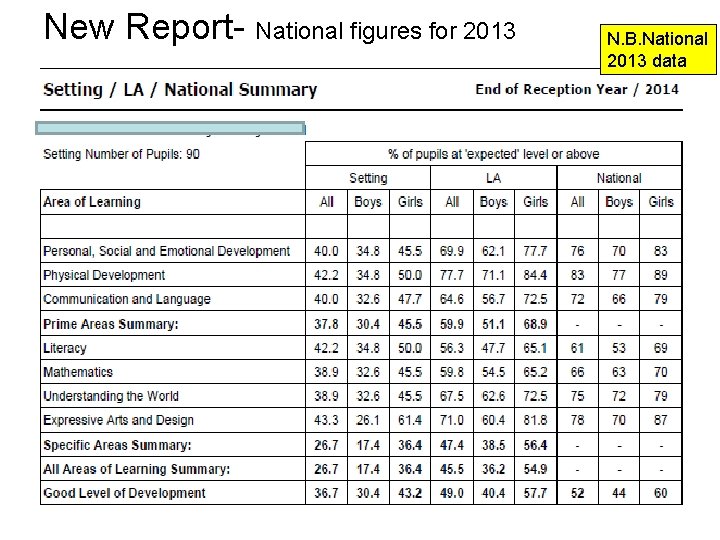
New Report- National figures for 2013 N. B. National 2013 data
First Statistical Release now available. Statistics - national statistics Early years foundation stage profile results: 2013 to 2014 From: Department for Education First published: 16 October 2014 https: //www. gov. uk/government/statistics/early-years-foundation-stageprofile-results-2013 -to-2014
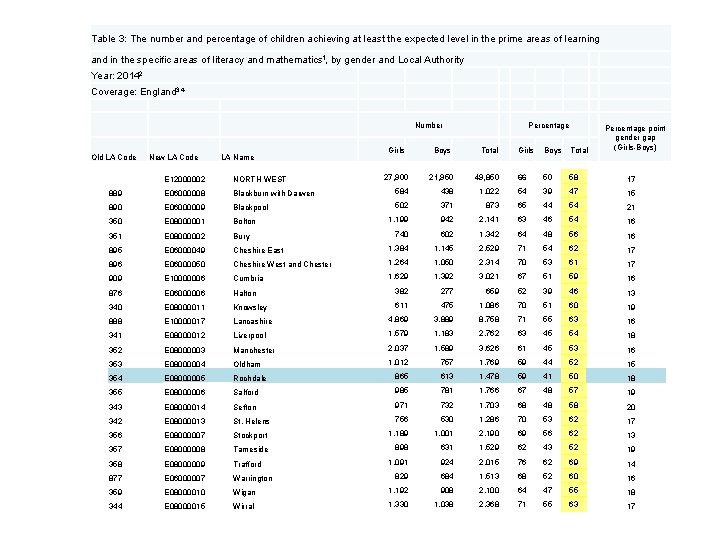
Table 3: The number and percentage of children achieving at least the expected level in the prime areas of learning and in the specific areas of literacy and mathematics 1, by gender and Local Authority Year: 20142 Coverage: England 3, 4 Number Old LA Code New LA Code LA Name E 12000002 NORTH WEST 889 E 06000008 Blackburn with Darwen 890 E 06000009 Blackpool 350 E 08000001 Bolton 351 E 08000002 Bury Girls Boys 27, 900 21, 950 584 438 Total Percentage point gender gap (Girls-Boys) Girls Boys Total 49, 850 66 50 58 17 1, 022 54 39 47 15 502 371 873 65 44 54 21 1, 199 942 2, 141 63 46 54 16 740 602 1, 342 64 48 56 16 1, 145 2, 529 71 54 62 17 895 E 06000049 Cheshire East 1, 384 896 E 06000050 Cheshire West and Chester 1, 264 1, 050 2, 314 70 53 61 17 1, 629 1, 392 3, 021 67 51 59 16 909 E 10000006 Cumbria 876 E 06000006 Halton 382 277 659 52 39 46 13 Knowsley 611 475 1, 086 70 51 60 19 3, 889 8, 758 71 55 63 16 340 E 08000011 888 E 10000017 Lancashire 4, 869 341 E 08000012 Liverpool 1, 579 1, 183 2, 762 63 45 54 18 1, 589 3, 626 61 45 53 16 15 352 E 08000003 Manchester 2, 037 353 E 08000004 Oldham 1, 012 757 1, 769 59 44 52 613 1, 478 59 41 50 354 E 08000005 Rochdale 865 355 E 08000006 Salford 985 781 1, 766 67 48 57 19 732 1, 703 68 48 58 20 18 343 E 08000014 Sefton 971 342 E 08000013 St. Helens 756 530 1, 286 70 53 62 17 356 E 08000007 Stockport 1, 189 1, 001 2, 190 69 56 62 13 898 631 1, 529 62 43 52 19 1, 091 924 2, 015 76 62 69 14 829 684 1, 513 68 52 60 16 357 E 08000008 Tameside 358 E 08000009 Trafford 877 E 06000007 Warrington 359 E 08000010 Wigan 1, 192 908 2, 100 64 47 55 18 Wirral 1, 330 1, 038 2, 368 71 55 63 17 344 E 08000015
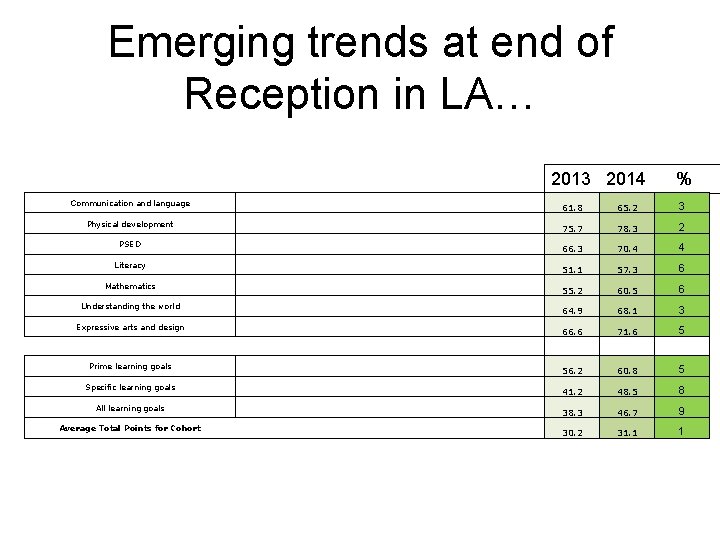
Emerging trends at end of Reception in LA… 2013 2014 % Communication and language Physical development PSED Literacy Mathematics Understanding the world Expressive arts and design Prime learning goals Specific learning goals All learning goals Average Total Points for Cohort 61. 8 65. 2 3 75. 7 78. 3 2 66. 3 70. 4 4 51. 1 57. 3 6 55. 2 60. 5 6 64. 9 68. 1 3 66. 6 71. 6 5 56. 2 60. 8 5 41. 2 48. 5 8 38. 3 46. 7 9 30. 2 31. 1 1
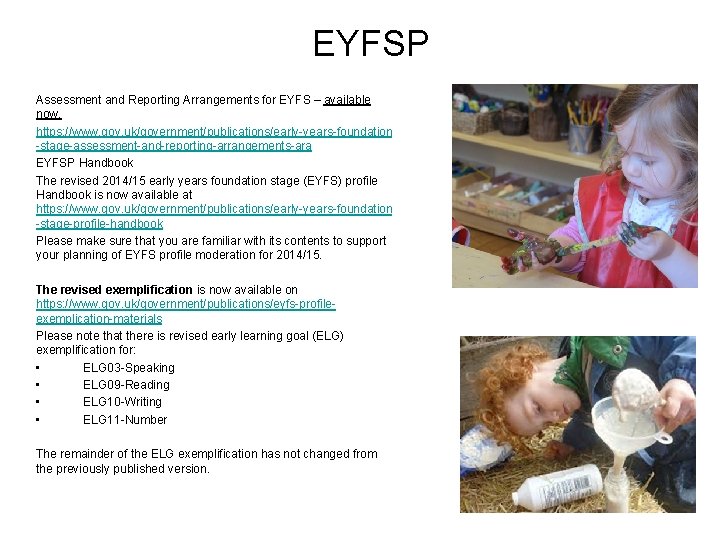
EYFSP Assessment and Reporting Arrangements for EYFS – available now. https: //www. gov. uk/government/publications/early-years-foundation -stage-assessment-and-reporting-arrangements-ara EYFSP Handbook The revised 2014/15 early years foundation stage (EYFS) profile Handbook is now available at https: //www. gov. uk/government/publications/early-years-foundation -stage-profile-handbook Please make sure that you are familiar with its contents to support your planning of EYFS profile moderation for 2014/15. The revised exemplification is now available on https: //www. gov. uk/government/publications/eyfs-profileexemplication-materials Please note that there is revised early learning goal (ELG) exemplification for: • ELG 03 -Speaking • ELG 09 -Reading • ELG 10 -Writing • ELG 11 -Number The remainder of the ELG exemplification has not changed from the previously published version.
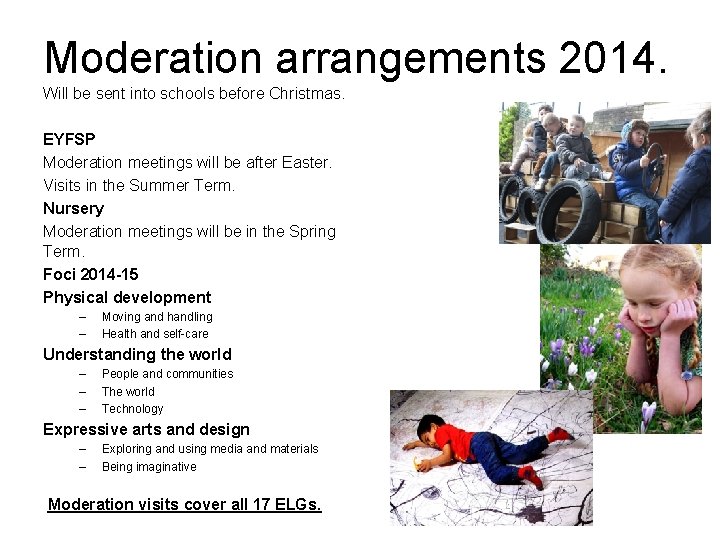
Moderation arrangements 2014. Will be sent into schools before Christmas. EYFSP Moderation meetings will be after Easter. Visits in the Summer Term. Nursery Moderation meetings will be in the Spring Term. Foci 2014 -15 Physical development – – Moving and handling Health and self-care Understanding the world – – – People and communities The world Technology Expressive arts and design – – Exploring and using media and materials Being imaginative Moderation visits cover all 17 ELGs.

Early Years Pupil Premium designed to help the most disadvantaged three and four year olds. Schools, nurseries and child-minders will be given up to £ 300 for every three and four year old from a low income family that attend their setting. The Early Years Pupil Premium, totalling £ 50 million, is designed to narrow the attainment gap between young children from low income families and their peers, setting them on a path to a more successful future. The funding will be introduced in April 2015. Early yeas settings will have the freedom to decide how to use the Early Years Pupil Premium to help three and four year olds learn and develop, for example hiring more qualified staff or specialists in activities like speech and language to give an extra focus on basic skills. Alongside this announcement, the Department for Education has asked the charity 4 Children to launch a call for evidence on the Early Years Pupil Premium in November 2014 - asking providers to identify and share good practice around meeting the needs of disadvantaged children. You can send in your submissions to Eypp@foundationyears. org. uk For further information about the practical implications of the premium contact: Bob Adams, Play & Childcare Development Manager: Bob. adams@rochdale. gov. uk 01706 927849
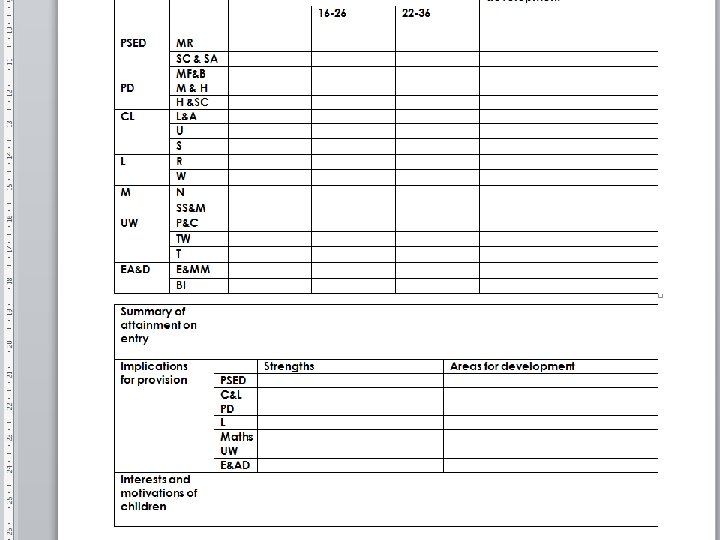
EYFS Data File We suggest colleagues might collate EYFS data in a file incorporating: • A brief analysis of summer data (EYPT) for school and in comparison to the LA. EYPT data can be used to compare the 2014 on exit data with 2013 on entry data to reflect on progress- ‘typical’, ’rapid’ and the impact of actions taken to support individuals and groups- case studies (as appropriate). • A simple overview of on entry judgements- identifying strengths and areas to be developed, significant groups etc. as per circulated format- this can be repeated e. g. on exit. • An action plan in response to data i. e. on entry data and the previous cohort’s EYPT data - to be reviewed as subsequent assessments are made. This could link to (or be part of) the School Development Plan. • Selected graphs from EYPT to illustrate significant areas e. g. am and pm cohorts, gender, individual children’s progress- to be added to throughout the year- as little as are required to illustrate a point. The EYPT is designed to be explored electronically. • As we build up EYFS data we can look at patterns/trends over time.
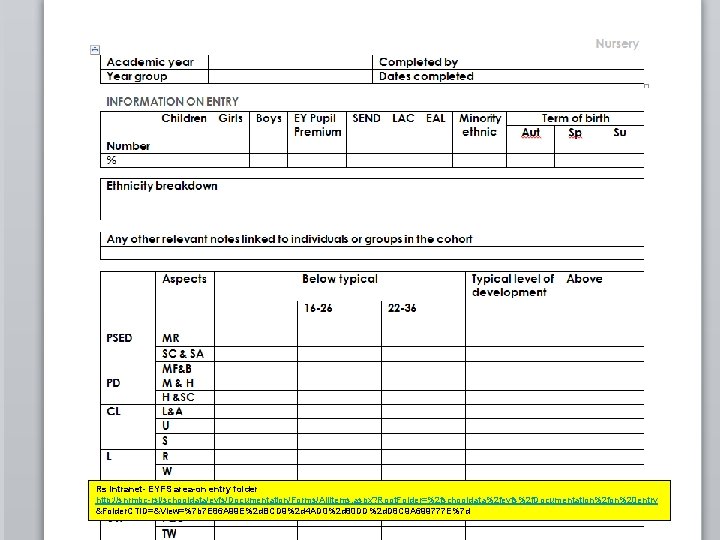
Rs intranet- EYFS area-on entry folder http: //snrmbc-rsi/schooldata/eyfs/Documentation/Forms/All. Items. aspx? Root. Folder=%2 fschooldata%2 feyfs%2 f. Documentation%2 fon%20 entry &Folder. CTID=&View=%7 b 7 E 86 A 99 E%2 d. BCD 9%2 d 4 AD 0%2 d 80 DD%2 d. D 8 C 9 A 699777 E%7 d
- Slides: 23