
Assessment and Tracking in Physics Motion Graphs Learning


- Slides: 6
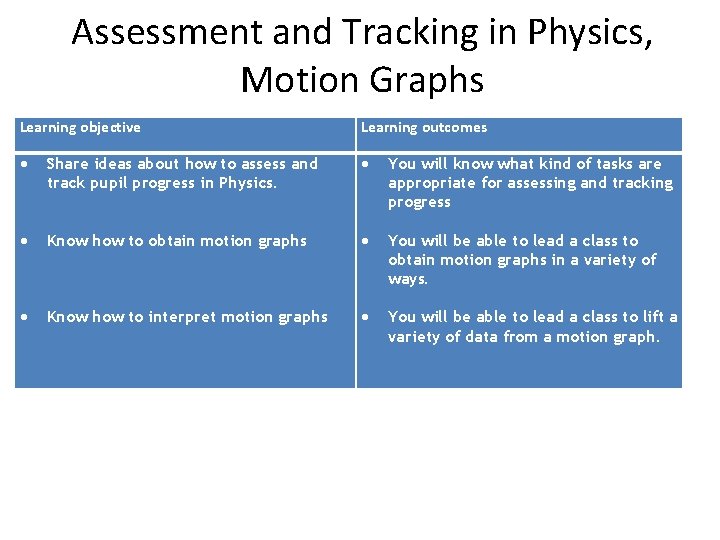
Assessment and Tracking in Physics, Motion Graphs Learning objective Learning outcomes Share ideas about how to assess and track pupil progress in Physics. You will know what kind of tasks are appropriate for assessing and tracking progress Know how to obtain motion graphs You will be able to lead a class to obtain motion graphs in a variety of ways. Know how to interpret motion graphs You will be able to lead a class to lift a variety of data from a motion graph.
Assessment and monitoring We assess and track pupil progress primarily in two ways: • Common homeworks - where the whole year group complete the same piece of work regardless of teacher • Common tests – often done at the end of each topic but sometimes less frequently (e. g. we have one DC and mains electricity test in year 11 even though they are two topics, same for nuclear physics)
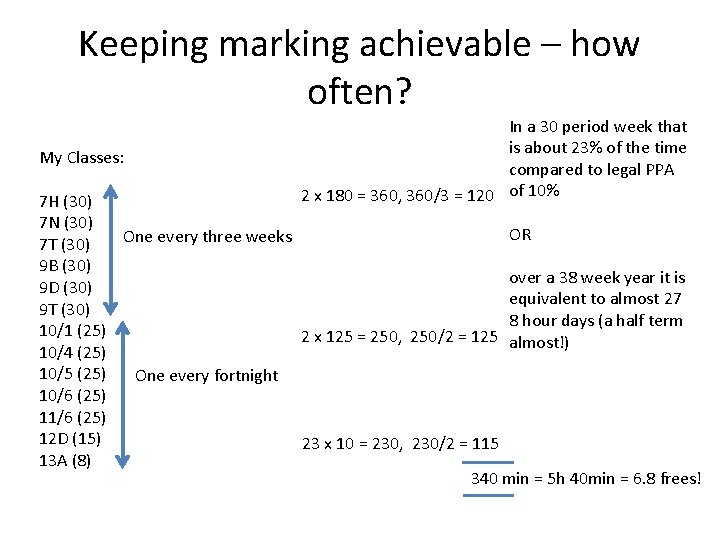
Keeping marking achievable – how often? My Classes: In a 30 period week that is about 23% of the time compared to legal PPA 2 x 180 = 360, 360/3 = 120 of 10% 7 H (30) 7 N (30) OR One every three weeks 7 T (30) 9 B (30) over a 38 week year it is 9 D (30) equivalent to almost 27 9 T (30) 8 hour days (a half term 10/1 (25) 2 x 125 = 250, 250/2 = 125 almost!) 10/4 (25) 10/5 (25) One every fortnight 10/6 (25) 11/6 (25) 12 D (15) 23 x 10 = 230, 230/2 = 115 13 A (8) 340 min = 5 h 40 min = 6. 8 frees!
Current Policy One piece of marked work every three weeks per class, more often if appropriate (and for exam classes it sometimes is). This means that in a 6/7 week half term I expect to see two pieces of work assessed and marked in the department spreadsheet. The rest is down to the discretion of the teacher and can be marked in class with verbal feedback given We use green pens to indicate verbal feedback and we generate reporting grades from the spread sheets adjusting them for individual students when we feel there is a case for doing so.
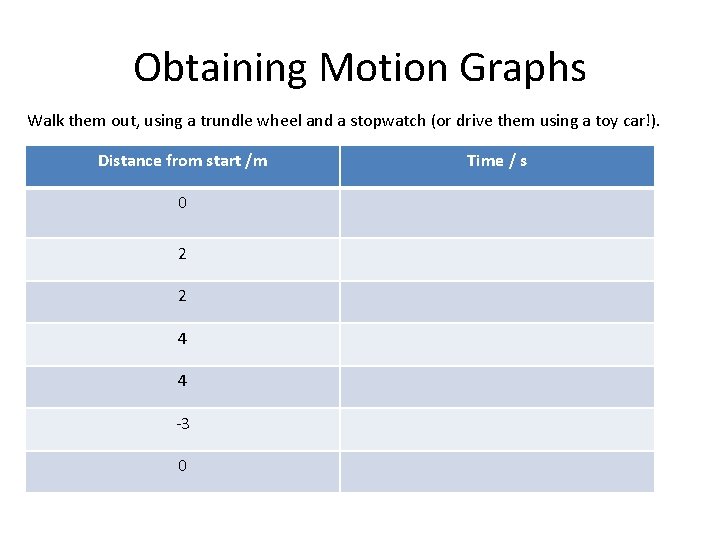
Obtaining Motion Graphs Walk them out, using a trundle wheel and a stopwatch (or drive them using a toy car!). Distance from start /m 0 2 2 4 4 -3 0 Time / s
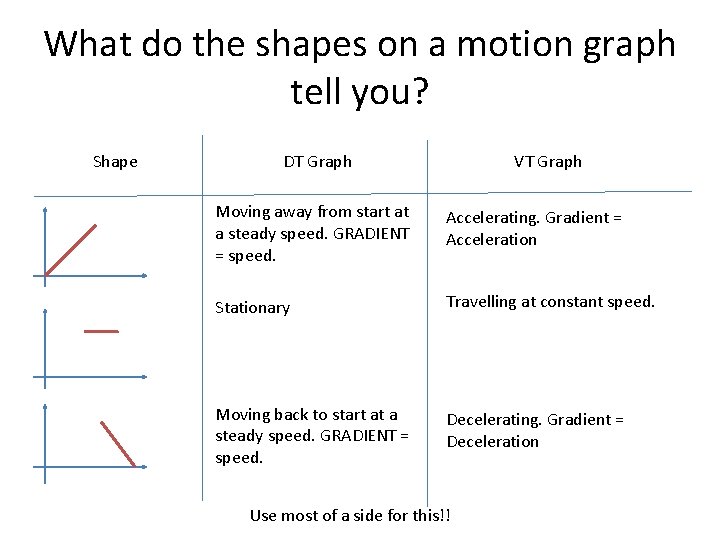
What do the shapes on a motion graph tell you? Shape DT Graph VT Graph Moving away from start at a steady speed. GRADIENT = speed. Accelerating. Gradient = Acceleration Stationary Travelling at constant speed. Moving back to start at a steady speed. GRADIENT = speed. Decelerating. Gradient = Deceleration Use most of a side for this!!