
Assessment and Moderation for learners with Complex Additional




- Slides: 16
Assessment and Moderation for learners with Complex Additional Support Needs For Scotland’s learners with Scotland’s educators
What is moderation? ‘Moderation is the way in which practitioners arrive at a shared understanding of standards and expectations. ’ • Moderation is integral to the planning of learning, teaching and assessment. • Moderation takes an ongoing, collegiate approach to learning, teaching and assessment. • Practitioners moderate assessment judgements by taking account of a sample of evidence from different sources to discuss standards and the progress of learners. • The process of moderation is not an activity that happens only at the end of a block or year • Moderation is used for all learning regardless of level – Foundation milestones to Level 4 For Scotland’s learners with Scotland’s educators
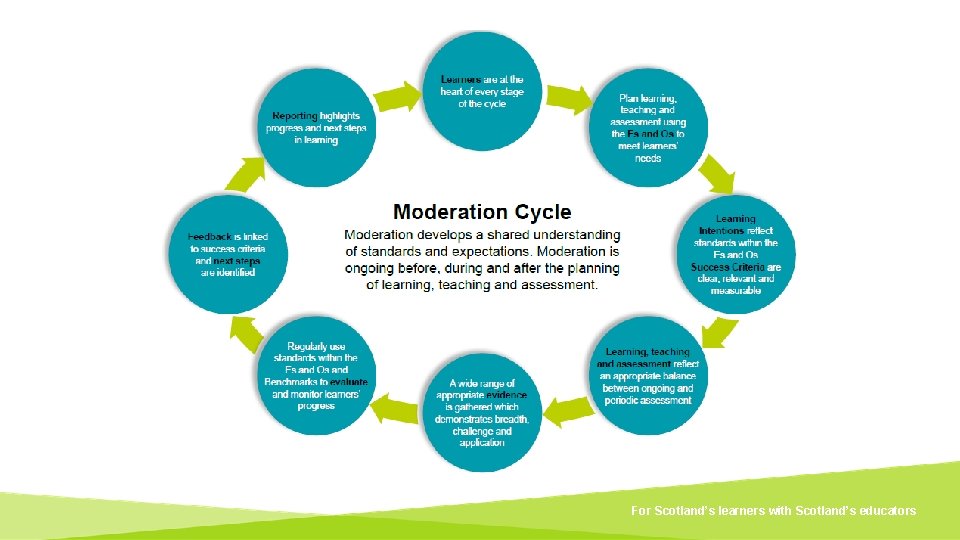
For Scotland’s learners with Scotland’s educators
Moderation…the process Moderation starts at the planning stage and involves discussions about: • • • Experiences and outcomes Learning intentions Success criteria Assessment (breadth, challenge and application) Evidence Evaluation Feedback Next steps Reporting For Scotland’s learners with Scotland’s educators
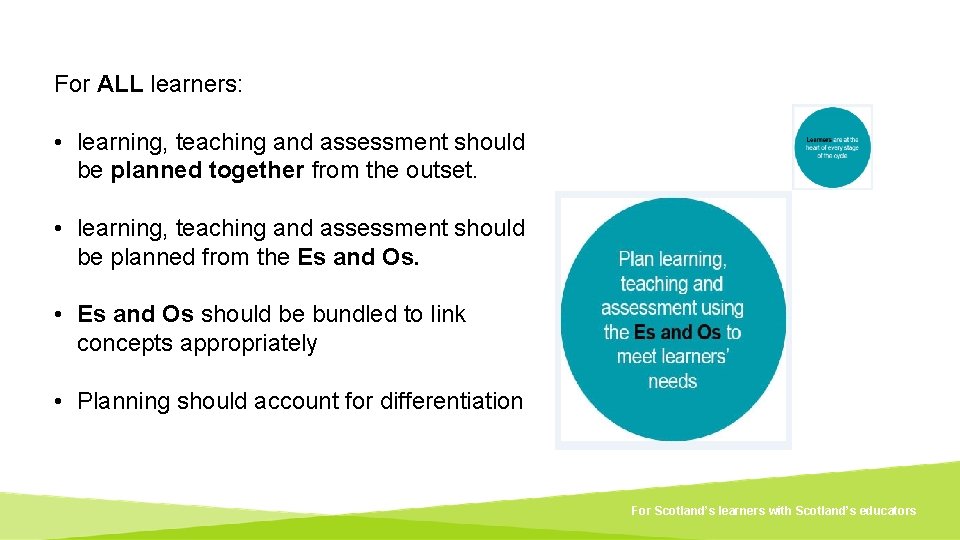
For ALL learners: • learning, teaching and assessment should be planned together from the outset. • learning, teaching and assessment should be planned from the Es and Os. • Es and Os should be bundled to link concepts appropriately • Planning should account for differentiation For Scotland’s learners with Scotland’s educators
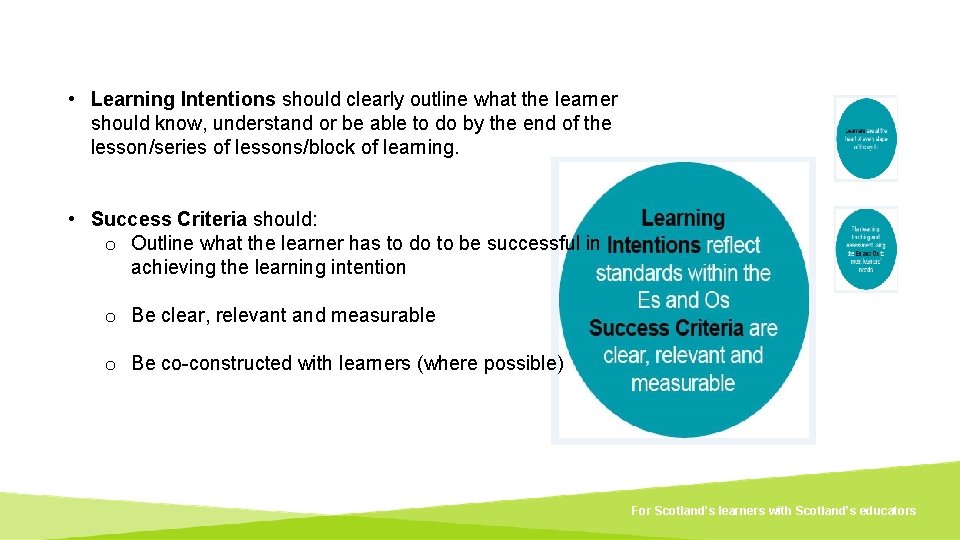
• Learning Intentions should clearly outline what the learner should know, understand or be able to do by the end of the lesson/series of lessons/block of learning. • Success Criteria should: o Outline what the learner has to do to be successful in achieving the learning intention o Be clear, relevant and measurable o Be co-constructed with learners (where possible) For Scotland’s learners with Scotland’s educators
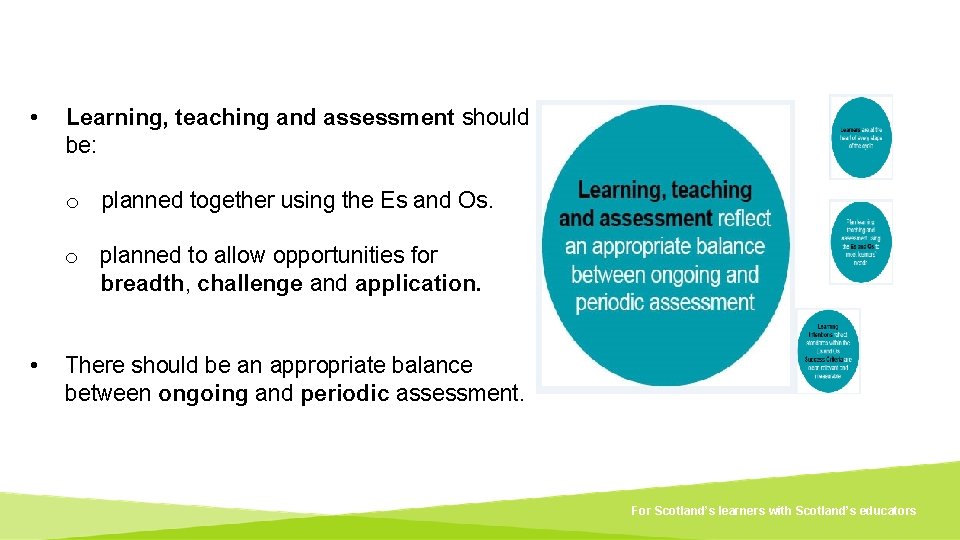
• Learning, teaching and assessment should be: o planned together using the Es and Os. o planned to allow opportunities for breadth, challenge and application. • There should be an appropriate balance between ongoing and periodic assessment. For Scotland’s learners with Scotland’s educators
• A range of evidence should be considered when making judgements around progress towards or achievement of a level. • The range of evidence will exist in different places (e. g. day-to-day observation within and outwith class, videos/photos, learner conversations, periodic assessments). • Evidence should demonstrate breadth, challenge and application. For Scotland’s learners with Scotland’s educators
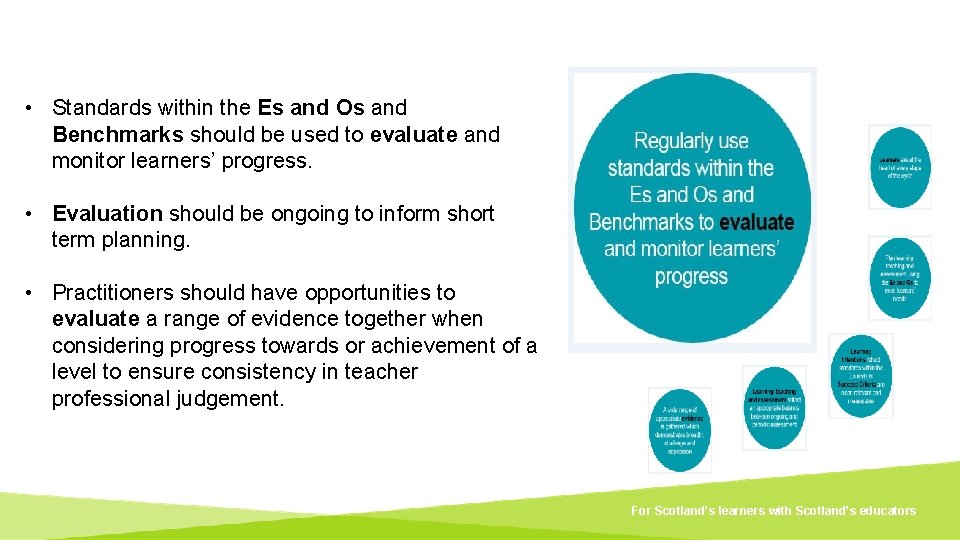
• Standards within the Es and Os and Benchmarks should be used to evaluate and monitor learners’ progress. • Evaluation should be ongoing to inform short term planning. • Practitioners should have opportunities to evaluate a range of evidence together when considering progress towards or achievement of a level to ensure consistency in teacher professional judgement. For Scotland’s learners with Scotland’s educators
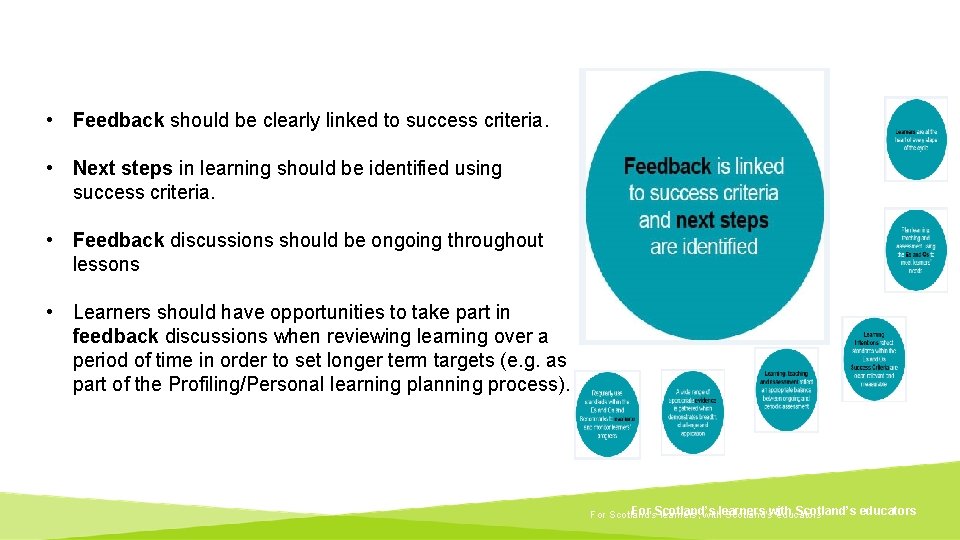
• Feedback should be clearly linked to success criteria. • Next steps in learning should be identified using success criteria. • Feedback discussions should be ongoing throughout lessons • Learners should have opportunities to take part in feedback discussions when reviewing learning over a period of time in order to set longer term targets (e. g. as part of the Profiling/Personal learning planning process). For Scotland’s educators For Scotland's learners, withlearners Scotland'swith educators
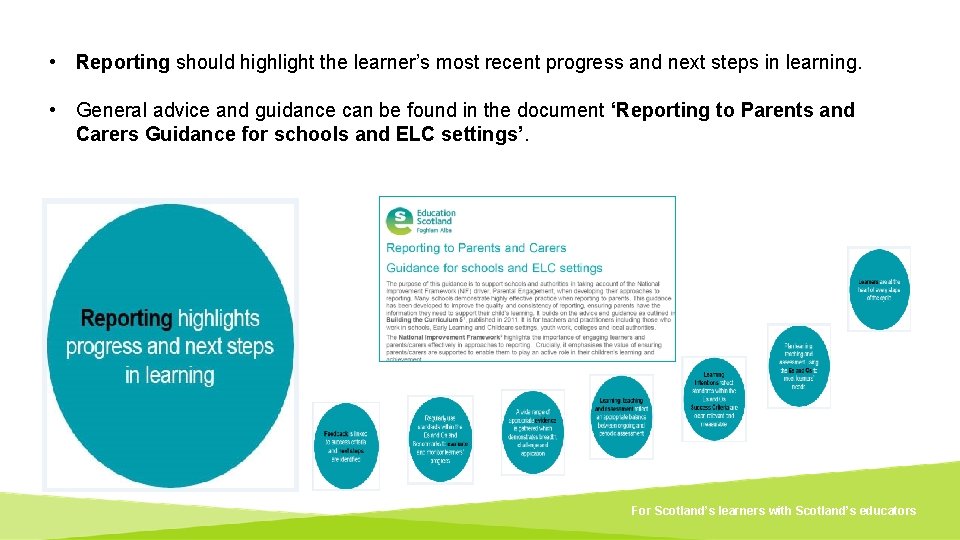
• Reporting should highlight the learner’s most recent progress and next steps in learning. • General advice and guidance can be found in the document ‘Reporting to Parents and Carers Guidance for schools and ELC settings’. For Scotland’s learners with Scotland’s educators
Assessment - Achievement of a Level Achievement of a level – based on evidence and teacher’s professional judgement, has the learner showed they have; • achieved a breadth of learning across the knowledge, understanding and skills? • responded consistently well to the level of challenge and has moved forward to learning at the next level in some aspects? • demonstrated application of what they have learned in new and unfamiliar situations? It is not necessary for learners to demonstrate mastery of every individual aspect of learning within Benchmarks at a particular level before moving on to the next level. However, it is important that there are no major gaps in their learning when looking across the major organisers in each curriculum area. For Scotland’s learners with Scotland’s educators
Benchmarks- Do’s and Don’t’s Summary Do • use Benchmarks to help assess whether learners are making suitable progress towards the national standards expected and use the evidence to plan their next, challenging steps in learning; • use Benchmarks for reporting locally at school level; • discuss Benchmarks within and across schools to achieve a shared understanding of the standards expected. For Scotland’s learners with Scotland’s educators
Benchmarks- Do’s and Don’t’s Summary Don’t • go straight to the Benchmarks when planning • use the Es and Os first; • focus on individual Benchmarks which may result in over/micro-assessing or duplicating records of learners’ progress; • spend time collating excessive evidence to assess learners’ achievement; • create overly-complex approaches to monitoring and tracking; • use Benchmarks to assess Es and Os individually. • plan periodic, holistic assessment of pupils’ learning. For Scotland’s learners with Scotland’s educators
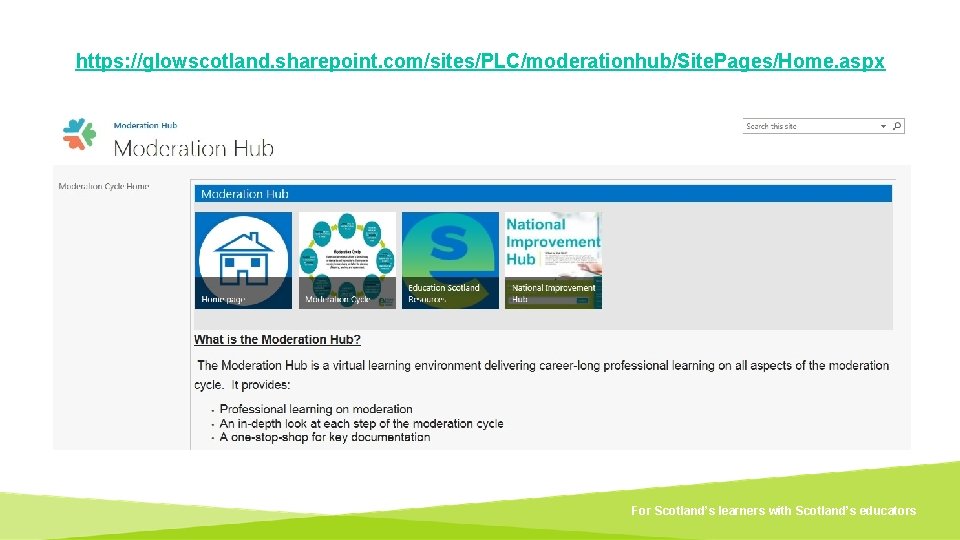
Resources Moderation hub https: //glowscotland. sharepoint. com/sites/PLC/moderationhub/Site. Pages/Home. aspx Benchmarks https: //education. gov. scot/improvement/Pages/Curriculum-for-Excellence-Benchmarks-. asp Milestones https: //education. gov. scot/improvement/learningresources/Milestones%20 to%20 support%20 learners%20 with%20 complex%20 additional%2 0 support%20 needs%20 -%20 Literacy%20 and%20 English For Scotland’s learners with Scotland’s educators
https: //glowscotland. sharepoint. com/sites/PLC/moderationhub/Site. Pages/Home. aspx For Scotland’s learners with Scotland’s educators