
Assessment and Management of Residual Leaks after LAA

- Slides: 17
Assessment and Management of Residual Leaks after LAA Closure George S. Hanzel, MD Director, Cardiac Catheterization Laboratory Department of Cardiovascular Medicine Beaumont Health, Royal Oak, MI
Disclosure Proctor for Watchman Do not receive remuneration 5/24/2021 2
Outline • • • Quick glimpse at surgical data Mechanism of peri-device leak Frequency of peri-device leak Consequence of peri-device leak Treatment of peri-device leak
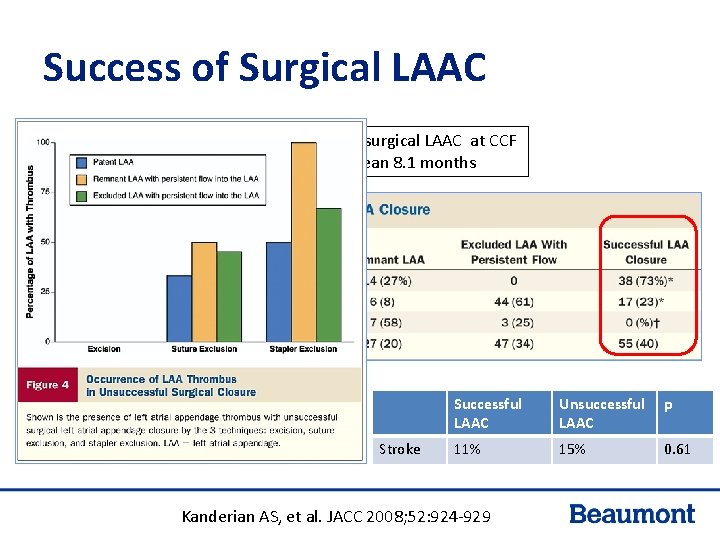
Success of Surgical LAAC 2546 patients underwent surgical LAAC at CCF 137 had post-op TEE at mean 8. 1 months Stroke Successful LAAC Unsuccessful LAAC p 11% 15% 0. 61 Kanderian AS, et al. JACC 2008; 52: 924 -929
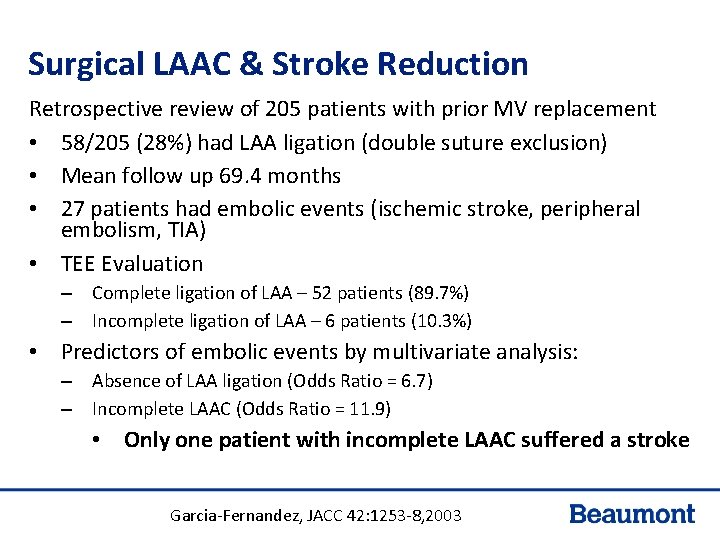
Surgical LAAC & Stroke Reduction Retrospective review of 205 patients with prior MV replacement • 58/205 (28%) had LAA ligation (double suture exclusion) • Mean follow up 69. 4 months • 27 patients had embolic events (ischemic stroke, peripheral embolism, TIA) • TEE Evaluation – Complete ligation of LAA – 52 patients (89. 7%) – Incomplete ligation of LAA – 6 patients (10. 3%) • Predictors of embolic events by multivariate analysis: – Absence of LAA ligation (Odds Ratio = 6. 7) – Incomplete LAAC (Odds Ratio = 11. 9) • Only one patient with incomplete LAAC suffered a stroke Garcia-Fernandez, JACC 42: 1253 -8, 2003
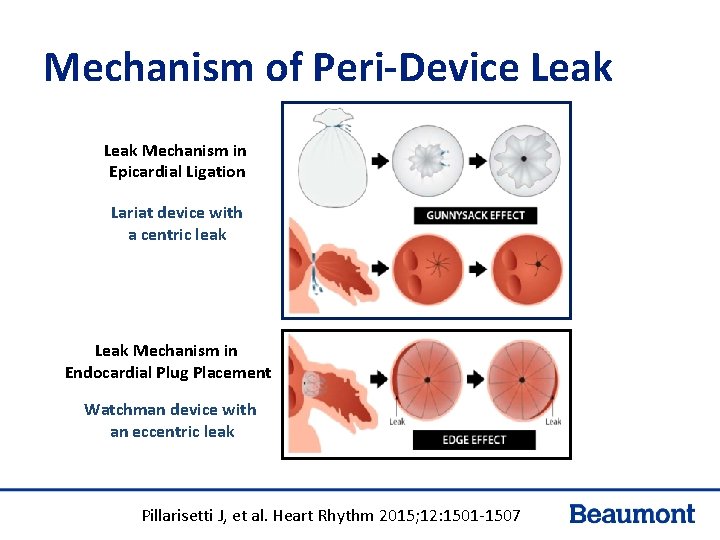
Mechanism of Peri-Device Leak Mechanism in Epicardial Ligation Lariat device with a centric leak Leak Mechanism in Endocardial Plug Placement Watchman device with an eccentric leak Pillarisetti J, et al. Heart Rhythm 2015; 12: 1501 -1507
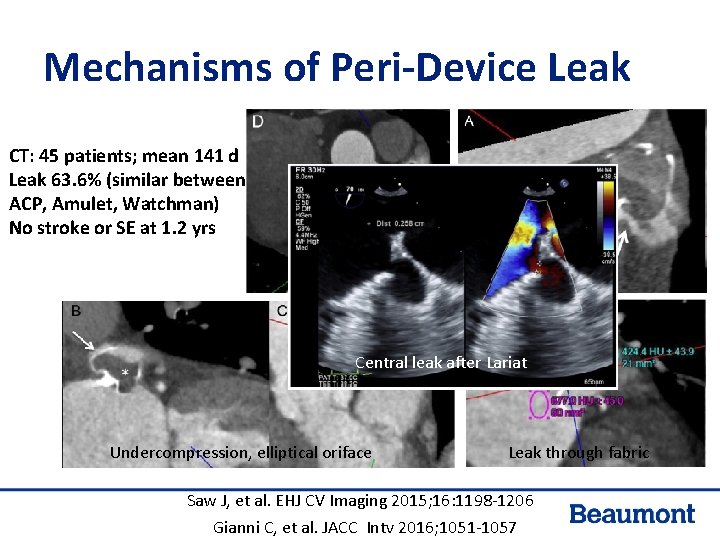
Mechanisms of Peri-Device Leak CT: 45 patients; mean 141 d Leak 63. 6% (similar between ACP, Amulet, Watchman) No stroke or SE at 1. 2 yrs Malalignment Uncovered lobe Central leak after Lariat Undercompression, elliptical oriface Leak through fabric Saw J, et al. EHJ CV Imaging 2015; 16: 1198 -1206 Gianni C, et al. JACC Intv 2016; 1051 -1057
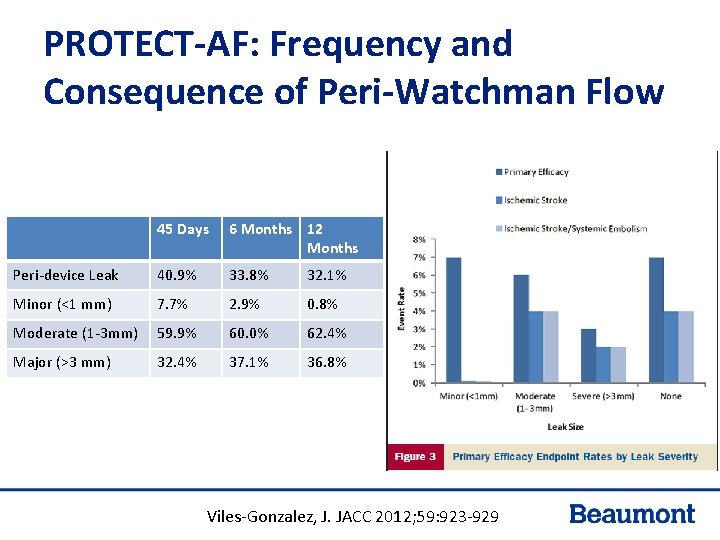
PROTECT-AF: Frequency and Consequence of Peri-Watchman Flow 45 Days 6 Months 12 Months Peri-device Leak 40. 9% 33. 8% 32. 1% Minor (<1 mm) 7. 7% 2. 9% 0. 8% Moderate (1 -3 mm) 59. 9% 60. 0% 62. 4% Major (>3 mm) 32. 4% 37. 1% 36. 8% Viles-Gonzalez, J. JACC 2012; 59: 923 -929
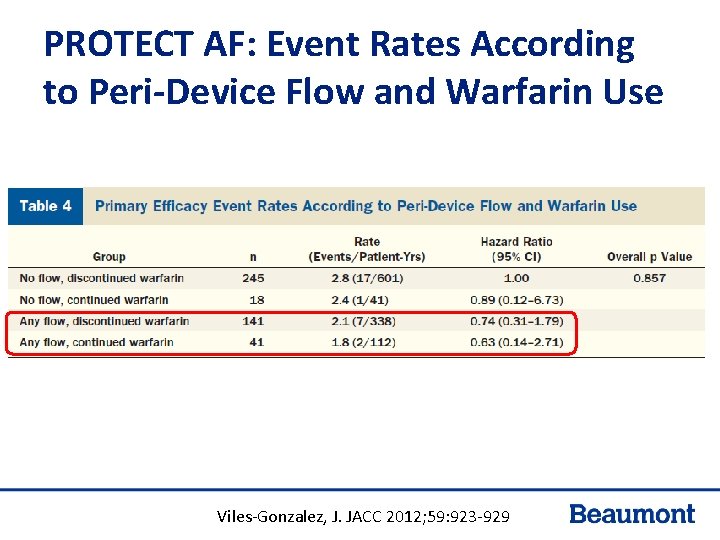
PROTECT AF: Event Rates According to Peri-Device Flow and Warfarin Use Viles-Gonzalez, J. JACC 2012; 59: 923 -929
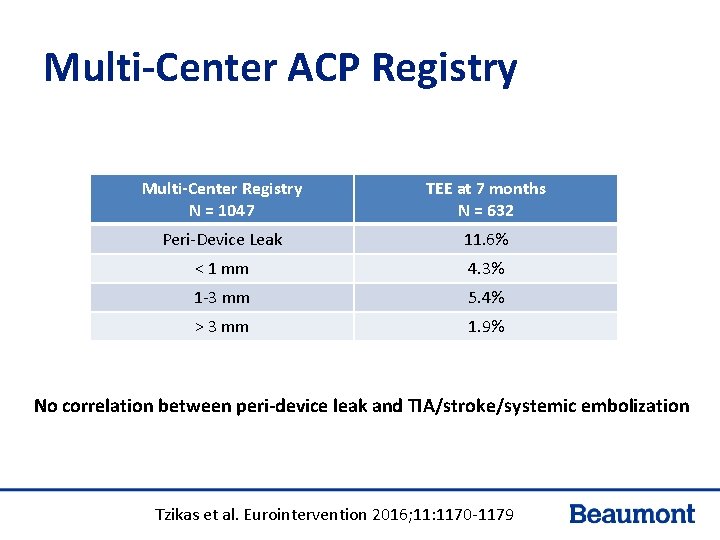
Multi-Center ACP Registry Multi-Center Registry N = 1047 TEE at 7 months N = 632 Peri-Device Leak 11. 6% < 1 mm 4. 3% 1 -3 mm 5. 4% > 3 mm 1. 9% No correlation between peri-device leak and TIA/stroke/systemic embolization Tzikas et al. Eurointervention 2016; 11: 1170 -1179
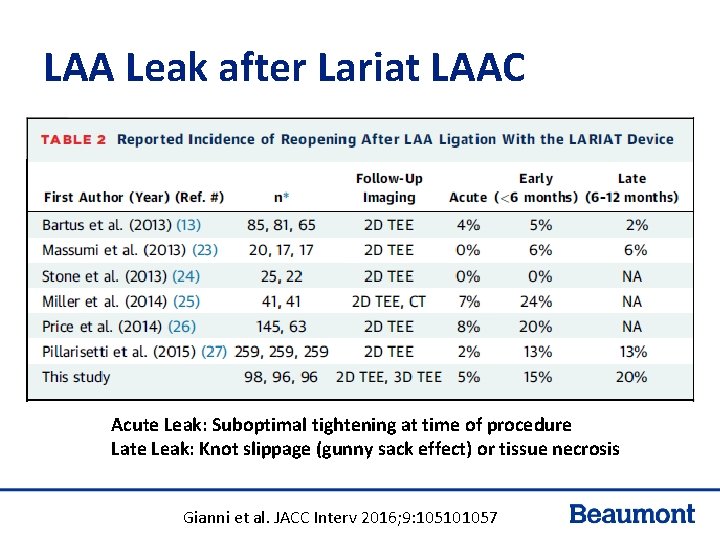
LAA Leak after Lariat LAAC Acute Leak: Suboptimal tightening at time of procedure Late Leak: Knot slippage (gunny sack effect) or tissue necrosis Gianni et al. JACC Interv 2016; 9: 105101057
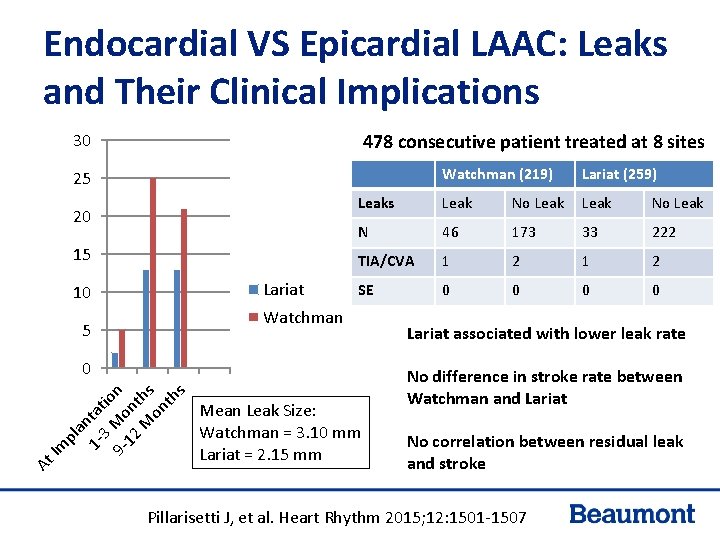
Endocardial VS Epicardial LAAC: Leaks and Their Clinical Implications 30 478 consecutive patient treated at 8 sites Watchman (219) Lariat (259) Leaks Leak No Leak N 46 173 33 222 TIA/CVA 1 2 SE 0 0 25 20 15 Lariat 10 Watchman 5 At Im pl a 1 - ntat 3 i 9 - Mo on 12 n M ths on th s 0 Mean Leak Size: Watchman = 3. 10 mm Lariat = 2. 15 mm Lariat associated with lower leak rate No difference in stroke rate between Watchman and Lariat No correlation between residual leak and stroke Pillarisetti J, et al. Heart Rhythm 2015; 12: 1501 -1507
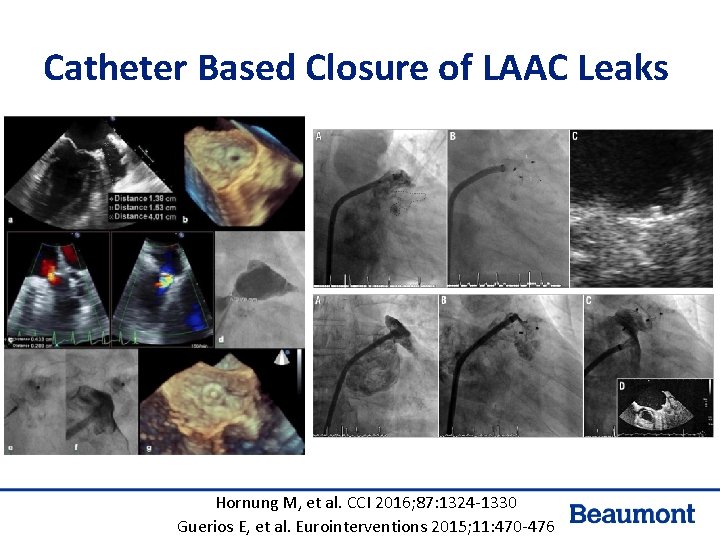
Catheter Based Closure of LAAC Leaks • Single center experience • 631 LAAC from 2003 -2013 • Device closure in 12 patients – Individualized decision but all leaks > 3 mm • Delayed 5 -6 months – Allow for endothelialization and minimize risk of device embolization • Large leaks or uncovered lobes – ACP/Amulet in 3 • Smaller leaks – AVPII or AVP III in 9 Hornung M, et al. CCI 2016; 87: 1324 -1330
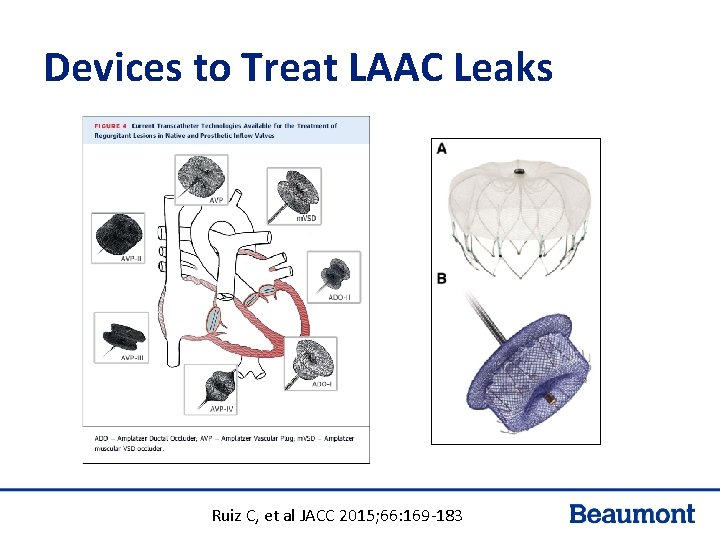
Devices to Treat LAAC Leaks Ruiz C, et al JACC 2015; 66: 169 -183
Catheter Based Closure of LAAC Leaks Hornung M, et al. CCI 2016; 87: 1324 -1330 Guerios E, et al. Eurointerventions 2015; 11: 470 -476
Conclusions • Mechanism of peri-device leak is device specific – Uncovered orifice (elliptical, undersizing), uncovered lobe, malalignment, flow through cap, gunny sack effect • Peri-device leak is common – 10 -30% of all devices • Clinical significance is uncertain – There does not seem to be a correlation between peri-device leak and stroke but all studies are retrospective, small and of relatively short duration • Optimal management is unclear – Conservative rx, DAPT, OAC, closure? – For large leak (>3 or >5 mm), uncovered lobe, or leak with thromboembolism consider OAC or device closure of the residual leak
Thank You