
Assessment and feedback Sted og dato Enhedens navn

Assessment and feedback

Sted og dato Enhedens navn Supervisor’s toolbox Meta-communication Approaches / styles Feedback and Assessment Perspectives Caps Themes and progression Dias 2
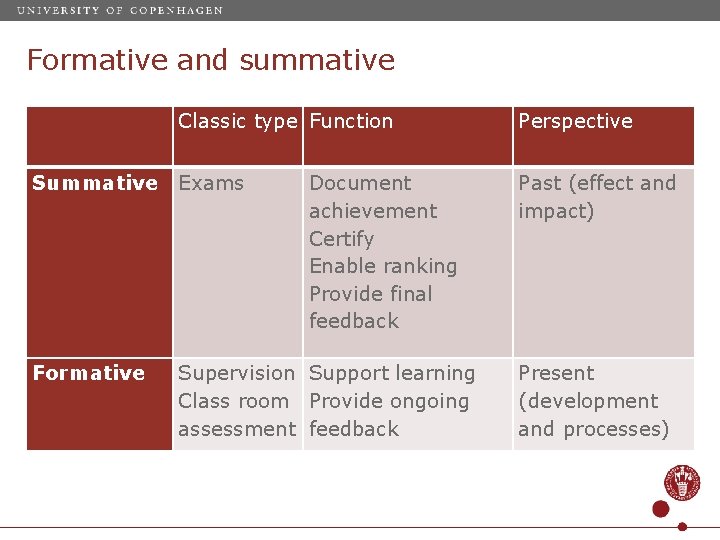
Formative and summative Classic type Function Perspective Summative Exams Past (effect and impact) Formative Supervision Support learning Class room Provide ongoing assessment feedback Document achievement Certify Enable ranking Provide final feedback Present (development and processes)
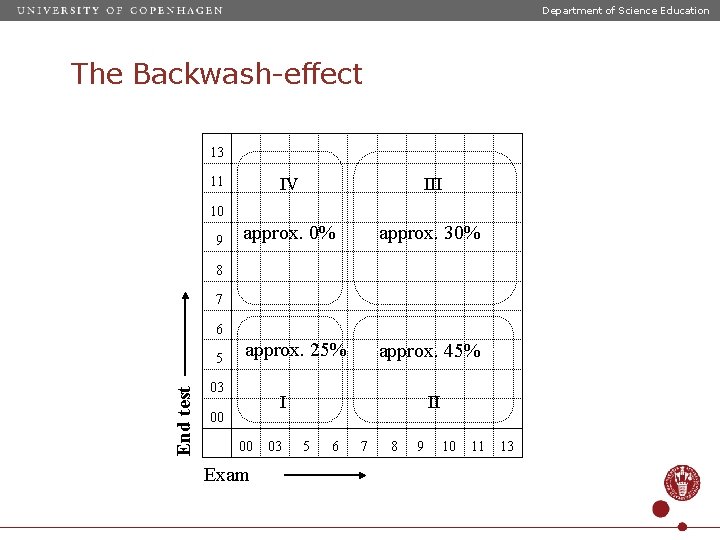
Department of Science Education The Backwash-effect 13 11 IV III approx. 0% approx. 30% approx. 25% approx. 45% 10 9 8 7 6 End test 5 03 I 00 00 Exam 03 II 5 6 7 8 9 10 11 13
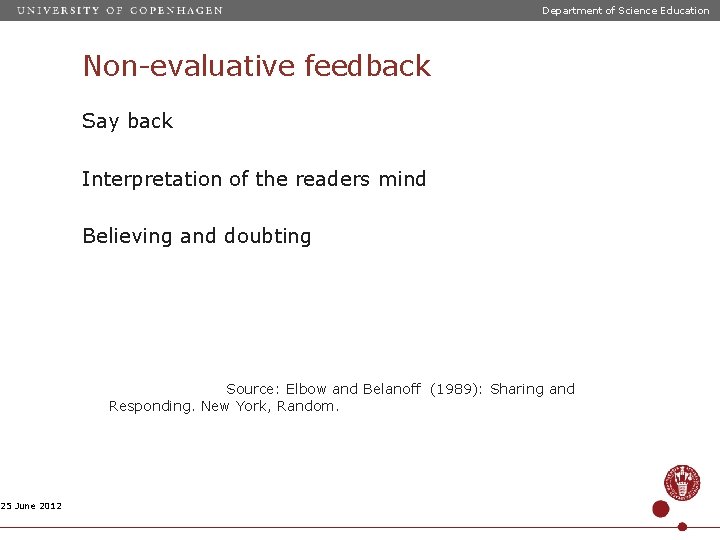
25 June 2012 Department of Science Education Non-evaluative feedback Say back Interpretation of the readers mind Believing and doubting Source: Elbow and Belanoff (1989): Sharing and Responding. New York, Random.
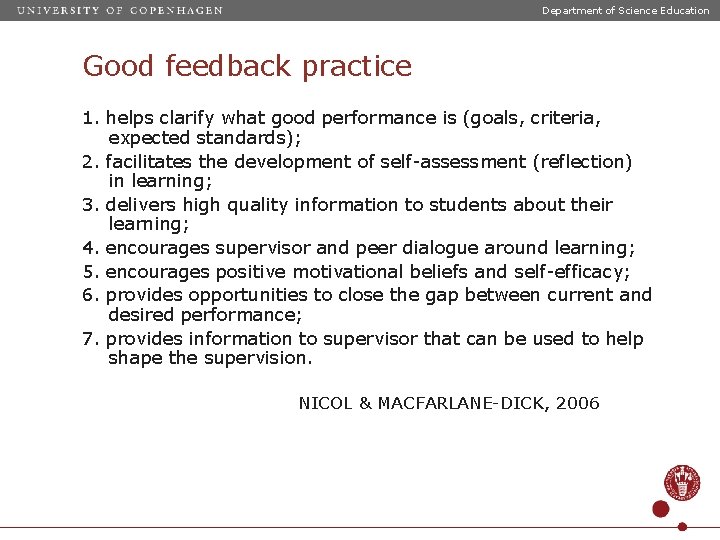
Department of Science Education Good feedback practice 1. helps clarify what good performance is (goals, criteria, expected standards); 2. facilitates the development of self-assessment (reflection) in learning; 3. delivers high quality information to students about their learning; 4. encourages supervisor and peer dialogue around learning; 5. encourages positive motivational beliefs and self-efficacy; 6. provides opportunities to close the gap between current and desired performance; 7. provides information to supervisor that can be used to help shape the supervision. NICOL & MACFARLANE-DICK, 2006
25 June 2012 Department of Science Education Examples of substance in feedback • Read the examples • Look for examples of positive and negative feedback • Is it specific? • Is it formative or summative? • Is it evaluative or nonevaluative Discuss implications
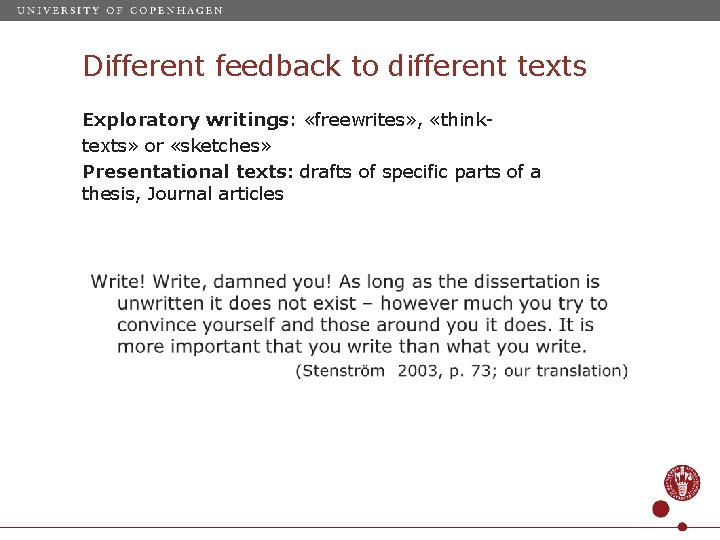
Different feedback to different texts Exploratory writings: «freewrites» , «thinktexts» or «sketches» Presentational texts: drafts of specific parts of a thesis, Journal articles
Getting students to write To increase our repertoire of ideas of things to write, Graham and Grant (1997, p. 31 f. ) suggest asking students to: • submit a given number of pages at or before every meeting • write a one-page synopsis of their thesis at regular intervals • free write their way through problems, blocks, and for coming to grips with new ideas • write a maximum of two/three pages describing the process of their research, identifying problems, thinking through possible solutions • write a one-page review of everything they read • write a two/three pages review of a number of articles dealing with a particular theme, comparing points of view, commenting on the relevance for their research • write expanded structures (synopses) for the whole thesis or for each of the proposed chapters or articles
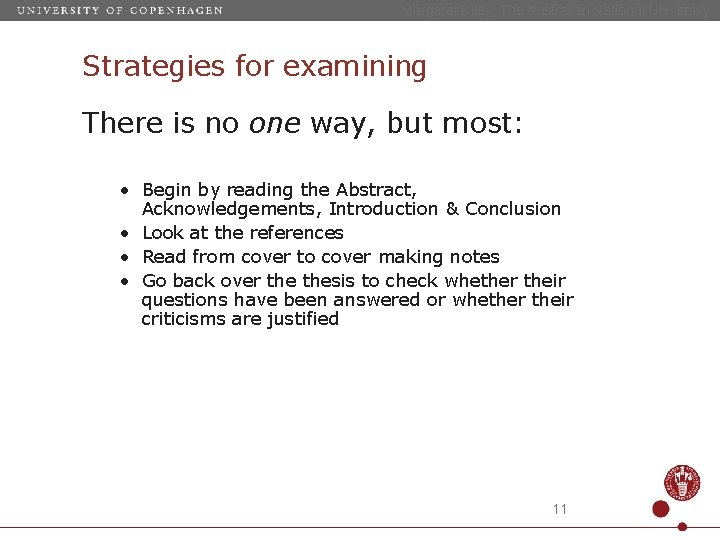
Margaret Kiley, The Australian National University Strategies for examining There is no one way, but most: • Begin by reading the Abstract, Acknowledgements, Introduction & Conclusion • Look at the references • Read from cover to cover making notes • Go back over thesis to check whether their questions have been answered or whether their criticisms are justified 11
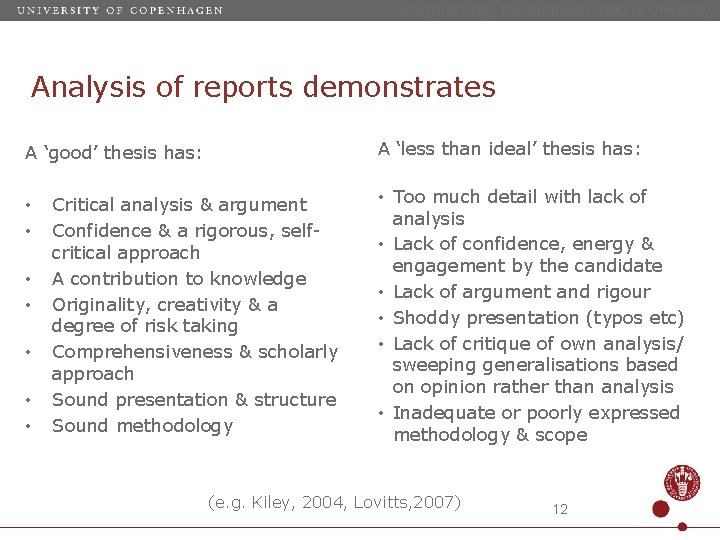
Margaret Kiley, The Australian National University Analysis of reports demonstrates A ‘less than ideal’ thesis has: A ‘good’ thesis has: • • Critical analysis & argument Confidence & a rigorous, selfcritical approach A contribution to knowledge Originality, creativity & a degree of risk taking Comprehensiveness & scholarly approach Sound presentation & structure Sound methodology • Too much detail with lack of analysis • Lack of confidence, energy & engagement by the candidate • Lack of argument and rigour • Shoddy presentation (typos etc) • Lack of critique of own analysis/ sweeping generalisations based on opinion rather than analysis • Inadequate or poorly expressed methodology & scope (e. g. Kiley, 2004, Lovitts, 2007) 12
- Slides: 12