
Assessment and Evaluation of exposure to Hand Arm




- Slides: 21
Assessment and Evaluation of exposure to Hand Arm and Whole Body Vibration in the Property Maintenance and Construction Industries in Ireland Margaret Mc. Callig B. Sc, Grad. IOSH
Contents Introduction to the Project n Aims & Objectives of the Project n Questionnaire Survey n Workplace Observations n Vibration Emission Measurements n Vibration Risk Assessment n Conclusions n References n
Introduction n Project carried out on behalf of the OPW at various sites throughout the country. n OPW are a state property maintenance & construction company n Three divisions included: Engineering Services, Historical Park & Garden Maintenance & Building Maintenance
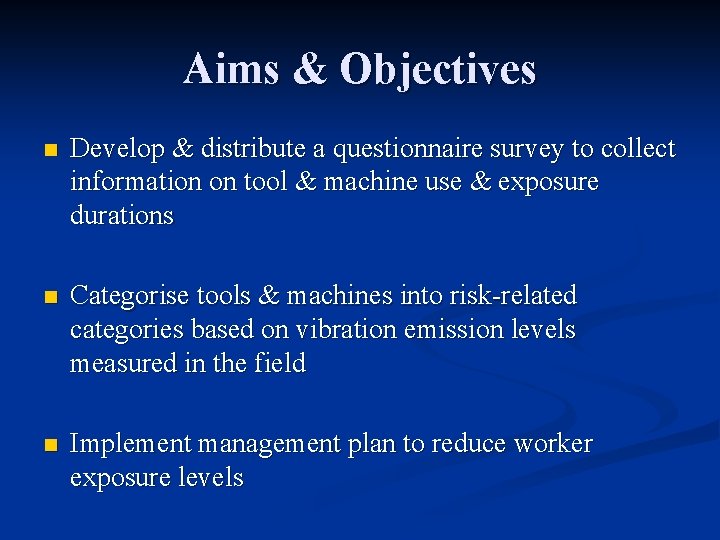
Aims & Objectives n Develop & distribute a questionnaire survey to collect information on tool & machine use & exposure durations n Categorise tools & machines into risk-related categories based on vibration emission levels measured in the field n Implement management plan to reduce worker exposure levels
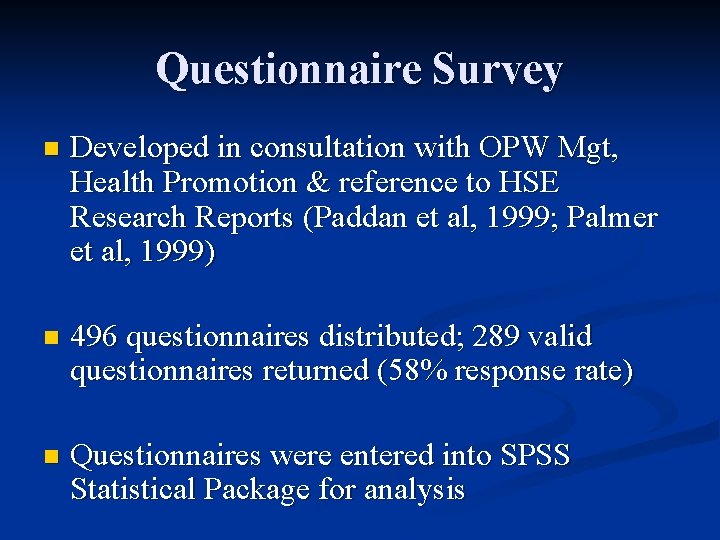
Questionnaire Survey n Developed in consultation with OPW Mgt, Health Promotion & reference to HSE Research Reports (Paddan et al, 1999; Palmer et al, 1999) n 496 questionnaires distributed; 289 valid questionnaires returned (58% response rate) n Questionnaires were entered into SPSS Statistical Package for analysis
Questionnaire Survey n 1. Questionnaire comprised of 3 Sections: Personal Information n 2. Job Information n 3. Age, Weight, Height, Lifestyle Job title, work environment, tool & machine use Health Effects n Pains / aches experienced in the last week / year
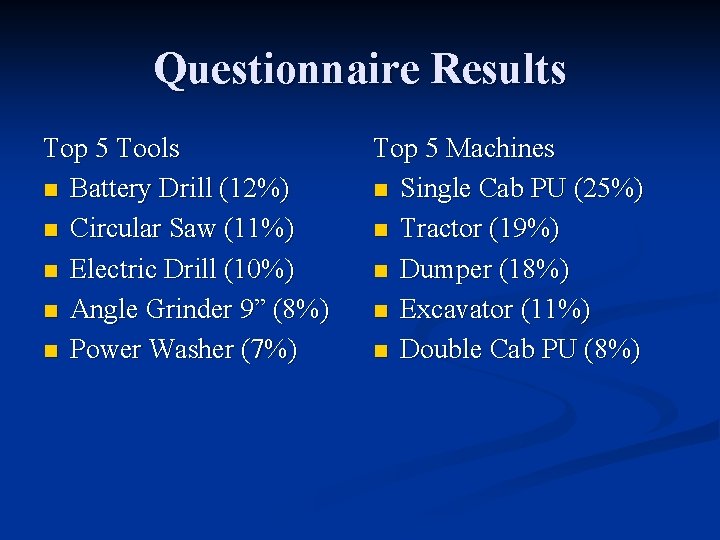
Questionnaire Results Top 5 Tools n Battery Drill (12%) n Circular Saw (11%) n Electric Drill (10%) n Angle Grinder 9” (8%) n Power Washer (7%) Top 5 Machines n Single Cab PU (25%) n Tractor (19%) n Dumper (18%) n Excavator (11%) n Double Cab PU (8%)
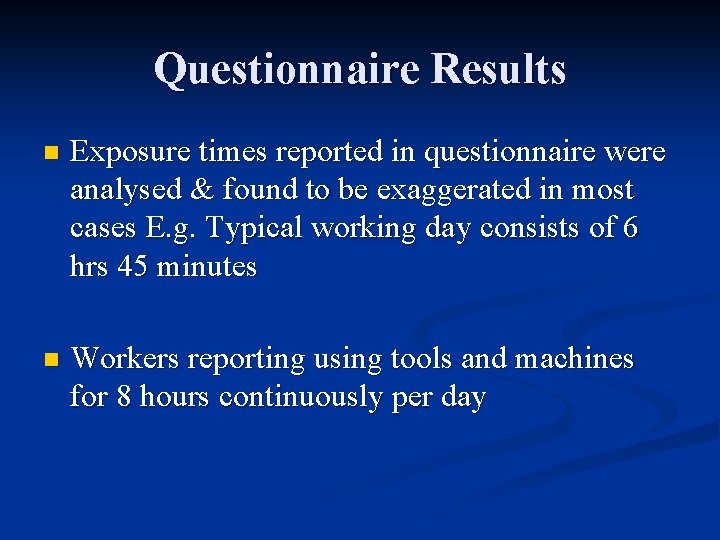
Questionnaire Results n Exposure times reported in questionnaire were analysed & found to be exaggerated in most cases E. g. Typical working day consists of 6 hrs 45 minutes n Workers reporting using tools and machines for 8 hours continuously per day
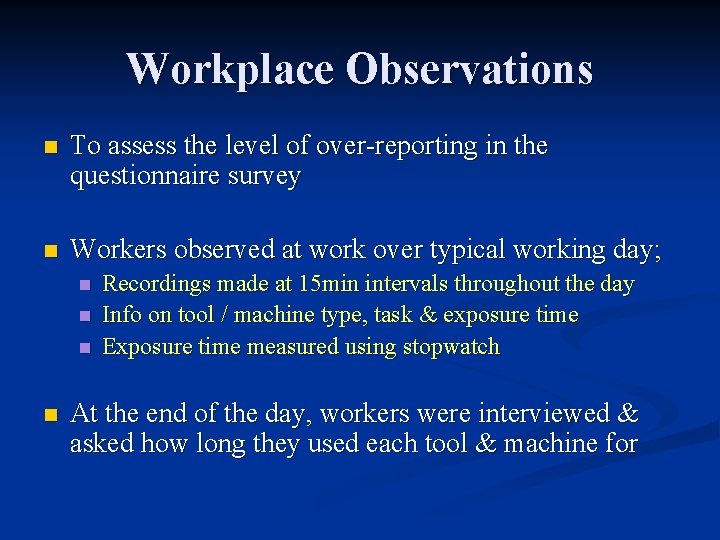
Workplace Observations n To assess the level of over-reporting in the questionnaire survey n Workers observed at work over typical working day; n n Recordings made at 15 min intervals throughout the day Info on tool / machine type, task & exposure time Exposure time measured using stopwatch At the end of the day, workers were interviewed & asked how long they used each tool & machine for
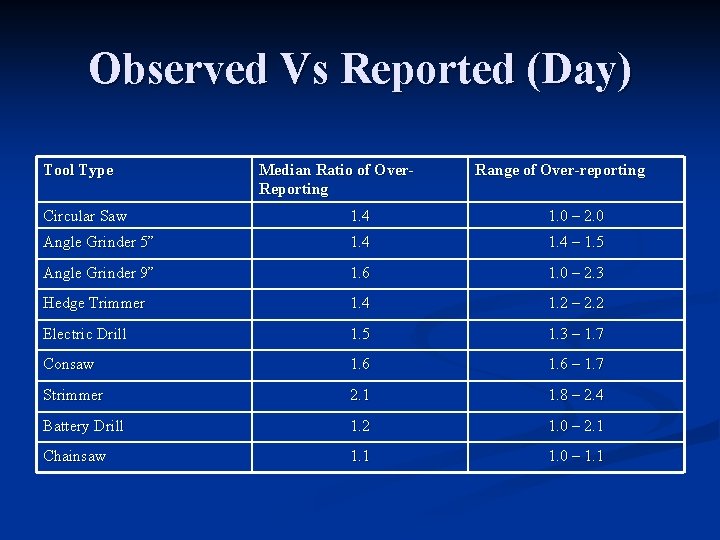
Observed Vs Reported (Day) Tool Type Median Ratio of Over. Reporting Range of Over-reporting Circular Saw 1. 4 1. 0 – 2. 0 Angle Grinder 5” 1. 4 – 1. 5 Angle Grinder 9” 1. 6 1. 0 – 2. 3 Hedge Trimmer 1. 4 1. 2 – 2. 2 Electric Drill 1. 5 1. 3 – 1. 7 Consaw 1. 6 – 1. 7 Strimmer 2. 1 1. 8 – 2. 4 Battery Drill 1. 2 1. 0 – 2. 1 Chainsaw 1. 1 1. 0 – 1. 1
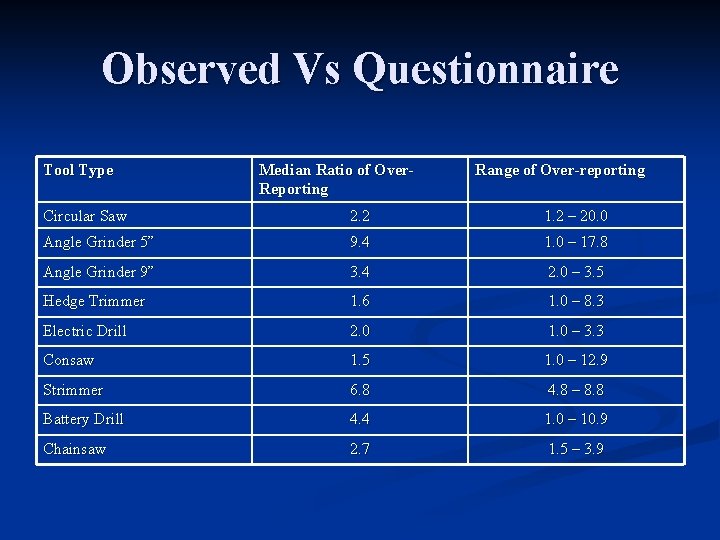
Observed Vs Questionnaire Tool Type Median Ratio of Over. Reporting Range of Over-reporting Circular Saw 2. 2 1. 2 – 20. 0 Angle Grinder 5” 9. 4 1. 0 – 17. 8 Angle Grinder 9” 3. 4 2. 0 – 3. 5 Hedge Trimmer 1. 6 1. 0 – 8. 3 Electric Drill 2. 0 1. 0 – 3. 3 Consaw 1. 5 1. 0 – 12. 9 Strimmer 6. 8 4. 8 – 8. 8 Battery Drill 4. 4 1. 0 – 10. 9 Chainsaw 2. 7 1. 5 – 3. 9
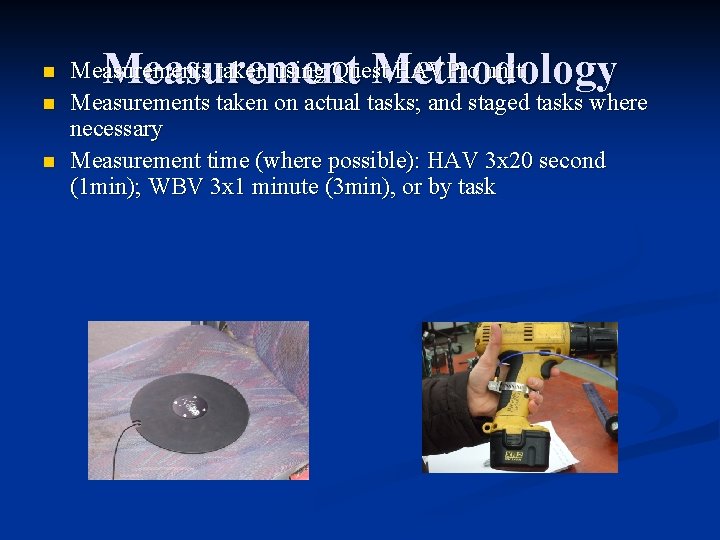
n n n Measurement Methodology Measurements taken using Quest HAVPro unit. Measurements taken on actual tasks; and staged tasks where necessary Measurement time (where possible): HAV 3 x 20 second (1 min); WBV 3 x 1 minute (3 min), or by task
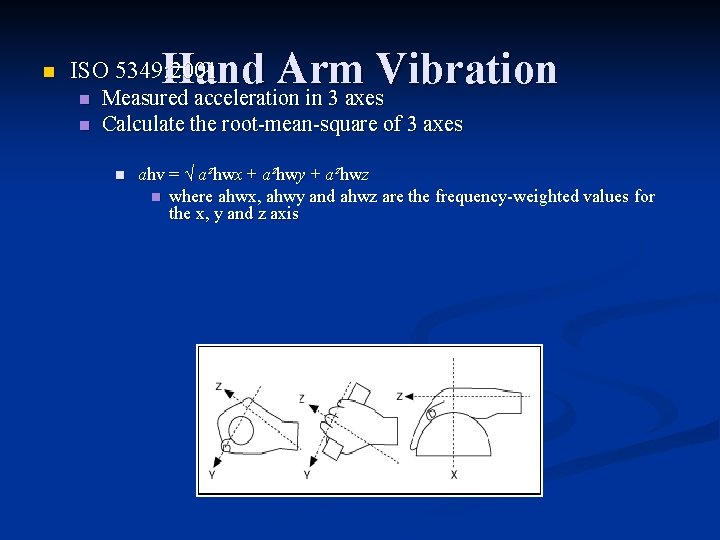
n n Hand Arm Vibration Measured acceleration in 3 axes n Calculate the root-mean-square of 3 axes ISO 5349: 2001 n ahv = √ a²hwx + a²hwy + a²hwz n where ahwx, ahwy and ahwz are the frequency-weighted values for the x, y and z axis
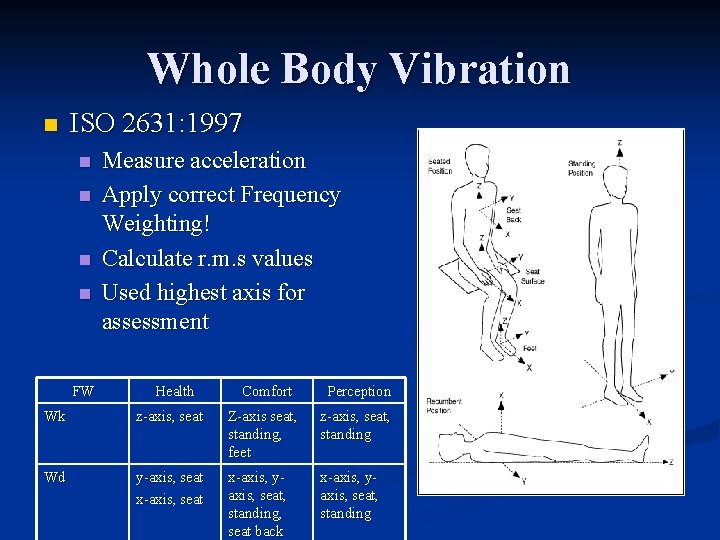
Whole Body Vibration n ISO 2631: 1997 n n FW Measure acceleration Apply correct Frequency Weighting! Calculate r. m. s values Used highest axis for assessment Health Comfort Perception Wk z-axis, seat Z-axis seat, standing, feet z-axis, seat, standing Wd y-axis, seat x-axis, yaxis, seat, standing, seat back x-axis, yaxis, seat, standing
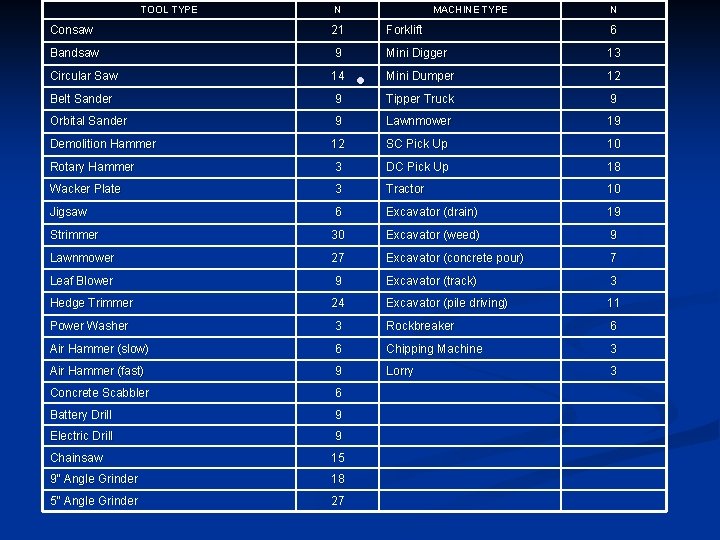
TOOL TYPE N Consaw 21 Bandsaw 9 Circular Saw 14 Belt Sander 9 Orbital Sander MACHINE TYPE N Forklift 6 Mini Digger 13 Mini Dumper 12 Tipper Truck 9 9 Lawnmower 19 Demolition Hammer 12 SC Pick Up 10 Rotary Hammer 3 DC Pick Up 18 Wacker Plate 3 Tractor 10 Jigsaw 6 Excavator (drain) 19 Strimmer 30 Excavator (weed) 9 Lawnmower 27 Excavator (concrete pour) 7 Leaf Blower 9 Excavator (track) 3 Hedge Trimmer 24 Excavator (pile driving) 11 Power Washer 3 Rockbreaker 6 Air Hammer (slow) 6 Chipping Machine 3 Air Hammer (fast) 9 Lorry 3 Concrete Scabbler 6 Battery Drill 9 Electric Drill 9 Chainsaw 15 9” Angle Grinder 18 5” Angle Grinder 27 .
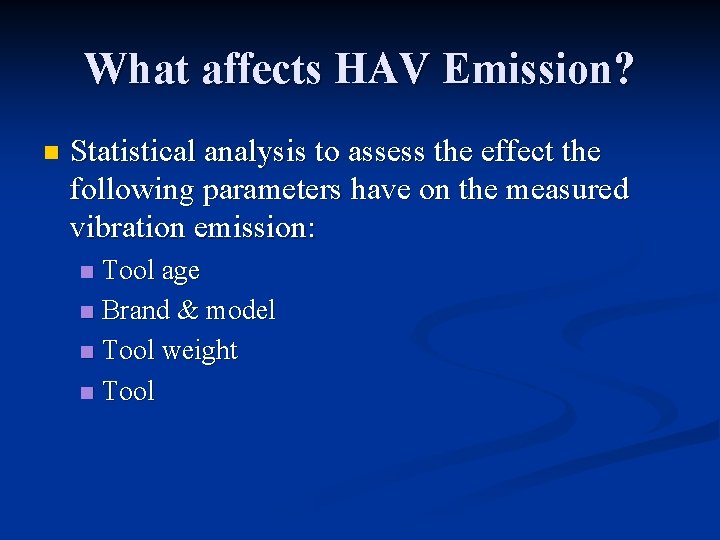
What affects HAV Emission? n Statistical analysis to assess the effect the following parameters have on the measured vibration emission: Tool age n Brand & model n Tool weight n Tool n
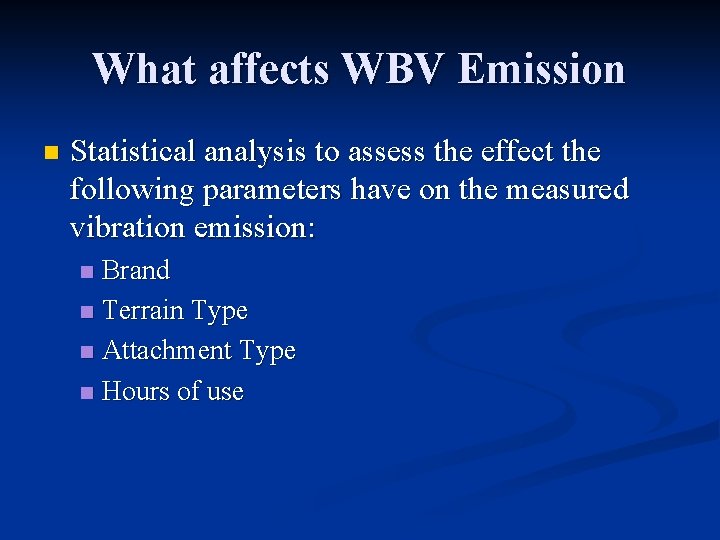
What affects WBV Emission n Statistical analysis to assess the effect the following parameters have on the measured vibration emission: Brand n Terrain Type n Attachment Type n Hours of use n
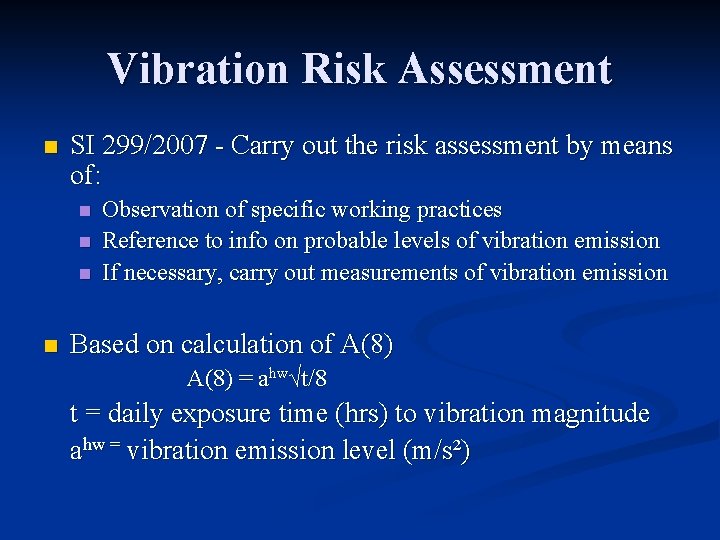
Vibration Risk Assessment n SI 299/2007 - Carry out the risk assessment by means of: n n Observation of specific working practices Reference to info on probable levels of vibration emission If necessary, carry out measurements of vibration emission Based on calculation of A(8) = ahw√t/8 t = daily exposure time (hrs) to vibration magnitude ahw = vibration emission level (m/s²)
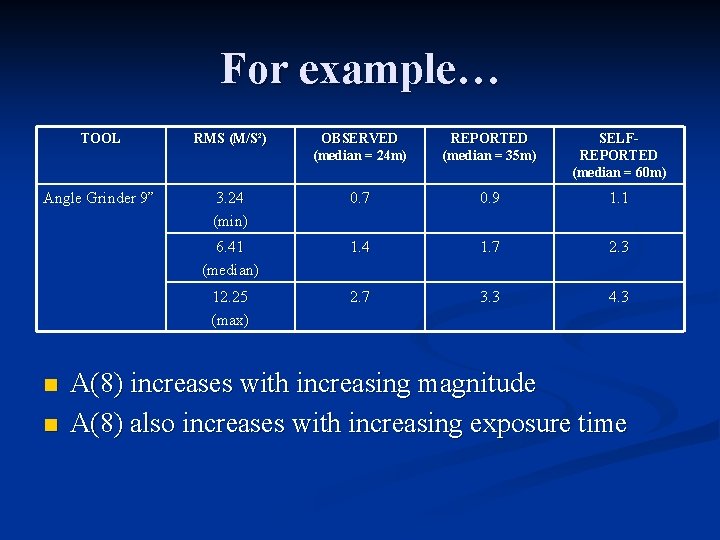
For example… TOOL RMS (M/S²) OBSERVED (median = 24 m) REPORTED (median = 35 m) SELFREPORTED (median = 60 m) Angle Grinder 9” 3. 24 (min) 0. 7 0. 9 1. 1 6. 41 (median) 1. 4 1. 7 2. 3 12. 25 (max) 2. 7 3. 3 4. 3 n n A(8) increases with increasing magnitude A(8) also increases with increasing exposure time
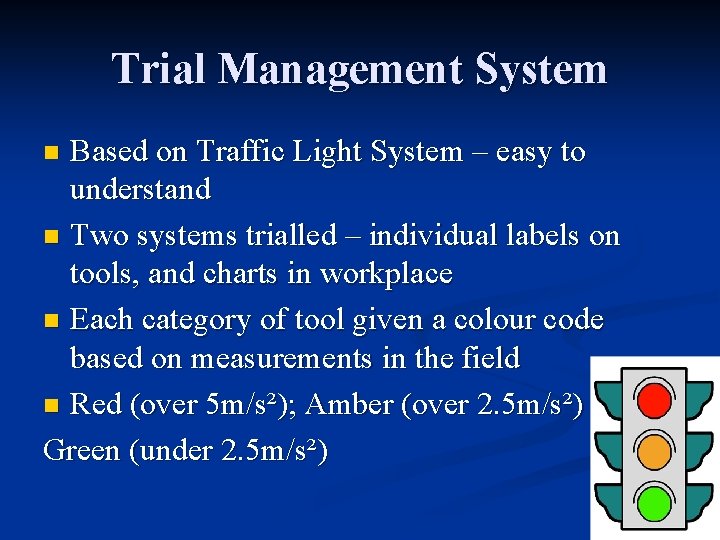
Trial Management System Based on Traffic Light System – easy to understand n Two systems trialled – individual labels on tools, and charts in workplace n Each category of tool given a colour code based on measurements in the field n Red (over 5 m/s²); Amber (over 2. 5 m/s²) Green (under 2. 5 m/s²) n
Contact Margaret Mc. Callig Dept of Experimental Physics School of Physics NUI Galway 091 – 493403 m. mccallig 1@nuigalway. ie