
Assessment and Diagnosis SOW 4341 Micro Level Roles

- Slides: 43
Assessment and Diagnosis SOW 4341: Micro Level Roles and Interventions in Social Work (Week 6) Reshawna Chapple, Ph. D, LCSW Associate Professor of Social Work University of Central Florida
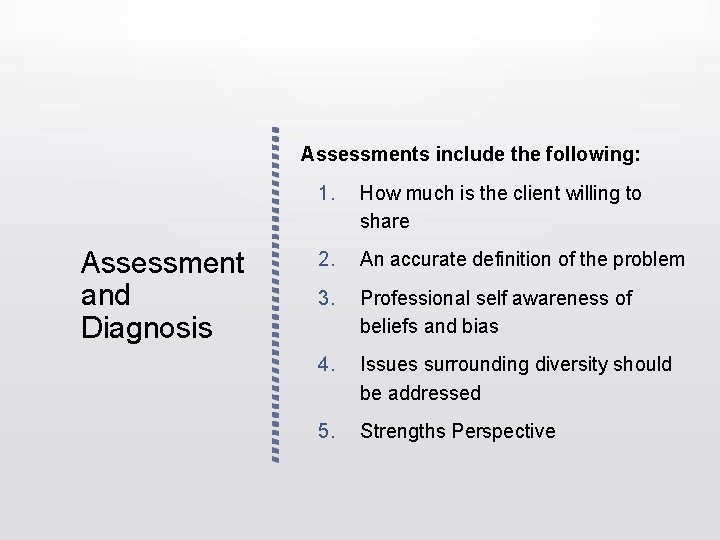
Assessments include the following: Assessment and Diagnosis 1. How much is the client willing to share 2. An accurate definition of the problem 3. Professional self awareness of beliefs and bias 4. Issues surrounding diversity should be addressed 5. Strengths Perspective
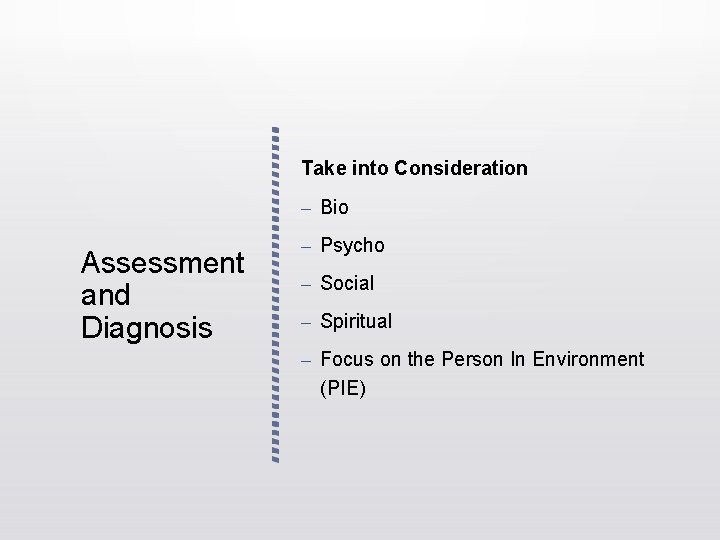
Take into Consideration – Bio Assessment and Diagnosis – Psycho – Social – Spiritual – Focus on the Person In Environment (PIE)
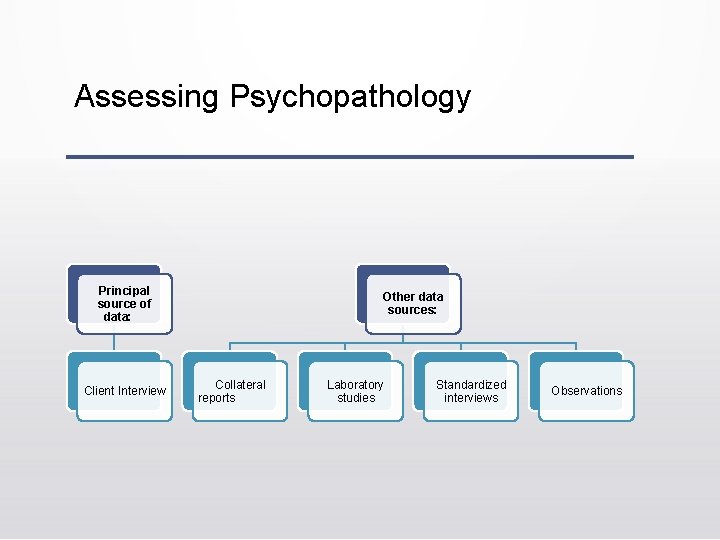
Assessing Psychopathology Principal source of data: Client Interview Other data sources: Collateral reports Laboratory studies Standardized interviews Observations
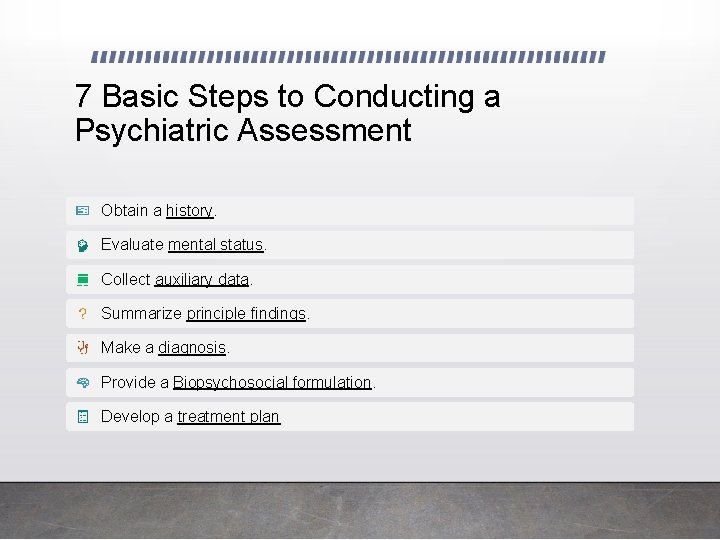
7 Basic Steps to Conducting a Psychiatric Assessment Obtain a history. Evaluate mental status. Collect auxiliary data. Summarize principle findings. Make a diagnosis. Provide a Biopsychosocial formulation. Develop a treatment plan
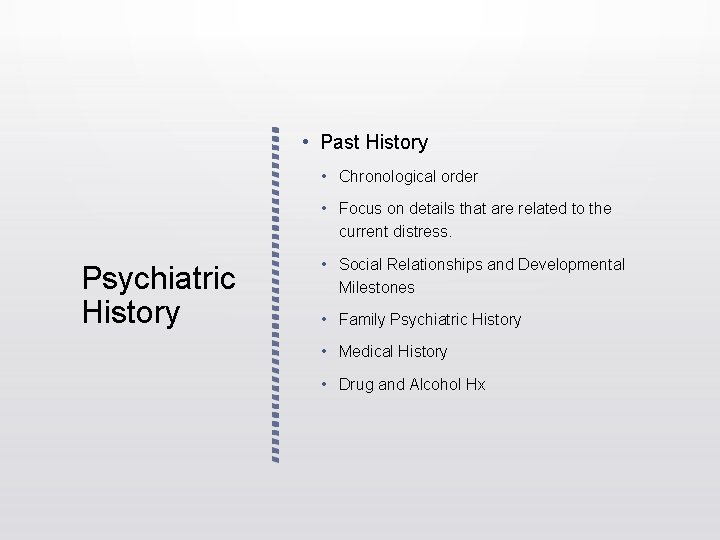
• Past History • Chronological order • Focus on details that are related to the current distress. Psychiatric History • Social Relationships and Developmental Milestones • Family Psychiatric History • Medical History • Drug and Alcohol Hx
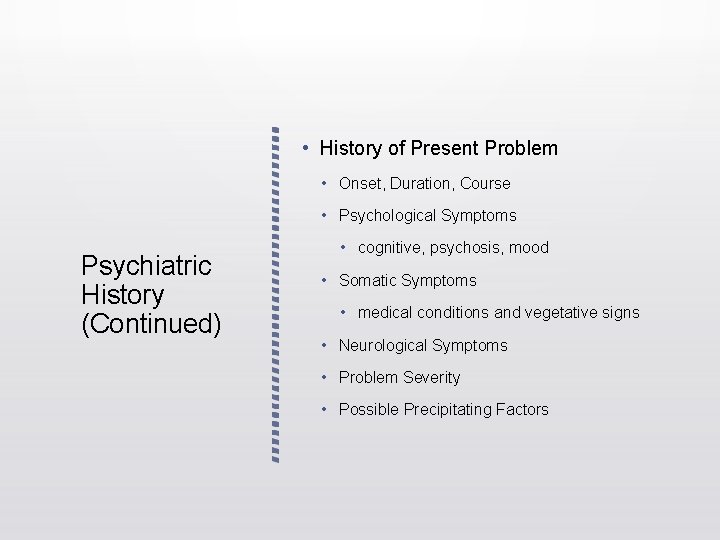
• History of Present Problem • Onset, Duration, Course • Psychological Symptoms Psychiatric History (Continued) • cognitive, psychosis, mood • Somatic Symptoms • medical conditions and vegetative signs • Neurological Symptoms • Problem Severity • Possible Precipitating Factors
– Informal vs. Formal MSE – Report of MSE should include concrete examples to illustrate every identified problem. – Not just “the client is delusional but “the client is convinced that he is the reincarnation of Jesus Christ…” Mental Status Examination – MSE report should follow a specific outline and include only a brief statement if a specific area is within normal range.
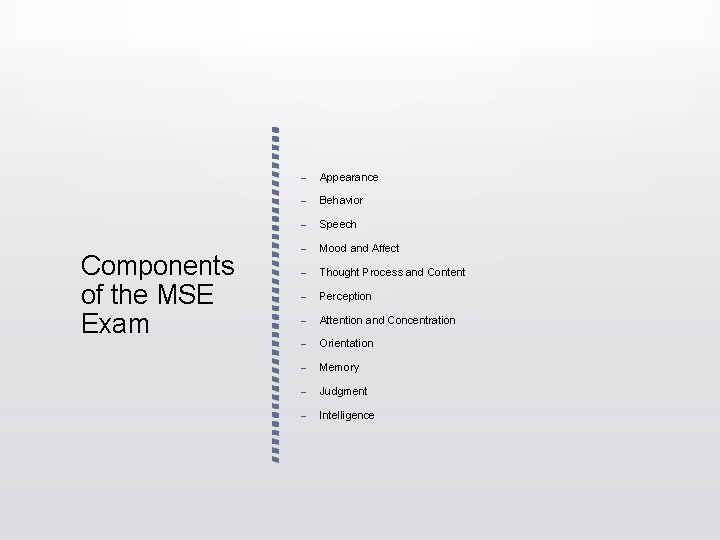
Components of the MSE Exam – Appearance – Behavior – Speech – Mood and Affect – Thought Process and Content – Perception – Attention and Concentration – Orientation – Memory – Judgment – Intelligence
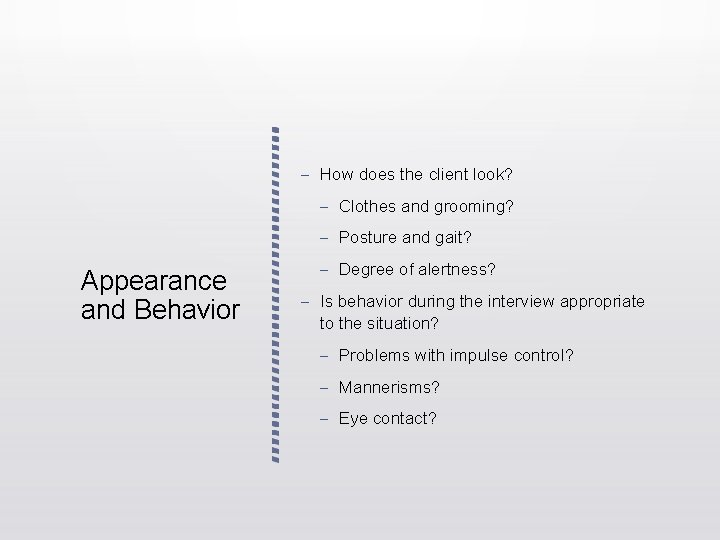
– How does the client look? – Clothes and grooming? – Posture and gait? Appearance and Behavior – Degree of alertness? – Is behavior during the interview appropriate to the situation? – Problems with impulse control? – Mannerisms? – Eye contact?
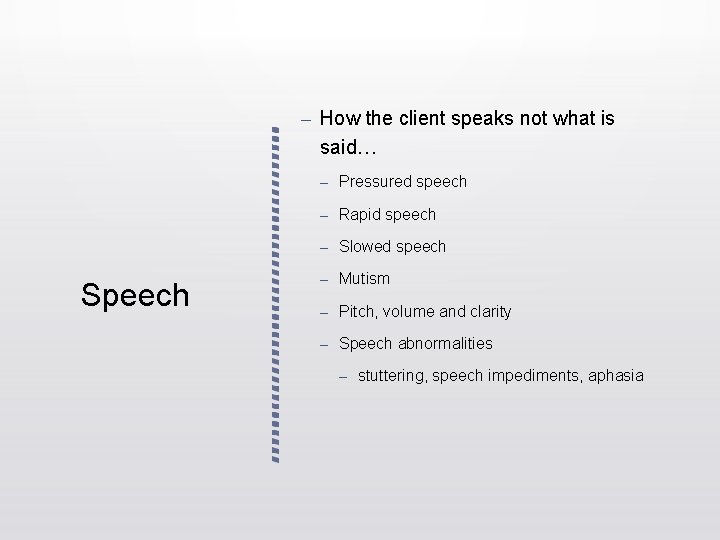
– How the client speaks not what is said… – Pressured speech – Rapid speech – Slowed speech Speech – Mutism – Pitch, volume and clarity – Speech abnormalities – stuttering, speech impediments, aphasia
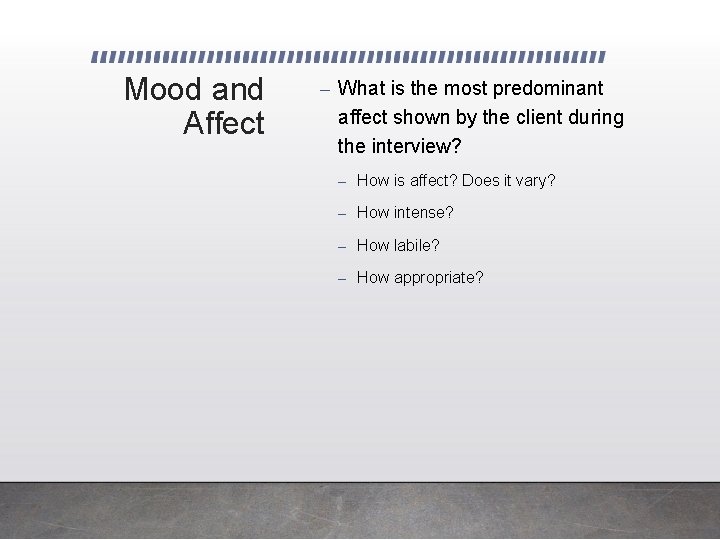
Mood and Affect – What is the most predominant affect shown by the client during the interview? – How is affect? Does it vary? – How intense? – How labile? – How appropriate?
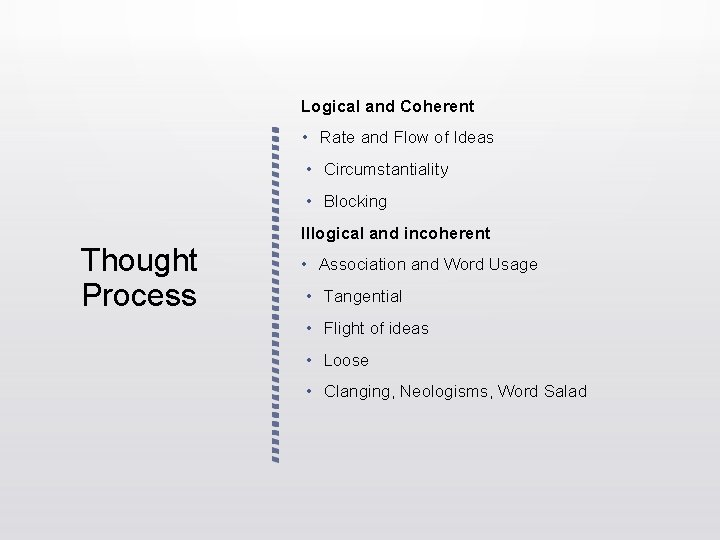
Logical and Coherent • Rate and Flow of Ideas • Circumstantiality • Blocking Illogical and incoherent Thought Process • Association and Word Usage • Tangential • Flight of ideas • Loose • Clanging, Neologisms, Word Salad
• Ideas of Reference • Depersonalization • Preoccupations and Obsessions • Suicidal or Homicidal Ideation Thoughts • Look for Unusual or Persistent Thoughts • Always assess thoughts of harming self or others.
A fixed false belief despite evidence to the contrary Delusions Category of Delusions – Grandeur – Control – Thought Broadcasting – Somatic – Persecution *Do not argue with strong delusions
• Hallucinations – perceiving sensory inputs in the absence of any external stimulus. Perceptual Disturbances – Seem very real to the person. – Often associated with drug and alcohol abuse. – Seen in all types of psychotic disorders
Types of Hallucinations – Auditory Perceptual Disturbances – Visual – Olfactory – Gustatory – Tactile
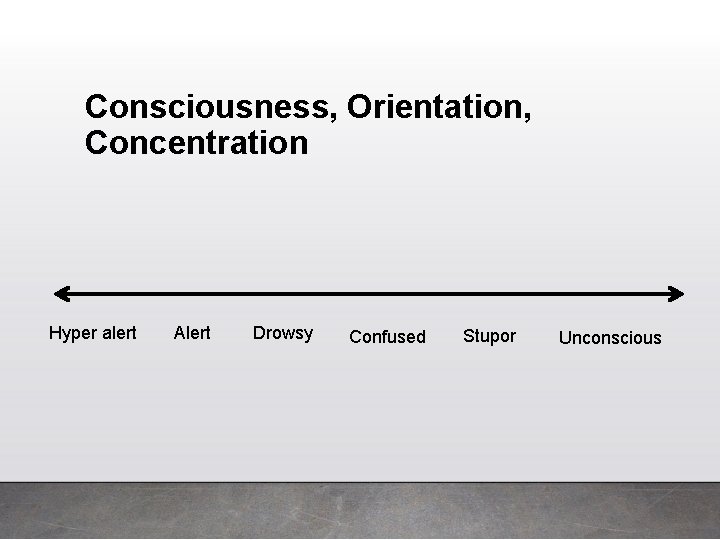
Consciousness, Orientation, Concentration Hyper alert Alert Drowsy Confused Stupor Unconscious
• Orientation Consciousness, Orientation, Concentration • Time • Place • Person
– Immediate – past few minutes – usually first to go – Digit span test: “Repeat after me 7, 3, 5, 9, 1 Memory – Recent – past several days to months – Remote – many years ago – usually the last to go
– Can be due to a variety of causes – substance abuse – organic brain disorders Memory Impairment on the MSE – anxiety, depression, trauma, psychosis – If memory is impaired how does the person respond to it? – Embarrassed and trying to cover it up? – Seems unaware of a memory problem? – Anxious, depressed, or hostile about it?
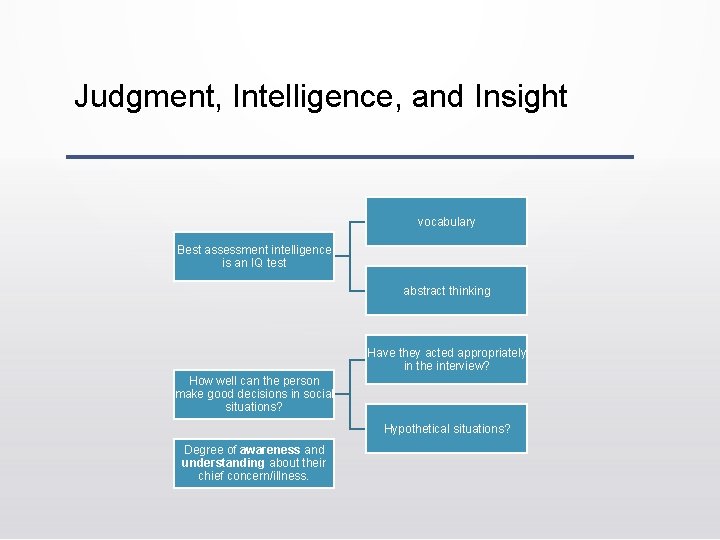
Judgment, Intelligence, and Insight vocabulary Best assessment intelligence is an IQ test abstract thinking Have they acted appropriately in the interview? How well can the person make good decisions in social situations? Hypothetical situations? Degree of awareness and understanding about their chief concern/illness.
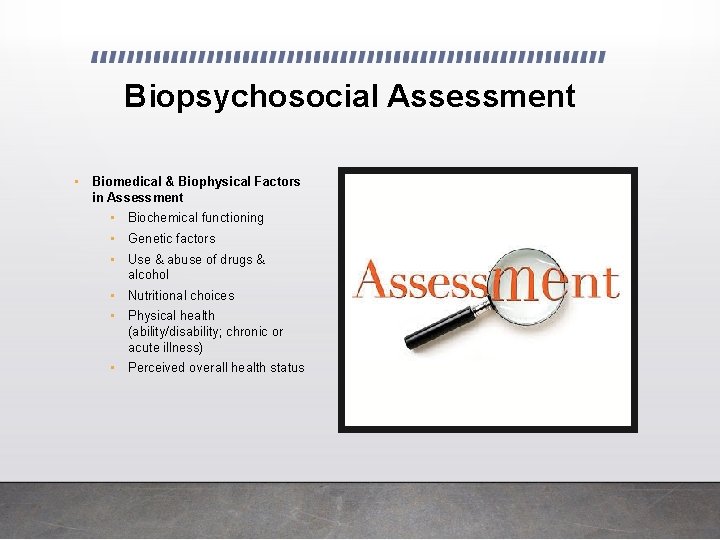
Biopsychosocial Assessment • Biomedical & Biophysical Factors in Assessment • Biochemical functioning • Genetic factors • Use & abuse of drugs & alcohol • Nutritional choices • Physical health (ability/disability; chronic or acute illness) • Perceived overall health status
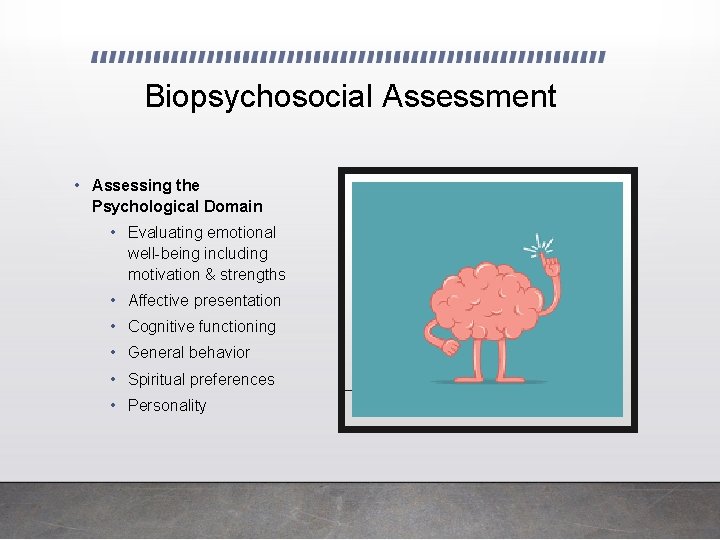
Biopsychosocial Assessment • Assessing the Psychological Domain • Evaluating emotional well-being including motivation & strengths • Affective presentation • Cognitive functioning • General behavior • Spiritual preferences • Personality
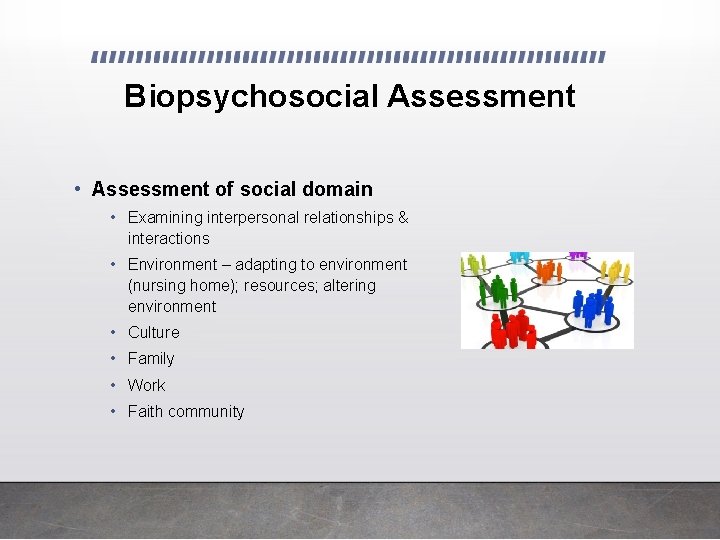
Biopsychosocial Assessment • Assessment of social domain • Examining interpersonal relationships & interactions • Environment – adapting to environment (nursing home); resources; altering environment • Culture • Family • Work • Faith community
Biopsychosocial Assessment • Cognitive functioning - how people think which is influenced by intellectual functioning, judgment, reality testing, coherence, values, beliefs, self-concept Affective Functioning – emotions are affected by cognitions & influence behavior • Assessment of lethality (suicidal risk) – when clients exhibit depressive symptoms or hopelessness, it is critical to evaluate suicidal risk • Behavioral functioning – target behavioral patterns that impair the client’s social functioning; need to assess both dysfunctional & functional patterns; some patterns of behaviors are effective & represent strengths
Diagnosis and the Social Work Profession • Social workers work in a variety of settings. • DSM classification system • DSM I to IV-TR to DSM 5 (current) • Axis I-V and “V” Codes to “Z” codes • Mental Status Exam (MSW) Examples • Limitations of the DSM
• Biological • Genes and heritability Individual Factors • Neurotransmitters (chemical imbalance) • Temperament • Physical Health • Developmental Stage • Intelligence
• Psychological Mechanisms Individual Factors • Self-efficacy and self-esteem • Self-regulation and emotion regulation • Coping Strategies
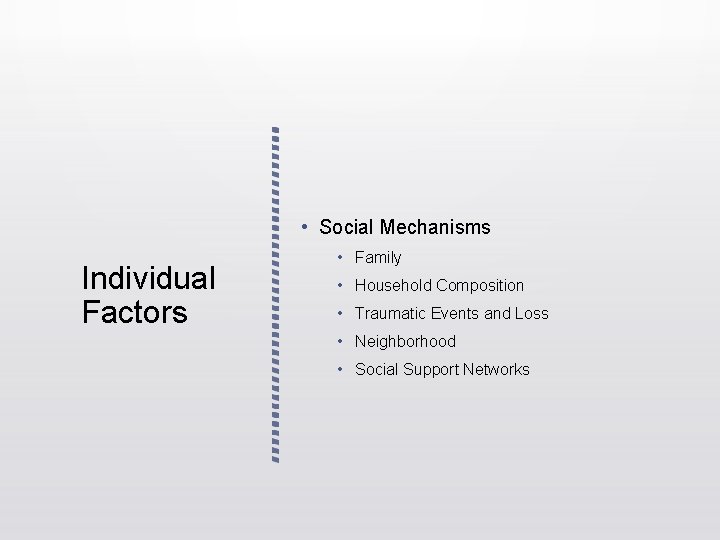
• Social Mechanisms Individual Factors • Family • Household Composition • Traumatic Events and Loss • Neighborhood • Social Support Networks
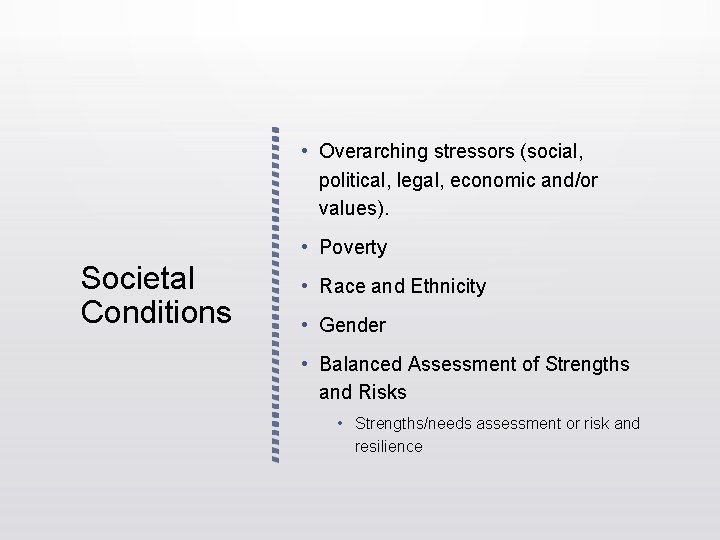
• Overarching stressors (social, political, legal, economic and/or values). • Poverty Societal Conditions • Race and Ethnicity • Gender • Balanced Assessment of Strengths and Risks • Strengths/needs assessment or risk and resilience
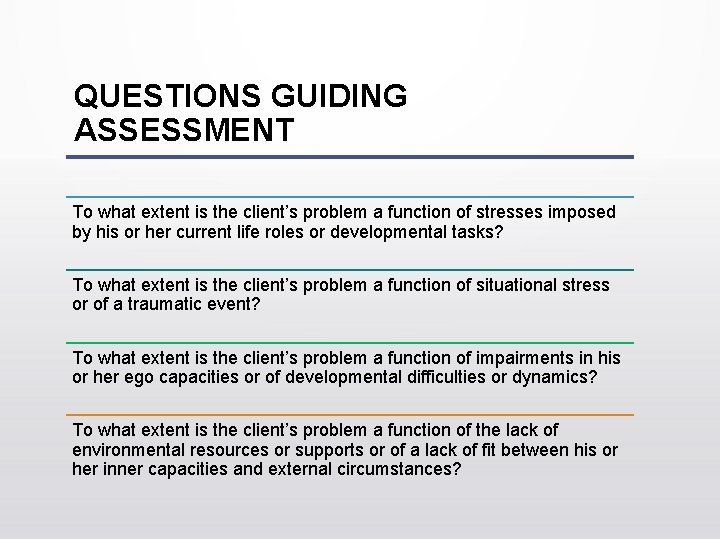
QUESTIONS GUIDING ASSESSMENT To what extent is the client’s problem a function of stresses imposed by his or her current life roles or developmental tasks? To what extent is the client’s problem a function of situational stress or of a traumatic event? To what extent is the client’s problem a function of impairments in his or her ego capacities or of developmental difficulties or dynamics? To what extent is the client’s problem a function of the lack of environmental resources or supports or of a lack of fit between his or her inner capacities and external circumstances?
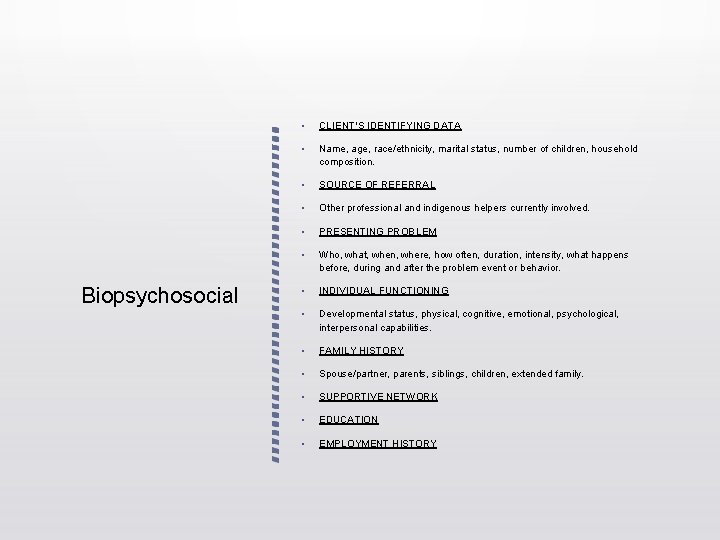
Biopsychosocial • CLIENT’S IDENTIFYING DATA • Name, age, race/ethnicity, marital status, number of children, household composition. • SOURCE OF REFERRAL • Other professional and indigenous helpers currently involved. • PRESENTING PROBLEM • Who, what, when, where, how often, duration, intensity, what happens before, during and after the problem event or behavior. • INDIVIDUAL FUNCTIONING • Developmental status, physical, cognitive, emotional, psychological, interpersonal capabilities. • FAMILY HISTORY • Spouse/partner, parents, siblings, children, extended family. • SUPPORTIVE NETWORK • EDUCATION • EMPLOYMENT HISTORY
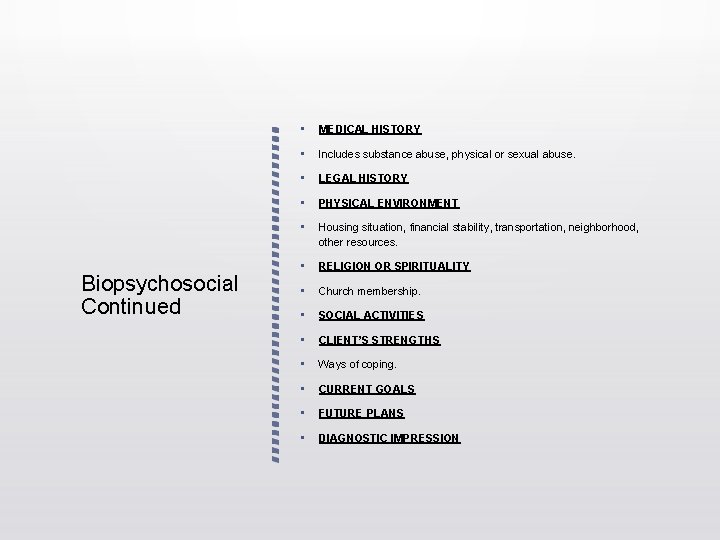
Biopsychosocial Continued • MEDICAL HISTORY • Includes substance abuse, physical or sexual abuse. • LEGAL HISTORY • PHYSICAL ENVIRONMENT • Housing situation, financial stability, transportation, neighborhood, other resources. • RELIGION OR SPIRITUALITY • Church membership. • SOCIAL ACTIVITIES • CLIENT’S STRENGTHS • Ways of coping. • CURRENT GOALS • FUTURE PLANS • DIAGNOSTIC IMPRESSION
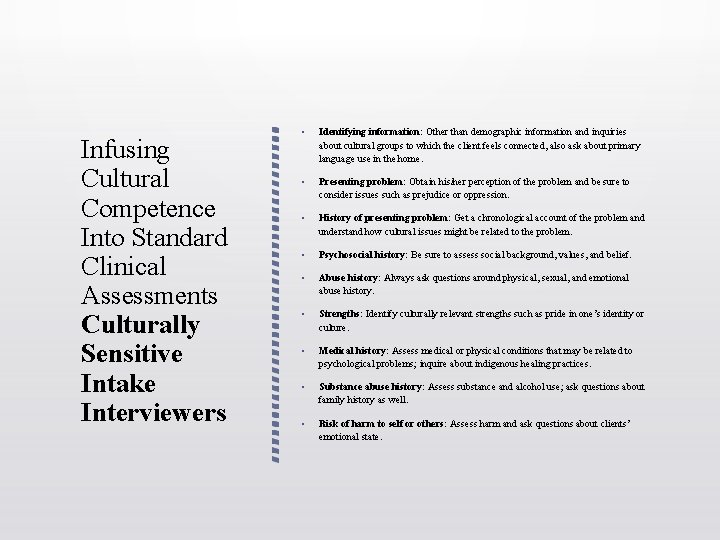
Infusing Cultural Competence Into Standard Clinical Assessments Culturally Sensitive Intake Interviewers • Identifying information: Other than demographic information and inquiries about cultural groups to which the client feels connected, also ask about primary language use in the home. • Presenting problem: Obtain his/her perception of the problem and be sure to consider issues such as prejudice or oppression. • History of presenting problem: Get a chronological account of the problem and understand how cultural issues might be related to the problem. • Psychosocial history: Be sure to assess social background, values, and belief. • Abuse history: Always ask questions around physical, sexual, and emotional abuse history. • Strengths: Identify culturally relevant strengths such as pride in one’s identity or culture. • Medical history: Assess medical or physical conditions that may be related to psychological problems; inquire about indigenous healing practices. • Substance abuse history: Assess substance and alcohol use; ask questions about family history as well. • Risk of harm to self or others: Assess harm and ask questions about clients’ emotional state.
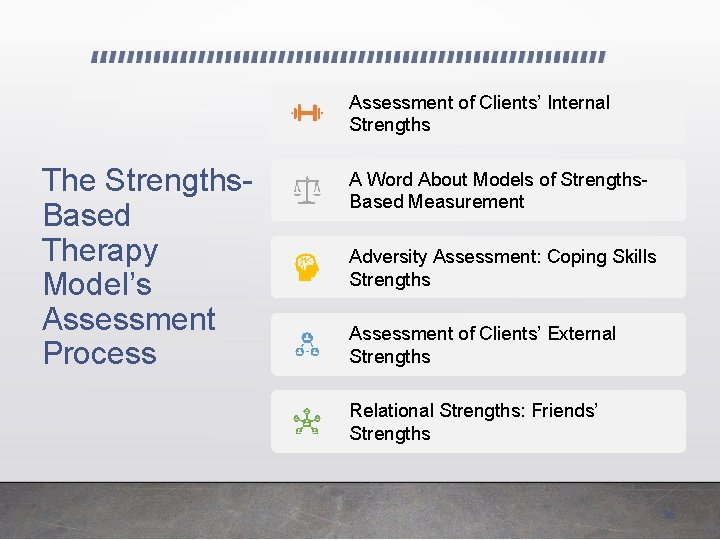
Assessment of Clients’ Internal Strengths The Strengths. Based Therapy Model’s Assessment Process A Word About Models of Strengths. Based Measurement Adversity Assessment: Coping Skills Strengths Assessment of Clients’ External Strengths Relational Strengths: Friends’ Strengths 36
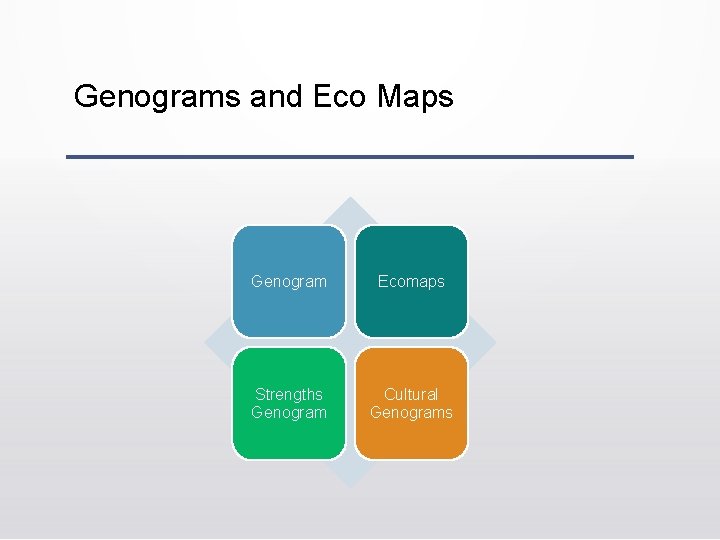
Genograms and Eco Maps Genogram Ecomaps Strengths Genogram Cultural Genograms
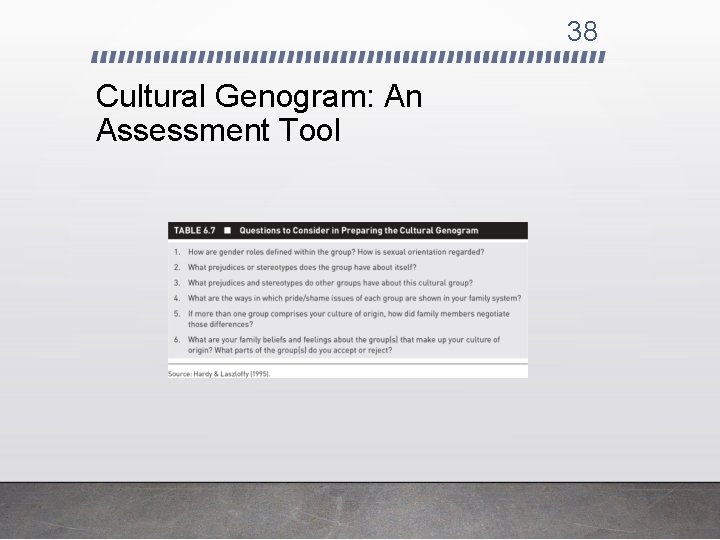
38 Cultural Genogram: An Assessment Tool
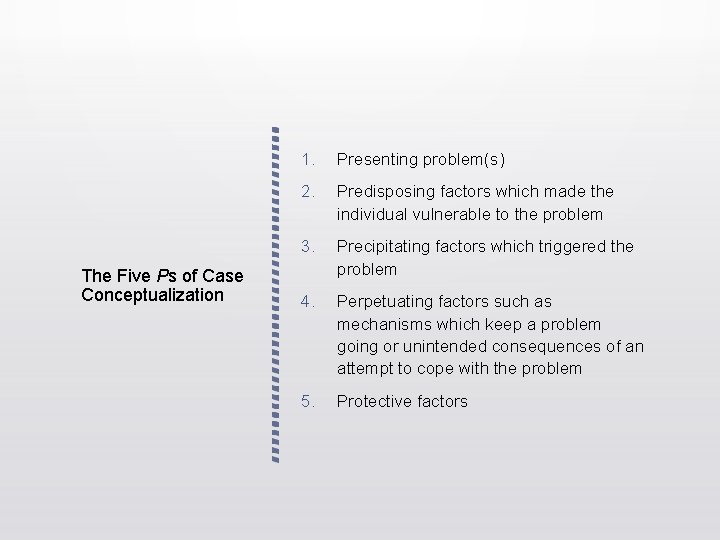
The Five Ps of Case Conceptualization 1. Presenting problem(s) 2. Predisposing factors which made the individual vulnerable to the problem 3. Precipitating factors which triggered the problem 4. Perpetuating factors such as mechanisms which keep a problem going or unintended consequences of an attempt to cope with the problem 5. Protective factors
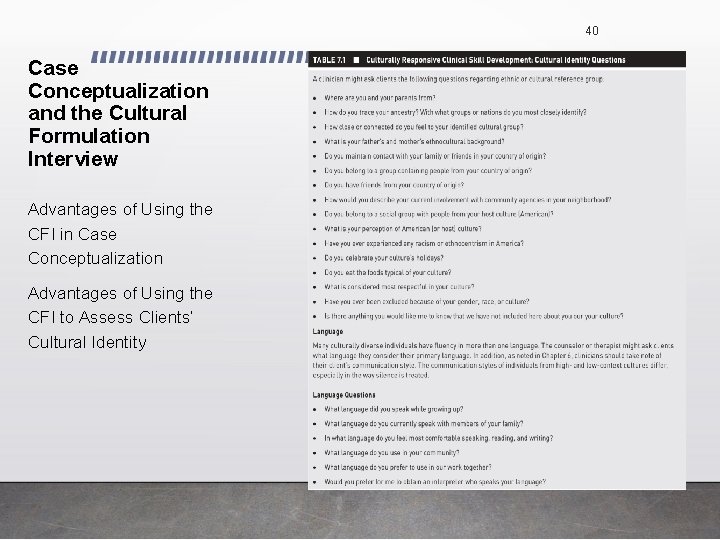
40 Case Conceptualization and the Cultural Formulation Interview Advantages of Using the CFI in Case Conceptualization Advantages of Using the CFI to Assess Clients’ Cultural Identity
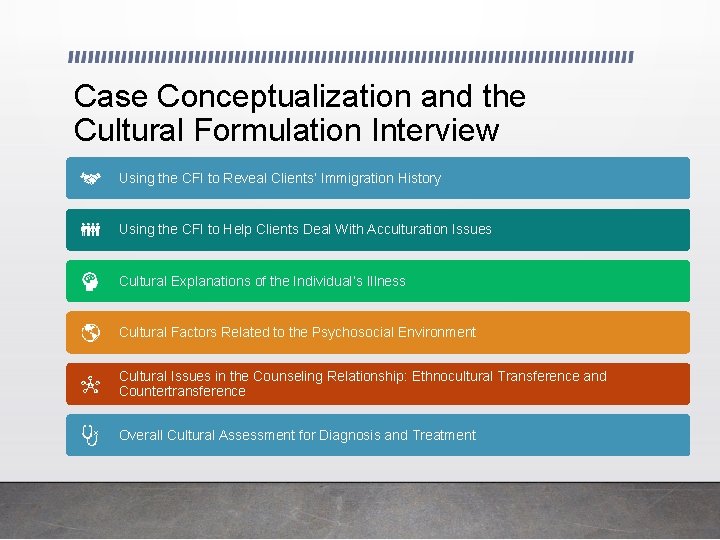
Case Conceptualization and the Cultural Formulation Interview Using the CFI to Reveal Clients’ Immigration History Using the CFI to Help Clients Deal With Acculturation Issues Cultural Explanations of the Individual’s Illness Cultural Factors Related to the Psychosocial Environment Cultural Issues in the Counseling Relationship: Ethnocultural Transference and Countertransference Overall Cultural Assessment for Diagnosis and Treatment
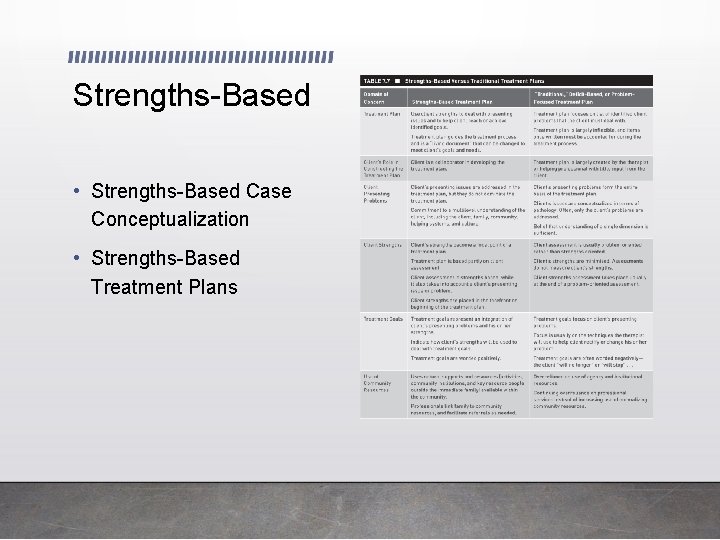
Strengths-Based • Strengths-Based Case Conceptualization • Strengths-Based Treatment Plans
Questions? Let’s Discuss