
ASSESSMENT AND DIAGNOSIS Overview Pain Underreported Underdiagnosed and






- Slides: 42
ASSESSMENT AND DIAGNOSIS
Overview
Pain: Underreported, Underdiagnosed and Undertreated • Ongoing pain has been underreported , underdiagnosed , and undertreated in nearly all health care settings • Individuals with pain that reduces quality of life should be encouraged to seek help • Comprehensive assessment and treatments likely to produce best results Institute of Medicine. Relieving Pain in America: A Blueprint for Transforming Prevention, Care, Education, and Research. The National Academies Press; Washington, DC: 2011.
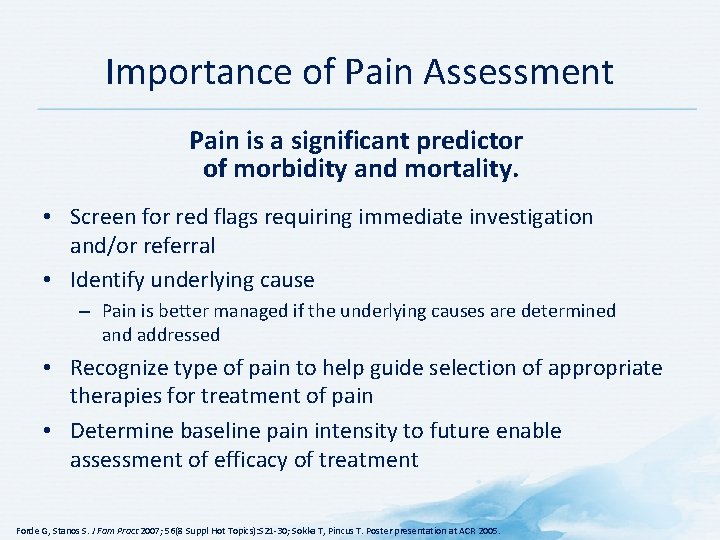
Importance of Pain Assessment Pain is a significant predictor of morbidity and mortality. • Screen for red flags requiring immediate investigation and/or referral • Identify underlying cause – Pain is better managed if the underlying causes are determined and addressed • Recognize type of pain to help guide selection of appropriate therapies for treatment of pain • Determine baseline pain intensity to future enable assessment of efficacy of treatment Forde G, Stanos S. J Fam Pract 2007; 56(8 Suppl Hot Topics): S 21 -30; Sokka T, Pincus T. Poster presentation at ACR 2005.
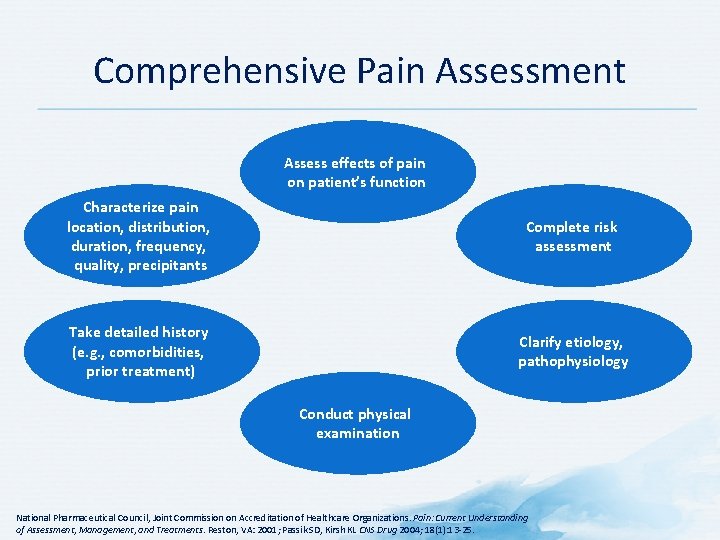
Comprehensive Pain Assessment Assess effects of pain on patient’s function Characterize pain location, distribution, duration, frequency, quality, precipitants Complete risk assessment Take detailed history (e. g. , comorbidities, prior treatment) Clarify etiology, pathophysiology Conduct physical examination National Pharmaceutical Council, Joint Commission on Accreditation of Healthcare Organizations. Pain: Current Understanding of Assessment, Management, and Treatments. Reston, VA: 2001; Passik SD, Kirsh KL CNS Drug 2004; 18(1): 13 -25.
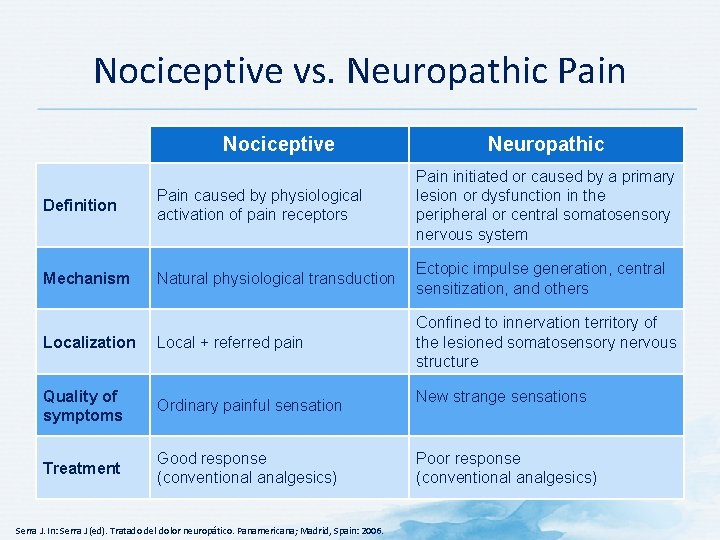
Nociceptive vs. Neuropathic Pain Nociceptive Neuropathic Definition Pain caused by physiological activation of pain receptors Pain initiated or caused by a primary lesion or dysfunction in the peripheral or central somatosensory nervous system Mechanism Natural physiological transduction Ectopic impulse generation, central sensitization, and others Localization Local + referred pain Confined to innervation territory of the lesioned somatosensory nervous structure Quality of symptoms Ordinary painful sensation Treatment Good response (conventional analgesics) Serra J. In: Serra J (ed). Tratado del dolor neuropático. Panamericana; Madrid, Spain: 2006. New strange sensations Poor response (conventional analgesics)
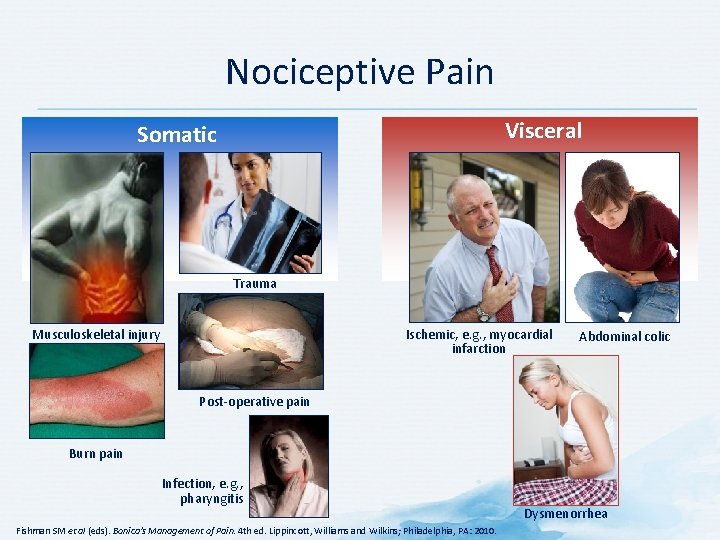
Nociceptive Pain Visceral Somatic Trauma Musculoskeletal injury Ischemic, e. g. , myocardial infarction Abdominal colic Post-operative pain Burn pain Infection, e. g. , pharyngitis Fishman SM et al (eds). Bonica’s Management of Pain. 4 th ed. Lippincott, Williams and Wilkins; Philadelphia, PA: 2010. Dysmenorrhea
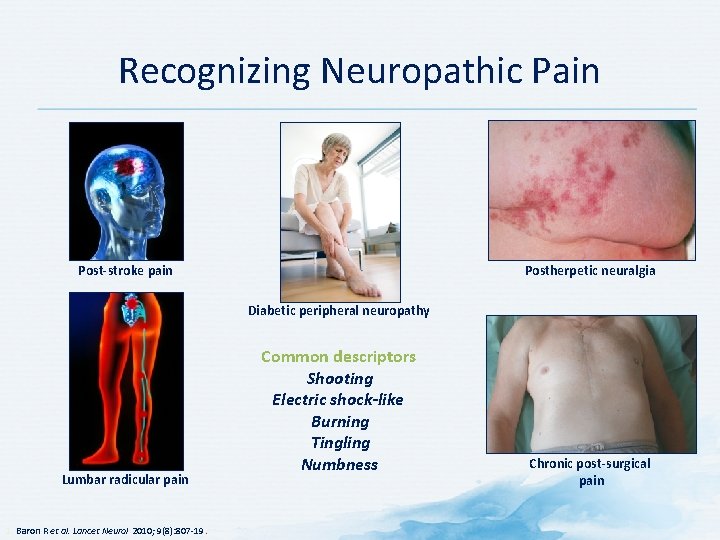
Recognizing Neuropathic Pain Post-stroke pain Postherpetic neuralgia Diabetic peripheral neuropathy Lumbar radicular pain 1. Baron R et al. Lancet Neurol 2010; 9(8): 807 -19. Common descriptors Shooting Electric shock-like Burning Tingling Numbness Chronic post-surgical pain
History
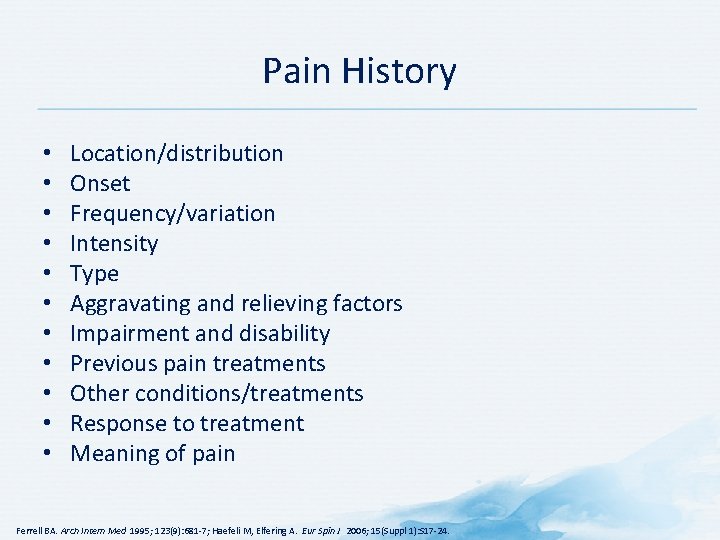
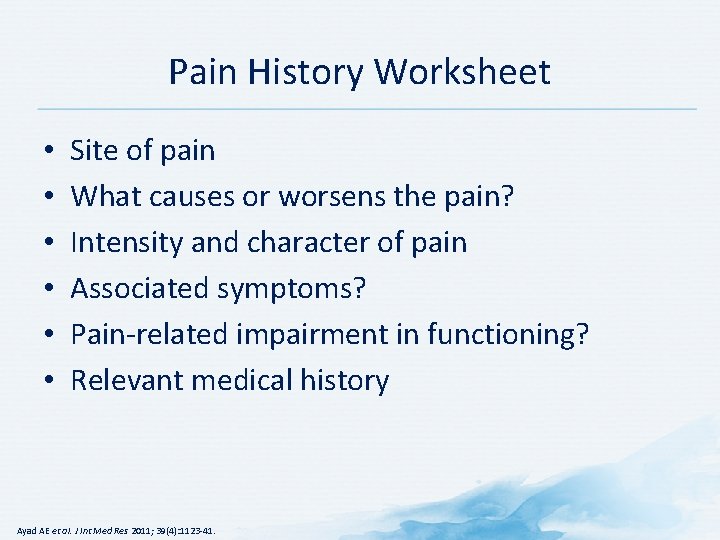
Pain History • • • Location/distribution Onset Frequency/variation Intensity Type Aggravating and relieving factors Impairment and disability Previous pain treatments Other conditions/treatments Response to treatment Meaning of pain Ferrell BA. Arch Intern Med 1995; 123(9): 681 -7; Haefeli M, Elfering A. Eur Spin J 2006; 15(Suppl 1): S 17 -24.
Pain History Worksheet • • • Site of pain What causes or worsens the pain? Intensity and character of pain Associated symptoms? Pain-related impairment in functioning? Relevant medical history Ayad AE et al. J Int Med Res 2011; 39(4): 1123 -41.
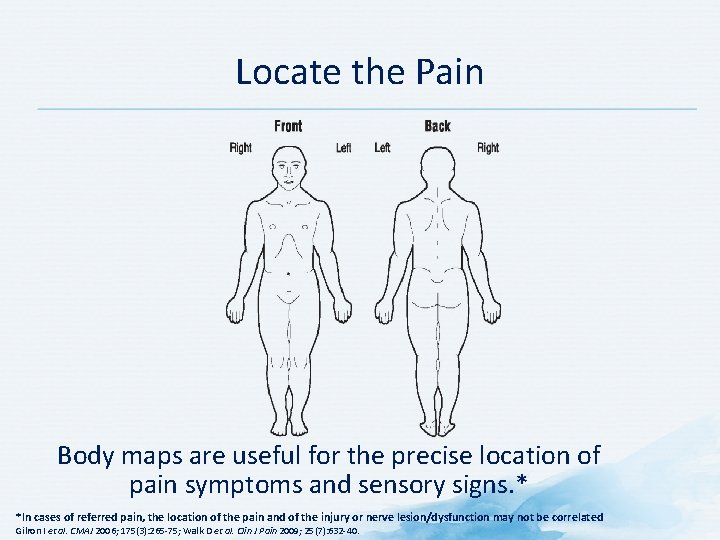
Locate the Pain Body maps are useful for the precise location of pain symptoms and sensory signs. * *In cases of referred pain, the location of the pain and of the injury or nerve lesion/dysfunction may not be correlated Gilron I et al. CMAJ 2006; 175(3): 265 -75; Walk D et al. Clin J Pain 2009; 25(7): 632 -40.
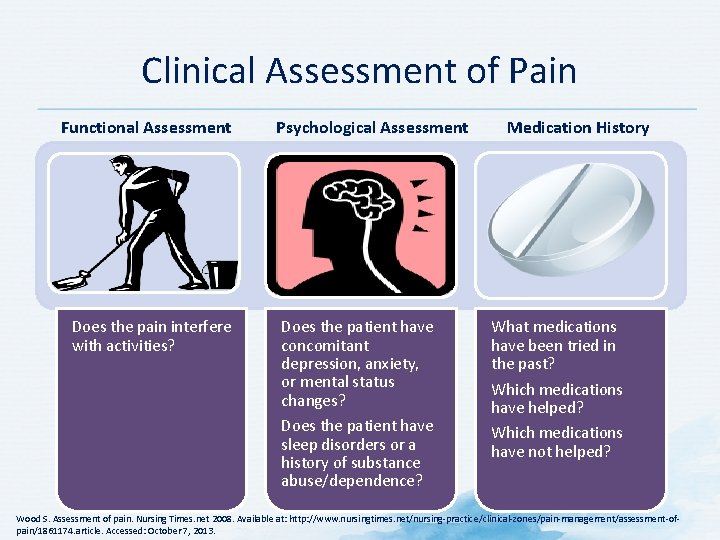
Clinical Assessment of Pain Functional Assessment Does the pain interfere with activities? Psychological Assessment Does the patient have concomitant depression, anxiety, or mental status changes? Does the patient have sleep disorders or a history of substance abuse/dependence? Medication History What medications have been tried in the past? Which medications have helped? Which medications have not helped? Wood S. Assessment of pain. Nursing Times. net 2008. Available at: http: //www. nursingtimes. net/nursing-practice/clinical-zones/pain-management/assessment-ofpain/1861174. article. Accessed: October 7, 2013.
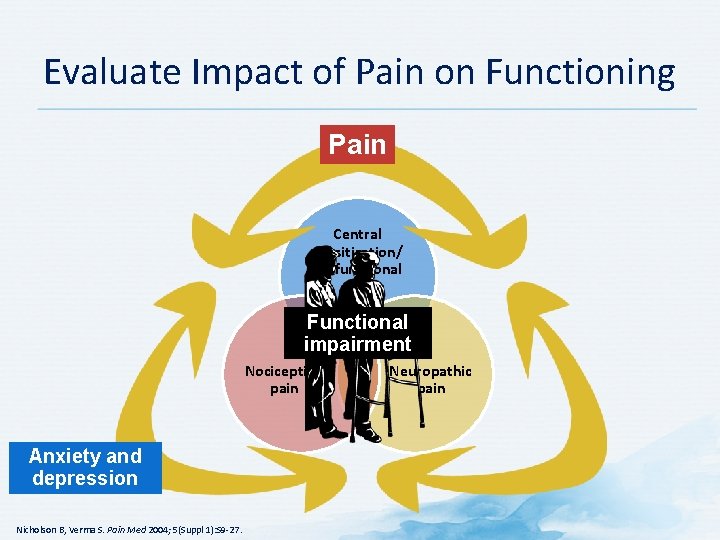
Evaluate Impact of Pain on Functioning Pain Central sensitization/ dysfunctional pain Functional impairment Nociceptive pain Anxiety and depression Nicholson B, Verma S. Pain Med 2004; 5(Suppl 1): S 9 -27. Neuropathic pain
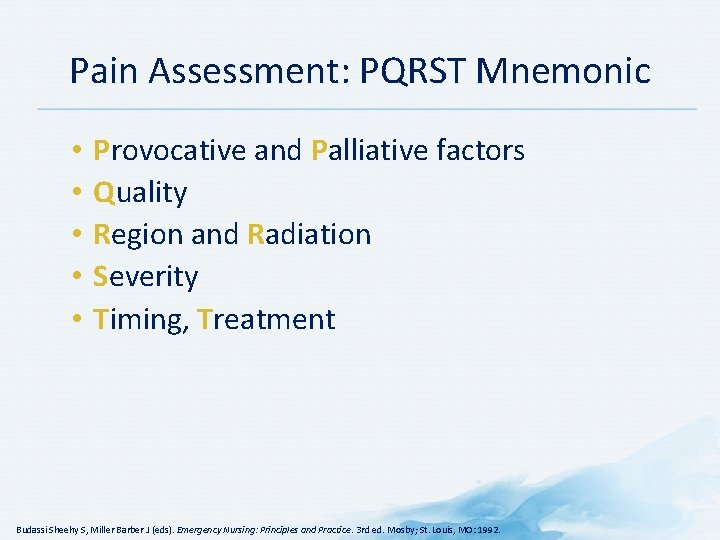
Pain Assessment: PQRST Mnemonic • • • Provocative and Palliative factors Quality Region and Radiation Severity Timing, Treatment Budassi Sheehy S, Miller Barber J (eds). Emergency Nursing: Principles and Practice. 3 rd ed. Mosby; St. Louis, MO: 1992.
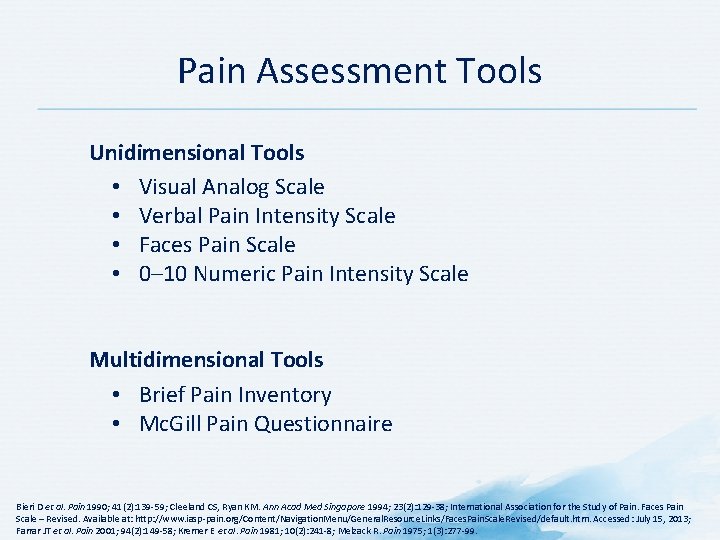
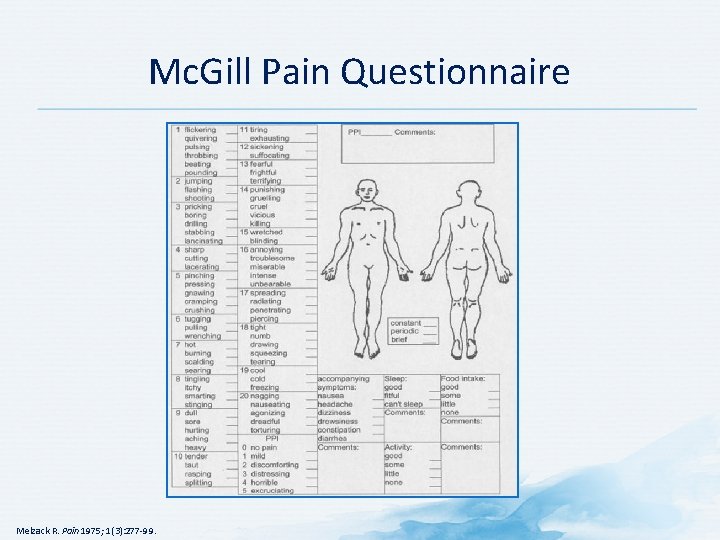
Pain Assessment Tools Unidimensional Tools • Visual Analog Scale • Verbal Pain Intensity Scale • Faces Pain Scale • 0– 10 Numeric Pain Intensity Scale Multidimensional Tools • Brief Pain Inventory • Mc. Gill Pain Questionnaire Bieri D et al. Pain 1990; 41(2): 139 -59; Cleeland CS, Ryan KM. Ann Acad Med Singapore 1994; 23(2): 129 -38; International Association for the Study of Pain. Faces Pain Scale – Revised. Available at: http: //www. iasp-pain. org/Content/Navigation. Menu/General. Resource. Links/Faces. Pain. Scale. Revised/default. htm. Accessed: July 15, 2013; Farrar JT et al. Pain 2001; 94(2): 149 -58; Kremer E et al. Pain 1981; 10(2): 241 -8; Melzack R. Pain 1975; 1(3): 277 -99.
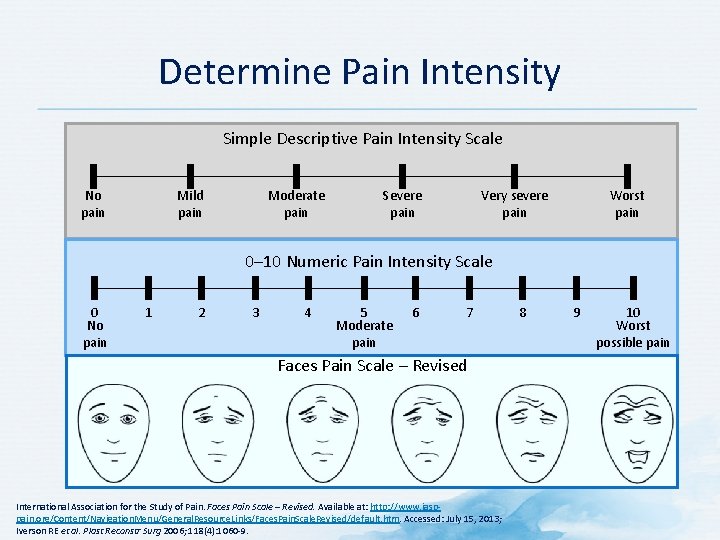
Determine Pain Intensity Simple Descriptive Pain Intensity Scale Mild pain No pain Moderate pain Severe pain Very severe pain Worst pain 0– 10 Numeric Pain Intensity Scale 0 No pain 1 2 3 4 5 Moderate pain 6 7 Faces Pain Scale – Revised International Association for the Study of Pain. Faces Pain Scale – Revised. Available at: http: //www. iasppain. org/Content/Navigation. Menu/General. Resource. Links/Faces. Pain. Scale. Revised/default. htm. Accessed: July 15, 2013; Iverson RE et al. Plast Reconstr Surg 2006; 118(4): 1060 -9. 8 9 10 Worst possible pain
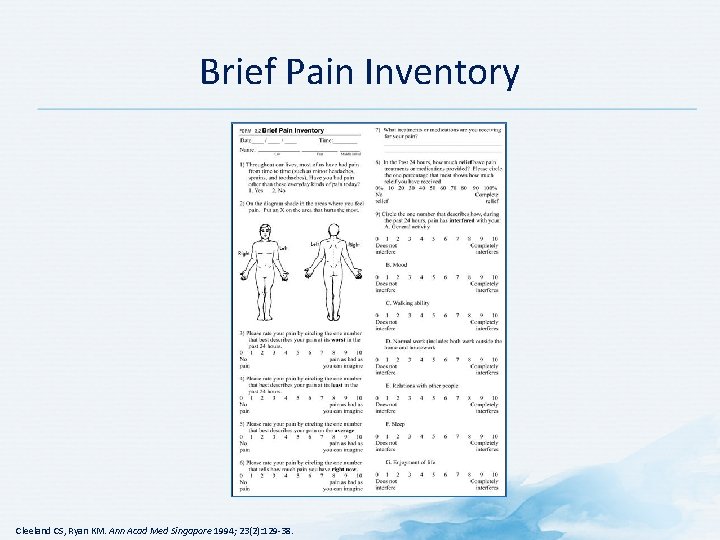
Brief Pain Inventory Cleeland CS, Ryan KM. Ann Acad Med Singapore 1994; 23(2): 129 -38.
Mc. Gill Pain Questionnaire Melzack R. Pain 1975; 1(3): 277 -99.
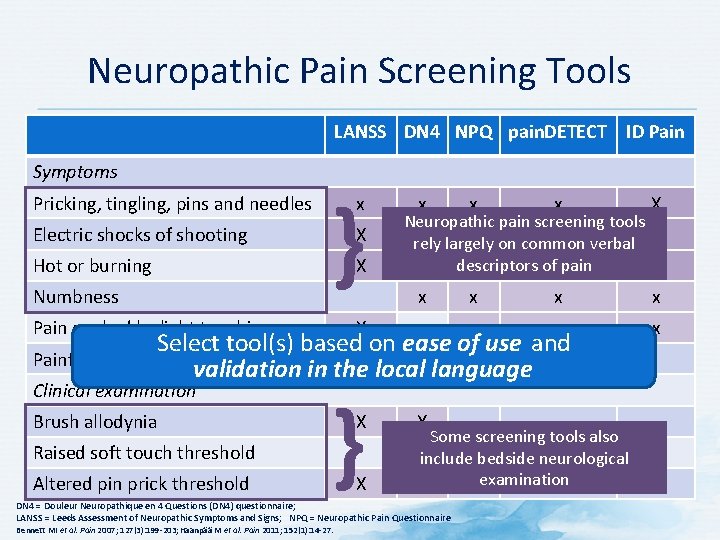
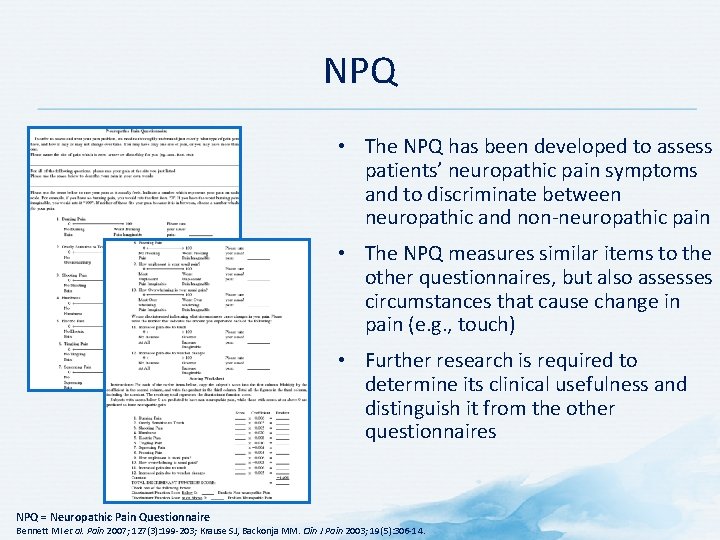
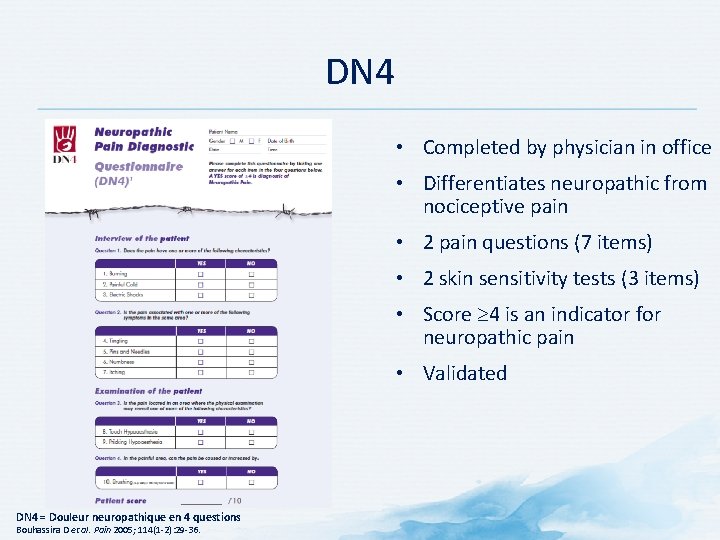
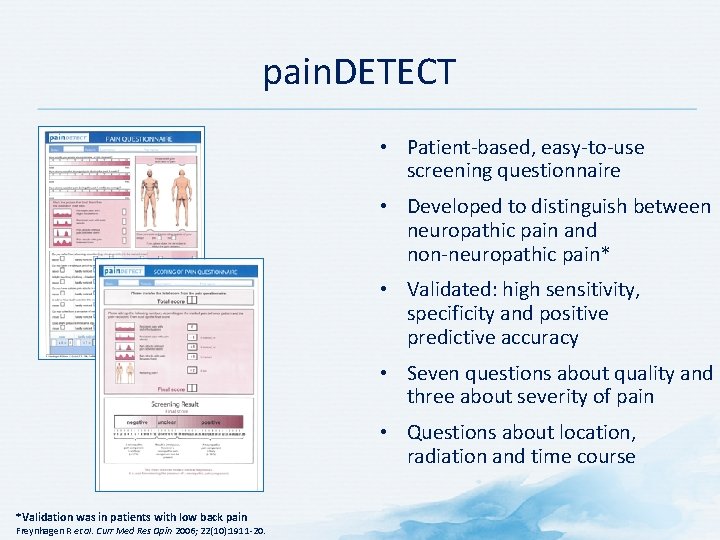
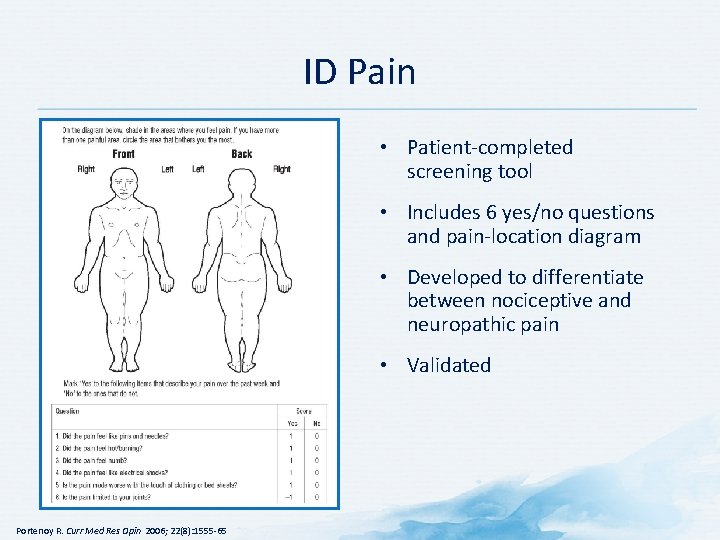
Neuropathic Pain Screening Tools LANSS DN 4 NPQ pain. DETECT ID Pain Symptoms Pricking, tingling, pins and needles Electric shocks of shooting Hot or burning Numbness } x X X Pain evoked by light touching x x x X x x x x Neuropathic pain screening tools x x rely largely on common verbal x descriptors of pain x x x X Select tool(s) based on ease of use and Painful cold or freezing pain X validation in the localx language Clinical examination Brush allodynia Raised soft touch threshold Altered pin prick threshold } X X X Some screening tools also Xinclude bedside neurological examination X DN 4 = Douleur Neuropathique en 4 Questions (DN 4) questionnaire; LANSS = Leeds Assessment of Neuropathic Symptoms and Signs; NPQ = Neuropathic Pain Questionnaire Bennett MI et al. Pain 2007; 127(3): 199 -203; Haanpää M et al. Pain 2011; 152(1): 14 -27.
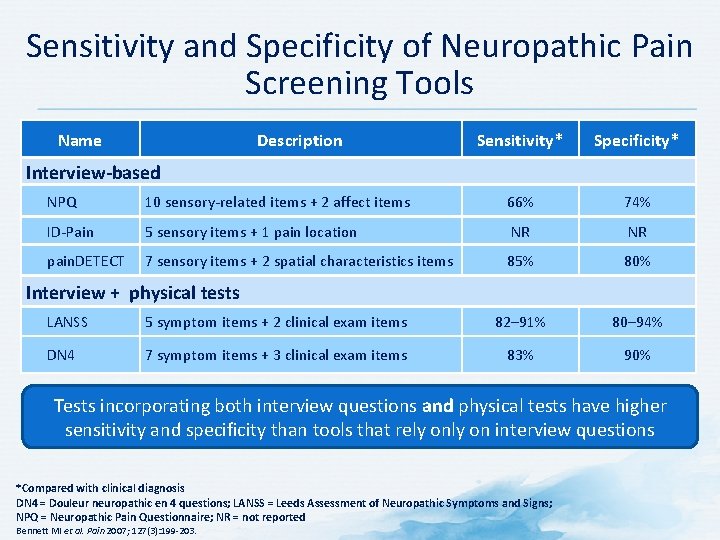
Sensitivity and Specificity of Neuropathic Pain Screening Tools Name Description Sensitivity* Specificity* Interview-based NPQ 10 sensory-related items + 2 affect items 66% 74% ID-Pain 5 sensory items + 1 pain location NR NR pain. DETECT 7 sensory items + 2 spatial characteristics items 85% 80% Interview + physical tests LANSS 5 symptom items + 2 clinical exam items 82– 91% 80– 94% DN 4 7 symptom items + 3 clinical exam items 83% 90% Tests incorporating both interview questions and physical tests have higher sensitivity and specificity than tools that rely on interview questions *Compared with clinical diagnosis DN 4 = Douleur neuropathic en 4 questions; LANSS = Leeds Assessment of Neuropathic Symptoms and Signs; NPQ = Neuropathic Pain Questionnaire; NR = not reported Bennett MI et al. Pain 2007; 127(3): 199 -203.
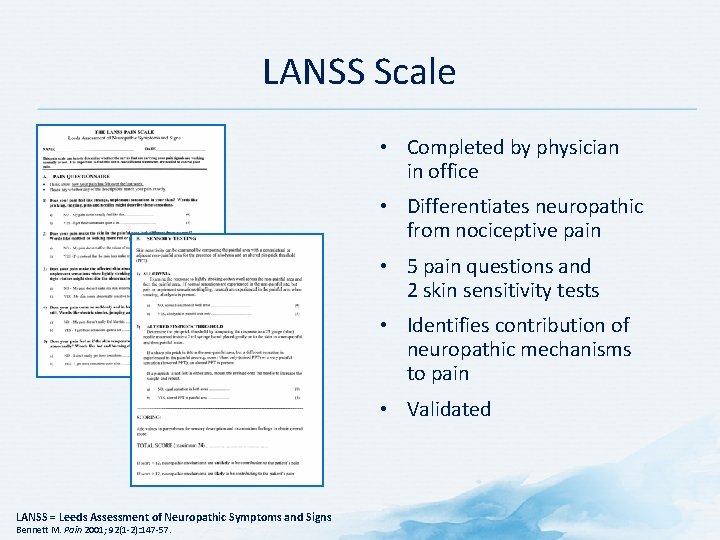
LANSS Scale • Completed by physician in office • Differentiates neuropathic from nociceptive pain • 5 pain questions and 2 skin sensitivity tests • Identifies contribution of neuropathic mechanisms to pain • Validated LANSS = Leeds Assessment of Neuropathic Symptoms and Signs Bennett M. Pain 2001; 92(1 -2): 147 -57.
NPQ • The NPQ has been developed to assess patients’ neuropathic pain symptoms and to discriminate between neuropathic and non-neuropathic pain • The NPQ measures similar items to the other questionnaires, but also assesses circumstances that cause change in pain (e. g. , touch) • Further research is required to determine its clinical usefulness and distinguish it from the other questionnaires NPQ = Neuropathic Pain Questionnaire Bennett MI et al. Pain 2007; 127(3): 199 -203; Krause SJ, Backonja MM. Clin J Pain 2003; 19(5): 306 -14.
DN 4 • Completed by physician in office • Differentiates neuropathic from nociceptive pain • 2 pain questions (7 items) • 2 skin sensitivity tests (3 items) • Score 4 is an indicator for neuropathic pain • Validated DN 4 = Douleur neuropathique en 4 questions Bouhassira D et al. Pain 2005; 114(1 -2): 29 -36.
pain. DETECT • Patient-based, easy-to-use screening questionnaire • Developed to distinguish between neuropathic pain and non-neuropathic pain* • Validated: high sensitivity, specificity and positive predictive accuracy • Seven questions about quality and three about severity of pain • Questions about location, radiation and time course *Validation was in patients with low back pain Freynhagen R et al. Curr Med Res Opin 2006; 22(10): 1911 -20.
ID Pain • Patient-completed screening tool • Includes 6 yes/no questions and pain-location diagram • Developed to differentiate between nociceptive and neuropathic pain • Validated Portenoy R. Curr Med Res Opin 2006; 22(8): 1555 -65
Physical Examination
Comprehensive Physical Examination Is Important • Conduct comprehensive physical and neurological exams when evaluating and identifying patient’s subjective complaints of pain 1 – Should serve to verify preliminary impression from history and guide the selection of laboratory and imaging studies 2 • Confirm or exclude underlying causes 1. American Society of Anesthesiologists Task Force on Pain Management, Chronic Pain Section. Anesthesiology 1997; 86(4): 995 -1004; 2. Brunton S. J Fam Pract 2004; 53(10 suppl): S 3 -10.
Examples of Bedside Tests for Neuropathic Pain • Touch tests can detect – Differences in skin temperature – Hypersensitivity – Unpleasant abnormal sensations – Sensory deficit • Tests to evoke pain – Response is the presence of positive sensory symptoms – Examples include touch, pinprick, pinch, and etiology-specific tests Baron R, Tölle TR. Curr Opin Support Palliat Care 2008; 2(1): 1 -8; Gilron I et al. CMAJ 2006; 175(3): 265 -75; Haanpää ML et al. Am J Med 2009; 122(10 Suppl): S 13 -21.
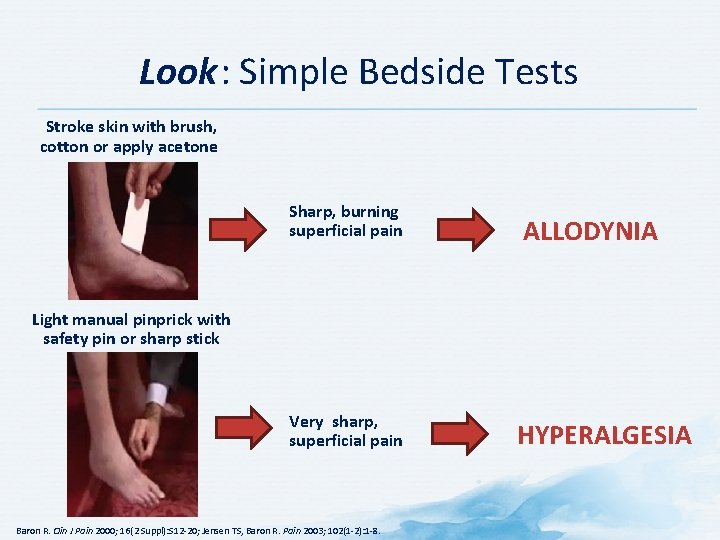
Look: Simple Bedside Tests Stroke skin with brush, cotton or apply acetone Sharp, burning superficial pain Very sharp, superficial pain ALLODYNIA Light manual pinprick with safety pin or sharp stick Baron R. Clin J Pain 2000; 16(2 Suppl): S 12 -20; Jensen TS, Baron R. Pain 2003; 102(1 -2): 1 -8. HYPERALGESIA
Imaging and Other Tests
Pain Diagnostics • • • Plain X-rays with multiple views MRI CT CT myelogram Nerve conduction velocity Electromyography CT = computed tomography; MRI = magnetic resonance imaging Brunton S. J Fam Pract 2004; 53(10 Suppl): S 3 -S 10.
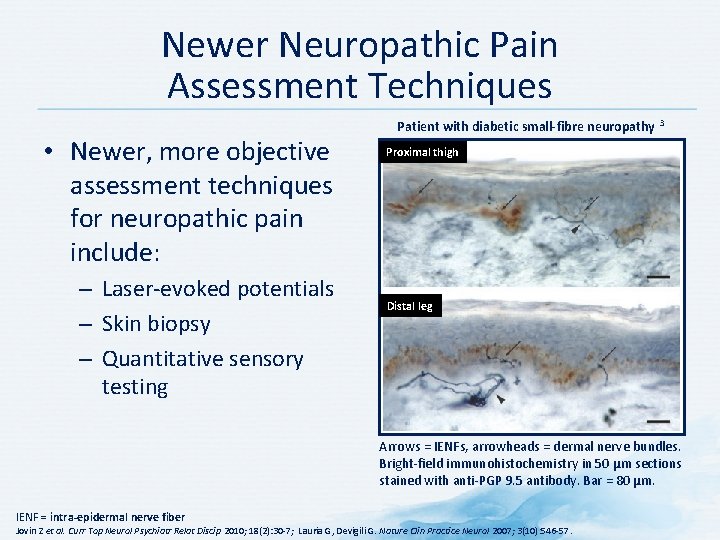
Newer Neuropathic Pain Assessment Techniques • Newer, more objective assessment techniques for neuropathic pain include: – Laser-evoked potentials – Skin biopsy – Quantitative sensory testing Patient with diabetic small-fibre neuropathy 3 Proximal thigh Distal leg Arrows = IENFs, arrowheads = dermal nerve bundles. Bright-field immunohistochemistry in 50 µm sections stained with anti-PGP 9. 5 antibody. Bar = 80 µm. IENF = intra-epidermal nerve fiber Jovin Z et al. Curr Top Neurol Psychiatr Relat Discip 2010; 18(2): 30 -7; Lauria G, Devigili G. Nature Clin Practice Neurol 2007; 3(10): 546 -57.
Laser-Evoked Potentials How They Work • • • Detect dysfunction of pain and temperature pathways, which are the basis of neuropathic pain development 2 Laser-generated radiant heat pulses selectively excite free nerve endings in the superficial skin layers 3 Brain responses are recorded 4 Late laser evoked potentials reflect activity of Aδ nerve endings in superficial skin layers 1 Laser evoked potential magnitudes may accurately gauge subjective experience of pain 4 EFNS = European Federation of Neurological Societies Potential Place in Practice • • • Easiest, most reliable, and most sensitive neurophysiological way to assess the function of nociceptive pathways 1 EFNS has recommended the use of laser evoked potentials as an ancillary tool in the evaluation of neuropathic pain 2 Use in diagnosis currently limited by availability of equipment 2 1. Cruccu G et al. Eur J Neurol 2010; 17(8): 1010 -8; Garcia-Larrea L, Godinho F. Eur Neurolog Disease 2007; 2: 39 -41; 2. Truini A et al. Clin Neurophysiol 2005; 116(4): 821 -6; Garcia-Larrea L et al. Brain 2002; 125(Pt 12): 2766 -81.
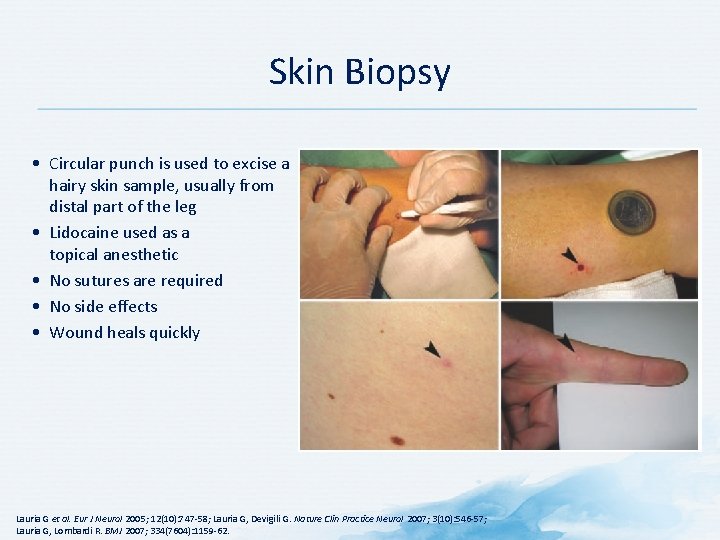
Skin Biopsy • Circular punch is used to excise a hairy skin sample, usually from distal part of the leg • Lidocaine used as a topical anesthetic • No sutures are required • No side effects • Wound heals quickly Lauria G et al. Eur J Neurol 2005; 12(10): 747 -58; Lauria G, Devigili G. Nature Clin Practice Neurol 2007; 3(10): 546 -57; Lauria G, Lombardi R. BMJ 2007; 334(7604): 1159 -62.
Quantitative Sensory Testing How It Works • • Involves measuring the responses evoked by mechanical and thermal stimuli of controlled intensity 2 Stimuli are applied to the skin in ascending and descending order 3 • Mechanical sensitivity: assessed using plastic filaments and pin prick sensation with weighted needles 3 • Vibration sensitivity: assessed using an electronic vibrameter 3 • Thermal sensitivity: assessed using a probe that operates on a thermoelectric principle 3 1. Rolke R et al. Pain 2006; 123(3): 231 -43; 2. Hansson P et al. Pain 2007; 129(3): 256 -9; 3. Jovin Z et al. Curr Top Neurol Psychiatr Relat Discip 2010; 18(2): 30 -7; 4. Cruccu G, Truini A. Neurol Sci 2006; 27(Suppl 4): S 288 -90. Limitations • • • Relies on the patient’s subjective assessment of pain 3 Outcomes of quantitative sensory testing and bedside testing do not necessarily coincide 2 Quantitative sensory testing abnormalities cannot be taken as conclusive demonstration of neuropathic pain 4 because they also occur in other conditions, such as rheumatoid arthritis 3 Time consuming and requires expensive equipment 4 Results can be influenced by various factors (e. g. , model or make of equipment, room temperature, site of stimulus, patient characteristics)2
Diagnosis
Pain Diagnosis • Confirm or exclude underlying causes • There is no single diagnostic test for pain • Multiple tests may not be helpful American Society of Anesthesiologists Task Force on Pain Management, Chronic Pain Section. Anesthesiology 1997; 86(4): 995 -1004; Brunton S. J Fam Pract 2004; 53(10 Suppl): S 3 -10.
Identify and Treat Underlying Cause Whenever possible, it is important to identify and treat the underlying cause of pain! Forde G, Stanos S. J Fam Pract 2007; 56(8 Suppl Hot Topics): S 21 -30.
Be Alert for Red Flags Evaluate for patients presenting with pain the presence of red flags! Initiate appropriate investigations/ management or refer to specialist Littlejohn GO. J R Coll Physicians Edinb 2005; 35(4): 340 -4.
Summary
Assessment and Diagnosis: Summary • Assessment of pain is critical and should include: – Location, duration, frequency, quality, severity, etc. – Medication history – Physical exam – Assessment of patient function – Psychological assessment – Risk assessment – Comorbidities – Determination of type(s) of pain