
Assessing Young Childrens Language and Literacy Assessment To
- Slides: 14
Assessing Young Children’s Language and Literacy
Assessment To judge the worth or importance of (Webster’s compact dictionary, 2002) In the early childhood setting, assessment is used to determine the on-going development of children. Assessment is derived from observations and used to develop individualized curriculum in order to meet the needs of children.
Reasons behind Observation and Assessment Observation and assessment provides us with the ability to: • Understand children’s individual development. • Plan for age appropriate and individualized curriculum. • Design the environment. • Evaluate teacher behaviors, interactions and effectiveness.
Two types of Assessment On-going Assessment (informal assessment) is assessment that happens in a child’s natural environment, gathered over time. On-Demand (formal assessment)Assessment is more formalized than on-going assessment and occurs periodically at specified intervals. http: //www. scholastic. com/teachers/article/for mal-vs-informal-assessments
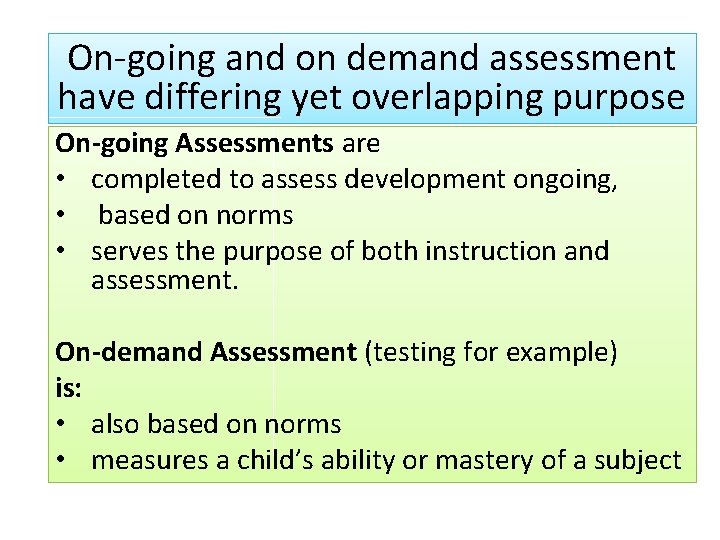
On-going and on demand assessment have differing yet overlapping purpose On-going Assessments are • completed to assess development ongoing, • based on norms • serves the purpose of both instruction and assessment. On-demand Assessment (testing for example) is: • also based on norms • measures a child’s ability or mastery of a subject
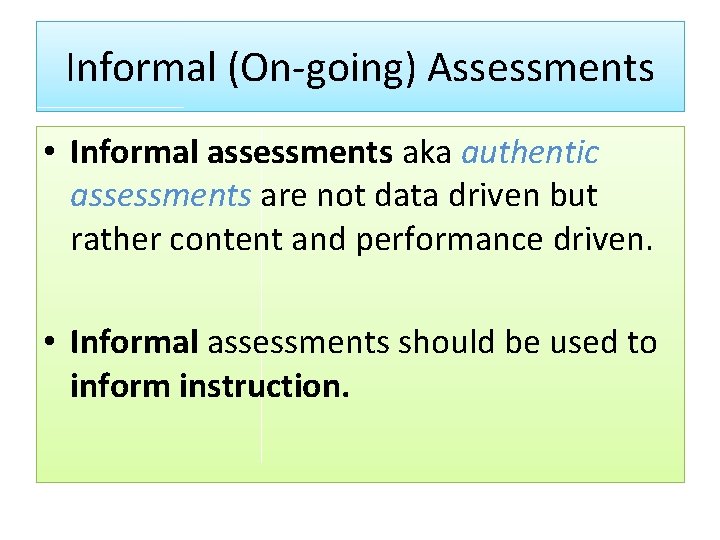
Informal (On-going) Assessments • Informal assessments aka authentic assessments are not data driven but rather content and performance driven. • Informal assessments should be used to inform instruction.
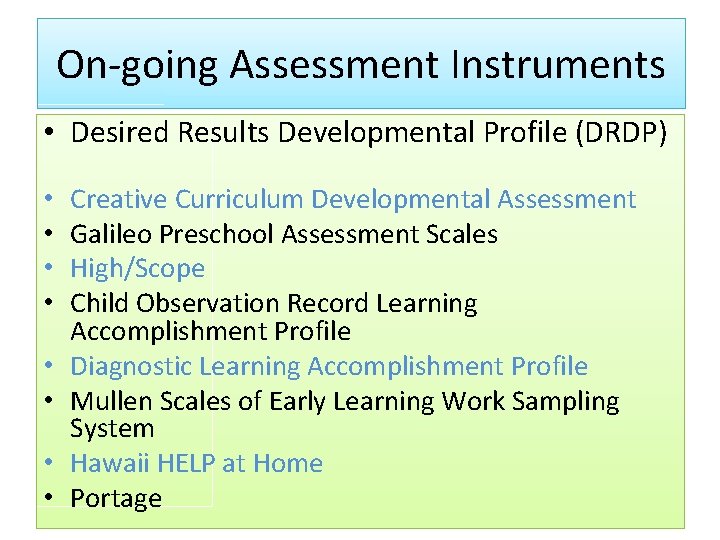
On-going Assessment Instruments • Desired Results Developmental Profile (DRDP) • • Creative Curriculum Developmental Assessment Galileo Preschool Assessment Scales High/Scope Child Observation Record Learning Accomplishment Profile Diagnostic Learning Accomplishment Profile Mullen Scales of Early Learning Work Sampling System Hawaii HELP at Home Portage
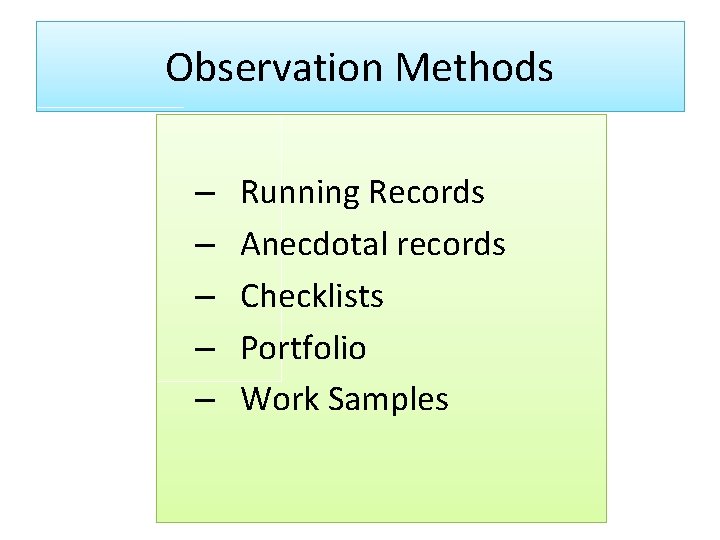
Observation Methods – – – Running Records Anecdotal records Checklists Portfolio Work Samples
Infants and Toddlers Observation learning website http: //toddlers. ccdmd. qc. ca/about http: //toddlers. ccdmd. qc. ca/observing http: //toddlers. ccdmd. qc. ca/video (Copy and paste any one of these into your browser and you will be able to go to this website. )
Formal (On Demand)Assessments The assessment used needs to match the purpose of assessing. • Formal or standardized measures should be used to assess overall achievement, to compare a student's performance with others at their age or grade, or to identify comparable strengths and weaknesses with peers. (On-demand or IN-AUTHENTIC ASSESSMENT)
Screening or On-Demand Assessment To assess according to skills or “to separate according to skills. ” (Webster’s compact dictionary, 2002) A screening tool is used to give a quick view of children’s skills in order to determine if additional help is needed to support a child’s development. (a screening tool is a formal assessment tool that results in determining the child’s current level of development)
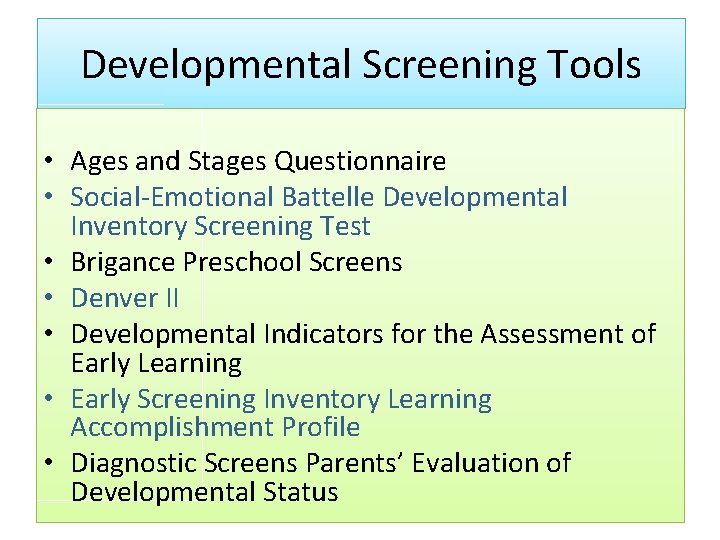
Developmental Screening Tools • Ages and Stages Questionnaire • Social-Emotional Battelle Developmental Inventory Screening Test • Brigance Preschool Screens • Denver II • Developmental Indicators for the Assessment of Early Learning • Early Screening Inventory Learning Accomplishment Profile • Diagnostic Screens Parents’ Evaluation of Developmental Status
Formal Assessments • Formal assessments have data which support the conclusions made from the test. We usually refer to these types of tests as standardized measures. These tests have been tried before on students and have statistics which support the conclusion such as the student is reading below average for his age. The data is mathematically computed and summarized. (Screening tools are formal assessments aka in-authentic form of assessment)
Common Core Standards What are the Common Core Standards? http: //www. cde. ca. gov/re/cc/tl/whatareccss. asp California Common Core State Standards: English Language Arts & Literacy in History/Social Studies, Science, and Technical Subjects http: //www. cde. ca. gov/be/st/ss/documents/final elaccssstandards. pdf