
Assessing the Internal Control Framework The practice of
- Slides: 13
Assessing the Internal Control Framework - The practice of the European Commission’s Internal Audit Service Mr Mirco Barbero European Commission, IAS. C 1
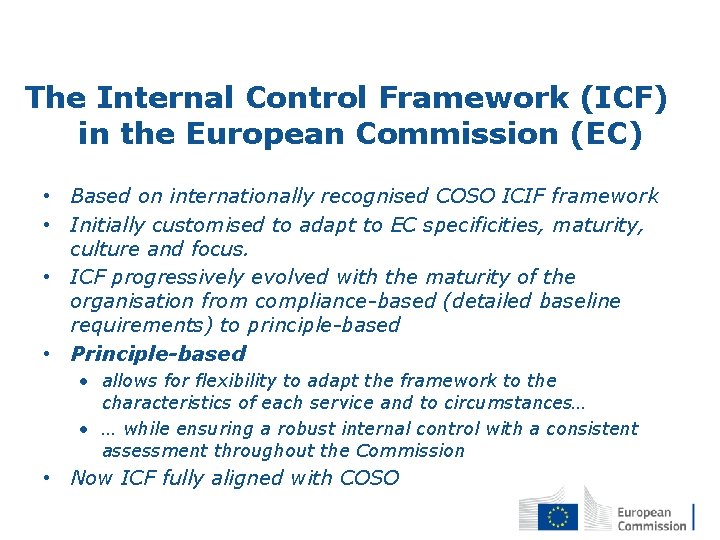
The Internal Control Framework (ICF) in the European Commission (EC) • Based on internationally recognised COSO ICIF framework • Initially customised to adapt to EC specificities, maturity, culture and focus. • ICF progressively evolved with the maturity of the organisation from compliance-based (detailed baseline requirements) to principle-based • Principle-based • allows for flexibility to adapt the framework to the characteristics of each service and to circumstances… • … while ensuring a robust internal control with a consistent assessment throughout the Commission • Now ICF fully aligned with COSO
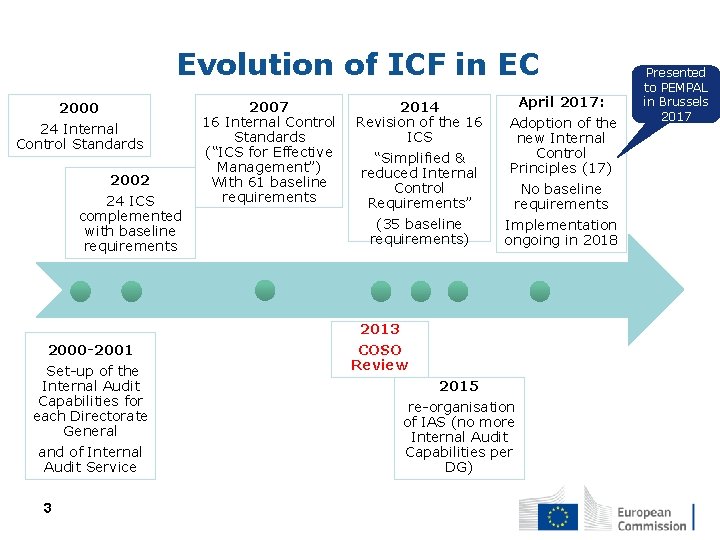
Evolution of ICF in EC 2000 24 Internal Control Standards 2002 24 ICS complemented with baseline requirements 2007 16 Internal Control Standards (“ICS for Effective Management”) With 61 baseline requirements 2014 Revision of the 16 ICS “Simplified & reduced Internal Control Requirements” (35 baseline requirements) April 2017: Adoption of the new Internal Control Principles (17) No baseline requirements Implementation ongoing in 2018 2013 2000 -2001 Set-up of the Internal Audit Capabilities for each Directorate General and of Internal Audit Service 3 COSO Review 2015 re-organisation of IAS (no more Internal Audit Capabilities per DG) Presented to PEMPAL in Brussels 2017
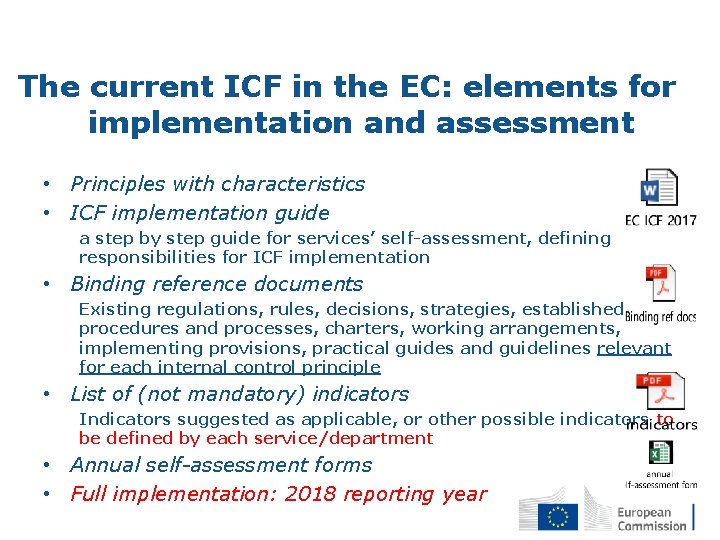
The current ICF in the EC: elements for implementation and assessment • Principles with characteristics • ICF implementation guide a step by step guide for services’ self-assessment, defining responsibilities for ICF implementation • Binding reference documents Existing regulations, rules, decisions, strategies, established procedures and processes, charters, working arrangements, implementing provisions, practical guides and guidelines relevant for each internal control principle • List of (not mandatory) indicators Indicators suggested as applicable, or other possible indicators to be defined by each service/department • Annual self-assessment forms • Full implementation: 2018 reporting year
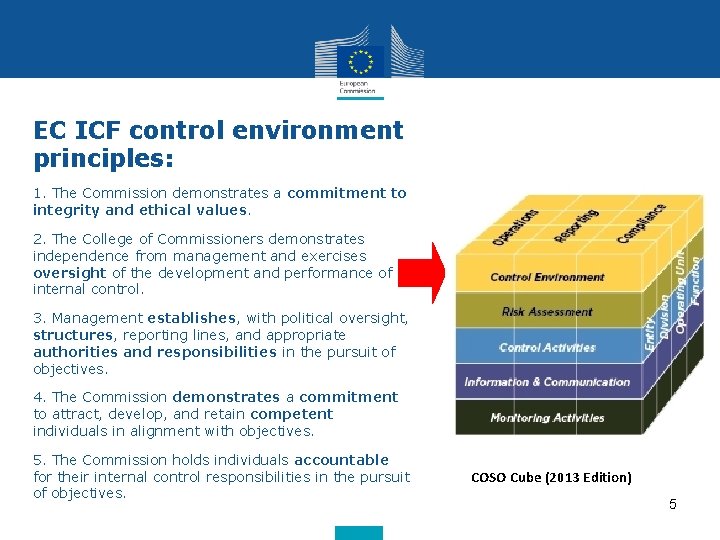
EC ICF control environment principles: 1. The Commission demonstrates a commitment to integrity and ethical values. 2. The College of Commissioners demonstrates independence from management and exercises oversight of the development and performance of internal control. 3. Management establishes, with political oversight, structures, reporting lines, and appropriate authorities and responsibilities in the pursuit of objectives. 4. The Commission demonstrates a commitment to attract, develop, and retain competent individuals in alignment with objectives. 5. The Commission holds individuals accountable for their internal control responsibilities in the pursuit of objectives. COSO Cube (2013 Edition) 5
IAS practices of assessment of the Control Environment: overview • Dedicated audits: ethics, governance, human resources • Plus, in a standard audit: • Selection of ICF as a reference framework for the audit • Binding reference documents used as criteria for finding • Assessment of risks related to the control environment (e. g. on conflict of interest, delegation of powers, tone at the top) • Review of self-assessment on ICF implementation • Current working group in the IAS to establish the revised IAS methodology after the ICF update
IAS practices of assessment of the Control Environment: example 1 Audit on ethics: • Use of surveys to staff assess tone at the top, staff awareness of ethical rules and standards • Review use of declaration of no conflict of interest (for external activities, spouses’ employment, etc. ) • Review of training on ethics: frequency, participation, content • Review of whistleblowing cases
IAS practices of assessment of the Control Environment: example 2 Audit on governance: • Review of international governance arrangements as benchmarking • Review of internal written arrangements between services, roles and responsibilities (including Unit missions, job description), decisional processes/management meetings, reporting for oversight/accountability
IAS practices of assessment of the Control Environment: example 3 Audit on Human Resources: • Review of HR strategy and planning • Review of training needs, offer and training effectiveness • Review of staff mobility and arrangements for continuity of operations • Review of staff objectives and appraisal
IAS practices of assessment of the Control Environment: examples 4 Aspects of assessment of Control environment in standard audits Principle 1: • Review of staff opinion surveys - when relevant – for indication of adequate tone at the top; • Verify respect of Code of Good administrative behaviour (e. g. delay in answering to citizens); • Review declarations of conflict of interest Principle 2: • Review the annual declaration of assurance and reporting to Commissioner (for fairness and completeness of information presented); • Review the minutes of management boards minutes; • Review of exception reporting and external complaints (if adequately addressed by management)
IAS practices of assessment of the Control Environment: examples 5 Aspects of assessment of Control environment in standard audits Principle 3: • Review of organisation chart (approved, updated, cover all staff), missions and job description (roles and responsibilities consistent with objectives and corresponding to work performed); • Test of financial circuits (segregation of duties, empowerment to sign); • Analysis of delays in approval processes (for effectiveness of oversight) Principle 4: • Review of training relevance, frequency, participation and satisfaction; • Verify arrangements for continuity of operations. Principle 5: • Review implementation of action plans for corrections/improvements; • Identify opportunities for improving staff efficiency
Challenges • Implementation of principles adapted to the specificities of each organisation requires auditors to know well each reality => account managers in IAS for each DG/Service • Assessment based on principles requires mature judgement and sound evidence-based arguments by auditors
Questions? Thank you for your attention ! 13