
ASSESSING SUSTAINABLE ICT How to assess the sustainability
ASSESSING SUSTAINABLE ICT How to assess the sustainability of ICT and whether it will make EMBs work more effective and efficient. Brown Kasaro Brown. Kasaro@elections. org. zm
Contents Ø Role of ICT in Elections Ø Sustainability, Efficiency & Effectiveness Ø Assessment Criteria Ø Conclusion
Role of ICT in Elections Ø Its generally accepted that integration of ICT in organisational functions is necessary for increased efficiency, cost-effectiveness, and competitiveness Ø EMBs cannot operate, today, without leveraging ICT in the delivery of their Mandate.
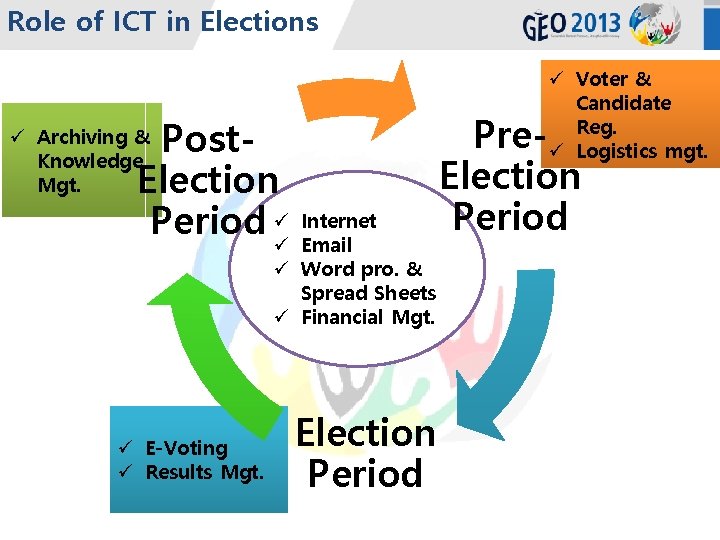
Role of ICT in Elections Post. Election Period üü Internet Email ü Archiving & Knowledge Mgt. ü Word pro. & Spread Sheets ü Financial Mgt. ü E-Voting ü Results Mgt. Election Period ü Voter & Candidate Reg. ü Logistics mgt. Pre. Election Period
The Sustainability concern In his 2011 report (A/66/314), the UN Secretary General , expresses concern “about electoral techniques and systems that are so complex or expensive that they have the potential to leave countries dependent on vendors or donors” And recommends, with respect to the UN support approach, that “The approach must ………. . be subject to clear sustainability criteria and monitoring and evaluation tools”
Sustainable, Effective & Efficient - ICT What is Sustainability? Ø Speaks about capacity/ability to endure i. e. to have long term positive impact. Ø An ICT solution can therefore be said to be sustainable, in the electoral context, if it will enable an EMB (or indeed a country) hold successive credible elections without compromising the ability of that EMB to provide electoral services in the future. Effective & Efficient Ø ICTs that will not only enable EMBs deliver their primary mandate of conducting elections, but also enable EMBs delivery this mandate timely and at a minimal cost in accordance with the electoral cycle
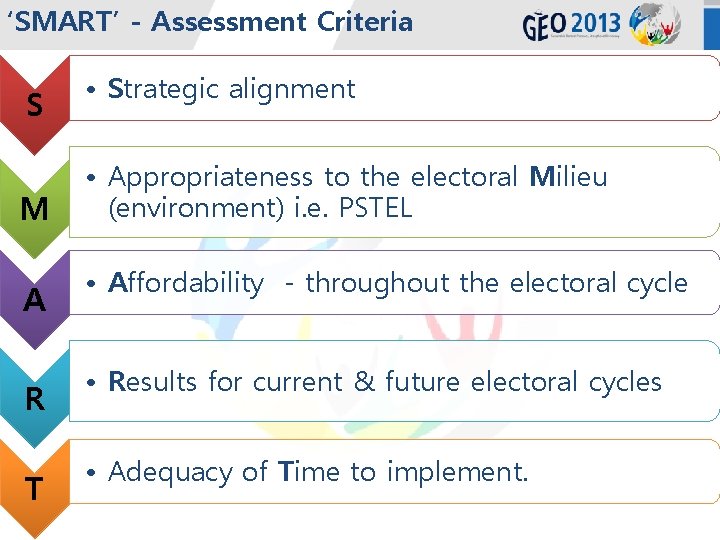
‘SMART’ - Assessment Criteria S M A R T • Strategic alignment • Appropriateness to the electoral Milieu (environment) i. e. PSTEL • Affordability - throughout the electoral cycle • Results for current & future electoral cycles • Adequacy of Time to implement.
Strategic Alignment Considerations: Ø What are the Mission, Vision & strategic directions or objectives of the EMB? Ø What are the goals of the ICT project? The two must be aligned! Its possible that the two may clash - An ICT solution that brings about efficiency in a process may compromise accountability or transparency.
Electoral Environment suitability Considerations: Ø What are the Political implications? ü Stakeholder confidence in the EMB. ü EMBs should not work under Political pressure to introduce technology. Ø What are the demographic, cultural and religious impacts? Ø The presence of supporting infrastructure. ü Integration with existing systems. Ø What are the physical environmental aspects that need to be planned for? Ø Are the proposed procedures/results legally aligned? Consult stakeholder extensively.
Affordability/Economy Considerations: Ø Can the EMB (and country) afford it throughout the electoral cycle i. e. both in the short and long term? Considering other competing needs – within the EMB or indeed for the Country! Ø Can the Ro. I be maximised through possible synergies with other Government departments? Ø Is there capacity in the EMB and country to support the technology? It’s a judgment call since one cannot put a price to a credible election
Lasting Results Considerations: Ø How can we ensure it delivers to the goals? ü Do manual procedures exist for the processes being automated? ü Project implementation approach q Training approach – Tech. admins & users M. Yard …. (IFES) “If procedures and management structures are not adequate to support a paper-based ……. . system, they will be inadequate to support an automated system, which will likely require a higher degree of organization” Feasibility studies.
Timeliness Considerations: Ø Is there adequate time on the election calendar to undertake the project? q Time for: ü Tendering Processes ü Delivery by Supplier including testing ü Training and configuration for deployment A. I Hassan … (IEBC, Kenya) “All technology and systems to be used in the election must be procured early and adequately tested over a sustained period of time to ensure its reliability and stability. This should be done in the whole country. ”
Conclusion GEO Gaborone Declaration 2011, recognised that “ elections exist as a cornerstone of democracy that empowers people to participate in the selection of their Political representatives” ICTs are merely a Tool, not an end in themselves! Thank You
- Slides: 13