
Assessing Strengths and Weaknesses Doing an Internal Analysis

- Slides: 16
Assessing Strengths and Weaknesses Doing an Internal Analysis Chapter 4 Group 5: Courtney Ellis, Casey Harvey, Travis Tempel Roberto Padilla, Julio Garcia, Miguel Medrano Glen Lesly, Mason Stone
Chapter Overview • • Internal Analysis Relationship between resources, capabilities and competitive advantage Characteristics of distinctive organizational capabilities Strengths and weaknesses Value chain analysis Organizational internal audit Capabilities assessment profile
Internal Analysis • The process of evaluating an organization’s skills and work activities • Provides important information about an organization's assets, skills, and work activities • What's good? What's lacking or deficient? • Most importantly, it evaluates the organization's resources, capabilities, and core competencies
Resources • Financial Resources • Physical Resources • Human Resources • Intangible Resources • Structural-Cultural Resources
Resources to Capabilities • Organizational Routines and Processes
Under Armour's Distinctive Capabilities • First to implement compression athletic wear with moisture wicking capabilities. • Reputation of better quality product. • Customers willing to pay more.
Distinctive Organizational Capabilities • Contributes to superior customer value • Is difficult for competitors to imitate • Can be used in a variety of ways
Strengths and Weaknesses • It’s all about comparison • Strengths – resources the organization possesses and capabilities it has developed • Weaknesses – resources and capabilities that are lacking or deficient and prevent the organization from developing a sustainable competitive advantage
Value Chain Analysis • A systematic way of examining all the organizations functional activities and how well they create customer value. • UA creates value for consumers and creates a competitive advantage through technology development. • Strong development team
Internal Audit • A thorough assessment of an organizations internal areas • Similar to financial audit • Assess the organizations resources and capabilities from the perspective of its different functions and organizational elements
Capabilities Assessment Profile • In-depth evaluation of an organization’s capabilities • Beneficial because it provides guidelines for identifying the organization’s distinctive capabilities
Capabilities Assessment Phases Phase 1: Identifying distinctive capabilites Phase 2: Developing and learning the distinctive capabilites
5 Steps of Phase 1 • Step 1: Prepare current product-market profile • Step 2: Identify sources of competitive advantage and disadvantage in the main product-market segments • Step 3: Describe all the organizational capabilities and competencies • Step 4: Sort the core capabilities and competencies according to strategic importance • Step 5: Identify and agree on the key capabilities and competencies Figure 4. 4 pg 115
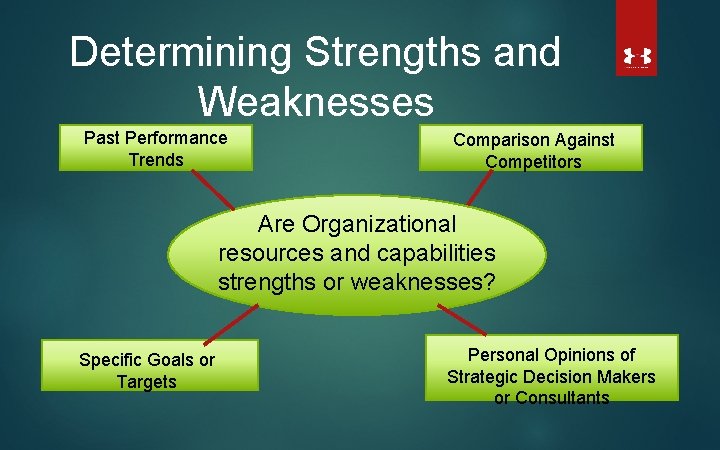
Determining Strengths and Weaknesses Past Performance Trends Comparison Against Competitors Are Organizational resources and capabilities strengths or weaknesses? Specific Goals or Targets Personal Opinions of Strategic Decision Makers or Consultants
Importance of Internal Analysis Important for two reasons: 1. ) Only way to identify an organization’s strengths and weaknesses 2. ) Needed for making good strategic decisions
Key Points • Internal analysis • Resources to capabilities • Distinctive organizational capabilities • Strengths and Weaknesses • Value chain analysis • Internal audit • Capabilities assessment phases • Determining strengths and weaknesses