
Assessing skills in SQE 1 and SQE 2
- Slides: 11
Assessing skills in SQE 1 and SQE 2
SQE skills – where are we? • SQE 1 pilot: what did we pilot? – 2 legal writing tasks and 1 legal research task – Each candidate (for pilot purposes) did this twice • SQE 1 pilot: findings – SQE 1 skills model not defensible – Insufficiently reliable or accurate – An unclear standard: “Threshold skill level to enable candidates to work effectively in professional legal services in an unqualified capacity” • Now seeking stakeholder views on skills across SQE 1 and 2
The assessment – a reminder SQE 1 Functioning Legal Knowledge Assessments • Substantive and procedural law: includes all QLD/CPE foundation subjects and LPC core subjects • Test of application of fundamental legal principles • Computer-based assessment Possible Practical Legal Skills Assessment • Legal writing, research or case analysis?
The assessment – a reminder SQE 2 Practical Legal Skills Assessments • Client interviewing, completion of attendance note, advocacy, case and matter analysis, legal research, legal writing and legal drafting • Criminal Practice, Dispute Resolution, Property, Wills and the Administration of Estates, Business Practice • Simulated role plays/written tasks • Pilot will test different options for SQE 2 design
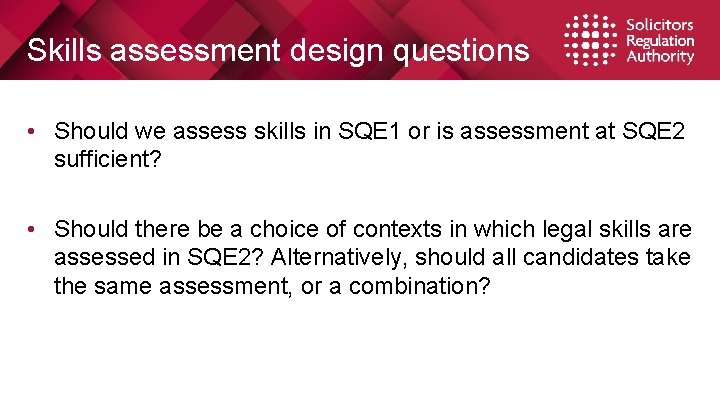
Skills assessment design questions • Should we assess skills in SQE 1 or is assessment at SQE 2 sufficient? • Should there be a choice of contexts in which legal skills are assessed in SQE 2? Alternatively, should all candidates take the same assessment, or a combination?
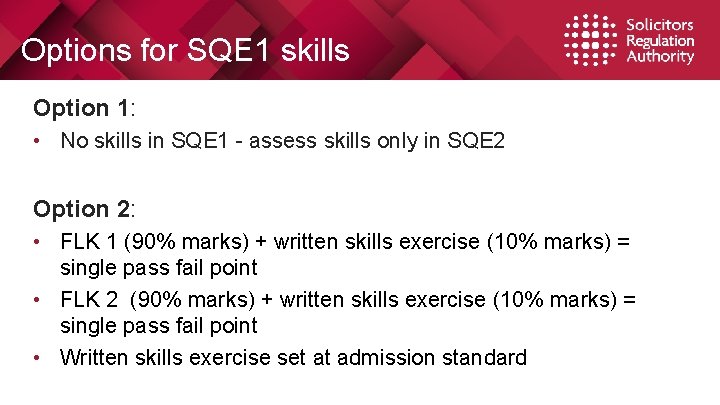
Options for SQE 1 skills Option 1: • No skills in SQE 1 - assess skills only in SQE 2 Option 2: • FLK 1 (90% marks) + written skills exercise (10% marks) = single pass fail point • FLK 2 (90% marks) + written skills exercise (10% marks) = single pass fail point • Written skills exercise set at admission standard
Views? Analysis of these alternative options: • • Advantages Disadvantages Mitigations Market impacts
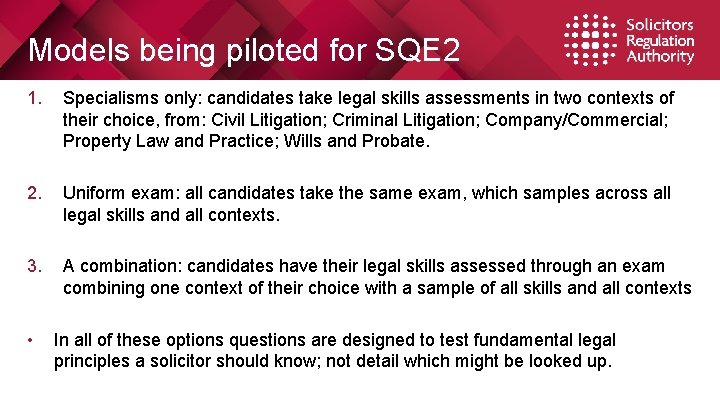
Models being piloted for SQE 2 1. Specialisms only: candidates take legal skills assessments in two contexts of their choice, from: Civil Litigation; Criminal Litigation; Company/Commercial; Property Law and Practice; Wills and Probate. 2. Uniform exam: all candidates take the same exam, which samples across all legal skills and all contexts. 3. A combination: candidates have their legal skills assessed through an exam combining one context of their choice with a sample of all skills and all contexts • In all of these options questions are designed to test fundamental legal principles a solicitor should know; not detail which might be looked up.
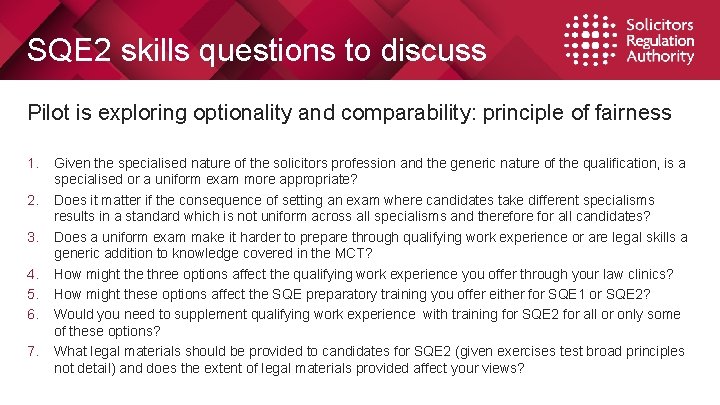
SQE 2 skills questions to discuss Pilot is exploring optionality and comparability: principle of fairness 1. 2. 3. 4. 5. 6. 7. Given the specialised nature of the solicitors profession and the generic nature of the qualification, is a specialised or a uniform exam more appropriate? Does it matter if the consequence of setting an exam where candidates take different specialisms results in a standard which is not uniform across all specialisms and therefore for all candidates? Does a uniform exam make it harder to prepare through qualifying work experience or are legal skills a generic addition to knowledge covered in the MCT? How might the three options affect the qualifying work experience you offer through your law clinics? How might these options affect the SQE preparatory training you offer either for SQE 1 or SQE 2? Would you need to supplement qualifying work experience with training for SQE 2 for all or only some of these options? What legal materials should be provided to candidates for SQE 2 (given exercises test broad principles not detail) and does the extent of legal materials provided affect your views?
Any questions?
Keep in touch Send your queries to sqe@sra. org. uk SQE resources sra. org. uk/sqe Join our SQE Linked. In group