
Assessing Seismic Collapse Risk of Buildings Olive View
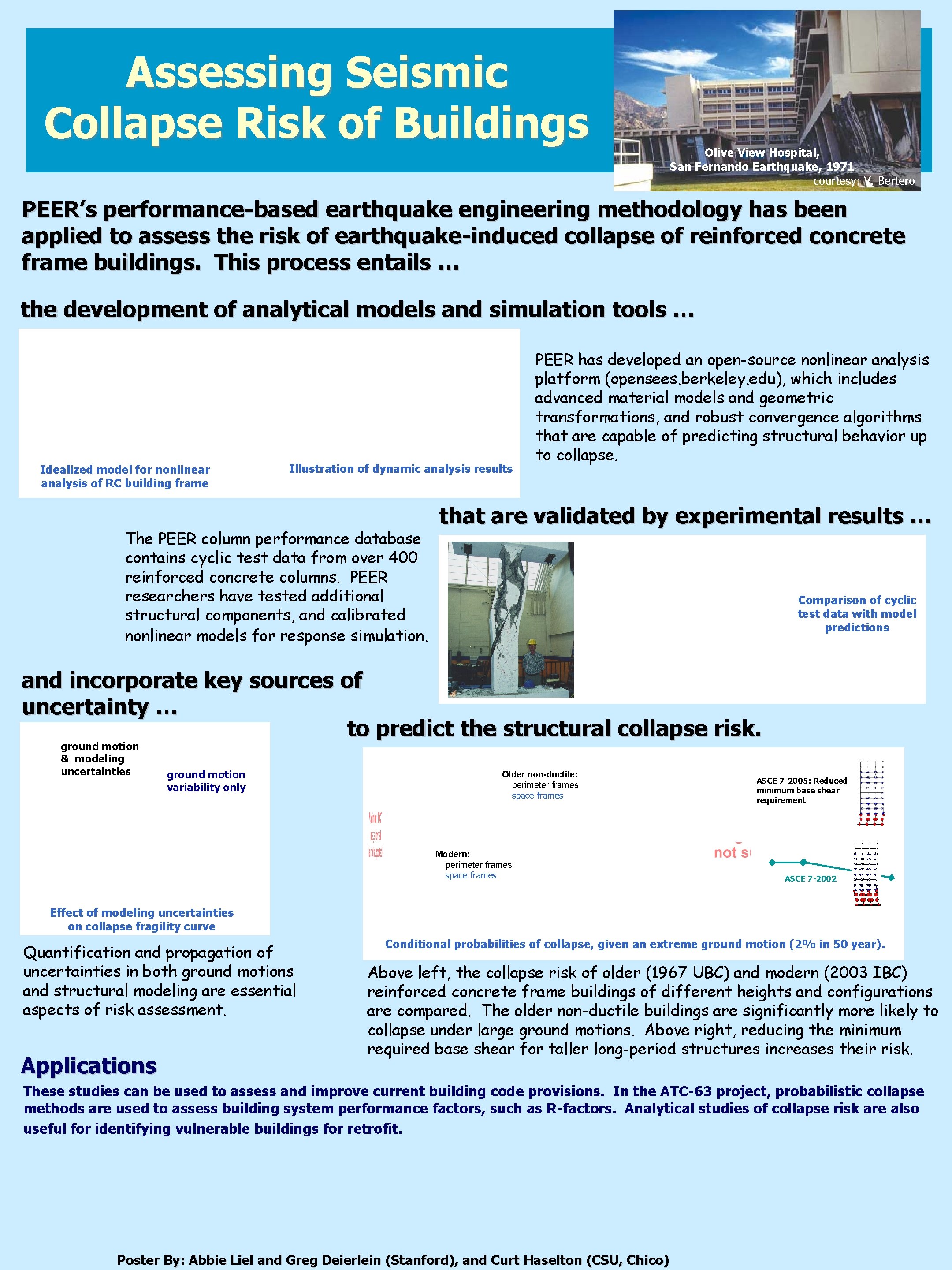
Assessing Seismic Collapse Risk of Buildings Olive View Hospital, San Fernando Earthquake, 1971 courtesy: V. Bertero PEER’s performance-based earthquake engineering methodology has been applied to assess the risk of earthquake-induced collapse of reinforced concrete frame buildings. This process entails … the development of analytical models and simulation tools … Idealized model for nonlinear analysis of RC building frame Illustration of dynamic analysis results The PEER column performance database contains cyclic test data from over 400 reinforced concrete columns. PEER researchers have tested additional structural components, and calibrated nonlinear models for response simulation. PEER has developed an open-source nonlinear analysis platform (opensees. berkeley. edu), which includes advanced material models and geometric transformations, and robust convergence algorithms that are capable of predicting structural behavior up to collapse. that are validated by experimental results … Comparison of cyclic test data with model predictions and incorporate key sources of uncertainty … to predict the structural collapse risk. ground motion & modeling uncertainties ground motion variability only Older non-ductile: perimeter frames space frames Modern: perimeter frames space frames ASCE 7 -2005: Reduced minimum base shear requirement ASCE 7 -2002 Effect of modeling uncertainties on collapse fragility curve Quantification and propagation of uncertainties in both ground motions and structural modeling are essential aspects of risk assessment. Applications Conditional probabilities of collapse, given an extreme ground motion (2% in 50 year). Above left, the collapse risk of older (1967 UBC) and modern (2003 IBC) reinforced concrete frame buildings of different heights and configurations are compared. The older non-ductile buildings are significantly more likely to collapse under large ground motions. Above right, reducing the minimum required base shear for taller long-period structures increases their risk. These studies can be used to assess and improve current building code provisions. In the ATC-63 project, probabilistic collapse methods are used to assess building system performance factors, such as R-factors. Analytical studies of collapse risk are also useful for identifying vulnerable buildings for retrofit. Poster By: Abbie Liel and Greg Deierlein (Stanford), and Curt Haselton (CSU, Chico)
- Slides: 1