
Assessing Program Fidelity Across Multiple Contexts The Fidelity
- Slides: 47
Assessing Program Fidelity Across Multiple Contexts: The Fidelity Index, Part II Session # 814 Joel Philp, Krista Collins, and Karyl Askew The Evaluation Group American Evaluation Association Annual Conference October 13 -18 2014 Denver, CO
For Today � Introductions – Joel, Krista, and Karyl � Review – Steps in Creating a Fidelity Index (Joel - 15 minutes) � Applications and lessons learned in different education contexts across different phases of fidelity assessment: Designing (Karyl –i 3 STEM - 15 minutes) Monitoring and Adaptation (Krista – RTT-D Blended Learning - 15 minutes) Reporting (Joel – i 3 College prep - 15 minutes) � Answer questions and hear your comments (20 -30 minutes)
Background �TEG has evaluated over 150 education-based programs over the last 20 years �Most are multi-year, multi-component programs �Most have some type of fidelity assessment, but little guidance exists Ex. , What Works Clearinghouse is explicit on impact evaluation, silent on implementation evaluation
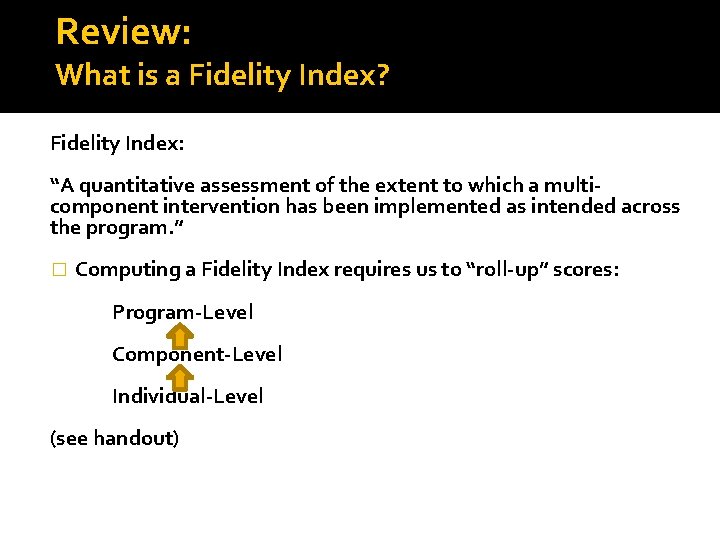
Review: What is a Fidelity Index? Fidelity Index: “A quantitative assessment of the extent to which a multicomponent intervention has been implemented as intended across the program. ” � Computing a Fidelity Index requires us to “roll-up” scores: Program-Level Component-Level Individual-Level (see handout)
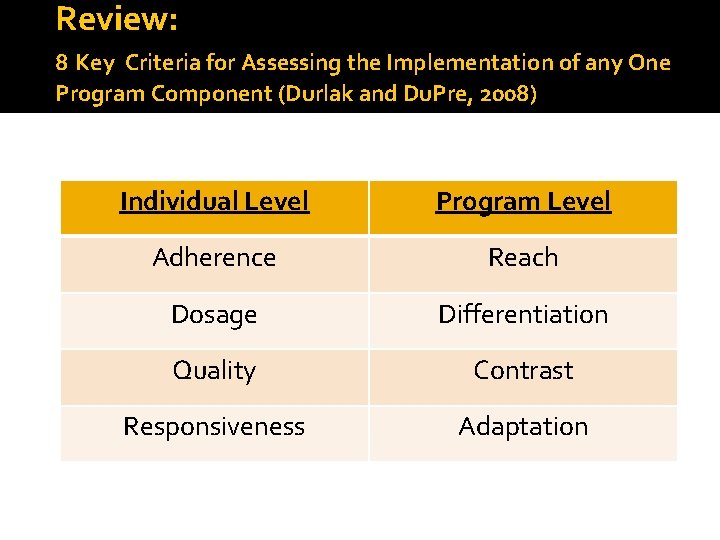
Review: 8 Key Criteria for Assessing the Implementation of any One Program Component (Durlak and Du. Pre, 2008) Individual Level Program Level Adherence Reach Dosage Differentiation Quality Contrast Responsiveness Adaptation
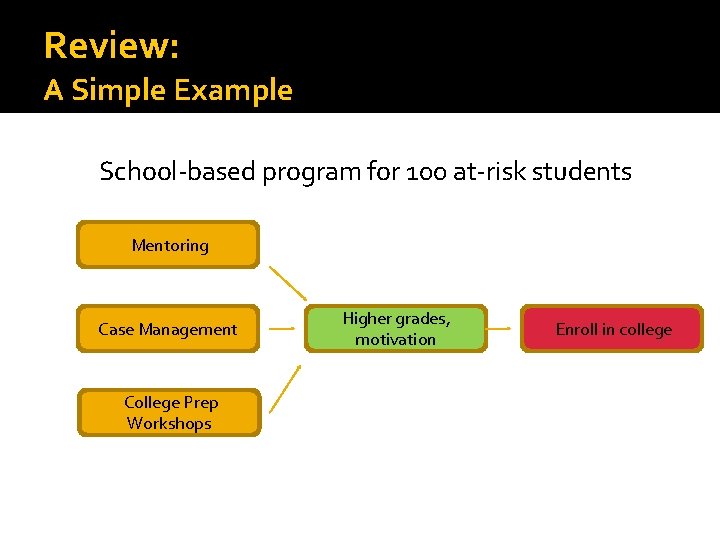
Review: A Simple Example School-based program for 100 at-risk students Mentoring Case Management College Prep Workshops Higher grades, motivation Enroll in college
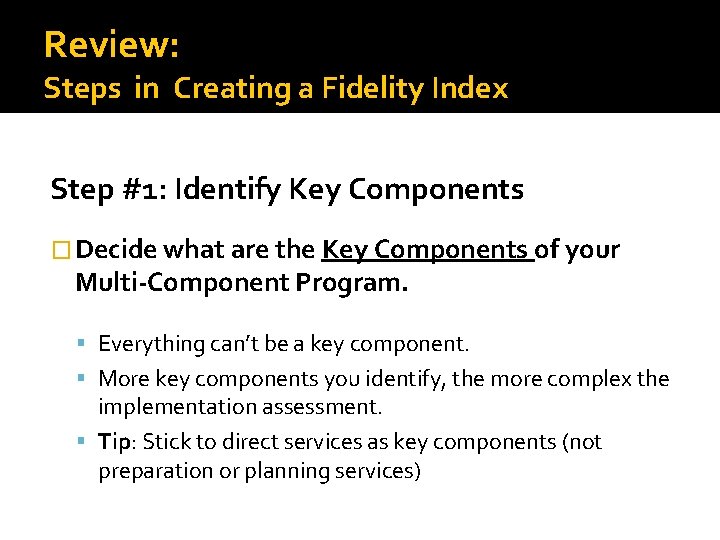
Review: Steps in Creating a Fidelity Index Step #1: Identify Key Components � Decide what are the Key Components of your Multi-Component Program. Everything can’t be a key component. More key components you identify, the more complex the implementation assessment. Tip: Stick to direct services as key components (not preparation or planning services)
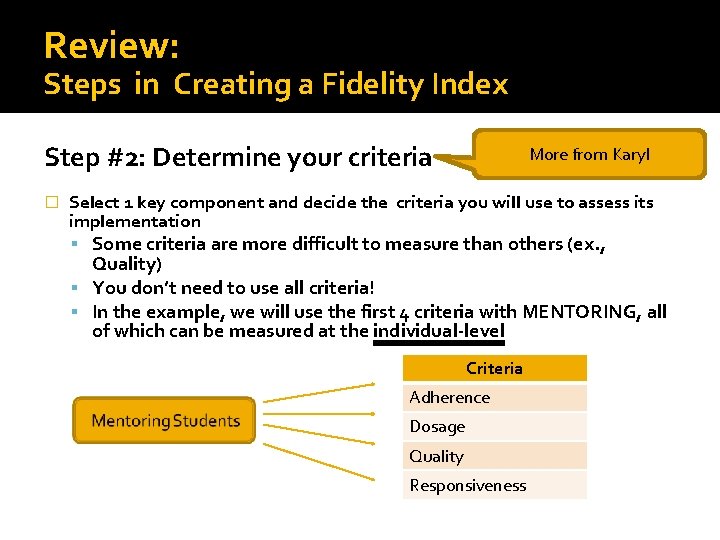
Review: Steps in Creating a Fidelity Index Step #2: Determine your criteria � More from Karyl Select 1 key component and decide the criteria you will use to assess its implementation Some criteria are more difficult to measure than others (ex. , Quality) You don’t need to use all criteria! In the example, we will use the first 4 criteria with MENTORING, all of which can be measured at the individual-level Criteria Adherence Dosage Quality Responsiveness
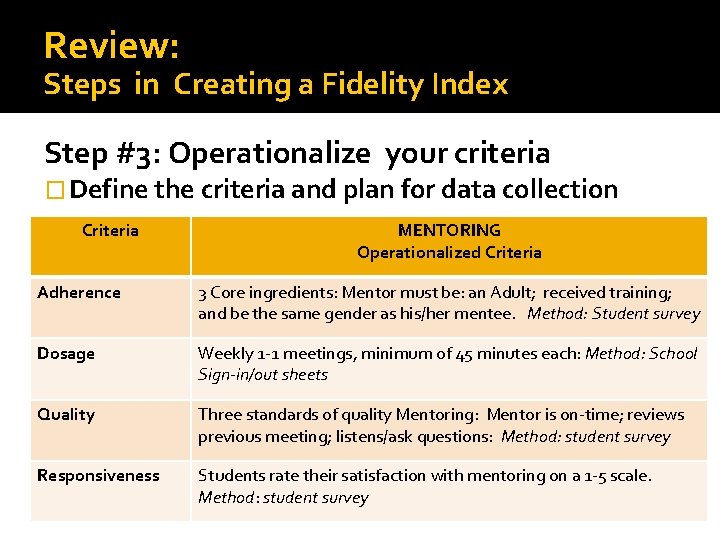
Review: Steps in Creating a Fidelity Index Step #3: Operationalize your criteria � Define the criteria and plan for data collection Criteria MENTORING Operationalized Criteria Adherence 3 Core ingredients: Mentor must be: an Adult; received training; and be the same gender as his/her mentee. Method: Student survey Dosage Weekly 1 -1 meetings, minimum of 45 minutes each: Method: School Sign-in/out sheets Quality Three standards of quality Mentoring: Mentor is on-time; reviews previous meeting; listens/ask questions: Method: student survey Responsiveness Students rate their satisfaction with mentoring on a 1 -5 scale. Method: student survey
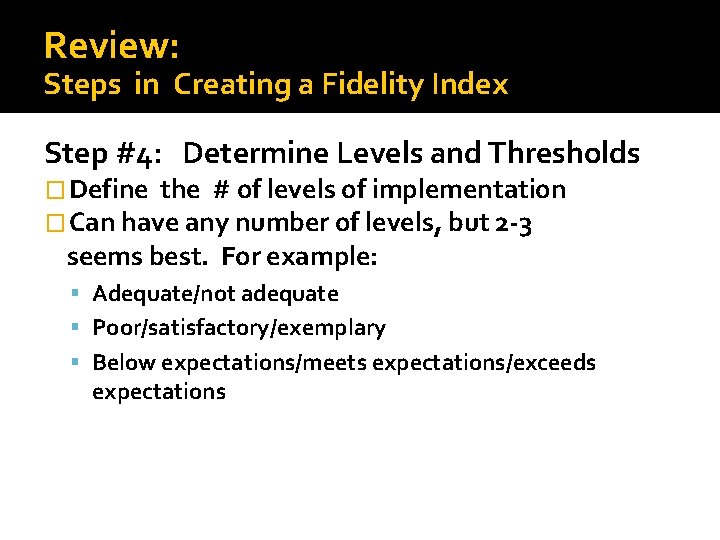
Review: Steps in Creating a Fidelity Index Step #4: Determine Levels and Thresholds � Define the # of levels of implementation � Can have any number of levels, but 2 -3 seems best. For example: Adequate/not adequate Poor/satisfactory/exemplary Below expectations/meets expectations/exceeds expectations
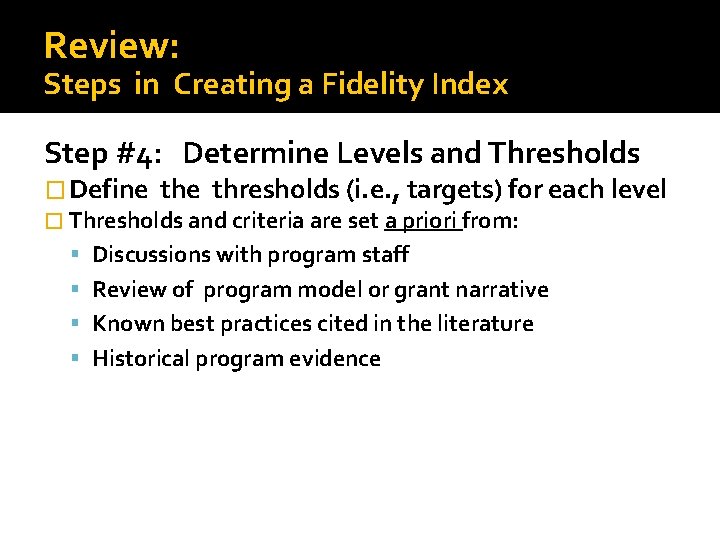
Review: Steps in Creating a Fidelity Index Step #4: Determine Levels and Thresholds � Define thresholds (i. e. , targets) for each level � Thresholds and criteria are set a priori from: Discussions with program staff Review of program model or grant narrative Known best practices cited in the literature Historical program evidence
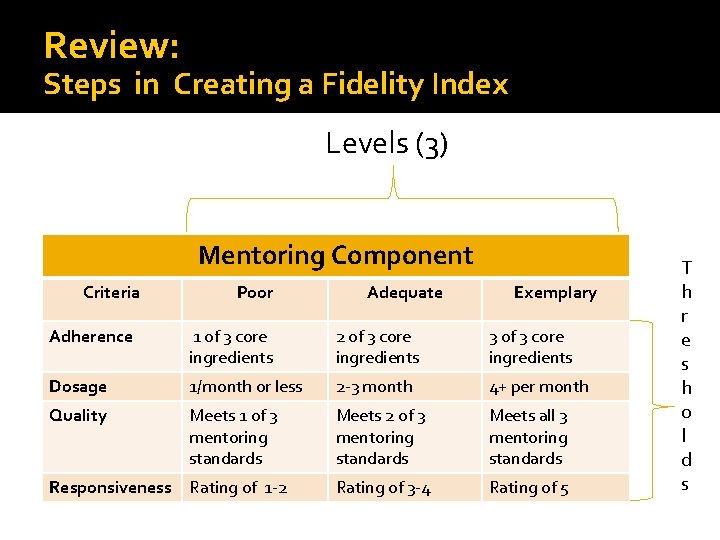
Review: Steps in Creating a Fidelity Index Levels (3) Mentoring Component Criteria Poor Adequate Exemplary Adherence 1 of 3 core ingredients 2 of 3 core ingredients 3 of 3 core ingredients Dosage 1/month or less 2 -3 month 4+ per month Quality Meets 1 of 3 mentoring standards Meets 2 of 3 mentoring standards Meets all 3 mentoring standards Rating of 3 -4 Rating of 5 Responsiveness Rating of 1 -2 T h r e s h o l d s
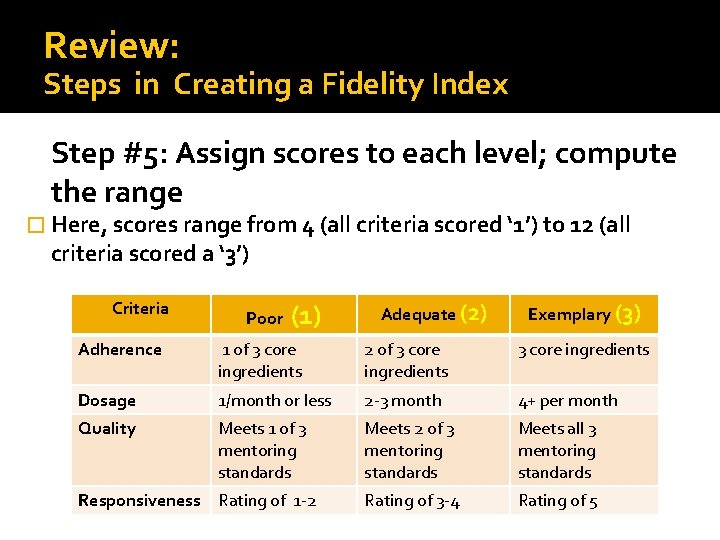
Review: Steps in Creating a Fidelity Index Step #5: Assign scores to each level; compute the range � Here, scores range from 4 (all criteria scored ‘ 1’) to 12 (all criteria scored a ‘ 3’) Criteria Poor (1) Adequate (2) Exemplary (3) Adherence 1 of 3 core ingredients 2 of 3 core ingredients Dosage 1/month or less 2 -3 month 4+ per month Quality Meets 1 of 3 mentoring standards Meets 2 of 3 mentoring standards Meets all 3 mentoring standards Rating of 3 -4 Rating of 5 Responsiveness Rating of 1 -2
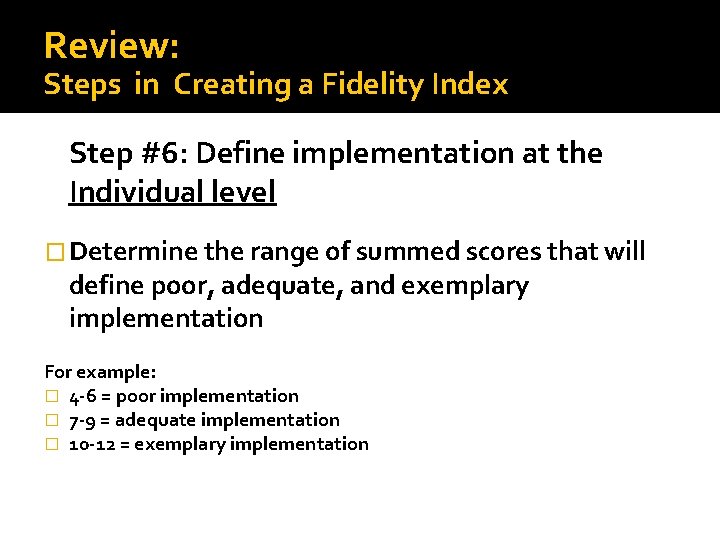
Review: Steps in Creating a Fidelity Index Step #6: Define implementation at the Individual level � Determine the range of summed scores that will define poor, adequate, and exemplary implementation For example: � 4 -6 = poor implementation � 7 -9 = adequate implementation � 10 -12 = exemplary implementation
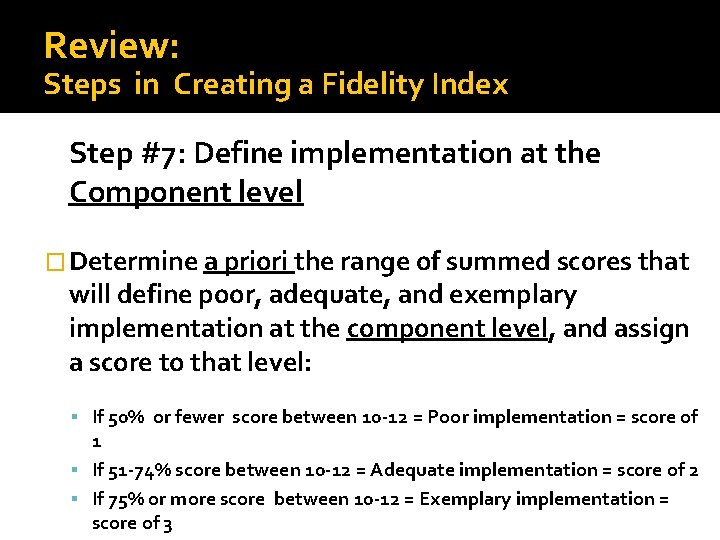
Review: Steps in Creating a Fidelity Index Step #7: Define implementation at the Component level � Determine a priori the range of summed scores that will define poor, adequate, and exemplary implementation at the component level, and assign a score to that level: If 50% or fewer score between 10 -12 = Poor implementation = score of 1 If 51 -74% score between 10 -12 = Adequate implementation = score of 2 If 75% or more score between 10 -12 = Exemplary implementation = score of 3
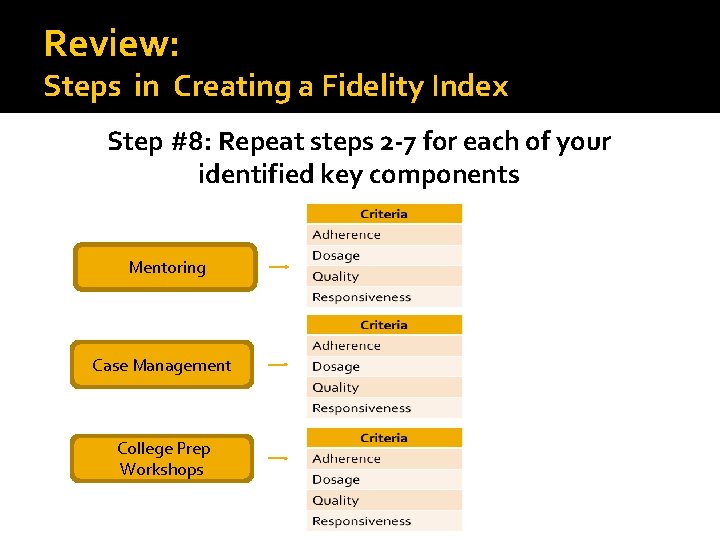
Review: Steps in Creating a Fidelity Index Step #8: Repeat steps 2 -7 for each of your identified key components Mentoring Case Management College Prep Workshops
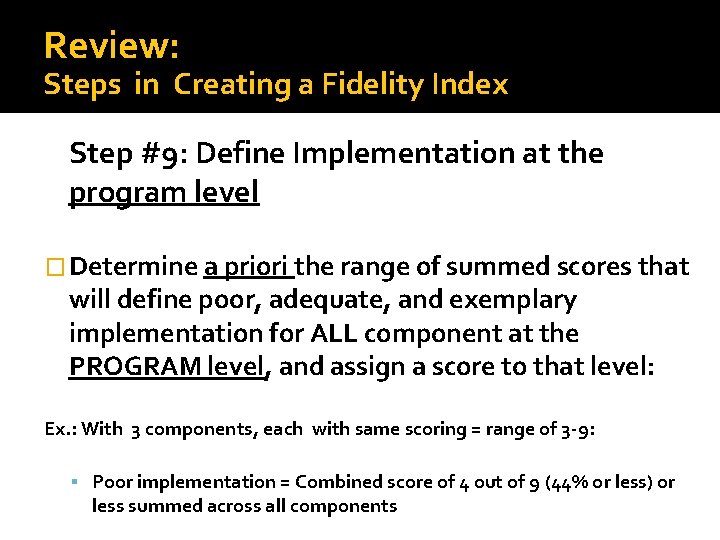
Review: Steps in Creating a Fidelity Index Step #9: Define Implementation at the program level � Determine a priori the range of summed scores that will define poor, adequate, and exemplary implementation for ALL component at the PROGRAM level, and assign a score to that level: Ex. : With 3 components, each with same scoring = range of 3 -9: Poor implementation = Combined score of 4 out of 9 (44% or less) or less summed across all components
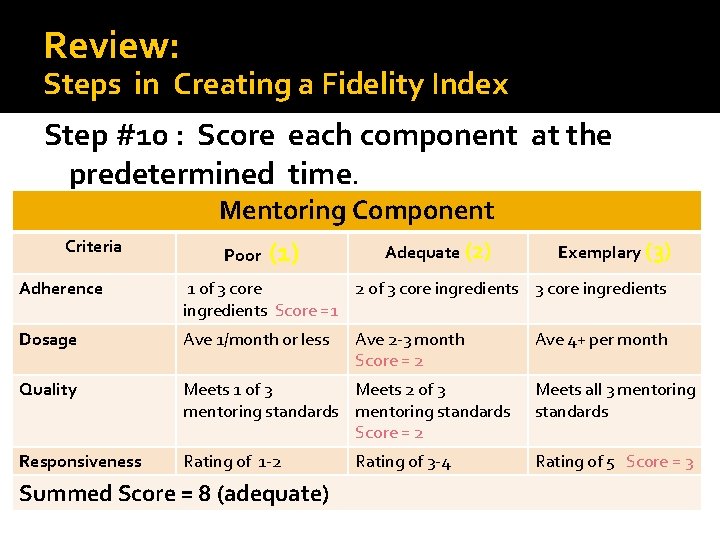
Review: Steps in Creating a Fidelity Index Step #10 : Score each component at the predetermined time. Mentoring Component Criteria Poor (1) Adequate (2) Exemplary (3) Adherence 1 of 3 core 2 of 3 core ingredients Score =1 Dosage Ave 1/month or less Quality Meets 1 of 3 Meets 2 of 3 mentoring standards Score = 2 Meets all 3 mentoring standards Responsiveness Rating of 1 -2 Rating of 5 Score = 3 Summed Score = 8 (adequate) Ave 2 -3 month Score = 2 Rating of 3 -4 Ave 4+ per month
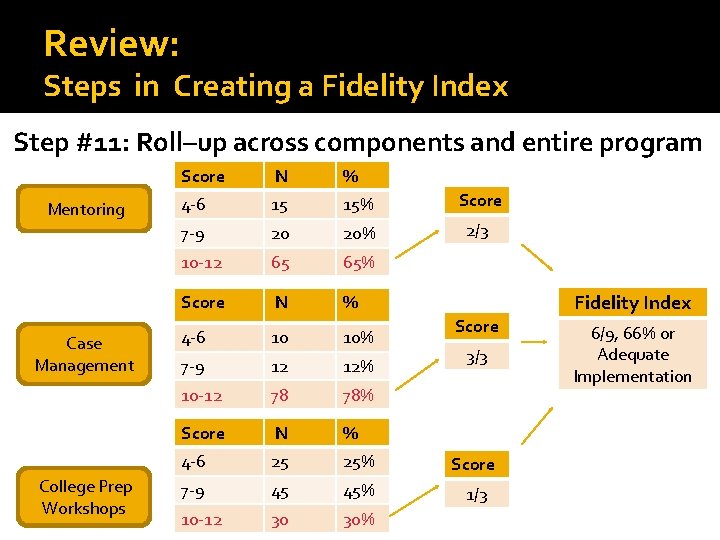
Review: Steps in Creating a Fidelity Index Step #11: Roll–up across components and entire program Mentoring Case Management College Prep Workshops Score N % 4 -6 15 15% Score 7 -9 20 20% 2/3 10 -12 65 65% Score N % 4 -6 10 10% 7 -9 12 12% 10 -12 78 78% Score N % 4 -6 25 25% Score 7 -9 45 45% 1/3 10 -12 30 30% Fidelity Index Score 3/3 6/9, 66% or Adequate Implementation
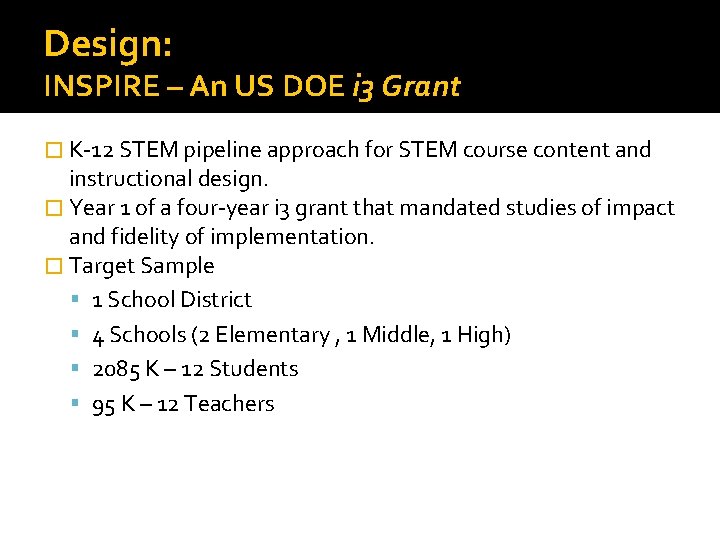
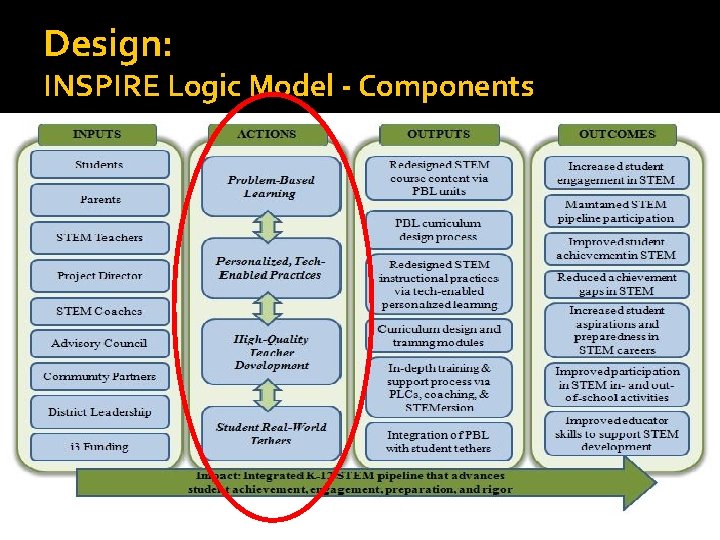
Design: INSPIRE – An US DOE i 3 Grant � K-12 STEM pipeline approach for STEM course content and instructional design. � Year 1 of a four-year i 3 grant that mandated studies of impact and fidelity of implementation. � Target Sample 1 School District 4 Schools (2 Elementary , 1 Middle, 1 High) 2085 K – 12 Students 95 K – 12 Teachers
Design: INSPIRE Logic Model - Components
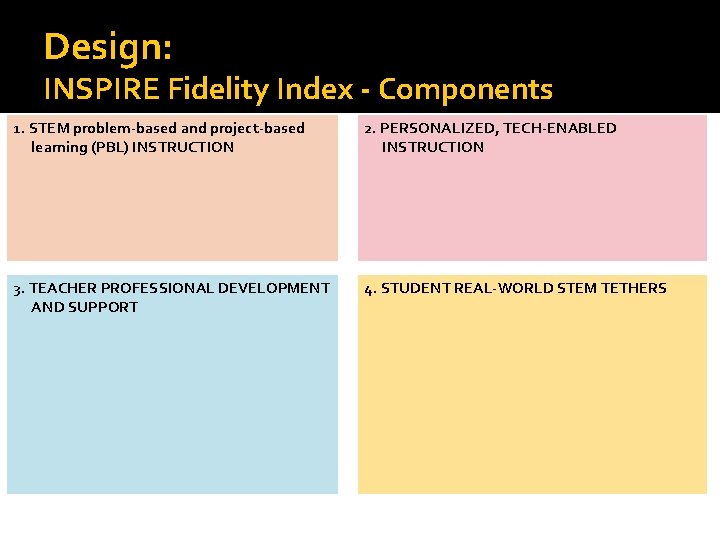
Design: INSPIRE Fidelity Index - Components 1. STEM problem-based and project-based learning (PBL) INSTRUCTION 2. PERSONALIZED, TECH-ENABLED INSTRUCTION 3. TEACHER PROFESSIONAL DEVELOPMENT AND SUPPORT 4. STUDENT REAL-WORLD STEM TETHERS
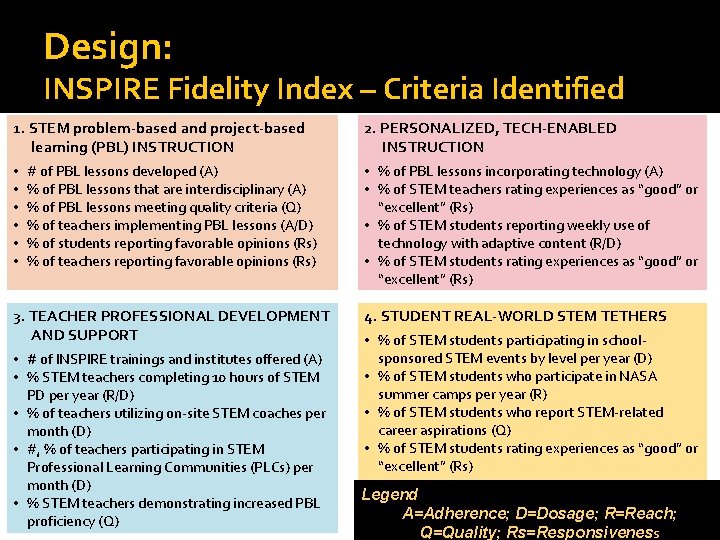
Design: INSPIRE Fidelity Index – Criteria Identified 1. STEM problem-based and project-based learning (PBL) INSTRUCTION • • • # of PBL lessons developed (A) % of PBL lessons that are interdisciplinary (A) % of PBL lessons meeting quality criteria (Q) % of teachers implementing PBL lessons (A/D) % of students reporting favorable opinions (Rs) % of teachers reporting favorable opinions (Rs) 3. TEACHER PROFESSIONAL DEVELOPMENT AND SUPPORT • # of INSPIRE trainings and institutes offered (A) • % STEM teachers completing 10 hours of STEM PD per year (R/D) • % of teachers utilizing on-site STEM coaches per month (D) • #, % of teachers participating in STEM Professional Learning Communities (PLCs) per month (D) • % STEM teachers demonstrating increased PBL proficiency (Q) 2. PERSONALIZED, TECH-ENABLED INSTRUCTION • % of PBL lessons incorporating technology (A) • % of STEM teachers rating experiences as “good” or “excellent” (Rs) • % of STEM students reporting weekly use of technology with adaptive content (R/D) • % of STEM students rating experiences as “good” or “excellent” (Rs) 4. STUDENT REAL-WORLD STEM TETHERS • % of STEM students participating in schoolsponsored STEM events by level per year (D) • % of STEM students who participate in NASA summer camps per year (R) • % of STEM students who report STEM-related career aspirations (Q) • % of STEM students rating experiences as “good” or “excellent” (Rs) Legend A=Adherence; D=Dosage; R=Reach; Q=Quality; Rs=Responsiveness
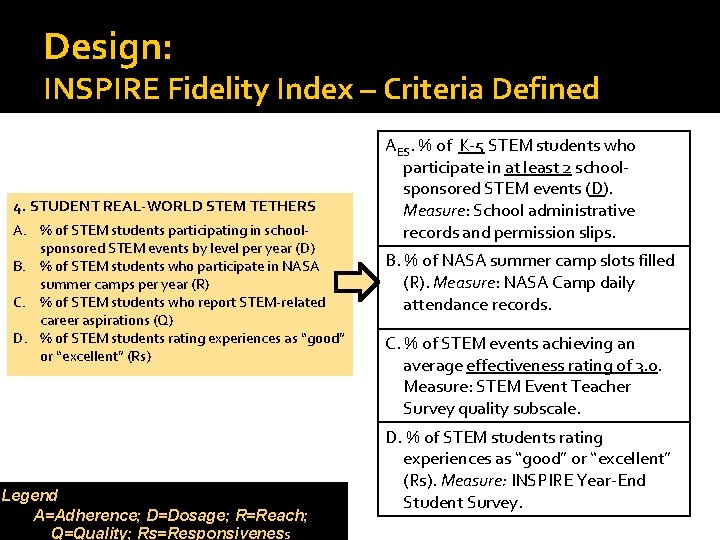
Design: INSPIRE Fidelity Index – Criteria Defined 4. STUDENT REAL-WORLD STEM TETHERS A. % of STEM students participating in schoolsponsored STEM events by level per year (D) B. % of STEM students who participate in NASA summer camps per year (R) C. % of STEM students who report STEM-related career aspirations (Q) D. % of STEM students rating experiences as “good” or “excellent” (Rs) Legend A=Adherence; D=Dosage; R=Reach; Q=Quality; Rs=Responsiveness AES. % of K-5 STEM students who participate in at least 2 schoolsponsored STEM events (D). Measure: School administrative records and permission slips. B. % of NASA summer camp slots filled (R). Measure: NASA Camp daily attendance records. C. % of STEM events achieving an average effectiveness rating of 3. 0. Measure: STEM Event Teacher Survey quality subscale. D. % of STEM students rating experiences as “good” or “excellent” (Rs). Measure: INSPIRE Year-End Student Survey.
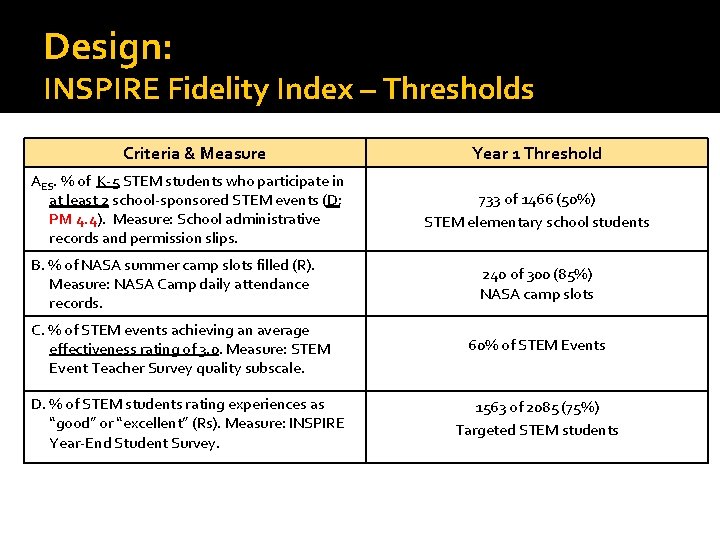
Design: INSPIRE Fidelity Index – Thresholds Criteria & Measure AES. % of K-5 STEM students who participate in at least 2 school-sponsored STEM events (D; PM 4. 4). Measure: School administrative records and permission slips. B. % of NASA summer camp slots filled (R). Measure: NASA Camp daily attendance records. C. % of STEM events achieving an average effectiveness rating of 3. 0. Measure: STEM Event Teacher Survey quality subscale. D. % of STEM students rating experiences as “good” or “excellent” (Rs). Measure: INSPIRE Year-End Student Survey. Year 1 Threshold 733 of 1466 (50%) STEM elementary school students 240 of 300 (85%) NASA camp slots 60% of STEM Events 1563 of 2085 (75%) Targeted STEM students
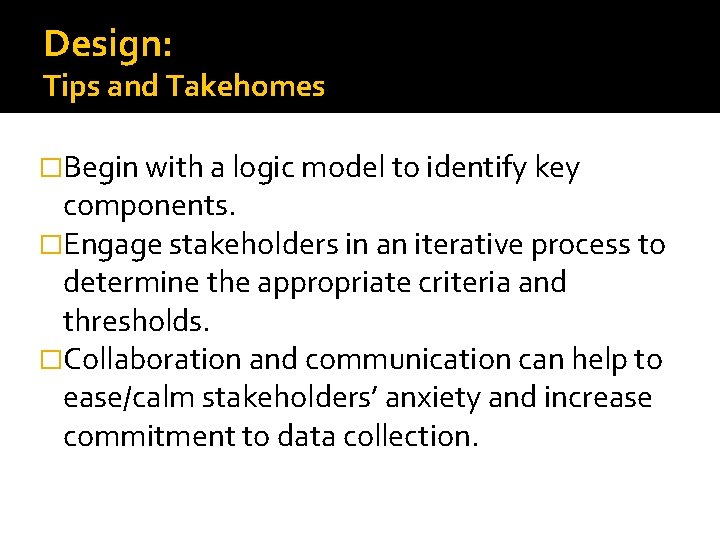
Design: Tips and Takehomes �Begin with a logic model to identify key components. �Engage stakeholders in an iterative process to determine the appropriate criteria and thresholds. �Collaboration and communication can help to ease/calm stakeholders’ anxiety and increase commitment to data collection.
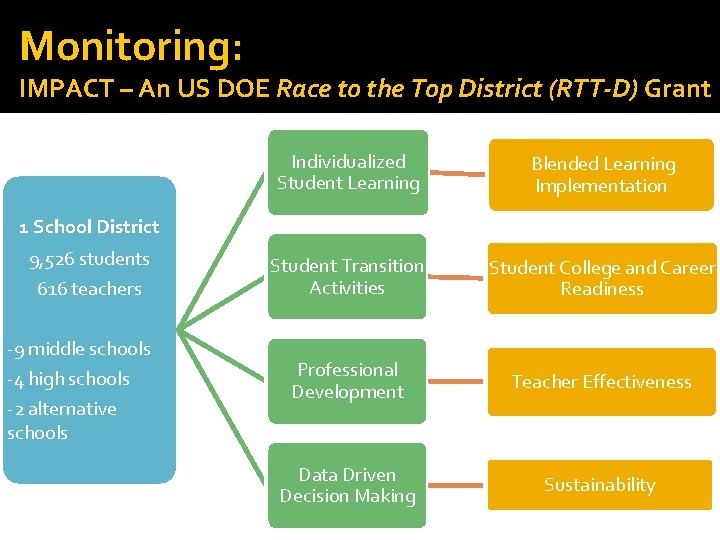
Monitoring: IMPACT – An US DOE Race to the Top District (RTT-D) Grant Individualized Student Learning Blended Learning Implementation Student Transition Activities Student College and Career Readiness Professional Development Teacher Effectiveness Data Driven Decision Making Sustainability 1 School District 9, 526 students 616 teachers -9 middle schools -4 high schools -2 alternative schools
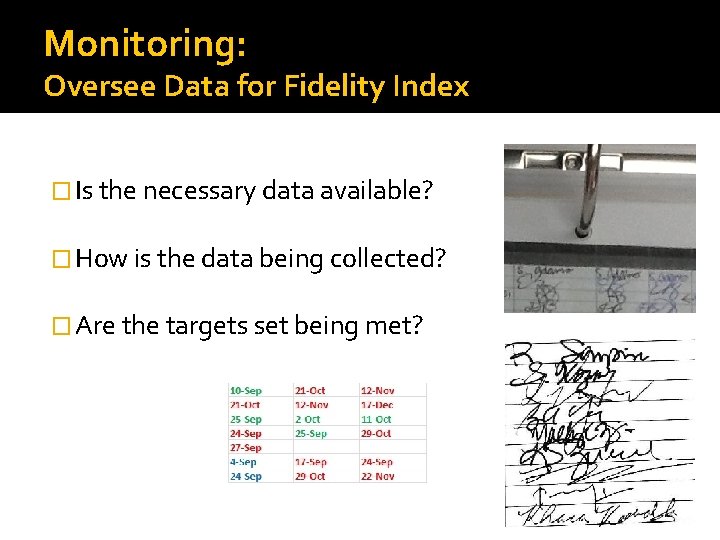
Monitoring: Oversee Data for Fidelity Index � Is the necessary data available? � How is the data being collected? � Are the targets set being met?
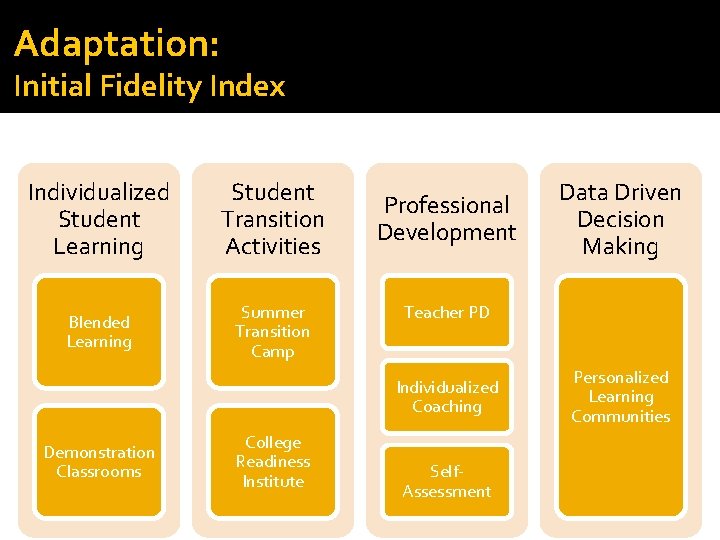
Adaptation: Initial Fidelity Index Individualized Student Learning Student Transition Activities Blended Learning Summer Transition Camp Professional Development Teacher PD Individualized Coaching Demonstration Classrooms College Readiness Institute Data Driven Decision Making Self. Assessment Personalized Learning Communities
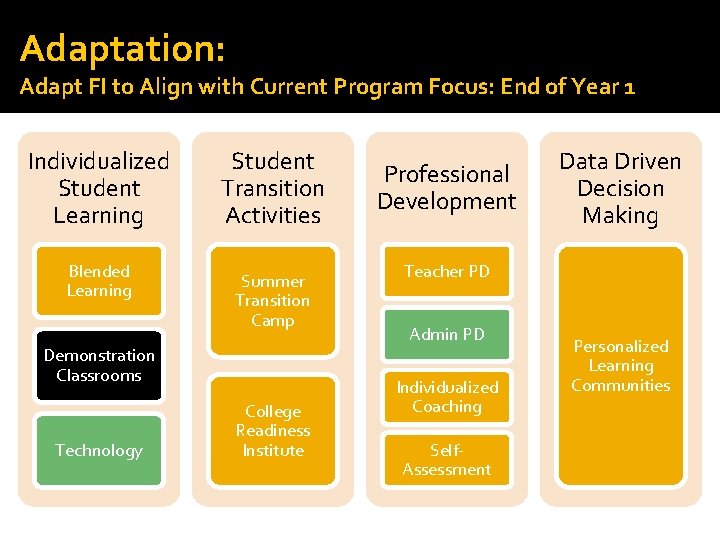
Adaptation: Adapt FI to Align with Current Program Focus: End of Year 1 Individualized Student Learning Blended Learning Student Transition Activities Summer Transition Camp Demonstration Classrooms Technology College Readiness Institute Professional Development Data Driven Decision Making Teacher PD Admin PD Individualized Coaching Self. Assessment Personalized Learning Communities
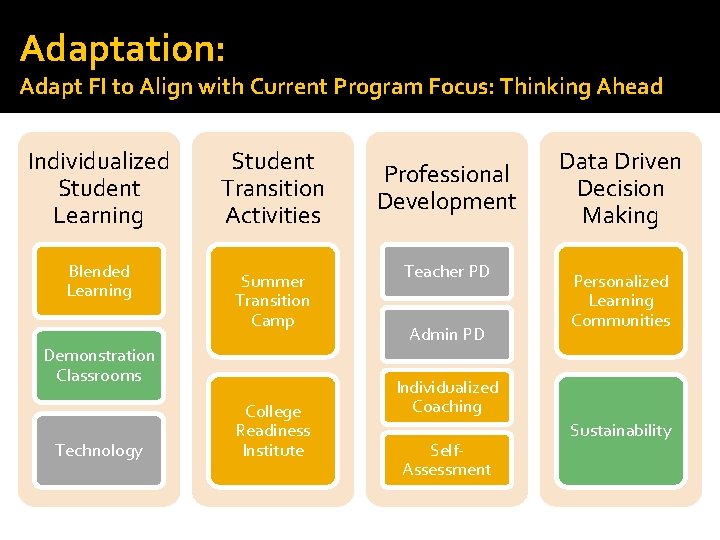
Adaptation: Adapt FI to Align with Current Program Focus: Thinking Ahead Individualized Student Learning Blended Learning Student Transition Activities Summer Transition Camp Demonstration Classrooms Technology College Readiness Institute Professional Development Teacher PD Admin PD Data Driven Decision Making Personalized Learning Communities Individualized Coaching Self. Assessment Sustainability
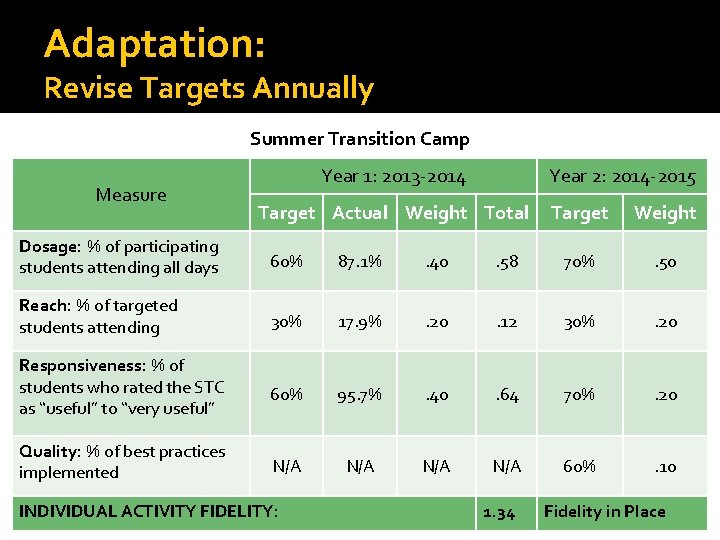
Adaptation: Revise Targets Annually Summer Transition Camp Measure Year 1: 2013 -2014 Year 2: 2014 -2015 Target Actual Weight Total Target Weight Dosage: % of participating students attending all days 60% 87. 1% . 40 . 58 70% . 50 Reach: % of targeted students attending 30% 17. 9% . 20 . 12 30% . 20 Responsiveness: % of students who rated the STC as “useful” to “very useful” 60% 95. 7% . 40 . 64 70% . 20 Quality: % of best practices implemented N/A N/A 60% . 10 INDIVIDUAL ACTIVITY FIDELITY: 1. 34 Fidelity in Place
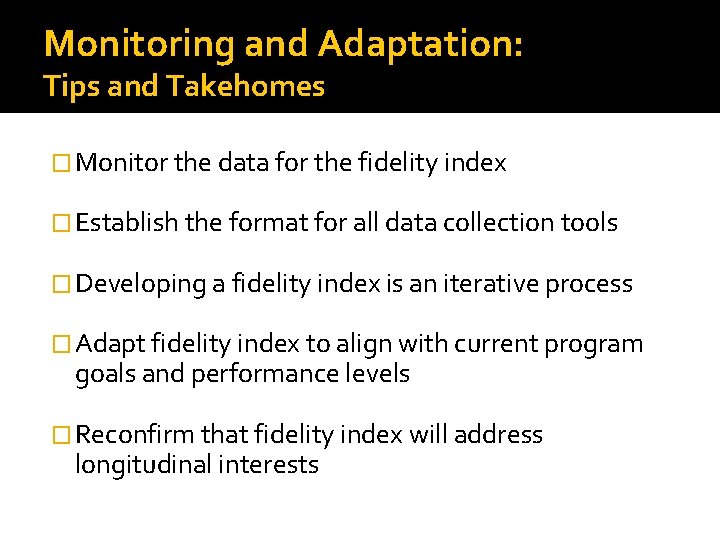
Monitoring and Adaptation: Tips and Takehomes � Monitor the data for the fidelity index � Establish the format for all data collection tools � Developing a fidelity index is an iterative process � Adapt fidelity index to align with current program goals and performance levels � Reconfirm that fidelity index will address longitudinal interests
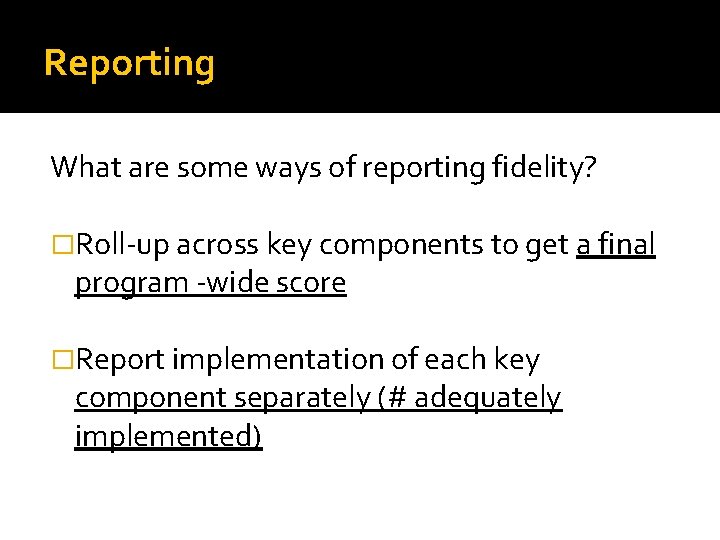
Reporting What are some ways of reporting fidelity? �Roll-up across key components to get a final program -wide score �Report implementation of each key component separately (# adequately implemented)
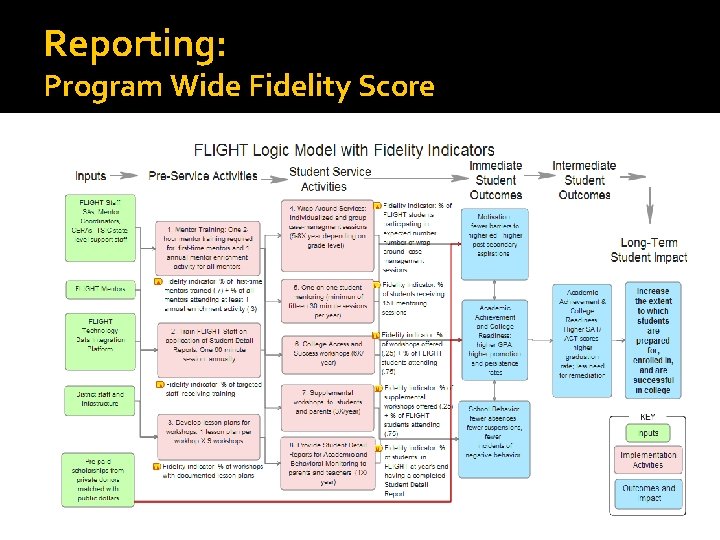
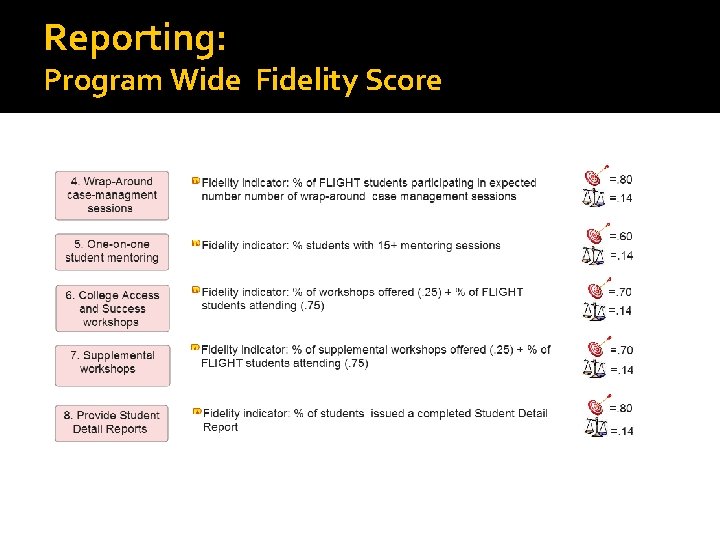
Reporting: Program Wide Fidelity Score
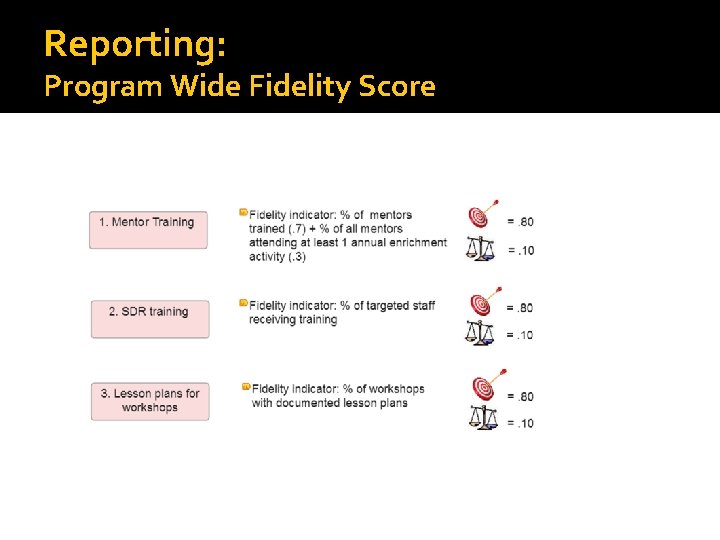
Reporting: Program Wide Fidelity Score
Reporting: Program Wide Fidelity Score
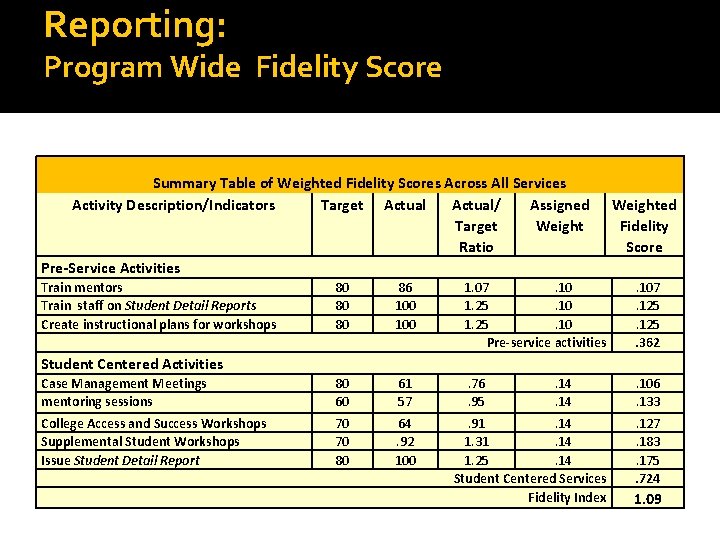
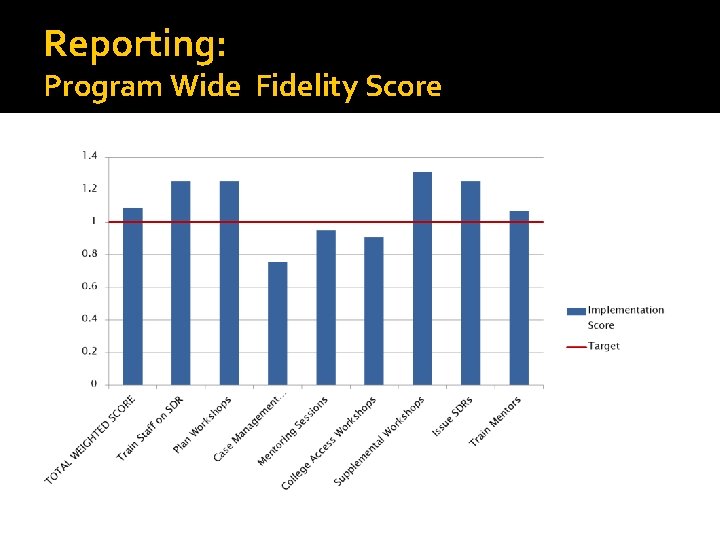
Reporting: Program Wide Fidelity Score • A program component score is the ratio between what was expected (the target) and what actually occurred • A score of 1. 0 = perfect fidelity between what was expected and what was observed. • A rubric qualifies the range of fidelity scores • Weighting the scores and summing across all activities yields an overall weighted score for the entire project, aka the Fidelity Index
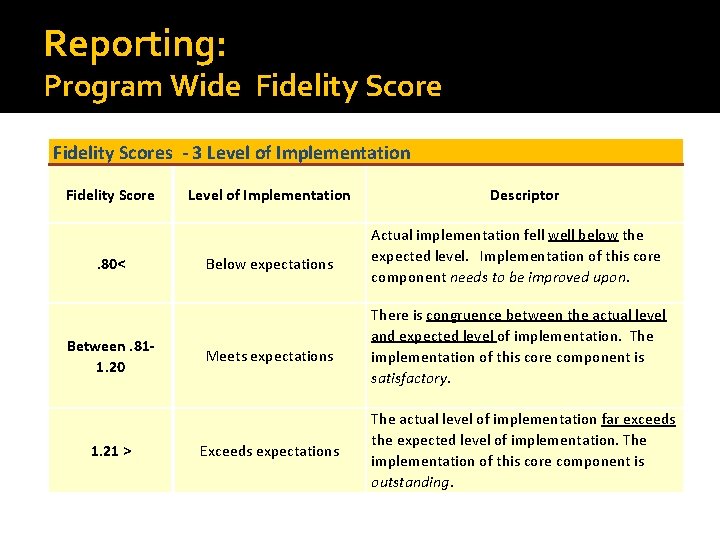
Reporting: Program Wide Fidelity Scores - 3 Level of Implementation Fidelity Score . 80< Between. 811. 20 1. 21 > Level of Implementation Below expectations Meets expectations Exceeds expectations Descriptor Actual implementation fell well below the expected level. Implementation of this core component needs to be improved upon. There is congruence between the actual level and expected level of implementation. The implementation of this core component is satisfactory. The actual level of implementation far exceeds the expected level of implementation. The implementation of this core component is outstanding.
Reporting: Program Wide Fidelity Score Summary Table of Weighted Fidelity Scores Across All Services Activity Description/Indicators Target Actual/ Assigned Target Weight Ratio Pre-Service Activities Train mentors Train staff on Student Detail Reports Create instructional plans for workshops Weighted Fidelity Score 80 80 80 86 100 1. 07. 10 1. 25. 10 Pre-service activities . 107. 125. 362 Case Management Meetings mentoring sessions 80 60 61 57 . 76. 95 . 106. 133 College Access and Success Workshops Supplemental Student Workshops Issue Student Detail Report 70 70 80 64. 92 100 Student Centered Activities. 14 . 91. 14 1. 31. 14 1. 25. 14 Student Centered Services Fidelity Index . 127. 183. 175. 724 1. 09
Reporting: Program Wide Fidelity Score
Reporting: # of Key Components Adequately Implemented �Just two levels - implementation adequate and inadequate �Defined a priori for each key component �If you report by components, you can always roll-up to the program level in the future (assuming performance levels were set a priori)
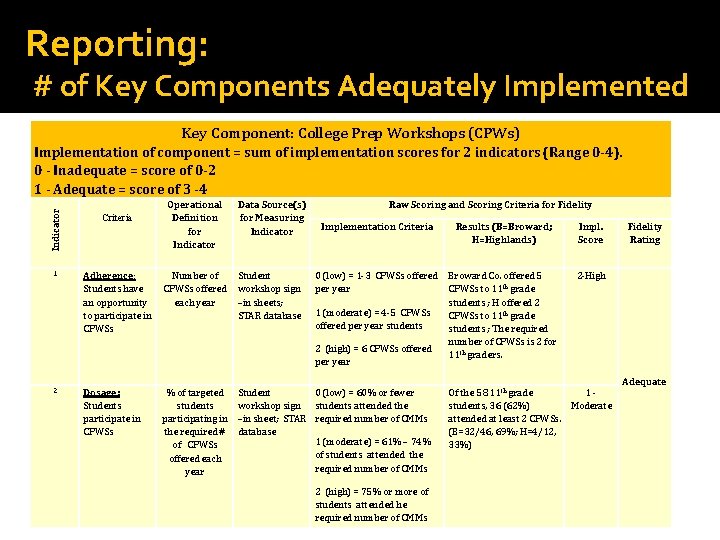
Reporting: # of Key Components Adequately Implemented Key Component: College Prep Workshops (CPWs) Indicator Implementation of component = sum of implementation scores for 2 indicators (Range 0 -4). 0 - Inadequate = score of 0 -2 1 - Adequate = score of 3 -4 1 Criteria Adherence: Students have an opportunity to participate in CPWSs Operational Definition for Indicator Data Source(s) for Measuring Indicator Number of CPWSs offered each year Student workshop sign –in sheets; STAR database Raw Scoring and Scoring Criteria for Fidelity Implementation Criteria Results (B=Broward; H=Highlands) Impl. Score 0 (low) = 1 -3 CPWSs offered per year Broward Co. offered 5 CPWSs to 11 th grade students ; H offered 2 CPWSs to 11 th grade students ; The required number of CPWSs is 2 for 11 th graders. 2 -High 1 (moderate) = 4 -5 CPWSs offered per year students 2 (high) = 6 CPWSs offered per year 2 Dosage: Students participate in CPWSs % of targeted students participating in the required # of CPWSs offered each year Student 0 (low) = 60% or fewer workshop sign students attended the –in sheet; STAR required number of CMMs database 1 (moderate) = 61% – 74% of students attended the required number of CMMs 2 (high) = 75% or more of students attended he required number of CMMs Of the 58 11 th grade 1 students, 36 (62%) Moderate attended at least 2 CPWSs. (B=32/46, 69%; H=4/12, 33%) Fidelity Rating Adequate
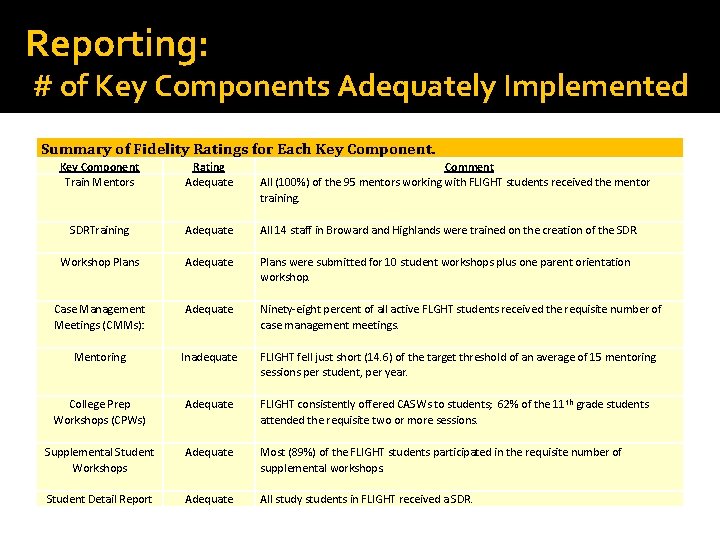
Reporting: # of Key Components Adequately Implemented Summary of Fidelity Ratings for Each Key Component Train Mentors Rating Adequate Comment All (100%) of the 95 mentors working with FLIGHT students received the mentor training. SDRTraining Adequate All 14 staff in Broward and Highlands were trained on the creation of the SDR. Workshop Plans Adequate Plans were submitted for 10 student workshops plus one parent orientation workshop. Case Management Meetings (CMMs): Adequate Ninety-eight percent of all active FLGHT students received the requisite number of case management meetings. Mentoring Inadequate FLIGHT fell just short (14. 6) of the target threshold of an average of 15 mentoring sessions per student, per year. College Prep Workshops (CPWs) Adequate FLIGHT consistently offered CASWs to students; 62% of the 11 th grade students attended the requisite two or more sessions. Supplemental Student Workshops Adequate Most (89%) of the FLIGHT students participated in the requisite number of supplemental workshops. Student Detail Report Adequate All study students in FLIGHT received a SDR.
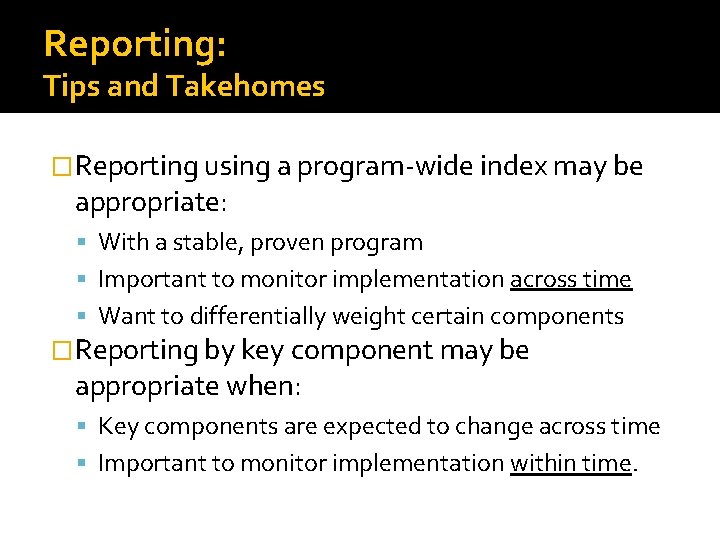
Reporting: Tips and Takehomes �Reporting using a program-wide index may be appropriate: With a stable, proven program Important to monitor implementation across time Want to differentially weight certain components �Reporting by key component may be appropriate when: Key components are expected to change across time Important to monitor implementation within time.
Discussion/Questions – 25 minutes
Contact Information Joel Philp : Joel@evaluationgroup. com Krista Collins: Krista@evaluationgroup. com Karyl Askew: Karyl@evaluationgroup. com