
Assessing Process Capability A Users View Fred Spiring

Assessing Process Capability: A User’s View Fred Spiring & Smiley Cheng The University of Manitoba & Pollard Banknote Ltd
Overview l Perspective l Process Background l Assessing Process Capability l Establishing Specs & Tolerances l Monitoring the Process l Improving the Process l Research areas
Perspective l Fall Technical Conference 2000 – Post (2000)-Practitioner’s view – Ramberg (2000)-Research view l J. of Quality Technology (January 2002) – Process Capability Indices-A Review, 19922000, Kotz and Johnson-Research view – Comments- variety of perspectives
Process Background l Producing Lottery Tickets – Multistage process, involving up to five printing presses – Multiplant organization, similar process with different equipment – Requirements and regulations result in interplant production

Process Background
Process Background l Preproduction – Customer concepts/art/requirements are translated into formal Customer Specifications by Marketing Group – In-house artists translate Customer Specifications into Production Specifications
Process Background Preproduction – Production Specifications were based on artists’ knowledge of colour rather than production equipment
Assessing Process Capability l Design Specifications – Continue to reflect artistic capabilities, such as colour sequence, traps, … – incorporate equipment capabilities in the design of the Lottery Ticket

Assessing Process Capability
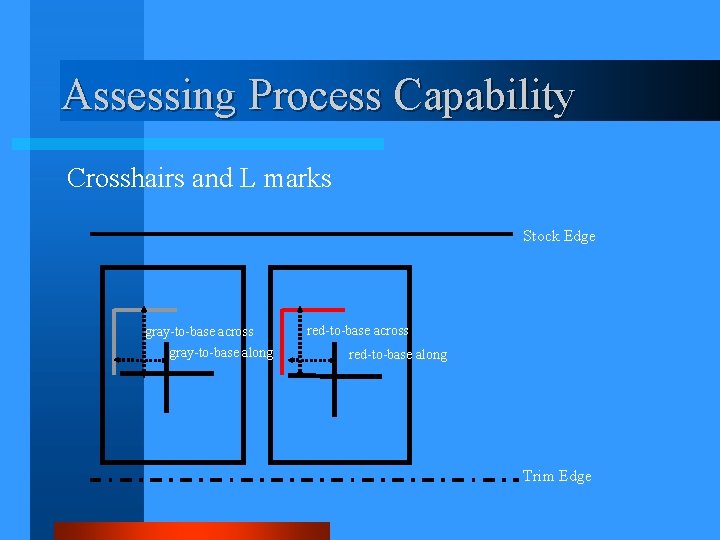
Assessing Process Capability Crosshairs and L marks Stock Edge gray-to-base across gray-to-base along red-to-base across red-to-base along Trim Edge
Assessing Process Capability Assessed the normality of the sample results in both the “across” and “along” directions l Examined “along” and “across” correlations l Assessed proximity of sample averages to targets l Examined the variability in the “across” and “along” directions l
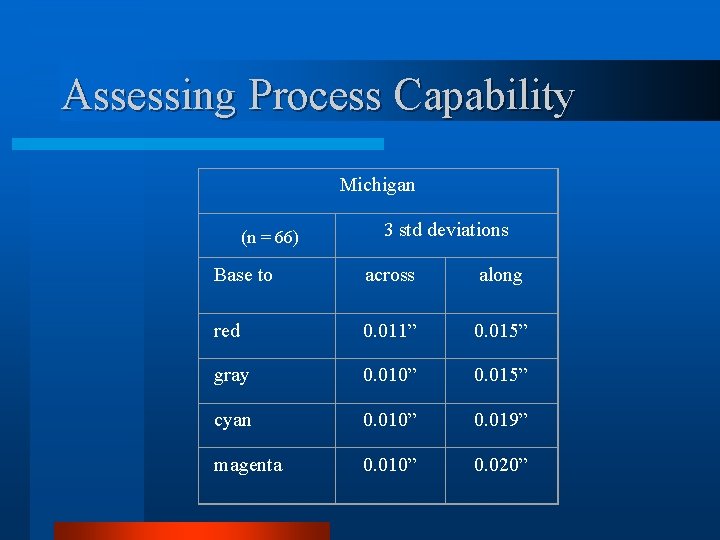
Assessing Process Capability Michigan (n = 66) 3 std deviations Base to across along red 0. 011” 0. 015” gray 0. 010” 0. 015” cyan 0. 010” 0. 019” magenta 0. 010” 0. 020”
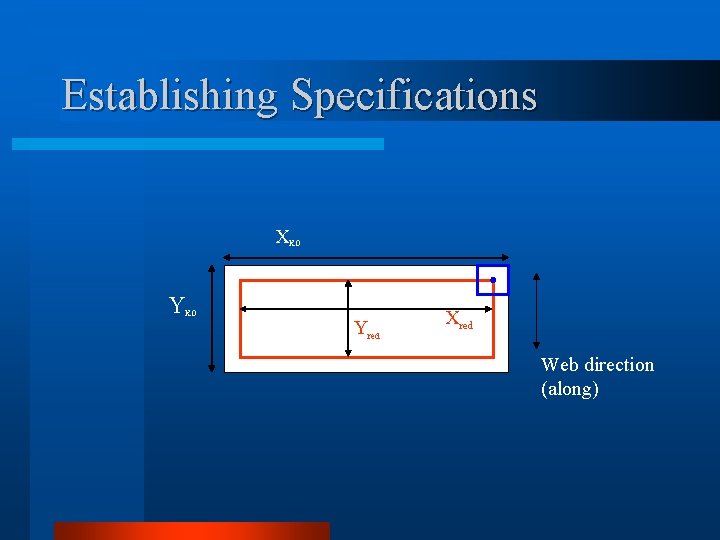
Establishing Specifications X Y KO KO Yred Xred Web direction (along)
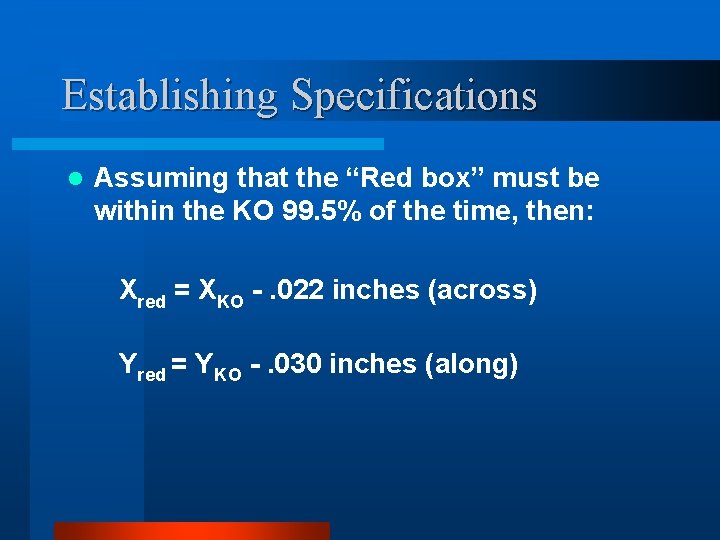
Establishing Specifications l Assuming that the “Red box” must be within the KO 99. 5% of the time, then: Xred = XKO -. 022 inches (across) Yred = YKO -. 030 inches (along)
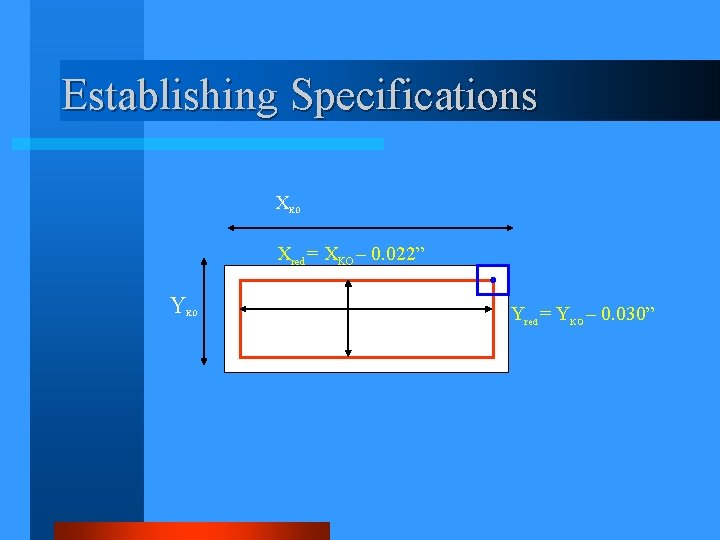
Establishing Specifications X KO Xred = XKO – 0. 022” Y KO Yred = YKO – 0. 030”
Establishing Specifications l Critical area that requires work l Specifications need to be legitimate and well thought out l Unreasonable specifications have lead to criticism of PCIs l Should be based on the process
Monitoring the process l Process is monitored daily to assess the efforts required to maintain registration – Automated data collection allows assessment of image location to press movement – Variables control charts are used to identify mechanical changes (x-bar and S charts)
Monitoring the Process
Monitoring the process l Process is monitored daily to assess the efforts required to maintain registration – Variables control charts are used to identify changes l Process Capability assessment performed on a quarterly basis – Process Capability chart is used to monitor
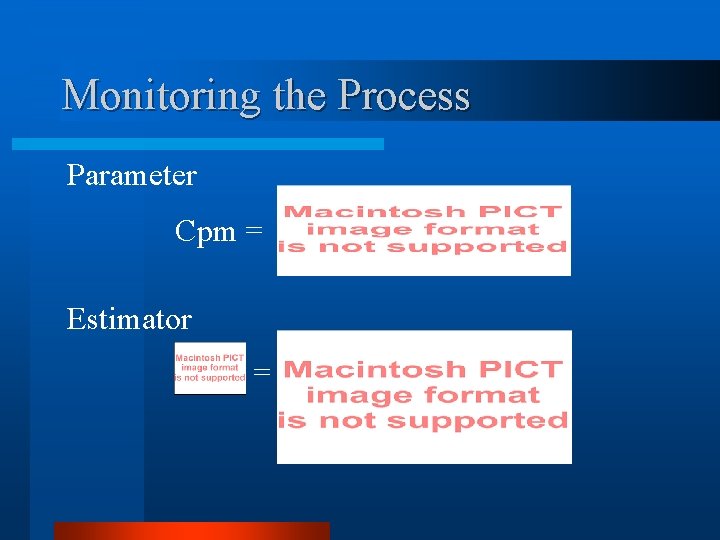
Monitoring the Process Parameter Cpm = Estimator =
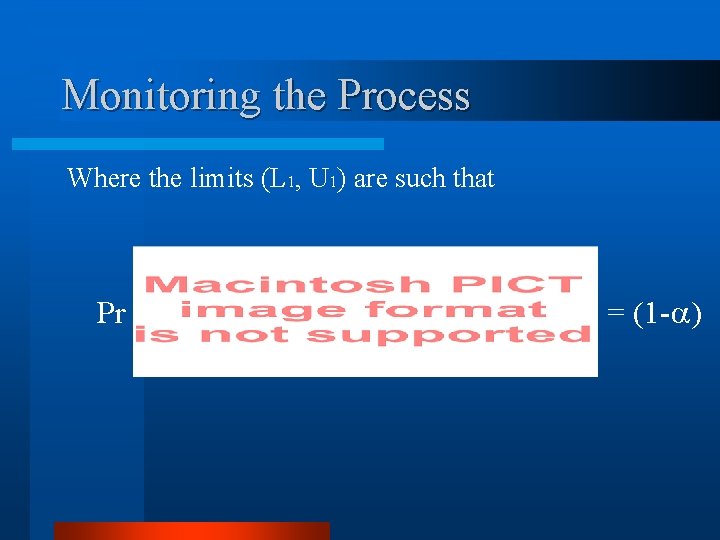
Monitoring the Process Where the limits (L 1, U 1) are such that Pr = (1 -a)

Monitoring the Process
Monitoring the Process l Another area where work is required l Process Capability is dynamic l “One-shot” assessments of capability can be misleading l Estimates of the PCIs are stochastic l Graphic assessments are critical
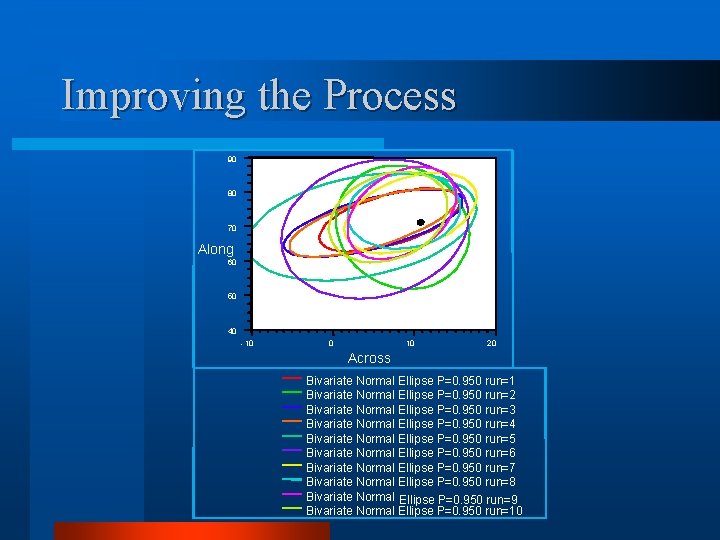
Improving the Process l Screening Design used to identify key combinations of controllable variables l “Crosshairs” and “L” were used to quantify and assess l Results were summarized in the across and along directions
Improving the Process 90 80 70 Along 60 50 40 - 10 0 10 Across 20 Bivariate Normal Ellipse P=0. 950 run=1 Bivariate Normal Ellipse P=0. 950 run=2 Bivariate Normal Ellipse P=0. 950 run=3 Bivariate Normal Ellipse P=0. 950 run=4 Bivariate Normal Ellipse P=0. 950 run=5 Bivariate Normal Ellipse P=0. 950 run=6 Bivariate Normal Ellipse P=0. 950 run=7 Bivariate Normal Ellipse P=0. 950 run=8 Bivariate Normal Ellipse P=0. 950 run=9 Bivariate Normal Ellipse P=0. 950 run=10
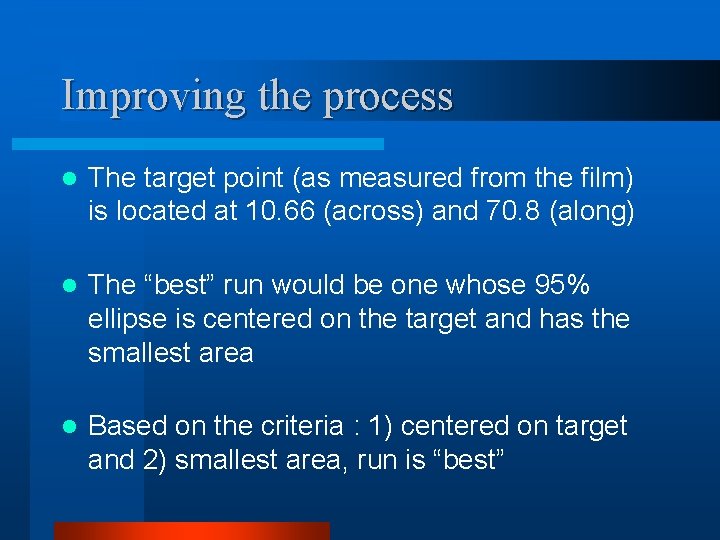
Improving the process l The target point (as measured from the film) is located at 10. 66 (across) and 70. 8 (along) l The “best” run would be one whose 95% ellipse is centered on the target and has the smallest area l Based on the criteria : 1) centered on target and 2) smallest area, run is “best”

Improving the Process
Research Areas Statistical input – Decisions and inferences continue to lack statistical assessment – Computer package incorporation of stochastic intervals/boundaries l Graphics and graphical methods – Inferences and monitoring tools l Links to costs/losses and benefits l
Selected References Spiring, F. A. Process Capability: A Total Quality Management Tool, Total Quality Management, 1995, Vol. 6 (1), pp 21 -33. l Spiring, F. A. , A Unifying Approach to Process Capability Indices, Journal of Quality Technology, 1997, 29(1), pp 49 -58. l Spiring, F. A. , “Assessing Process Capability with Indices” in Statistical Process Monitoring and Optimization edited by S. H. Park & G. Geoffrey Vining, Marcel Dekker, 2000. l
- Slides: 29